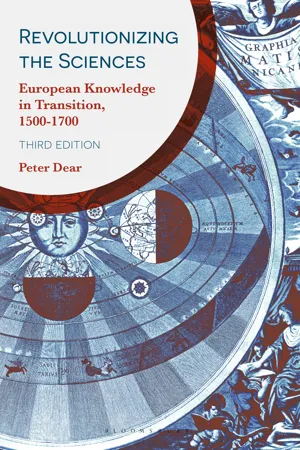
This heavily revised third edition of an award-winning text offers a keen insight into the development of scientific thought in early modern Europe. Including coverage of the central scientific figures of the time, including Copernicus, Kelper, Galileo, Newton and Bacon, this book provides a comprehensive overview of how the Scientific Revolution happened and why. Highlighting Europe's colonial and trade expansion in the sixteenth and 17th centuries, Peter Dear traces the revolution in scientific thought that changed the natural world from something to be contemplated into something to be used. This book is ideal for undergraduate and postgraduate students of Early Modern history, European history, history of medicine, history of science and technology and the history and philosophy of science. The first edition was the winner of the Watson Davis and Helen Miles Davis Prize of the History of Science Society. New to this Edition:
- Greater treatment of alchemy and associated craft activities, to reflect ongoing new scholarship
- More focus on geographical issues, especially relating to Spain and its New World territories, as well as Eastern Europe, but also further afield in Islamic territories including the Ottoman Empire, and South and East Asia
- New material on the themes of 'science and religion', gender and class
- More extensive treatment of the relationship in this period of medicine to the various sciences and especially to new natural philosophies
- Incorporation of new scholarship throughout
- A whole chapter dedicated to Francis Bacon
- Further discussion of the gendered elements of natural philosophy
- A brand new historiographical essay
- 229 pages
- English
- PDF
- Available on iOS & Android
eBook - PDF
About this book
Information
Table of contents
- Cover
- Contents
- List of Figures
- Preface
- Introduction Natural Philosophy and Instrumentality
- Chapter One ‘What was Worth Knowing’ in 1500
- Chapter Two Humanism and Ancient Wisdom: How to Learn Things in the Sixteenth Century
- Chapter Three Paracelsus and Bacon: Philosophy as Practical Knowledge
- Chapter Four Mathematical Practitioners and Mathematical Philosophers
- Chapter Five Mechanism and Corpuscles: Descartes Builds a Universe
- Chapter Six Extra-Curricular Activities: New Places for Natural Knowledge
- Chapter Seven Experiment: How to Learn Things about Nature in the Seventeenth Century
- Chapter Eight Cartesians and Newtonians
- Conclusion What was Worth Knowing by the Eighteenth Century?
- Notes and References
- Documentation and Further Reading
- Dramatis Personae
- Glossary of Major Terms
- Index
Trusted by 375,005 students
Access to over 1.5 million titles for a fair monthly price.
Study more efficiently using our study tools.
Frequently asked questions
Yes, you can cancel anytime from the Subscription tab in your account settings on the Perlego website. Your subscription will stay active until the end of your current billing period. Learn how to cancel your subscription
No, books cannot be downloaded as external files, such as PDFs, for use outside of Perlego. However, you can download books within the Perlego app for offline reading on mobile or tablet. Learn how to download books offline
Perlego offers two plans: Essential and Complete
- Essential is ideal for learners and professionals who enjoy exploring a wide range of subjects. Access the Essential Library with 800,000+ trusted titles and best-sellers across business, personal growth, and the humanities. Includes unlimited reading time and Standard Read Aloud voice.
- Complete: Perfect for advanced learners and researchers needing full, unrestricted access. Unlock 1.5M+ books across hundreds of subjects, including academic and specialized titles. The Complete Plan also includes advanced features like Premium Read Aloud and Research Assistant.
We are an online textbook subscription service, where you can get access to an entire online library for less than the price of a single book per month. With over 1.5 million books across 990+ topics, we’ve got you covered! Learn about our mission
Look out for the read-aloud symbol on your next book to see if you can listen to it. The read-aloud tool reads text aloud for you, highlighting the text as it is being read. You can pause it, speed it up and slow it down. Learn more about Read Aloud
Yes! You can use the Perlego app on both iOS and Android devices to read anytime, anywhere — even offline. Perfect for commutes or when you’re on the go.
Please note we cannot support devices running on iOS 13 and Android 7 or earlier. Learn more about using the app
Please note we cannot support devices running on iOS 13 and Android 7 or earlier. Learn more about using the app
Yes, you can access Revolutionizing the Sciences by Peter Dear in PDF and/or ePUB format, as well as other popular books in History & European History. We have over 1.5 million books available in our catalogue for you to explore.