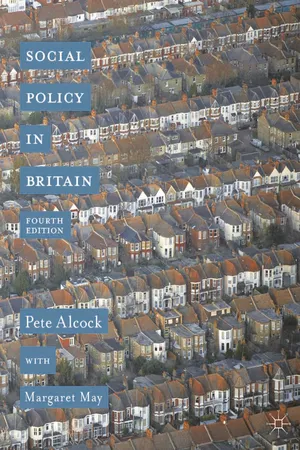
In this fourth edition of the best-selling core introductory textbook, Pete Alcock and Margaret May provide an essential up-to-date guide on social policy. Continuing with the unbeaten narrative style and accessible approach of the previous editions, the authors explore the major topics of social policy in a clear and digestible way. By breaking down the complexities behind policy developments and their outcomes, it demonstrates the relationship between core areas of policy and the society we live in. Engaging, accessible and comprehensive, this is the ideal book for introductory courses on Social Policy and the perfect companion for practitioners who need to keep up to date and informed about the latest developments in the field.
- 360 pages
- English
- ePUB (mobile friendly)
- Available on iOS & Android
eBook - ePub
Social Policy in Britain
About this book
Information
1
Introduction: The Development of Social Policy
SUMMARY OF KEY POINTS
- Social policy is a unique subject, but is closely linked to the other social sciences and studied by students undertaking a wide range of social science courses and professional qualifications.
- Over time the scope of analysis and debate in the subject has broadened, captured in the change in title from social administration to social policy.
- Academic study of social policy has always been closely linked to policy practice, with leading academics sometimes acting as advisers to government.
- The creation of the ‘welfare state’ by the post-war Labour government established public services to meet welfare needs.
- Criticisms of state welfare from the New Left and the New Right have argued that the continued expansion of state welfare is not sustainable. In the last quarter of the last century this seemed to be borne out as an economic crisis led to retrenchment in social policy planning and welfare expenditure.
- At the beginning of the twenty-first century a Third Way, between the left and the right, was championed by government in the UK.
- Following the economic recession of 2008/09 there has been pressure to reduce public spending on welfare provision in the UK, and elsewhere.
- Social policy can no longer be studied solely within national boundaries, and comparative analysis of welfare in different countries has revealed that in different countries there are different mixes of welfare services.
- It is how this ‘welfare mix’ operates, and changes, in Britain that is the core concern of students of social policy.
- This mix also varies within Britain now, as a result of the devolution of much social policy planning to the separate administrations in Scotland, Wales and Northern Ireland.
WHAT IS SOCIAL POLICY?
Social policy is an academic subject, studied by students on undergraduate and postgraduate degree programmes and in a number of areas of professional training. It is also studied by some students at A level or in further education; but for the most part social policy study takes place in universities and other higher education institutions. Social policy can be studied as a discrete subject, on a ‘single honours’ programme; but there are many other students (indeed the large majority) studying the subject as one element in a broader social studies programme, or as part of a related programme in sociology or political science or, as mentioned above, as part of a programme of professional training – for instance, in social work, health science, housing or planning.
Social policy is also, however, the term used to refer to the actions taken within society to develop and deliver services for people in order to meet their needs for welfare and wellbeing. Social policy is thus both the name of the academic subject and the focus of what is studied. Thus sociologists study society, whilst social policy students study social policy. This may seem confusing, but it need not be. Indeed the terminological link between what we study and we do makes clear the link between analysis and practice which is what attracts many people into social policy, as we shall discuss below.
Studying social policy alongside other subjects such as sociology or economics also raises questions about the extent to which social policy is a discrete subject, or discipline, as academics sometimes call them. It is likely that there will always be argument and debate about what constitutes an academic subject, and in social science, in particular, there is debate about the overlap between subjects such as sociology, economics, politics and social policy, and about what should be the core concerns of each. Certainly social policy overlaps with other subjects, such as these and others like social work or criminology; and this has led some to question whether social policy is an interdisciplinary field rather than a discrete academic subject. This is not a terribly fruitful debate, however, for disciplinary boundaries are disputed in all academic subjects, and interdisciplinary work is widely promoted across the social sciences.
In most British universities social policy in fact often shares departmental status with cognate social sciences such as sociology, or with professional education such as social work, and the teaching of these is generally closely related, with social policy included in all. And in research institutes specialists in social policy often work alongside sociologists, economists, statisticians and even lawyers. However, within this broader context some key features do delineate social policy. Where it differs from sociology, for instance, is in its specific focus upon the development and implementation of policy measures in order to influence the social circumstances of individuals rather than the more general study of those social circumstances themselves. And, where it differs from economics, is in its focus upon welfare policies, or policies impacting upon the welfare of citizens, rather than those seeking to influence the production of goods, materials and services.
What is more, if we move on to examine the historical development of social policy, we can see how these issues have been played out – how the attempt to provide a specific focus for study was embarked upon, how this led to boundary disputes with other subjects, how it was subject to external political influence and to internal theoretical debate, and how these events changed the nature of social policy itself. In fact, debates over the nature of social policy even resulted in a change in name for the subject from social administration to social policy, symbolized by the change of the professional association, representing academics and researchers in universities, from the Social Administration Association to the Social Policy Association (SPA) in 1987. This was a change that was not without conflict and disagreement (see Glennerster 1988; Smith 1988; Donnison 1994). Nor is it necessarily complete, and some university departments and qualifications are still referred to as social administration.
Within the British social policy tradition in particular, what has also distinguished social policy from some other social science subjects has been its specific, and driving, concern not merely to understand the world, but also to change it. In this tradition social policy is not only a descriptive subject, it is also a prescriptive one. This is in part because the early academic development of social policy in Britain was closely allied to the political development of Fabianism. The Fabians were both academics and politicians, and they wanted to utilize academic research and analysis in order to influence government welfare policy. Throughout much of the early part of last century the development of British social policy was often synonymous with the concerns and perspectives of the Fabians; and the subject largely shared Fabianism’s benign view of the role of state provision within welfare policy. Social policy also shared the empirical focus of Fabianism, in particular its concern to measure the need for, and the impact of, state welfare provision.
The ideological and empirical alliances with Fabianism were, however, associated most closely with the social administration perspective of the subject, and with a concern with what is done by policy action, and how it is done, rather than why this is done, or indeed whether it should be done. This narrower focus has come under critical scrutiny as the academic subject has developed over the last 50 years or so. Of particular importance in this process of development was the work of Richard Titmuss, the first Professor of Social Administration, who was appointed at the London School of Economics (LSE) in 1950. In his inaugural lecture at the LSE Titmuss described social policy as ‘the study of the social sciences whose object… is the improvement of the conditions of life of the individual in the setting of family and group relations’ (1958). This included a commitment to prescription (improving living conditions) and to an understanding of social context. These concerns were taken up by Titmuss in his later work, which remains the most influential legacy of conceptual reflection and empirical analysis within the subject, both within the UK and beyond (see Alcock et al. 2001). Titmuss was especially concerned, however, to argue that the role of academic study was to explore the values that lay behind policy decisions and the research evidence that should shed light on these, rather than to extol the virtues of particular policy changes. It is this reflective approach which led him to challenge some of the narrower perceptions of the achievements of the Fabian-inspired welfare reforms of post-war Britain, and which still provides an inspiration to critical judgement amongst students of the subject today.
In the latter half of the twentieth century the narrow focus of the Fabian tradition upon how to improve existing welfare services thus began to come under increasing criticism and attack from different perspectives which sought to widen the questions asked by the subject and to challenge the underlying assumption of the benign role of the state in welfare provision. Furthermore, the narrow focus and assumptions of the social administration tradition have also been called into question by the increasing academic and political concern with international comparisons of welfare policy. For what international comparisons quickly reveal, as Titmuss again was influential in pointing out, is that welfare policies have not developed elsewhere as they have done in Britain; that different political assumptions in different countries have led to different patterns of provision; and, therefore, that different political assumptions could lead to different patterns of provision in Britain too.
The cumulative effect of these questions and challenges has been to bring about a significant shift in the focus of academic debate and political influence within the subject, which has been represented by the change in title from administration to policy. This has resulted in a shift from a subject that was, in Mishra’s (1989) terms, ‘pragmatic, Britain-centred, socially concerned and empirical’, to one that is characterized by ideological division, theoretical pluralism and a growing internationalism. However, this shift, significant though it is, should not deter us from recognizing the continuities, as well as the discontinuities, in the development of social policy.
FABIANISM AND THE ROOTS OF SOCIAL WELFARE
The concern of social policy writers to contribute to the development of political change – as well as to analyse it – has been a key feature since its birth as a subject in Britain. Interest in it began to develop at a time when state policy towards the welfare of citizens was undergoing a radical revision and Fabian politics were seeking both to understand and influence this. The Fabian Society was formed in 1884, under the leading guidance of Sidney and Beatrice Webb who were firm believers that collective provision for welfare through the state was an essential, and inevitable, development within British capitalist society; Sidney Webb also held strong views on the moral values of social (or socialist) provision (Headlam 1892; Ball 1896).
One of the early examples of the influence of Fabian thinking was within the Royal Commission on the Poor Laws and the Relief of Distress, of which Beatrice Webb was a member. The Commission was established by the government, in 1905, to review the old Victorian approach to support for the poor. It signified a recognition by government of the need to overhaul welfare policies and the importance of social policy debate in shaping this process, and it increased the pressure on government to bring about the major changes in social security and other policies that were introduced in the ten years before the First World War.
Debate about the future direction of welfare policy was a central concern of the work of the Commission, and when it reported in 1909 the Commission produced both a Majority and Minority Report, as the members could not all agree about the role that the state should play as provider of ...
Table of contents
- Cover
- Title
- Copyright
- Contents
- List of boxes, figures and tables
- How to use this book
- Acknowledgements
- List of abbreviations
- 1 Introduction: The Development of Social Policy
- PART 1 Structures and Contexts
- PART 2 Key Policy Areas
- PART 3 Theories and Debates
- References
- Index
Trusted by 375,005 students
Access to over 1.5 million titles for a fair monthly price.
Study more efficiently using our study tools.
Frequently asked questions
Yes, you can cancel anytime from the Subscription tab in your account settings on the Perlego website. Your subscription will stay active until the end of your current billing period. Learn how to cancel your subscription
No, books cannot be downloaded as external files, such as PDFs, for use outside of Perlego. However, you can download books within the Perlego app for offline reading on mobile or tablet. Learn how to download books offline
Perlego offers two plans: Essential and Complete
- Essential is ideal for learners and professionals who enjoy exploring a wide range of subjects. Access the Essential Library with 800,000+ trusted titles and best-sellers across business, personal growth, and the humanities. Includes unlimited reading time and Standard Read Aloud voice.
- Complete: Perfect for advanced learners and researchers needing full, unrestricted access. Unlock 1.5M+ books across hundreds of subjects, including academic and specialized titles. The Complete Plan also includes advanced features like Premium Read Aloud and Research Assistant.
We are an online textbook subscription service, where you can get access to an entire online library for less than the price of a single book per month. With over 1.5 million books across 990+ topics, we’ve got you covered! Learn about our mission
Look out for the read-aloud symbol on your next book to see if you can listen to it. The read-aloud tool reads text aloud for you, highlighting the text as it is being read. You can pause it, speed it up and slow it down. Learn more about Read Aloud
Yes! You can use the Perlego app on both iOS and Android devices to read anytime, anywhere — even offline. Perfect for commutes or when you’re on the go.
Please note we cannot support devices running on iOS 13 and Android 7 or earlier. Learn more about using the app
Please note we cannot support devices running on iOS 13 and Android 7 or earlier. Learn more about using the app
Yes, you can access Social Policy in Britain by Pete Alcock,Margaret May in PDF and/or ePUB format, as well as other popular books in Politics & International Relations & Social Policy. We have over 1.5 million books available in our catalogue for you to explore.