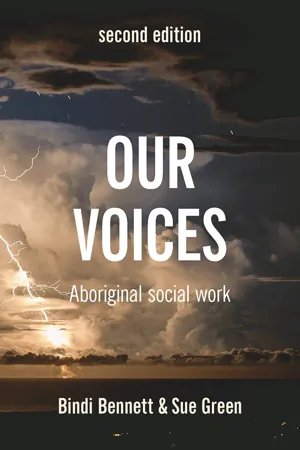
The second edition of Our Voices is a ground-breaking collection of writings from Aboriginal social work educators who have collaborated to develop a toolkit of appropriate behaviours, interactions, networks, and intervention. The the text explores a range of current and emerging social work practice issues such as cultural supervision, working with communities, understanding trauma, collaboration and relationship building, and the ubiquity of whiteness in Australian social work. It covers these issues with new and innovative approaches and provides valuable insights into how social work practice can be developed, taught and practiced in ways that more effectively engage Indigenous communities.
- 268 pages
- English
- ePUB (mobile friendly)
- Available on iOS & Android
eBook - ePub
About this book
Information
Part 1
Theory
1
The importance of Aboriginal history for practitioners
Bindi Bennett
Introduction
To know where we are going, we must know where we have been.
This chapter outlines the history of Aboriginal peoples from European colonisation to the present day and discusses past policies and practices that continue to impact on their wellbeing. It provides an Aboriginal perspective on the history and policies that have been important in Australia. All social workers should be aware of these events to develop effective, responsive and useful practice.
This chapter does not detail every historical event that has impacted Aboriginal people. The intention is to provide a broad social work perspective about the history and policies that have impacted Aboriginal people and to highlight the important events and developments. This chapter focuses on Australian Aboriginal peoples.
History
Many social workers know little of the history surrounding Aboriginal people when they enter their profession. Aboriginal people also may not know all the history that has occurred in their communities and others across Australia. Often this lack of knowledge may be due to individuals or their parents/grandparents being removed from their traditional Country. Many social work educators and students are puzzled by the fact that historical events, such as the Stolen Generations, remain significant for the thinking and behaviour of Aboriginal peoples and their communities. This chapter addresses some of the gaps in historical knowledge and identifies why this history still resonates in the lives of Aboriginal communities.
The history of Australia has continued to impact Aboriginal people and is reflected in a range of health and social issues including: intergenerational trauma; substance abuse; mental and physical health; poverty; over representation in the criminal justice system; family violence; loss of culture; and loss of family connection. All these issues have their roots in the history of colonisation. Unfortunately, the social work and welfare professions and the system more broadly have inadvertently played a role in this process. That is why it is critical to know and reflect on the role of social work in this history when working with Aboriginal individuals, families and communities. It is the responsibility of social workers to arm themselves with this knowledge, and to understand that this history will be part of the fabric of the community and must be acknowledged and reflected in their practices.
Aboriginal people are often social work clients due to intergenerational disadvantage. For many decades services and service providers have been highly Eurocentric in their practices, with a lack of cultural knowledge, and this has affected their relationships with Aboriginal people. For this reason, social workers entering an Aboriginal community are often met with wari-ness, distrust and cynicism. Consequently, social workers generally do not have a very good reputation in Aboriginal communities and this makes it difficult for them to build sustaining and cooperative relationships. To overcome this hostility social workers need be knowledgeable of and empathetic with Aboriginal history when working with Aboriginal people (Ralph, 1997).
Pre-contact
Aboriginal culture is believed to be among the oldest continuous cultures in the world (Dockery, 2010) and archaeological evidence indicates that Aboriginal people have been living in Australia for at least 65,000 years (Clarkson et al., 2017). Others suggest that this is an underestimate, and that 200,000 years is a more accurate figure (Broome, 1982). Aboriginal people believe that they have inhabited the land since the beginning of time and are part of the Dreamtime itself, where time is cyclic and does not necessarily progress in a linear fashion (personal communications, Uncle Stan Grant, 2010). ‘The past, present and future are not separate concepts in all worldviews … only one time and place, that creation is forever unfolding yesterday, today and tomorrow’ (Wal Wal Ngallemetta in Yunkaporta, 2009, p. 2). At the time of European settlement in the late 18th century there were estimated to be around 500 tribal groups.
A common feature of Aboriginal culture was the emphasis placed on kinship, and the relationships within families and members of Aboriginal communities. Aboriginal people concentrated upon maintaining and sustaining their Country, relationships and ecosystems.
Prior to invasion, the Aboriginal population comprised a diverse group of communities, each shaped by personal, group and community identities determined by territory and language groups, law definitions (totems and clans) and kinship systems (The University of Sydney, 2014). The collective single category of ‘Aboriginal’ is a result of the early colonists’ misperceptions and lack of understanding of the Australian Indigenous peoples. Today the category ‘Aboriginal’ is a unitary social construct that deflects attention away from the diverse communities and language groups that make up the Aboriginal population. Many people claim their descent from a particular Aboriginal clan, tribe or language group for example Wiradyuri, Gamilaroi (Gamilaraay), Ngunawal, Biripi, Darkinjung, Eora and Yolngu. These names are referred to by Aboriginal people as the ‘Country’ they belong to or come from. Aboriginal people’s genealogy is often traced by this Country and by the people who lived on this Country (for example, someone might identify him or herself in this way: I am James (pseudonym) Blue family from Darkinjung Country). Individuals also identify themselves via broader terms that are region-ally specific and include Koori (generally New South Wales and Victoria region), Murri (Queensland), Nyungah (Western Australia), Anangu (South Australia), Yolngu (Northern Territory) and Palawa (Tasmania).
Colonisation was imposed in many countries, and needs to be viewed in the context of European imperial expansion. In Australia, colonisation relates to the period of European expansion in which Britain and its European neighbours invaded, settled and exploited the country (Smith, 2006). Since colonisation there have been many policies and actions that have negatively impacted Aboriginal peoples.
Dispossession
In 1770, Captain James Cook, aboard the vessel Endeavour sailed into Bot-any Bay and Sydney Cove in New South Wales. This area was to become the first site for British settlement.
Aboriginal people lacked two things that would have made effective defence possible against the British. The first was a military technology, and the second was the organisational capacity for large-scale warfare (Prentis, 2009). Europeans recognised ‘civilisation’ as represented by a group having a key leader, and by that group owning and controlling the land (in the form of infrastructure, religion, written communication, animals and agri-culture). Aboriginal people appeared to lack an organised leader (such as a King or Queen); had no herds of animals; and no written communication. This was evidence enough to the invaders that there was no civilisation or culture.
Cook chose to regard the land and area as terra nullius, which means empty land (Herbert in Bolt, 2009, p. 11) or, more importantly, a land empty of everything except flora and fauna. Aboriginal people were therefore not considered people, let alone a unified people with a recog-nisable government, and so a treaty1 was not offered. Land perceived to be/designated as terra nullius could be colonised (Bolt, 2009, p. 11). Social evolutionary theory of the time reinforced the perception that Aboriginal people were ‘primitive’ and therefore ‘inferior’ (Muecke, 1992). This theory also influenced the disciplines of anthropology, history and literature, and dominated the European understanding of Aboriginal people in Australia. Aboriginal people were treated as problematic, needing to be taken over by a superior race who would commandeer the empty and untilled land (Reynolds, 1987). Based on terra nullius, sovereignty and ownership of the land was claimed by British authorities.
Meanwhile in Europe there was an industrial revolution developing and the emergence of the Age of Enlightenment. ‘Progress’ was being made through the manufacturing of goods such as cotton and steel and the expansion of world trade. However, social services were minimal. Due to unemployment, poverty and overcrowding, petty crime became an issue. With no space to house the growing number of people convicted, Britain needed somewhere to locate their criminals preferably at some distance from the cities and, if possible, away from Britain. On ‘26 January 1788 British ships containing 290 seamen, soldiers and officials and 717 convicts sailed into Port Jackson’ (Broome, 1982, p. 22), and over the next 80 years, over 160,000 convicts were transported to Australia (Hughes, 1986).
European settlement was often met with resistance from the Aboriginal population. Broome (1982) states that there were at least 17 violent encounters between Aboriginal people and British people in the first month of colonisation, and three factors gave rise to this hostility. The first was that the colony was established as an open prison, leading to some angry prisoners showing hostility to Aboriginal people. The second was that the British came with preconceived ideas, including the view that Aboriginal people were inferior and less worthy; and so, it can be imagined that they treated Aboriginal people with disrespect and Aboriginal people may not have reacted kindly to this treatment. Thirdly, the British dispossessed Aboriginal people of their land and possessions. The absence of a unified government or a military organisation limited the ability of the Aboriginal people to challenge and resist colonisation.
The frontier hostile encounters meant that there were numerous reprisals and massacres of Aboriginal peoples across Australia (Reynolds, 1987), resulting in a dramatic decline in the population. It is estimated that the pre-contact population of Aboriginal people was over one million. By 1888 this was reduced to 60,000 and by 1911 only 31,000 (Evans, 2004, p. 107). A good example of this dramatic decline in population is afforded by the history of the Aboriginal population in Tasmania, where from 1824 to 1831 the population declined from approximately 1,500 to 350 (Reynolds, 1999, p. 71). The Tasmanian Government then removed the remaining population to Flinders Island to ‘protect’ them, where what began as a population of over 200 was, by 1847, reduced to 47 by disease and social deprivation (Reynolds, 1999).
Diseases brought by the settlers also had an impact on death rates of the whole Aboriginal population. Malnutrition, crowded living conditions and diseases, such as leprosy, smallpox and syphilis increased the rates of morbidity and mortality (Sherwood, 2010).
Colonisation
Settlement and expansion by non-Indigenous settlers also meant that the Aboriginal people’s access to their country, and their ability to maintain societal, legal and religious obligations was reduced (Reynolds, 1987; Sherwood, 2010). The destruction of the social and political infrastructure had a significant impact on the ability of Aboriginal people to pass on their knowledge and culture to their children and young people.
The discipline of anthropology played an integral role in the perception of Aboriginal people as primitive and therefore inferior. Baldwin Spencer and Frank Gillen are considered to be the founding fathers of Australian anthropology because they were the first to adopt a ‘scientific’ anthropological approach to Aboriginal people (Charlesworth, 2005, p. 6). Spencer and Gillen presented arguments that Aboriginal people were not only inferior but culturally, intellectually and biologically unable to progress. Other misguided anthropologists informed by these perspectives went on to conduct much of the early research on Aboriginal peoples, cultures and communities, studying Aboriginal people for their ‘otherness’. Much discourse occurred with regard to Aboriginal people through ‘scientific’ testing and ‘real’ characteristics such as skin colour and blood quantum (Hollinsworth, 1992).
A distortion of Darwinian theory was used by some to mean that Aborigines were at such a level of primitiveness that, in the face of the ‘civilised’ British, they would soon become extinct (Tatz, 1999). Missions and reserves2 were established from the late 1700s to move Aboriginal people to and they were seen as a place where Aboriginal people could die out (Tatz, 1999) isolated from the settled white communities. At the same time, there was an increase in often-forced relationships between white men and Aboriginal women that resulted in ‘half-caste’ (sic) children being born. This was considered ‘alarming’ and a ‘problem’ by white authorities, and the general non-Indigenous community, not for any humanitarian or moral reasons, but because as it meant that Aboriginal people were not dying out but, in fact, were increasing in numbers. There were, however, some who held a different opinion about ‘half-castes’ (sic) who were known to have white fathers and therefore could be assimilated into the dominant society. This is discussed in more detail later in the chapter.
Protectionism
In response to social evolution and the misinterpretation of Darwinian theory, protectionism began in the late 1800s. Inherent in this policy was the view that Aboriginal people needed to be segregated and protected while they died out. Government settlements and church operated missions were established to facilitate the relocation of Aboriginal people either forcibly, through encouragement or by coercion. As one source (not named) remarked ‘all the mission can really achieve for them is a kind of Christian burial service’ (Tatz, 1999, p. 326).
Missions and reserves were a way of controlling Aboriginal people and restricting them to limited areas. In New South Wales, the Maloga Reserve was the first reserve established in 1778 and by 1939 there were at least 180 reserves created (NSW Department of Aboriginal Affairs, 1998). Although not necessarily established by churches, reserves and missions were generally administered and controlled by missionaries and religious advocates. On mission reserves, Aboriginal people were ‘civilised’ by being taught hymns, scripture, housework, horticulture, livestock management and some skilled trades (NSW Department of Aboriginal Affairs, 1998). Inevita-bly, many reserves tried to convert Aboriginal people to Christianity. A. O. Neville (1875–1954), Chief Protector of Western Australia at this time and a strong advocate for removing Aboriginal ...
Table of contents
- Cover
- Half Title
- Title Page
- Copyright
- Contents
- List of Figures
- List of Tables
- About the Authors
- Acknowledgement
- Introduction
- PART 1: Theory
- PART 2: Practice
- PART 3: Contemporary Issues in Social Work
- Required resources
- Index
Trusted by 375,005 students
Access to over 1.5 million titles for a fair monthly price.
Study more efficiently using our study tools.
Frequently asked questions
Yes, you can cancel anytime from the Subscription tab in your account settings on the Perlego website. Your subscription will stay active until the end of your current billing period. Learn how to cancel your subscription
No, books cannot be downloaded as external files, such as PDFs, for use outside of Perlego. However, you can download books within the Perlego app for offline reading on mobile or tablet. Learn how to download books offline
Perlego offers two plans: Essential and Complete
- Essential is ideal for learners and professionals who enjoy exploring a wide range of subjects. Access the Essential Library with 800,000+ trusted titles and best-sellers across business, personal growth, and the humanities. Includes unlimited reading time and Standard Read Aloud voice.
- Complete: Perfect for advanced learners and researchers needing full, unrestricted access. Unlock 1.5M+ books across hundreds of subjects, including academic and specialized titles. The Complete Plan also includes advanced features like Premium Read Aloud and Research Assistant.
We are an online textbook subscription service, where you can get access to an entire online library for less than the price of a single book per month. With over 1.5 million books across 990+ topics, we’ve got you covered! Learn about our mission
Look out for the read-aloud symbol on your next book to see if you can listen to it. The read-aloud tool reads text aloud for you, highlighting the text as it is being read. You can pause it, speed it up and slow it down. Learn more about Read Aloud
Yes! You can use the Perlego app on both iOS and Android devices to read anytime, anywhere — even offline. Perfect for commutes or when you’re on the go.
Please note we cannot support devices running on iOS 13 and Android 7 or earlier. Learn more about using the app
Please note we cannot support devices running on iOS 13 and Android 7 or earlier. Learn more about using the app
Yes, you can access Our Voices by Bindi Bennett, Sue Green in PDF and/or ePUB format, as well as other popular books in Politics & International Relations & Social Policy. We have over 1.5 million books available in our catalogue for you to explore.