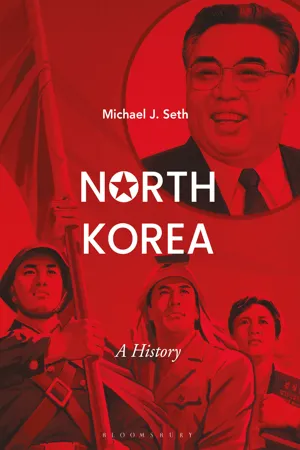
In this key textbook, Michael J. Seth offers an excellent synthesis of existing scholarship, including a thorough examination of contemporary sources. Seth masterfully traces how North Korea gradually transformed itself from a Soviet-style socialist state to an ultra-nationalist, dynastic one, illuminating this journey with an engaging understanding of the political, ideological, economic and social forces at play. Throughout, Seth adds a rich dimension by placing North Korean history into broader global perspective and considering the implications for the future of the country. With a helpful glossary and an exhaustive bibliography, this clear and accessible overview is an ideal text for students of North Korean history, and for anyone with an interest in the evolution of this uncommon nation.
- 300 pages
- English
- ePUB (mobile friendly)
- Available on iOS & Android
eBook - ePub
About this book
Information
© Michael J. Seth 2018
Michael J. SethNorth Koreahttps://doi.org/10.26777/978-1-352-00219-5_11. Historical Roots of the North Korean State
Michael J. Seth1
(1)
History Department, James Madison University, Harrisonburg, Virginia, USA
North Korea was created by revolutionaries driven by nationalism, anti-imperialism and the search for the right path to modernity. All three were the products of its encounter with the modern world that began in the late nineteenth century. An intense nationalism, accompanied by a fierce desire to be free of foreign control characterized not just Kim Il Sung and the builders of the North Korean state but many modern Korean leaders. An ancient, ethnically homogeneous society with its distinctive culture, Korea found itself caught up in the world of nineteenth-century imperialism for which it was unprepared. China, Russia and Japan fought for control over the peninsula, with Japan emerging victorious. In 1910 it was annexed by Japan which governed it as a colony for 35 years. Under direct foreign rule for the first time in their history Koreans responded with modern nationalist and anti-imperialist movements that sought to regain their independence, and secure it by creating a strong and powerful nation that could take its place among the leading states of the world. This was the aim of the DPRK’s leaders, and differed in these respects little from that of all Korean nationalists including those that ruled the South after 1948.
Early Historical Background
Much of Korea’s long history may seem too remote to be of relevance to the story of North Korea but, in fact, this is not so. As is true of their East Asian neighbors Koreans have been historically minded, and their interpretation of the past is central to their modern identity. North Korea’s ideology and the way it sees itself are intertwined with its understanding of Korean history.
Korea as a unified state dates back to the seventh century. Three kingdoms – Shilla (or Silla) in the southeastern part of the peninsula, Paekche in the southwest and Koguryŏ in the North – had emerged by the fourth century and competed for supremacy until Shilla emerged victorious in 676. Thereafter, except for a brief period in the early tenth century one state governed the peninsula. The northern border fluctuated somewhat, but has not changed significantly since the early 1400s. When the country was partitioned in 1945 it ended 13 centuries of unity. Few states in the twentieth century were as old or had such stable boundaries. It was also homogeneous to an unusual degree. Whatever varied peoples may have lived on the peninsula, they had long become a single ethnic-linguistic group by the nineteenth century. North Korea today is possibly the world’s most ethnically uniform society, and South Korea would be a candidate for the second most. While China had a profound influence on their society, Koreans maintained a distinctive culture with their own dress, styles of houses, folk art and customs, their own unique alphabet developed in the fifteenth century, and their own cultural identity. Until the late nineteenth century there were no significant Korean communities outside Korea so that it was, uncommonly, a land where political, linguistic-ethnic and cultural boundaries were nearly the same. Korean history was also characterized by a high degree of historical continuity. Three dynasties ruled from the 676 to 1910 without radical changes in the basic institutions. In the Shilla period it was ruled by the Kim royal family. In 935 a new dynasty ruled from Kaesong (Kaesŏng) in what is now North Korea renaming the state Koryŏ. After nearly five centuries of rule the Yi dynasty came to power in 1392 with a new name for the state: Chosŏn. The Yi or Chosŏn dynasty, moved the capital to Seoul and remained on the throne until the Japanese annexed Korea in 1910. During 13 centuries of monarchic rule many of the same aristocratic families dominated politics and society century after century. Only the intrusion of foreign imperialism and the Japanese takeover brought a break in history and even then the old aristocratic lineages controlled much of the countryside until the land reforms after 1945.
Korea has been shaped by its relationship with its neighbors. Korea was part of the Chinese tributary system, with the Korean king a vassal of the Chinese emperor. This was sometimes misunderstood by Westerners to mean something short of full independence, but the reality was that Korea was fully autonomous. Its obeisance to its huge neighbor was usually more ceremonial than substantive. Korean nationalists in the early twentieth century felt ashamed at what they regarded as their subservience to China – which in both North and South Korea is referred to as sadaejuūi, literally translated as “serve the great-ism”; in modern times it had the connotation of slavishly serving a great power rather than being proudly independent. Before 1876, however, the educated classes, at least, took pride in being part of the great cosmopolitan world centered in China and in their adherence to “the study of the Way,” as the Confucian tradition was sometimes called. Indeed, the rigid adherence to Neo-Confucianism that characterized Korea from at least the fifteenth century exceeded that of China, Vietnam or Japan but enabled the ruling class to see their society as the truest bastion of righteousness.
From Hermit Kingdom to Colony
North Korean propaganda portrays Korea as a victim of imperialist aggression. In fact, in South Korea too Korean history, despite long periods of peace, is often depicted as one of repeated foreign invasions: the Khitans from inner Asia in the tenth century, the Mongols in the thirteenth, the Japanese in the late sixteenth and the Manchus in the early seventeenth centuries. To avoid trouble Chosŏn state sought to limit its contact with the outside world. The aggressive, globalizing Euro-centered world of the late nineteenth century, however, did not make opting out of the emerging international economic system possible. After the British forcibly pried China open to Western trade in the Opium War of 1839–1842, and after the Americans “opened” Japan in 1854, some Western attention was drawn to the hermit kingdom. The British unsuccessfully attempted to initiate trade. Meanwhile, French missionaries sneaked into the country, and following the execution of several of them France sent a punitive expedition in 1866.1
North Koreans regard the General Sherman incident as the beginning of the modern era of imperialist intervention into their country. This obscure affair, little known to Americans, has been made into a major event, with the official version memorized by all school children. In August 1866 a heavily armed American ship, the General Sherman, with a crew of Americans, Chinese, Malays and British sailed up the Taedong River to Pyongyang seeking to open up trade. A local official explained that the country was closed to trade with foreigners but the ship ignored the request to leave. After tense negotiations led to an exchange of fire between the crew and locals, the Koreans burned the ship, which was caught on a sandbar, and killed its crew. For a while the Americans did not know what had happened to the ship. The government in Seoul informed the Chinese of the incident and through the Chinese the USA eventually learned of its fate. In 1871 the US Minister to China, Frederick Low, led five ships and 1,200 men under Admiral John Rodgers on a punitive expedition. The Americans attacked the island of Kanghwa and some coastal forts. The Koreans fought to the death, inflicting a few casualties on the Americans. Without authorization to proceed further, and frustrated by the Koreans’ refusal to talk, Low and Rodgers withdrew. The government, proud to have driven off the barbarians, both the French in 1866 and the Americans in 1871, erected stone signs that proclaimed “Western barbarian invade or land. If we do not fight we must then appease them. To urge appeasement own to betray the nation.”2
But Korea’s isolation quickly came to an end. In 1876, acting in imitation of the Westerners that had recently forced them to open their ports to trade, the Japanese sent their gunboats to Korea and intimidated the court into opening up the country to commerce and formal diplomatic relations with Tokyo. Within a few years the USA, Britain, France and others had joined the Japanese. Some members of the yangban aristocratic elite as well as other educated non-aristocrats were quick to appreciate the need to carry out modern reforms if the kingdom was to survive. But the Koreans never had the leisure to experiment with adaptations of Western institutions and technologies since China, Russia and Japan aggressively competed for influence and intervened in the internal affairs of their country. These powers were able to take advantage of the internal rivalries within the ruling class which failed to form a united front against foreign aggression. Japan, which was the most committed power in the region and determined to gain control of what they considered to be a strategically important peninsula, first defeated China in the Sino-Japanese War 1894–1895 and then triumphed over Russia in the Russo-Japanese War 1904–1905 to become the master of Korea. In 1905 Korea became a Japanese protectorate with the approval of Britain and the USA; five years later it became a colony. Koreans reacted to these events in varied ways. Some accepted the reality of Japanese dominance and cooperated with their new rulers, others resisted. The latter waged a guerilla war against the Japanese from 1907 to 1911. About 15,000 of these poorly armed, disparate groups called ūibyŏng (righteous armies) lost their lives before the resistance was stamped out. A few Koreans went into exile, fleeing to Shanghai, Hawaii and elsewhere, or crossed the border into Manchuria or Siberia. Most simply went on with their lives and accommodated themselves to the new order.
These years between 1876 and 1910 were important because they marked Korea’s entry into the modern world and exposed Koreans to new ideas about their place in it. By 1910 Koreans studying in Japan, and a few in Europe and America encountered a bewildering array of new ways of thinking about society and government. Ideas of modern science, progress, constitutionalism, state sovereignty, popular sovereignty, human rights, international law and equality entered the discourse of the educated most often through Japanese translations. Of course, there is nothing special about this; Koreans were only participating in the global diffusion and evolution of these new concepts. What was unusual was that, unlike many Asian, African, Middle Eastern, Latin American and other peoples, Koreans, owing to their effective isolation until fairly recently in world history, were exposed to these ideas more suddenly. There was no small group of “Dutch Learning” scholars as there had been in Japan, or Western-exposed intellectuals such as in early nineteenth-century Bengal or Istanbul. Yet the younger generation of educated Koreans eagerly embraced these new ideas in what amounted to an intellectual revolution.
Korea’s Unusual and Traumatic Colonial Experience
North Korean society, to a considerable extent, is rooted in the colonial experience. The 35-year colonial regime, 1910 to 1945, touched the lives of almost every Korean, often in disturbing and even traumatizing ways. It was during this period that modern nationalist, anti-imperialist movements began and that competing visions of modernity became defined. It would be hard to exaggerate just how profound that experience was in shaping the character of North Korea. Many of its defining features – the militarization of its society, its coercive methods to marshal the population for state goals, its xenophobia, the cult of the ruling family and its intense, fierce nationalism – were shaped by the peculiar features of Japanese rule.
In many ways Korea was a typical colony. The Japanese had modeled much of their colonial administration on that of the major European powers. As in the case of most Western imperialists the Japanese saw themselves as agents of modernization and progress. They created a modern infrastructure with railroads, schools and port facilities; brought about improvements in agriculture; and established certain industries. But economic development was designed to produce raw materials and products needed by the mother country, which directed and controlled its development. Yet Korea’s colonial experience was unusual in that Korea was neither a contiguous appendage to a land empire nor ruled by a distant overseas power. Only 115 miles from Japan’s shores, Korea had a long history of interaction with its colonizer, including the sixteenth-century invasions and attempted conquest. It was a familiar, often menacing neighbor. Japan shared a common East Asian cultural heritage with Korean Confucian values that included an emphasis on rank, hierarchy, authority and respect for education. This it married to Western concepts of science, industry, technology and bureaucratic efficiency.
Japan’s colonial rule of Korea was also unusual in its intensive nature, to the degree it promoted industrialization and to the massive wartime mobilization of the population during World War II. Most colonies were ruled through local indigenous officials or elites. Japan, however, ruled Korea directly. In the late 1930s nearly a quarter of a million Japanese served in Korea as bureaucrats, police and garrison soldiers and as employees of state banks, companies and schools – a contingent ten times that of the French personnel who were sent to administer Vietnam, a country similar in size and population; and equal in number to that of the British in India, which had twenty times the population. The vast bureaucracy and police system penetrated throughout Korean society, including the Japanese village school teacher and the Japanese village policemen who carried out regular home inspections to see to it that health and other regulations were being carried out. After 1931 colonial Korea was also far more industrialized than most colonies. In particular, the northern part of the country, with its abundant mineral resources, hydroelectric potential and proximity to the expanding Japanese empire in China, was rapidly developed. Seeing Korea as an important base for the expansion into China, an elaborate railroad system was built as well as other infrastructure. Thus by 1945 Japan had set much of the foundations for an i...
Table of contents
- Cover
- Frontmatter
- 1. Historical Roots of the North Korean State
- 2. Birth of the DPRK and Failed Reunification, 1945–1953
- 3. Industrialization and Political Consolidation, 1953–1967
- 4. Creating a Monolithic System and a Dynastic State, 1967–1980
- 5. From Stagnation to Crisis, 1980–1994
- 6. Famine and Survival, 1994–2005
- 7. Failed Revolution, Enduring State 2005–2016
- Backmatter
Trusted by 375,005 students
Access to over 1.5 million titles for a fair monthly price.
Study more efficiently using our study tools.
Frequently asked questions
Yes, you can cancel anytime from the Subscription tab in your account settings on the Perlego website. Your subscription will stay active until the end of your current billing period. Learn how to cancel your subscription
No, books cannot be downloaded as external files, such as PDFs, for use outside of Perlego. However, you can download books within the Perlego app for offline reading on mobile or tablet. Learn how to download books offline
Perlego offers two plans: Essential and Complete
- Essential is ideal for learners and professionals who enjoy exploring a wide range of subjects. Access the Essential Library with 800,000+ trusted titles and best-sellers across business, personal growth, and the humanities. Includes unlimited reading time and Standard Read Aloud voice.
- Complete: Perfect for advanced learners and researchers needing full, unrestricted access. Unlock 1.5M+ books across hundreds of subjects, including academic and specialized titles. The Complete Plan also includes advanced features like Premium Read Aloud and Research Assistant.
We are an online textbook subscription service, where you can get access to an entire online library for less than the price of a single book per month. With over 1.5 million books across 990+ topics, we’ve got you covered! Learn about our mission
Look out for the read-aloud symbol on your next book to see if you can listen to it. The read-aloud tool reads text aloud for you, highlighting the text as it is being read. You can pause it, speed it up and slow it down. Learn more about Read Aloud
Yes! You can use the Perlego app on both iOS and Android devices to read anytime, anywhere — even offline. Perfect for commutes or when you’re on the go.
Please note we cannot support devices running on iOS 13 and Android 7 or earlier. Learn more about using the app
Please note we cannot support devices running on iOS 13 and Android 7 or earlier. Learn more about using the app
Yes, you can access North Korea by Michael J. Seth in PDF and/or ePUB format, as well as other popular books in History & Korean History. We have over 1.5 million books available in our catalogue for you to explore.