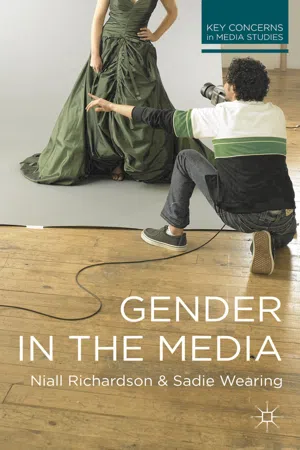
This lively and engaging text introduces students to the key contemporary issues in the study of gender and the media. Integrating cultural theory with text-based criticism, Gender in the Media analyses recent debates in feminist cultural theory, masculinity studies and queer theory, before applying these cultural paradigms to critical readings in relevant media contexts.
Richardson and Wearing address a wide range of new media texts and topics, covering television dramas, make-over shows, life-style magazines, internet dating and more. Critical, current and far-reaching, this book is invaluable for all students of media and gender studies, as well as for anyone interested in gender representation in different media forms.
- 148 pages
- English
- ePUB (mobile friendly)
- Available on iOS & Android
eBook - ePub
Gender in the Media
About this book
Information
PART I
Questions of Theory
1 | Feminisms |
Introduction: Feminist Media Studies – ‘Making the invisible Visible’
It is always important to start any discussion of feminism with a reminder that it is not a single entity agreed on in advance by those who identify as feminists, be they activists or academics (a far from simple distinction). Rather, feminism should be understood as an area of contestation and debate. It is an arena of fraught arguments over the social and symbolic meanings attached to gender and sexuality as well as to race, class, age, ability and so on. What unites feminist perspectives on a very wide range of issues – from the ratio of women in governments, to questions of employment rights and rewards, to reproductive health, to debates over sex work or gender violence – is a concern to interrogate existing gender relations, identities or norms with a view to the potential for these to change and transform. ‘Second-wave feminism’ is the term frequently used to mark a period of activist, transformative, feminist engagement, occurring in distinct ways in the USA, the UK and Europe, which has reshaped the cultural and political status of women in these geographical areas. Feminist theory is also very clear that distinctions need to be made between women, such that one of the first questions a contemporary student needs to ask is ‘which women’ and ‘where’ rather than assuming that the category is self-evident. Feminists are interested in questions of justice and inequalities but also in the question of difference. As Liesbet Van Zoonen puts it, despite the differences amongst feminist approaches in different contexts:
Some common concepts … distinguish feminism from other perspectives in the social sciences and the humanities. Its unconditional focus [is] on analysing gender as a mechanism that structures material and symbolic worlds and our experiences of them … This is not to say that such a focus will always result in the conclusion that gender is the defining factor … Ethnicity, sexuality, class and a range of other discourses intersect with gender in various and sometimes contradictory ways.
(Van Zoonen 1994: 3)
For feminist media scholars too, the area is marked less by a single line of interest and more by a consensus that media is gendered. In other words gender is significant in production, reception and institutional contexts, as well as in relation to representational and symbolic practice. Feminist scholars of media come from a variety of disciplines. In addition to media and communications, the field has been marked by the input of sociologists and literary, film, television and cultural studies scholars. Moreover, it is also an area of significance to those working within the media industries. Importantly too, as Hollows and Moseley (2006) suggest, feminism is also experienced and encountered by audiences through popular culture. All of these perspectives share the understanding that gender matters in relation to media.
An introduction of this type cannot hope to offer a comprehensive analysis of all the work which takes a feminist approach to media, but the sketch that follows is designed to introduce some of the key debates which have structured the field, including key areas of representation, symbolic function and reception.
Annette Kuhn suggests that it is helpful to regard feminism as a ‘frame of reference or a standpoint’ or ‘as a set of conceptual tools and a method or series of methods’ (Kuhn 1994: 68). Whilst these are conceptually distinct, they need to be thought of together. One distinction is whether scholarship employs a sociological or a humanities influenced approach. A sociological analysis can be identified as the ‘images of women’ approach in that it considers the political importance of representations of women, especially in relation to how these images can be seen to ‘reflect’ the position of women in the real world. By contrast, the approaches derived from literary criticism and film theory are more likely to consider the ways that mediation works in relation to representation and to attend to questions of ideology and social construction using methods and theories from semiotics, structuralism and psychoanalysis. These debates could be labelled the ‘women as image’ approach.
These distinctions and differences between feminist methods and theories are linked through a feminist perspective. Different groups have different investments in the analysis of gender and media. Those working within the industry have a very different relationship to it than those immersed in theoretical debate. However, what these different perspectives do share is a concern with the politics of gender and sexual relations (including exclusions and injustices) in relation to the media industries and its products. They contest and critique, in different ways, the existing structures and regimes of media. What unites feminist analysis is the desire to ‘make visible the invisible’ (ibid.: 71) at the levels of text, production and context.
Questions surrounding the relationship between representation and the social world have been key issues for feminists whose interest is predicated on the assumption that the media are powerful and influence the ways in which we all experience gender. This, in part, relates to the key insight, outlined in the Introduction, that biological sex and cultural gender can be understood as distinct, and that the media is part of the process through which gender accrues meaning. French feminist philosopher Simone de Beauvoir argues in The Second Sex that one is not ‘born woman’ rather one is ‘made’. This idea, that biological sex (how one is born female) should be understood as distinct from what one becomes – gender (woman) – means that the distinction between female and feminine is a crucial insight for feminism. (More recently this sex/gender distinction has been subject to criticism as various philosophers have argued that sex itself is also constructed and produced via culture and within matrices of power (Butler 1990).) Nonetheless, despite these qualifications it is hard to over estimate the importance of the idea that femininity and masculinity are historically and culturally variable, and also that they are raced (Truth 1995; hooks 1996) and classed (Skeggs 2004). As stressed in the Introduction, the media are implicated in the ways that masculinity and femininity are constructed, maintained and transformed and analysis of this process is a key aspect of feminist media debate.
Representations: Images of Women
Media and cultural imagery of women came to be seen as one of the key sites for feminist engagement in the 1970s. During this period activists, as well as academics, raised questions about representation which are still pertinent and the subject of much popular gender debate today. Why are women’s bodies used so extensively to sell things? What are the dominant and dominating images associated with femininity? What role do the media play in ascribing and regulating prescriptive gender roles? Traditional versions of masculine and feminine roles and identities can easily be identified in contemporary media culture – scatterbrained women still angst about their appearance and vie for ‘Mr Right’ (e.g. the Bridget Jones franchise and many other ‘chick flicks’), while (super) heroes are still overwhelmingly male. Of course some imagery is changing but, for the most part, gender in the mainstream media is still largely understood as dichotomous and, as we saw in the Introduction, is part of the socialization of both men and women.
In 1978 Gaye Tuchman famously described the representation of women in the mass media as ‘symbolic annihilation’ (Tuchman et al. 1978: 8), noting that ‘relatively few’ women were portrayed at all and when they were they were generally confined to being either a ‘child like adornment’ or a dutiful housewife. Where they did appear as ‘working women’ they were ‘condemned’ or ‘trivialised’. The sex role stereotyping that was uncovered through this kind of research found plenty of evidence to support the view that the media was complicit in upholding unequal relations between men and women through the stress placed on keeping women in the private sphere of home and the domestic, whilst men performed the public roles. For feminists this public/private distinction is understood as a key problem to be analysed and broken down, rather than something inevitable or natural, hence the slogan ‘the personal is political’. Feminist engagement in debates over popular culture in this early period were particularly interested in contesting the dominance of particular versions of femininity and a key and much cited text here is Betty Friedan’s The Feminine Mystique. She argued that the idealisation and manufacture (in large part through the media) of the feminine suburban middle-class white norm fostered deep unhappiness in women whose lives were constrained by such limited ambition (2001). Of course, Friedan’s critique comes from a quite privileged and limited perspective. Nonetheless, it is an important and very influential text and the primacy it accords to the white, middle-class norm is close to the perspective of many of the commentators on gender in the press, even today, as we will see in the discussion of Mad Men in Chapter 4 (see pp. 78–80). The predominance of this image of femininity then, as passive, pretty and dependent, still has relevance.
Tuchman uncovered the relative invisibility of women in media representation. Her analysis showed a numerical bias in favour of the representation of men. We might fondly imagine that things have changed a great deal since the 1970s. Unfortunately, however, the reality is depressingly consistent. The Centre for the Study of Women in Television and Film publishes detailed statistics and reports on the roles of women within the film and television industry, both behind and in front of the camera. Their findings show that women are still underrepresented in all aspects. Films which do feature women have routinely lower budgets, open in fewer cinemas and are screened for less time (Lauzen 2008). In 2011 only 33 per cent of characters in the 100 highest grossing US films were female and only 11 per cent were lead protagonists, a decline from 16 per cent in 2002, demonstrating that progress in this area is far from a given (Lauzen 2012). Furthermore, the kind of representation is also far from gender neutral, with men more likely to be offered ‘leadership’ roles than women, which the author of the report accounts for in part because she also notes that female characters tend to be younger than male characters, with 50 per cent of male characters being over 40 as opposed to 25 per cent of female. These statistics are also mirrored in the way that films are made, with only 18 per cent of the production workforce (directors, executive producers, writers, cinematographers and editors) of the 250 highest grossing US films of 2012 being female (Lauzen 2013), while women made up a miserable 9 per cent of the most revered role in cinema – the director. While the question of the gender of the cinematic gaze has preoccupied critics and theorists for a long time (see the discussion of Mulvey below) these statistics are a stark reminder that the questions which preoccupied the feminist commentators of the 1970s – who is responsible for the representations that surround us, and how are they gendered? – are questions that still need to be asked despite the success of films like Bridesmaids or The Heat which might suggest that women have equal access to the screen.
The problem identified with the kind of research that looks at images of women is that it can tend to rather oversimplify the question of the image itself. It also positions feminist critics as ‘outsiders’ looking on and judging popular culture, and it has consistently been called to task for its dependence on a ‘hypodermic’ model of communication which not only sees women as passive dupes of ideology, who lack the critic’s superior ability to see through stereotypical imagery, but which has also failed to take women’s enjoyment of popular culture seriously (Hollows and Moseley 2006: 4). Calls for ‘realistic images’ in place of idealised or demeaning ones won’t solve the problem because reality is more complex and women more heterogeneous than any ‘corrective’ image can hope to account for. Critics argue that it may well be useful to think about the way that particular groups are represented through stereotypes because of what this reveals about the systematic nature of oppression and because it stresses the potentially profound psychic and social consequences for individuals. However, they also suggest that analysis based on stereotype runs very serious risks of reproducing rather than contesting these constructs (Shohat and Stam 1994). Van Zoonen reminds us that engagements with media which critique images for being stereotypical or unrealistic are based on a premise that gender itself is simple and the result of a straightforward distinction, whereas the reality is more complex (see Carter and Steiner 2004: 14).
As will be discussed later in this chapter, media scholarship on gender has, over the past two decades, taken seriously some of the genres explicitly aimed at women. This has been considered important, not least because those genres associated with the ‘feminine’ were often dismissed as trivial and unworthy of scholarly attention. Women’s magazines are one such area, and we will take this up in Chapter 6 through a discussion of celebrity; but it is worth noting here that women’s magazines stage an important aspect of the reproduction of femininity within capitalist society (a link also returned to in Chapter 4 in relation to television drama and in Chapter 5 in relation to the make-over show). Femininity in women’s magazines is often figured as something which basically needs ‘work’, constant maintenance and the injection of lots of money. Also of note is the fact that magazines rely on advertising to sustain production which makes them vulnerable to editorial pressures (ibid.: 180). Prescriptive ideas about the ideal feminine body (as well as about job, house and other lifestyle elements that magazines routinely pronounce on) have been criticised by some feminists for the ‘discipline’ that comes to be exerted on women. For example, drawing on the ideas of Michel Foucault, both Sandra Bartky and Susan Bordo suggest that women’s bodies are disciplined into taking on very particular and constrained shapes by the discourses of bodily perfectibility that is endemic to Western cultures (see pp. 107–8). Their work stresses how much effort and work on an ongoing daily basis it takes to ‘produce’ the normatively gendered, feminine body. Susan Bordo, in her study, particularly stresses the ‘pathology’ of the cultural expectation to be thin (Bordo 2003). Work on women’s magazines has also, however, stressed the pleasures of feminine identifications.
Perhaps ironically, the idea that femininity needs work, that it is not a natural and inevitable part of being female, is an insight from women’s magazine culture which is shared by feminists who utilise psychoanalysis, a very different perspective from that of the ‘images of women’ critique with which we started. These critics have made a profound intervention in debates about gender and the media. (For further investigation into the history of feminist film criticism see Thornham and Richardson 2013.)
Psychoanalysis in Feminist Media Studies: Women as Image
Many feminists are suspicious of psychoanalysis, the body of work associated with Sigmund Freud and others. Psychoanalysis suggests that much of what we think we know about ourselves is illusory because we are subject to unconscious processes of which we are only vaguely aware. At one time Freud’s work was routinely dismissed by feminists as being complicit in the maintenance of patriarchal relations because his theories of infantile sexuality and the psychic processes that constitute identity are often read as if they are a blueprint for ‘normal’ (i.e. gender conformist and heterosexual) development. However, as has been widely noted by feminist media scholars, Juliet Mitchell (1975) challenged the assumption that the theory was recommending this, or that it was proscriptive. Rather, she argued that it was descriptive, an ‘analysis’ of how sexuality develops in a patriarchal society (ibid.: xiii; see also Rose 1983).
This unsettling of the very category of ‘woman’, assuming it not to be a pre-given certainty attained by all, was to become a key feature of queer theory’s intervention in discussions about the subject of feminism (Butler 1990) and belongs, more broadly, to a post-structuralist account of subjectivity understood as precarious, unstable and fluid. Rose’s work of this period (1986) stressed the significance for feminism of the work of French psychoanalyst Jacques Lacan’s ideas about language. Lacan stressed that there are only two positions that it is possible to occupy within language: that of ‘man’ or ‘woman’; and so language traps subjects into one of these. For the male child, under prevailing conditions, identity is in part achieved by his realisation that he has something girls don’t have, thus he (unconsciously) assumes this must be the crucial thing. Masculinity is thus based on a fantasy of precarious wholeness which depends (for it to have meaning) on the fantasy of a lack in the ‘other’ (femininity). Masculine identity is then an achievement grounded in an identification with the phallus (a sign of power, associated with but not reducible to the male sexual organ). In this view, femininity then is also merely an achievement, or ‘masquerade’, certainly not an essence or reflection of an existing self, but, importantly, in this view it is a fantasy which emanates from the male position. At this point of course many feminists (and others) tend to throw their arms up in exasperation. However, as Sue Thornham points out (2000), Rose uses Lacan’s work to stress the role of representation, fantasy and the unconscious in the production of sexed identity and its more general political and cultural repercussions, and which is of great interest to those working on media images. For media and film theory the insights of post-structuralism and psychoanalytic thinking on identity have emphasised how gendered meanings are established and maintained and how they operate on different levels.
In relation to film and media, psychoanalytic work stresses the uncovering of the unconscious processes at work in the very structures of cinema and its hold on the viewer. One aspect of this is the centrality of ideas of the cinematic gaze, which is described in Laura Mulvey’s formidably influential article ‘Visual Pleasure and Narrative Cinema’ (1975), which can reasonably be said to have kept generations of media and film scholars arguing. Mulvey’s article suggests that cinematic pleasure is the affirmation of the heterosexual fantasy of man as active, desiring subject and woman as passive, desired object. Mulvey argued that mainstream, narrative cinema is ‘cut to the measure of male desire’ leaving the spectator structurally locked into a preconstituted, gendered position through the three ‘looks’ (camera, character and director) that classical Hollywood cinema offers. Women, in this argument, are ‘bearers’ rather than ‘makers’ of meaning and the ‘visual pleasure’ of cinema is primarily a heterosexual male pleasure in looking at women. However, this pleasure, for men, is always highly ambivalent since it reminds them of the ‘fact’ of sexual difference, which is threatening. This threat, then, has to be contained. In cinema this containment happens through two narrative structures: the woman can be investigated and eventually punished for inspiring such castration anxiety; or, alternatively, this anxiety can be allayed through fetishisation of the female body (hair, legs, shoes, etc.). Where this structure leaves male desire for, as well as identification with, other men, and where it leaves the desiring female view...
Table of contents
- Cover
- Title Page
- Copyright
- Contents
- Introduction: Gender and Representation
- Part I: Questions of Theory
- Part II: Media Case Studies
- Conclusion
- Bibliography
- Index
Trusted by 375,005 students
Access to over 1.5 million titles for a fair monthly price.
Study more efficiently using our study tools.
Frequently asked questions
Yes, you can cancel anytime from the Subscription tab in your account settings on the Perlego website. Your subscription will stay active until the end of your current billing period. Learn how to cancel your subscription
No, books cannot be downloaded as external files, such as PDFs, for use outside of Perlego. However, you can download books within the Perlego app for offline reading on mobile or tablet. Learn how to download books offline
Perlego offers two plans: Essential and Complete
- Essential is ideal for learners and professionals who enjoy exploring a wide range of subjects. Access the Essential Library with 800,000+ trusted titles and best-sellers across business, personal growth, and the humanities. Includes unlimited reading time and Standard Read Aloud voice.
- Complete: Perfect for advanced learners and researchers needing full, unrestricted access. Unlock 1.5M+ books across hundreds of subjects, including academic and specialized titles. The Complete Plan also includes advanced features like Premium Read Aloud and Research Assistant.
We are an online textbook subscription service, where you can get access to an entire online library for less than the price of a single book per month. With over 1.5 million books across 990+ topics, we’ve got you covered! Learn about our mission
Look out for the read-aloud symbol on your next book to see if you can listen to it. The read-aloud tool reads text aloud for you, highlighting the text as it is being read. You can pause it, speed it up and slow it down. Learn more about Read Aloud
Yes! You can use the Perlego app on both iOS and Android devices to read anytime, anywhere — even offline. Perfect for commutes or when you’re on the go.
Please note we cannot support devices running on iOS 13 and Android 7 or earlier. Learn more about using the app
Please note we cannot support devices running on iOS 13 and Android 7 or earlier. Learn more about using the app
Yes, you can access Gender in the Media by Niall Richardson in PDF and/or ePUB format, as well as other popular books in Social Sciences & Gender Studies. We have over 1.5 million books available in our catalogue for you to explore.