eBook - ePub
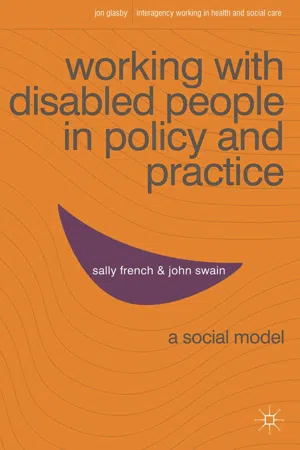
Working with Disabled People in Policy and Practice
A social model
- 224 pages
- English
- ePUB (mobile friendly)
- Available on iOS & Android
eBook - ePub
About this book
Part of Palgrave's Interagency Working in Health and Social Care series, this book explores the policy and practice which frames work with disabled people. Providing a critical review of the mainstream services available to disabled people, it assesses the successes and failures of interagency working, and offers a model for future practice.
Information
| 1 | Modelling Disability and Impairment |
In this chapter we discuss:
- The individual model of disability

- The social model of disability
- Long term conditions
- The tragedy model of disability
- The affirmative model of disability
- Implications for policy and practice
In this chapter we will examine two central models of disability, the individual model and the social model, to illustrate the ways in which underlying ideas and concepts can shape policy and practice in health and social care. We will also consider the tragedy model and the affirmative model, which are closely associated with the individual and social models of disability. Some consideration will also be given to the term ‘long term conditions’, which is frequently used alongside ‘disability’ in research and policy documents.
A model can be defined as a conceptual framework for understanding causal relationships. It usually lies within the framework of a broader theory (Brown, 2009). For example, an inability to move around in the environment may be thought to be caused by physical impairment. Within every society there are competing models of disability, with some being more dominant than others at different times (Oliver, 2004; Wilder, 2006). In earlier centuries, for example, models of disability were based upon religion (Whalley Hammell, 2006). Although often in conflict, models of disability may gradually influence and modify each other. The models put forward by powerful groups within society, such as the medical profession, tend to dominate the models of less powerful groups, such as those of disabled people themselves (French and Swain, 2002).
It is essential to explore these models of disability, for attitudes and behaviour towards disabled people, policy, professional practice, and the running of institutions, including hospitals, rehabilitation centres and social service departments, are based, at least in part, upon them. As Oliver states:
The ‘lack of fit’ between able-bodied and disabled people’s definitions is more than just a semantic quibble for it has important implications both for the provision of services and the ability to control one’s life. (1993a, p. 61)
Even the ways in which single words are defined can shape both policy and practice. The word ‘independence’ is an example.
| Box 1.1 | What is independence? |
The predominant meaning of independence among health and social care professionals is the ability to do things for oneself. This definition has, however, been challenged by disabled people who view independence in terms of self-determination, control and managing and organizing any assistance that is required. Ryan and Holman state that, ‘independence is not necessarily about what you can do for yourself, but rather about what others can do for you, in ways that you want it done’ (1998, p. 19).
Additionally, some cultures have a collectivist orientation and do not value independence as much as others. In a very real sense, we are all dependent on each other for our survival so nobody is truly independent.
The individual model of disability
The most widespread view of disability at the present time, at least in the Western world, is based upon the assumption that the difficulties disabled people experience are a direct result of their individual physical, sensory or intellectual impairments (Oliver and Sapey, 2006; French and Swain, 2008). Problems are thus viewed as residing within the individual. The individual model of disability is deeply ingrained and ‘taken as given’ in the medical, psychological and sociological literature. Even in the literature on the sociology of health and illness, disability as a social problem is rarely acknowledged (Barnes and Mercer, 1996; Swain et al., 2003).
The medical model can be regarded as a subcategory of the overarching individual model of disability where disability is conceived as part of the disease process, abnormality and individual tragedy – something that happens to unfortunate individuals on a more or less random basis. Treatment, in turn, is based upon the idea that the problem resides within the individual and must be overcome by the individual’s own efforts. Disabled people have, for example, been critical of the countless hours they have spent attempting to learn to walk or talk at the expense of their education and leisure (Oliver, 1993b; French and Swain, 2008). According to this perception of disability, disabled people have something wrong with them that needs to be corrected so that they can be as much like other people as possible.
The predominance of medicine in the lives of disabled people, especially when they are young, has been criticized by disabled people. Mason and Rieser state:
For young people the disadvantages of medical treatment need to be weighted against the possible advantages. Children are not usually asked if they want speech therapy, physiotherapy, orthopaedic surgery, hospitalisation, drugs or cumbersome and ugly ‘aids and appliances’. We are not asked whether we want to be put on daily regimes or programmes which use hours of precious play-time. All these things are just imposed on us with the assumption that we share our parents’ or therapists’ desire for us to be more ‘normal’ at all costs. We are not even consulted as adults as to whether we think those things had been necessary or useful. (1992, p. 82)
Individualistic definitions of disability certainly have the potential to do serious harm. The medicalization of learning disability, whereby people were institutionalized and abused, is one example (Potts and Fido, 1991; Atkinson et al., 2000). Other examples are the practice of oralism, where deaf children were prevented from using sign language and punished for using it (Humphries and Gordon, 1992; Dimmock, 1993), and ‘sight-saving’ schools where visually impaired children were prevented from using their sight and, in consequence, were denied a full education (French, 2005). Research about disabled people is also underpinned by the individual model. It is usually medical or psychological in orientation, rather than social and political, which has serious implications for disabled people as research knowledge underpins both policy and practice (Barnes and Mercer, 1997; Swain and French, 2004).
None of these arguments imply that considering the medical or individual needs of disabled individuals is wrong. Disabled people, like everyone else, require an excellent health and social care service that may free them of symptoms, assist with independence and even save their lives. Insulin, for instance, has saved the lives of people with diabetes and an in-dwelling shunt has saved the lives of babies with hydrocephalus. Similarly, visually impaired people with glaucoma may have their sight preserved by eye drops or surgery and social assistance may enable disabled people to live fuller lives. The problem with the individual model is that it has been used to interpret disabled people’s needs and to dominate their lives. The effect of the physical, attitudinal and social environment on disabled people has been largely ignored or regarded as relatively fixed, which has maintained the status quo and kept disabled people in their disadvantaged state within society (Oliver and Sapey, 2006). Thus the onus has been on disabled people to adapt to a disabling environment (Swain, French, Barnes et al., 2004). This is something that disabled people have increasingly joined forces to challenge. As Oliver states:
The disability movement throughout the world is rejecting approaches based upon the restoration of normality and insisting on approaches based upon the celebration of difference. (1996a, p. 44)
The social model of disability
The social model of disability is often referred to as the ‘barriers approach’ where disability is viewed not in terms of the individual’s impairment, but in terms of environmental, structural, and attitudinal barriers which impinge upon the lives of disabled people and which have the potential to impede their inclusion and progress in many areas of life, including employment, education, housing and leisure, unless they are minimized or removed (Oliver, 1996a). The social model of disability has arisen from the thinking, writings and growing cultural identity of disabled people themselves (Swain, French, Barnes et al., 2004).
The definition of impairment and disability shown in Box 1.2 is that of the Union of the Physically Impaired Against Segregation (UPIAS), which was an early radical group of the Disabled People’s Movement. Its major importance is that it breaks the causal link between impairment and disability.
| Box 1.2 | Impairment and disability |
Impairment
‘Lacking part or all of a limb, or having a defective limb, organ or mechanism of the body.’
Disability
‘The disadvantage or restriction of activity caused by a contemporary social organisation which takes no or little account of people who have physical impairments and thus excludes them from participation in the mainstream of social activities. Physical disability is therefore a particular form of social oppression.’
(UPIAS, 1976, p. 14)
The word ‘physical’ has now been removed from this definition so as to include people with learning difficulties and users of the mental health system. This and similar definitions break the connection between impairment and disability, which are viewed as separate entities with no causal link. This is similar to the distinction made between sex (a biological entity) and gender (a social entity) in the women’s movement (Gove and Watt, 2004).
The World Health Organization’s International Classification of Impairments, Disabilities and Handicaps (ICIDH) (1980) and the revised version (ICIDH-2) (2001) have been rejected by the Disabled People’s Movement because, despite taking social and environmental factors into account, the meaning of disability is still underpinned by the individual model and the causal link between impairment and disability remains intact (Pfeiffer, 2000; Hurst, 2000).
Disability is viewed within the social model in terms of barriers (French, 2004a). There are three types of barriers, which all interact (see Box 1.3).
| Box 1.3 | Disabling barriers |
- Structural barriers – which refer to the underlying norms, mores and ideologies of organizations and institutions, which are based on judgements of ‘normality’ and which are sustained by hierarchies of power.
- Environmental barriers – which refer to physical barriers within the environment, for example steps and cluttered pavements, and to lack of resources for disabled people, for example lack of Braille and lack of sign language interpreters. It also refers to the ways things are done which may exclude disabled people, for example the way meetings are conducted and the time allowed for tasks.
- Attitudinal barriers – which refer to the adverse attitudes and behaviour of people towards disabled people.
These three types of barriers interact to give rise to economic, political and cultural disadvantage at every level in society.
It can be seen that the social model of disability locates disability not within the individual disabled person, but within society. Thus the person who uses a wheelchair is not disabled by paralysis but by building design, lack of lifts, rigid work practices, and the attitudes and behaviour of others. Similarly, the visually impaired person is not disabled by lack of sight, but by lack of Braille and large print, cluttered pavements, and stereotypical ideas about blindness. Finkelstein (1998) has argued that non-disabled people would be equally disabled if the environment were not designed with their needs in mind, for example if the height of doorways only accommodated wheelchair users. Human beings fashion the world to suit their own capabilities and limitations and disabled people want nothing more than that.
The social model of disability highlights the social and political nature of disability. It has been formulated by the Disabled People’s Movement and has gathered strength over the past thirty-five years as the movement has grown and...
Table of contents
- Cover
- Title
- Copyright
- Contents
- List of Boxes and Figures
- Acknowledgements
- Introduction
- 1 Modelling Disability and Impairment
- 2 The Context: from Segregation to Equal Rights
- 3 Disabled People: Health and Social Care
- 4 Residential Care
- 5 Control of Health and Social Care Services by Disabled People
- 6 Towards a Social Model of Inter-agency Working
- 7 User Involvement in Services for Disabled People
- 8 Disability and Diversity
- 9 Families and ‘Carers’
- Conclusion
- References
- Index
Trusted by 375,005 students
Access to over 1.5 million titles for a fair monthly price.
Study more efficiently using our study tools.
Frequently asked questions
Yes, you can cancel anytime from the Subscription tab in your account settings on the Perlego website. Your subscription will stay active until the end of your current billing period. Learn how to cancel your subscription
No, books cannot be downloaded as external files, such as PDFs, for use outside of Perlego. However, you can download books within the Perlego app for offline reading on mobile or tablet. Learn how to download books offline
Perlego offers two plans: Essential and Complete
- Essential is ideal for learners and professionals who enjoy exploring a wide range of subjects. Access the Essential Library with 800,000+ trusted titles and best-sellers across business, personal growth, and the humanities. Includes unlimited reading time and Standard Read Aloud voice.
- Complete: Perfect for advanced learners and researchers needing full, unrestricted access. Unlock 1.5M+ books across hundreds of subjects, including academic and specialized titles. The Complete Plan also includes advanced features like Premium Read Aloud and Research Assistant.
We are an online textbook subscription service, where you can get access to an entire online library for less than the price of a single book per month. With over 1.5 million books across 990+ topics, we’ve got you covered! Learn about our mission
Look out for the read-aloud symbol on your next book to see if you can listen to it. The read-aloud tool reads text aloud for you, highlighting the text as it is being read. You can pause it, speed it up and slow it down. Learn more about Read Aloud
Yes! You can use the Perlego app on both iOS and Android devices to read anytime, anywhere — even offline. Perfect for commutes or when you’re on the go.
Please note we cannot support devices running on iOS 13 and Android 7 or earlier. Learn more about using the app
Please note we cannot support devices running on iOS 13 and Android 7 or earlier. Learn more about using the app
Yes, you can access Working with Disabled People in Policy and Practice by Sally French,John Swain in PDF and/or ePUB format, as well as other popular books in Política y relaciones internacionales & Política social. We have over 1.5 million books available in our catalogue for you to explore.