One of the most popular and controversial scientists of the 20th century, Hans Eysenck had a major impact on psychology and society. Who was this charismatic and sometimes divisive figure, and why is he so relevant to science in the 21st century?
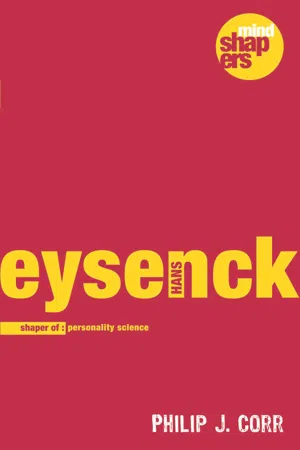
Hans Eysenck (1916 – 1997) was a key figure in psychology, and his legacy still provokes varied and passionate responses. With interests that ranged from personality and intelligence to sex and violence in the media, Eysenck was unafraid to tackle contentious subjects of social and political importance. In the centenary of Eysenck's birth, Philip Corr explores the life and research of this contradictory and intriguing psychologist. With access to some of the people that were closest to Eysenck during his lifetime, Corr considers the scientific and historical contexts and assesses the continuing relevance of Eysenck's work.
- 360 pages
- English
- ePUB (mobile friendly)
- Available on iOS & Android
eBook - ePub
Hans Eysenck
About this book
Information

Hans Juergen Eysenck is recognised as one of the most brilliant psychologists of the twentieth century. Not only did he make important and lasting contributions to our scientific understanding of the human mind and behaviour, he is responsible for popularising psychology, first becoming its public face in Britain and then its voice of controversy. Throughout his long career, he also makes a very substantial difference to the professional standing of psychology and, after the passing of many years since his death, he still very much matters to people. His work and life energise the entire field. He also has the ability to inspire and irritate, often in equal measure.
Now, there are many different ways to characterise anyone’s life and work, and it is always pleasing to have a punchy subtitle to a biography to capture the essence of the subject – or, more accurately, what the biographer decides is the essence. In the case of Eysenck, any such decision is bound for failure; it would be neither entirely accurate nor comprehensive. For example, the adjective ‘maverick’ is one possible subtitle, referring to someone who is a lone dissenter, independent of mind and behaviour, nonconformist, unconventional, unorthodox, individualistic, rebellious, disruptive, and something of a loose cannon. Etymological roots trace this word to, in Welsh, ‘valiant hero’ and in Hebrew, ‘shiny, brilliant’. All of these definitions have been appropriately applied to Eysenck. Indeed, ‘Maverick’ was the initial title of the BBC series Heretics, aired in 1994, that devoted an entire episode to him. In his autobiography, Eysenck displays clear delight in these adjectives – he mentions ‘trouble-maker’ in the same context.
However, Eysenck is very traditional in his academic approach and style, emphasising the need for a rigorous science of the mind and behaviour – he is no cocaine-stimulated Sigmund Freud, drunken R. D. Laing, or politically radical Eric Fromm – indeed, during the entirety of his life, Eysenck eschews even the humble pleasures afforded by alcohol for fear that it
might impair his intellect.1 But behind his formal academic persona, he is without doubt an intellectual radical and adventurer; a disruptor of the conventional, and convenient, wisdom, and an explorer of the uses and excuses of ill-considered thinking.
By the end of this book, you should have formed your own subtitle, and thus, what Eysenck means to you. For reasons made apparent throughout this book, my preferred one is A Contradictory Psychology.
An artistic comparison
As mentioned in the Preface and discussed further in the final chapter of this book, Eysenck is a truly disruptive spirit. He does things in his own way and provokes people to change the way they see the world. Inevitably, the messenger gets attacked along with the message.
Eysenck’s antecedents prepare him well for combining the theoretical and, broadly speaking, artistic side of science. As detailed in the next chapter, both his parents were in show business (and he even appeared in a film with his mother); his first research love is the psychology of aesthetics; he is always interested in creativity and genius; and he is a natural-born (but not showy) performer, with skills honed on the knees of his show business parents and maternal grandmother.
Other resemblances with the artistic spirit bear noting. For example, truly inspirational artists break new ground; but only after the passage of some time does the audience at first admire, then follow, and finally attempt to emulate. The true artist is independent of mind and spirit, and positively repulses the convenience of tradition and authority.
Despite the close connection between art and science – think of the works of Leonardo da Vinci – as C. P. Snow famously outlined in his ‘two cultures’ lecture in 1959, in the modern world they have been separated and, largely, isolated.2 It is likely that truly pioneering advances in science have more of the artist element than we recognise, or in our quest for professional reputation would wish to believe. For example, upon reflecting upon the physical structure of the double helix, Crick and Watson are reputed to have said, ‘It was too beautiful, too elegant to be wrong’ – surely, an artistic statement from two great scientists! And perhaps like many great artists, the scientist may get increasingly self-indulgent as their work becomes accepted and they are inducted into ‘normal’ society – or more accurately, society inducts to them. In this process of divinification, they become a magnified persona, and along with their talents their flaws become more apparent – rather like ancient heroes, they are seen to be descended from immortal gods (in this case scientific ones) and with all the qualities and faults on a much larger scale. They become larger than life figures and a mythology builds up around them. It is interesting to note that, as discussed in Chapter 3, Eysenck’s theory of aesthetic appreciation is predicted by Order × Complexity: in many respects, the formula that characterises his entire life.
Although we must guard against the temptation to take this comparison too far, the artistic side of Eysenck’s work and life may help to account for the hostilities he provokes and the great diversity of opinion attached to him. However, I cannot recall this comparison being made before; the closest we get is Eysenck’s own depiction of his scientific work as being ‘romantic’ (see Chapter 15). This side of Eysenck is rarely mentioned; however, once considered, it starts to open doors on understanding his complex, and seemingly contradictory, life.
Contradiction and contrariness
Whatever else, contrariness and contradiction are the backbone to the Eysenck story, and it is where we must begin.
These aspects offer a ready access to Eysenck the man and his work, and especially Eysenck the public persona. Few people would claim that he is not a contrarian – in fact, he takes this style to a new height of perfection. In terms of contradictions, these consist of three parts. First, his views contradict those of the mainstream – then and (but less so) now. Secondly, his personality contains what appear to be contradictory features.3 Thirdly, people’s reactions to him are contradictory (some people admire and respect him, others detest him). In a manner reminiscent of Richard Nixon, Eysenck likes to portray himself as misunderstood and set upon; as he says in the 1994 BBC programme, Heretics, ‘When I started out in science I felt a bit like a big friendly dog that gets kicked in the teeth because of the reception of original ideas received by other people.’ Although some people find it hard to recognise this self-characterisation, this may well be the way he sees himself.
As an illustration of these contradictions, Arthur Jensen (1997) recalled asking a psychiatrist at the Maudsley Hospital about Eysenck during the early years of his career and is told: ‘Oh, a brilliant and charming fellow. Ferocious only in the face of opposition.’4 However, this style does not apply to his face-to-face interactions with colleagues and students where he comes across as considerate, moderate, and rather shy. In stark contrast, in public lectures he does not hesitate to use his cool intellect and vast knowledge of his subject, delivered in a serene style with modulated tones, to put down any questioner who has the vain belief that they can undermine his argument – very few manage to do so.
Contrariness may not be too difficult to understand, and it is frequently observed; however, contradiction is something different – it makes the task of writing an account of Eysenck’s professional life all the more challenging. He cannot be depicted only with horns or a halo – he is a far more interesting character than either of these crude depictions allow. As recognised by one of his refulgent students, who went on to a glittering career of his own, Jeffrey Gray (1997. p. xi),5
It is a truism to say of almost anyone that he is a person full of paradoxes, but one that applies to Hans Eysenck in spades.
Few other scientists have their personality and science so bound together: to think of Eysenck’s psychology is to think of the man himself – the image of Eysenck. Untying this person–scientist Gordian knot is no easy task – and it may be a futile one! – because Eysenck is admired and detested as much as for what he stands for (or seems to stand for) as for the ideas he advocates. Within psychology, too, this Gordian knot is not easily untied: to accept his psychology, it seems necessary to accept the ways he goes about his business (e.g., his ways of reasoning, his public engagement, and his whole modus operandi). Nevertheless, his scientific work can, and must, be disentangled, otherwise we end up with a caricature that obscures rather than enlightens.
Why another biography?
There have already been several biographies of Eysenck in addition to his own autobiography,6 as well as several Festschrifts from admiring colleagues,7 and personal reflection pieces.8 Thus, much of his life is already known. Gibson’s (1981) biography provides an informative, sympathetic, and intimate account of Eysenck’s life, capturing many of his essential features.9 More recently, Buchanan’s (2010) book,9 aptly named Playing with Fire , provides a densely researched and critical perspective that focusses on perceived controversy to the relative neglect of scientific contribution. But, Buchanan’s book fails to provide an accurate portrait of Eysenck, at least as seen from the perspective of many colleagues, friends, and acquaintances. Buchanan recognises this possibility in the very last paragraph of his book, where he states (p. 427),
…I know there will be arguments about the factual record, and my interpretations, accents and emphases. I suspect this will only be the beginning of a new debate about Hans Eysenck’s legacy and influence.
Still, the reader may well ask: why trouble the world with another book on Eysenck? This is a fair point, and deserves a reply.
One justification is that, given Eysenck’s extraordinary engagement with issues of public concern, no book has yet considered his life and work from a broader social perspective, taking into account his central scientific ideas and their lasting relevance. Gibson’s book is now dated, and does not cover Eysenck’s later years, and Buchanan’s (2010) book is based on a premise that limits its appeal as a biography of a scientist: ‘This book is not about whether Hans Eysenck was right or wrong’ – which he means in a strictly scientific sense.11 However, surely this is the fundamental issue. Perhaps a new biography that combines science and hindsight, placed in an historical context, has something to offer – the reader will decide.
Scientific appreciation is especially important in comprehending why Eysenck means so much to so many people (in both positive and negative ways) – to consider his contribution in a science-free vacuum leaves us with a picture of a complex, controversial, and, often, contradictory man that serves only to add to the bafflement as to the source of his influence on fellow psychologists, many of whom admire, respect, and even in the words of a past President of the American Psychological Association, Frank Farley, ‘Love the guy’.
The premise of this book is that a biography of any scientist that starts from the notion that the merits of their scientific work are not of central interest is bound to be of limited value because we are only really interested in their life because of their science: it is this that ultimately defines them once the dust of passing personal and professional bandwagons has settled. Put in black and white terms, if Eysenck is controversial and right in his science then this is a very different outcome to his being controversial and wrong – in scientific terms, wrongness and rightness cannot reside solely in the eye of the beholder. More importantly, this places into proper context Eysenck’s status of ‘controversy’ that characterises so much of his work and life. A guiding assumption of this book is that the criteria of verification and falsification in science are what matters. As these are the very criteria that Eysenck himself emphasises, then his own work may be appropriately judged against them.
Scientific contribution and controversy
In anticipation of the detailed material discussed in the chapters of this book, a brief sketch of Eysenck’s diverse research interests may be in order. This might play the useful role of placing his life’s work into an appropriate scientific context: some of which are very substantial indeed and ensure him of a place in the history books, while others are of a more marginal nature.
But first, one view expressed to me – no doubt, shared by other psychologists who are protective of Eysenck’s reputation and legacy – is that a scientific biography would be best served by focussing on his major contributions, and avoiding undue mention of his forays into fringe areas, such as parapsychology, and highly controversial fields such as race and intelligence. This opinion is understandable and has merit, however I have chosen not to follow it for a number of reasons.
First, and perhaps most importantly, it would not do justice to Eysenck’s own choices, and what he considers important especially during the later part of his career. Secondly, Eysenck’s best work shines through on its merits and its importance is not diluted by consideration of (apparently) less substantive contributions. Lastly, the danger of cherry-picking and leaving behind the less desirable fruits would fail to provide a truly balanced account of his life. In addition, it is quite possible that some of his more contentious ideas and works may yet blossom (e.g., psychotherapy for health prevention and, even, amelioration of prejudicial attitudes). There may be more to Eysenck’s psychology that, even today, we can discern. It is not for the biographer to interpret Eysenck’s own choices: they stand alone proud and demand respect. Nevertheless, some evaluation of his scientific work, as it appears today, is warranted, especially for the non-psychologist who is bound to find difficult the task of separating the scientific wheat from the chaff – a problem that even the knowledgeable psychologist does not find easy.
To begin on some highlights, few would doubt Eysenck’s major contribution to three main areas: scientific personality psychology; critique of psychoanalysis; and the development of behaviour therapy alongside the promotion of the new field of clinical psychology – three topics that are interwoven into his unique scientific fabric.
Personality
Eysenck’s first and perhaps truly lasting contribution is his work on the structure and causes of personality, especially its biological basis. Here he emphasises the importance of the interplay of genes and the environment, and the role played by individual differences in brain processes. This work starts in the early 1940s and extends to his death in 1997 – indeed, his very last journal article is on this very topic. This life-long work stands well the test of time and assures Eysenck’s name in the history books. Personality psychology today so very much resembles Eysenck’s vision of it from the early 1940s.
Despite what is sometimes suggested to the contrary, as recorded by David Cohen who interviewed Eysenck as part of his excellent 1977 Psychologists on Psychology book, Eyse...
Table of contents
- Cover
- Title Page
- Copyright
- Contents
- List of Figures
- Preface
- Publisher’s Acknowledgements
- 1. A Contradictory Psychology
- 2. An Interesting Childhood
- 3. An Alien in London
- 4. A Lucky Break
- 5. Discovering the New World
- 6. Challenging Behaviour
- 7. An Implacable Personality
- 8. A Rebellious Cause
- 9. A Punishing Advocacy
- 10. Revealing Social Attitudes
- 11. A Crucifying Education
- 12. Progressing Intelligence
- 13. Up in Smoke
- 14. Science in the Shadows
- 15. The Centenary of a Maverick
- Notes
- People Quoted in this Book
- Index
Trusted by 375,005 students
Access to over 1.5 million titles for a fair monthly price.
Study more efficiently using our study tools.
Frequently asked questions
Yes, you can cancel anytime from the Subscription tab in your account settings on the Perlego website. Your subscription will stay active until the end of your current billing period. Learn how to cancel your subscription
No, books cannot be downloaded as external files, such as PDFs, for use outside of Perlego. However, you can download books within the Perlego app for offline reading on mobile or tablet. Learn how to download books offline
Perlego offers two plans: Essential and Complete
- Essential is ideal for learners and professionals who enjoy exploring a wide range of subjects. Access the Essential Library with 800,000+ trusted titles and best-sellers across business, personal growth, and the humanities. Includes unlimited reading time and Standard Read Aloud voice.
- Complete: Perfect for advanced learners and researchers needing full, unrestricted access. Unlock 1.5M+ books across hundreds of subjects, including academic and specialized titles. The Complete Plan also includes advanced features like Premium Read Aloud and Research Assistant.
We are an online textbook subscription service, where you can get access to an entire online library for less than the price of a single book per month. With over 1.5 million books across 990+ topics, we’ve got you covered! Learn about our mission
Look out for the read-aloud symbol on your next book to see if you can listen to it. The read-aloud tool reads text aloud for you, highlighting the text as it is being read. You can pause it, speed it up and slow it down. Learn more about Read Aloud
Yes! You can use the Perlego app on both iOS and Android devices to read anytime, anywhere — even offline. Perfect for commutes or when you’re on the go.
Please note we cannot support devices running on iOS 13 and Android 7 or earlier. Learn more about using the app
Please note we cannot support devices running on iOS 13 and Android 7 or earlier. Learn more about using the app
Yes, you can access Hans Eysenck by Philip J Corr in PDF and/or ePUB format, as well as other popular books in Psychology & History & Theory in Psychology. We have over 1.5 million books available in our catalogue for you to explore.