Now going into its seventh edition, Neil Thompson's Anti-Discriminatory Practice has been providing a trusted introduction to the challenges of promoting social justice and equality for a quarter of a century. Addressing the common concepts and issues across the various forms of discrimination, this book explores the reasons why the development of anti-discriminatory practice is so vital, and examines the steps that need to be taken towards constructing a social work practice based on principles of anti-discrimination and the promotion of equality.
Promoting social justice, diversity and equality in social work practice is as vital today as it was when Anti-Discriminatory Practice was first published, and there is still much to learn. Written with Thompson's inimitable clarity, this new, fully updated edition of a classic text is key reading for undergraduate and postgraduate students of social work. Practitioners will also benefit hugely from Neil Thompson's experience and expertise.
New to this Edition:
- A new edition of a popular and trusted textbook fully updated to reflect the many changes since the last edition
- Voice of Experience and Practice Focus examples, encourage readers to think contextually and integrate theory and practice
- An explicit theory base, with key points from each chapter drawn out to highlight specific main themes
- A range of questions for reflection and guidance on further learning
Accompanying online resources for this title can be found at bloomsburyonlineresources.com/the-effective-social-worker. These resources are designed to support teaching and learning when using this textbook and are available at no extra cost.
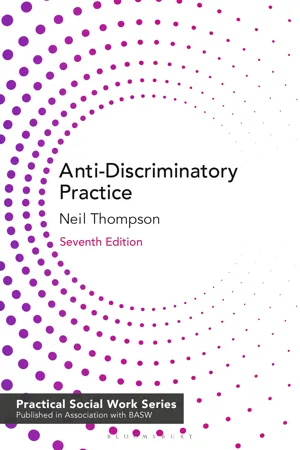
- 232 pages
- English
- ePUB (mobile friendly)
- Available on iOS & Android
eBook - ePub
About this book
Information
CHAPTER 1
EQUALITY, DIVERSITY AND SOCIAL JUSTICE
CHAPTER OVERVIEW
In this chapter you will:
• Learn more about the key concept of discrimination and why it is so important in social work and related professional disciplines
• Start to understand how anti-discriminatory practice is underpinned by a commitment to equality, diversity and social justice
• Appreciate the importance of moving away from medicalized approaches to personal and social problems which oversimplify complex issues
Introduction
People are different, in the sense that the population in general and social work’s clientele in particular are characterized by immense diversity. Where there is difference, there is the potential for unfair discrimination, in so far as it creates the potential for particular individuals or groups to be identified as ‘different’ and therefore treated less favourably (I will return to this point below). Anti-discriminatory practice is, or should be, more than simply tackling those well-publicized areas of discrimination and oppression that attract considerable attention - it should encompass all forms of discrimination that can be seen to lead to disadvantage, disempowerment and oppression. That is, we need to adopt a holistic approach to discrimination and related matters, rather than a narrow or partial one.
The managing diversity approach (as highlighted in the early days in the work of Kandola and Fullerton, 1998) is one of the models we will explore in more detail below. However, for now, we can note that it can be criticized for being too individualistic and paying inadequate attention to cultural and structural levels of discrimination and is therefore not sufficiently holistic. However, one of its strong points is that it acknowledges:
• the significance of diversity (that is, variety across individuals and groups of people) and the need to affirm and value it;
• that differences between people can and should be seen as assets to be appreciated, rather than problems to be solved; and
• that difference can so easily lead to unfair discrimination.
Diversity is therefore an important concept that we need to take seriously but, as we shall see, we need to make sure that it is not oversimplified or seen as an easy answer (Malik, 2008; 2014). As von Mende and Houlihan (2007) comment:
The persistence of discrimination, inequalities and power differences suggests that the rhetoric of diversity can be criticized as sanitizing difference, and simply masking or attenuating underlying conflicts (Netmetz and Christensen, 1996).
(von Mende and Houlihan, 2007, p. 217)
Race, ethnicity, gender, class, sexual identity, age, language, disability, religion and so on are just some of the dimensions of diversity and therefore just some of the ways in which difference can so easily be translated into discrimination and oppression as a result of the various power-related processes to be discussed in later chapters. However, these are not only dimensions of diversity in a sociological sense, they are also dimensions of experience in a psychological sense. That is, each sociologically defined area of discrimination can be analysed and explored as a discrete aspect of the social world. However, to each individual person, these are not discrete areas, they are very real intertwined dimensions of experience, part and parcel of our lived experience (what is often referred to by the French technical term, ‘le vécu’) and have to be understood as such. That is, the reality for each person is having to deal with a complex set of interactions across perhaps several of these different areas, rather than simply encountering discrete, unconnected areas to be considered in isolation.
This means, in effect, that we must consider each situation in its own right, rather than apply general principles in an oversimplified and dogmatic way. We must not make assumptions about ‘men’ or ‘black people’ or ‘disabled people’ or ‘Welsh speakers’, but rather consider each unique individual in the context of what we know of the influences and implications of these broad categories and their sociological significance – to link the social level of context to the personal level of unique individual experience (Thompson, 2018b) rather than fall into one of the two disastrous, but none the less common traps of either (i) treating unique individuals as if they were simply non-specific examples of social categories; or (ii) failing to recognize that individuals are unique partly because of the diversity of the social context that plays a part in shaping all of our experiences.
It should be clear, then, that discrimination is not a simple matter and that it would therefore be both inappropriate and dangerous to adopt an oversimplified approach to the challenges of developing anti-discriminatory practice. We therefore need to develop quite a sophisticated level of understanding of the complexities involved, rather than look for simple solutions that can be both woefully inadequate (in terms of doing justice to the intricacies of what we are dealing with) and potentially disastrous (in terms of making the situation worse). It is for this reason that the first two chapters of the book concentrate on developing a platform for building up a theoretical understanding of discrimination and related concepts so that we are able to begin to face the demands of anti-discriminatory practice in an informed way.
In the first of these two scene-setting chapters we explore some key concepts before, in Chapter 2, examining a particular theoretical framework that can pull together our understanding of discrimination. Understandably, we begin our discussion of the key concepts with discrimination itself. We then move on to look at the three very important concepts that form the subtitle of the book, namely equality, diversity and social justice. This leads into a consideration of oppression, the negative and unwelcome results of discrimination (Mullaly and West, 2017). Finally, we examine the need to avoid ‘medicalization’, a process of pathologizing individuals that has highly discriminatory – and thus oppressive – consequences.
Voice of experience 1.1
I used to work in a team that thought that all the talk about discrimination was a load of nonsense. It was hard work trying to get them to see that so many of the situations they were dealing with involved one or more forms of discrimination. We had to discuss it at several team meetings before people could see just how important it was. Viv, manager of a hospital social work team
What is discrimination?
The literal meaning of the term ‘to discriminate’ is to identify a difference. As such it is not necessarily a negative term. For example, being able to discriminate between safe food and harmful poison is clearly a good thing. However, when the term is used in a legal, moral or political sense (as in this book), it is generally used to refer to unfair discrimination. That is, it refers to the process (or set of processes) through which (i) a difference is identified; and (ii) that difference is used as the basis of unfair treatment. To use the technical term, a person or group ‘suffers a detriment’ (that is, experiences a disadvantage) because they are identified as ‘different’ (in terms of gender, race/ethnicity, sexual identity and so on) in ways that are deemed to be socially and/or politically significant.
Instead of differences between people being seen as positive (as per the diversity approach mentioned above and to be discussed more fully below), they become the basis of unfair discrimination, a basis for disadvantaging certain groups of people. This discrimination then becomes a source of oppression. It is through the process of identifying some people as ‘different’ that they receive inhuman or degrading treatment (a key part of the definition of oppression we will explore more fully in Chapter 2) and are thus oppressed.
While this is a satisfactory basic definition of discrimination, what it does not do is indicate the important role of power that is involved. Anyone can discriminate against anyone else. However, where the impact will be of major proportions is in those cases where relatively powerful groups will be in a position to discriminate systematically (whether directly or indirectly) against those in relatively powerless groups. Such power can arise because of personal circumstances or characteristics, cultural norms or structural position (in Chapter 2 we will look at these dimensions of power in more detail). This is where established patterns of discrimination have become ingrained in social practices – racism, sexism, ageism and so on, and are not simply examples of individual preference or prejudice.
Discrimination is therefore a sociological and political phenomenon as well as a psychological one, hence the need for a holistic approach, as mentioned earlier.
Practice focus 1.1
Lynne was a psychology graduate who had recently begun her social work training on a postgraduate course. From the sociology component of the course, she began to appreciate how narrow her perspective had previously been. She began to realize that, although her psychological perspective was very important and valuable, she also needed to understand the wider sociological issues that were so relevant to the life experiences of social work clients, relationships between social workers and clients and so on. She had begun to develop the ‘sociological imagination’.
Note that, in referring to power, I was very careful to use the term ‘relatively’. This is because, as we shall see below, there has been a tendency to oversimplify issues of power and reduce them to a simple dichotomy of two groups in society: the powerful and the powerless. Power is a much more complex phenomenon than this, and so it is important, at this early stage in our discussions, not to fall into the trap of presenting it too simply (see Thompson, 2007, for a fuller explanation of the significance of power and the complexities associated with it).
A key point to note is that the model of anti-discriminatory practice presented here is not a narrow one that ignores important wider sociopolitical concerns. In the early days of putting discrimination and oppression on the social work agenda some people conceptualized anti-discriminatory practice in narrow, legalistic terms - a very different approach from the one that I am adopting, and advocating, here. An authentic anti-discriminatory practice is far more than a commitment to legal compliance.
Good practice is anti-discriminatory practice
Social workers can be seen as mediators between their clients and the wider state apparatus and social order. This position of ‘mediator’ is a crucial one, as it means that social workers are in a pivotal position in terms of the relationship between the state and its citizens.
The relationship is a double-edged one, consisting of elements of care and control. It is also double-edged in the sense that it can lead to either potential empowerment or potential oppression – social work interventions can help or hinder, empower or oppress. Which aspect is to the fore, which element or tendency is reinforced depends largely on the actions of the social...
Table of contents
- Cover
- Series-page
- Titlepage
- Dedication
- Brif Contents
- Contents
- List of figures
- Preface
- Acknowledgements
- The author
- Introduction
- 1 Equality, diversity and social justice
- 2 The theory base
- 3 Gender and sexism
- 4 Ethnicity and racism
- 5 Ageism and alienation
- 6 Disability and social handicap
- 7 Sexual identity and heterosexism
- 8 Faith and religious discrimination
- 9 Conclusion
- References
- Index
- eCopyright
Trusted by 375,005 students
Access to over 1.5 million titles for a fair monthly price.
Study more efficiently using our study tools.
Frequently asked questions
Yes, you can cancel anytime from the Subscription tab in your account settings on the Perlego website. Your subscription will stay active until the end of your current billing period. Learn how to cancel your subscription
No, books cannot be downloaded as external files, such as PDFs, for use outside of Perlego. However, you can download books within the Perlego app for offline reading on mobile or tablet. Learn how to download books offline
Perlego offers two plans: Essential and Complete
- Essential is ideal for learners and professionals who enjoy exploring a wide range of subjects. Access the Essential Library with 800,000+ trusted titles and best-sellers across business, personal growth, and the humanities. Includes unlimited reading time and Standard Read Aloud voice.
- Complete: Perfect for advanced learners and researchers needing full, unrestricted access. Unlock 1.5M+ books across hundreds of subjects, including academic and specialized titles. The Complete Plan also includes advanced features like Premium Read Aloud and Research Assistant.
We are an online textbook subscription service, where you can get access to an entire online library for less than the price of a single book per month. With over 1.5 million books across 990+ topics, we’ve got you covered! Learn about our mission
Look out for the read-aloud symbol on your next book to see if you can listen to it. The read-aloud tool reads text aloud for you, highlighting the text as it is being read. You can pause it, speed it up and slow it down. Learn more about Read Aloud
Yes! You can use the Perlego app on both iOS and Android devices to read anytime, anywhere — even offline. Perfect for commutes or when you’re on the go.
Please note we cannot support devices running on iOS 13 and Android 7 or earlier. Learn more about using the app
Please note we cannot support devices running on iOS 13 and Android 7 or earlier. Learn more about using the app
Yes, you can access Anti-Discriminatory Practice by Neil Thompson in PDF and/or ePUB format, as well as other popular books in Education & Education General. We have over 1.5 million books available in our catalogue for you to explore.