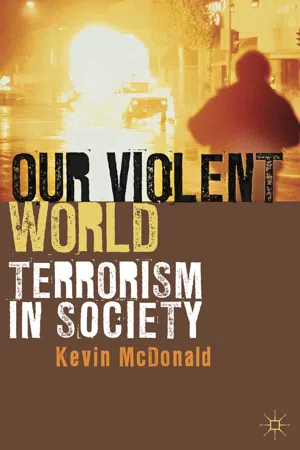
What can the analysis of violence and terror tell us about the modern world? Why is violence often used to achieve religious, cultural or political goals? Can we understand the search for the extreme that increasingly shapes violence today?
From 1960s student movements to today's global jihad, this text explores the factors and debates shaping violence and terrorism in our contemporary society. Each chapter confronts examples of disturbing terrorist acts and events of mass violence from recent history and uses these to examine key questions, theories and concepts surrounding this sensitive and controversial topic. In particular, the book:
- Identifies core tools for the analysis of public violence
- Explores the processes that mutate social movements into violent groups
- Describes the cultural, embodied, experiential and imagined dimensions of violence
- Highlights different periods and varying forms of terrorist violence
- Examines the role of globalization, media, technology and the visual in violence and terror today.
Our Violent World shows how the social sciences can contribute to an understanding of violence and responses to terror, as well as the construction of a social world less dominated by fear of the other. It is a must-read for students and citizens.
- 224 pages
- English
- ePUB (mobile friendly)
- Available on iOS & Android
eBook - ePub
About this book
Information
1
The Return of Violence
The early years of the twenty-first century have been shaped by an accelerating shift of social life from national societies to a new global reality. The signs are widespread: the increasing integration of economic and financial systems, population flows and mobility, a new awareness of shared realities, from global films to fashions, the pervasive presence of the Internet and the increasing mediatization of social life, new global risks such as climate change, epidemics and global crime. This new reality brings with it extraordinary possibilities, opening up exchanges, industries and creative flows, evident in the rise of social media and a cluster of practices around new forms of social connection. But at the same time, increased levels of complexity and integration bring with them new types of vulnerability and global shock waves, evident in the reverberations and amplifications of financial crises, flows of disease or the dislocations associated with climate change.
Among the most significant of these changes are transformations in forms of social and political violence, the kinds of violence recently described by the philosopher Charles Taylor as ‘categorial’, directed towards people whom the protagonists do not personally know (2011). Often such violence is contrasted to the violence that takes place within personal relationships, but as we will see as this book develops, this distinction is not as clear as it once may have been. The chapters that follow attempt to explore a context that has become increasingly evident, as violence that once appeared to be ‘contained’ by key dimensions of modern society is now much more fluid, increasingly part of the flows making up a global world (Urry 2005). But such violence is not a ‘thing’ or an object. It is a form of agency, an embodied relationship and human experience. As such, it is a critical lens through which to explore wider transformations of social life. On the other hand, to separate violence from such transformations profoundly limits our capacity to understand, and respond to, one of the most urgent questions shaping the twenty-first century.
The Surveillance Society
Most of us are aware of changing forms or potentials of violence through the growth of security and surveillance (Crelinsten 2009). Some developments are obvious, such as airport security. Others are less so, such as passport tracking systems, internment camps, control orders and detention without trial, or erosion of the distinction between immigration policy and security policy (Connolly 2005: 54). Some receive extensive debate in the press and social media, while other developments are less discussed. Over recent years, for example, states as different as Iran, Saudi Arabia, Israel and the United States have been engaged in the construction of thousands of kilometres of walls along national borders, a development that the political scientist Wendy Brown calls ‘walling’, something she contends is driven by ‘waning sovereignty’ (2010). Global military expenditure, which had declined in the years following the end of the Cold War in 1989, expanded rapidly over the first decade of the new century, increasing by some 49 per cent to reach US$1.53 trillion in 2009 (Stockholm International Peace Research Institute 2011). New types of public surveillance involve pervasive but ambiguous categories of ‘pre-crime’ as public policy seeks to identify groups and individuals ‘at risk’ of committing criminal acts (Zedner 2007). The changing role of the criminal justice system has become evident in the relentless increase in the number of people imprisoned in the world, a figure that reached some 10.65 million in 2009 (Walmsley 2010).
Political theorists in particular have been aware of the ways these transformations ‘resonate’, mutually amplifying each other (Connolly 2005: 54). Brian Massumi (2007) argues that we are witnessing the emergence of a new type of governance in complex societies, one shaped by a shift from a model of prevention, which operates in an ‘objectively knowable world’, to a model of pre-emption, which involves the attempt to wield power in a world based on uncertainty. Brad Evans (2010) points to the rise of ‘consequentialist ethics’ involved in this development, where forms of moral judgement framed in terms of ‘right’ and ‘wrong’ are becoming redefined as calculations to determine whether a situation is to be judged better or worse as a result of a course of action. These are not minor transformations. The OECD argues that ‘security’ has become a major area of economic activity, a driver of modern economies (OECD 2004), while the sociologist David Lyon traces the contours of a surveillance society increasingly based on digital technologies (Lyon 2004). The political philosopher William Connolly argues that this new social and political model involves an increasing mobilization of the population against ‘unspecified enemies’ (2005: 54).
The Blurring of War and Peace
One way to think about this transformation is in terms of a changing relationship between peace and war. The historical sociologist Charles Tilly argues that the emergence of modern societies from the seventeenth century to the Second World War saw violence moving in two directions: increasingly deadly inter-state confrontations and increasingly peaceful domestic societies, evident in the disarming of populations and the rise of peaceful forms of protest and conflict (Tilly 2002, 2003). This constituted an increasingly clear separation between zones of war and zones of peace, a separation that for the philosopher Immanuel Kant constituted the very basis of modern society (Kleingold 2006: ix). This account of the birth of modernity locates violence beyond the borders of increasingly peaceful societies, and to a significant extent has established itself as a structure of thought preventing any significant exploration of the violence at the heart of modern societies, in particular the violence present in colonial expansion, or in the extent of atrocities and extreme violence undertaken by the colonizers in the process of decolonization (Bennett 2011). Within this modern self-understanding, the capacity for extreme violence has always been associated with ‘the other’, with modern society, by definition, understood as being inherently peaceful.
The securitization we have referred to above signals two related transformations: the separation between war and peace is becoming less and less clear, while the state’s monopoly of violence is becoming less and less certain. Rather than war being an external event, the cultural geographer Nigel Thrift argues that contemporary, globalizing societies have entered an ‘era of permanent and pervasive war’ (2011: 11), with war no longer understood as taking place beyond borders, but across all areas of social life. This shift seems particularly evident when we look at urban design, where we encounter not simply the increasing integration of blast proofing and other defensive systems into buildings, but the actual militarization of urban space, evident in particular in contemporary military theory where older conceptions of ‘battlefield’ are giving way to new models of ‘battle space’ (see Graham 2012) where the space of warfare becomes ‘coterminus ... with the space of civil society itself’ (Dillon and Reid 2009: 128). This pattern is evident in the extent that conceptions of urban security developed in a warzone such as post-2003 Baghdad have established themselves as paradigms for policing and security in the cities of North American and Europe (Graham 2010).
War, from this perspective, rather than being an activity beyond the borders of modern society, becomes instead a lens with which to conceive of the core organization of such societies. The rise of war as a lens to frame social life has been particularly evident in military theory. William Lind, for example, argues that the world has entered an age of ‘fourth generation war’, characterized by the loss of the state’s monopoly over the exercise of war. Today states find themselves at war with non-state opponents, wars he argues that states are losing. Writing in a respected journal, Lind argues ‘invasion by immigration can be at least as dangerous as invasion by a state army’ (2004: 14). We do not need to embrace this type of argument to recognize that the twenty-first century has been shaped by an awareness of a new vulnerability.
The New Vulnerability
The period immediately following the collapse of the Berlin Wall in 1989 was one of celebration of the end of the dangers of the Cold War. This sense of liberation played an important role in the way journalists, politicians and scholars enthusiastically embraced the concept of globalization in the 1990s, installing it as a new ‘master narrative’ to make sense of transformations reshaping the world, closely linked with the development of what the sociologist Manuel Castells (2001) called the ‘internet galaxy’. Observers of this transformation highlighted the potential of new global social movements (McDonald 2006), non-governmental organizations (Tarrow 2005), and celebrated the potential of what increasingly came to be called ‘global civil society’ (Keane 2003).
But there was also a darker narrative. One influential example was articulated by the American journalist Robert Kaplan (1994), who argued that the end of the Cold War would bring with it an unconstrained expansion of violent conflicts exacerbated by population explosion, and economic and environmental collapse, which would set in motion massive flows of refugees and the proliferation of ‘small wars’. This was not a ‘global civil society’, but a world threatened by chaos, violence and, ultimately, the collapse of the system of international regulation that had been forged by the major powers in the years following the Second World War. Kaplan was not alone. He was joined by the political scientist Samuel Huntington (1996), who argued that the political conflicts of the Cold War period, shaped by opposing ideologies, were giving way to a new type of conflict that he described as a ‘clash of civilizations’.
The terms of this debate were transformed by the attacks of 11 September 2001. The attacks not only killed some 3,000 people, they also set in motion a series of shockwaves that are still resonating over a decade later. The United States became militarily engaged in Afghanistan, in what would become the longest war in its history. The attacks highlighted the vulnerability of complex systems, when a small group of people armed with box cutters and fake bombs could succeed in bringing down structures at the centre of world financial and symbolic power (Urry 2005). The period that followed underlined that these attacks were not an isolated event, but signalled the emergence of a movement that manifested its existence essentially through violence. In October 2002, bomb blasts in the nightclub district in Bali, Indonesia, killed over 200 people (Koschade 2006). In March 2004, four massive explosions ripped apart crowded commuter trains in Madrid, Spain, killing 191 people and injuring over 1,000 (Moghadam 2006). In that same month in the United Kingdom a group of men were arrested in possession of some 600 kilograms of ammonium nitrate, later being convicted of planning to blow up a shopping centre and a night club (Scolino and Grey 2006). The following year, in July 2005, four young men blew themselves up on London’s transport system, killing themselves and 52 others, while two weeks later another group attempted a similar action (Pape 2006). In Germany in 2006, suitcases filled with powerful explosives failed to detonate on high-speed trains (Khosrokhavar 2009), while in Australia in 2008 a group of men were convicted under anti-terrorism legislation of planning mass murder at a sporting event (Lentini 2008). In November of that same year a group of ten young men launched an attack on Mumbai, India’s financial capital, using high-powered rifles and explosives, killing some 170 people over three days (Shekhar 2009). In May 2010, a man attempted to detonate an incendiary bomb in a car parked near New York’s Times Square on a busy Saturday night (United States Attorney, New York Southern District New York 2010). In the United Kingdom in February 2012 a group of men pleaded guilty to planning to detonate a bomb at the London Stock Exchange (Burns and Cowell 2012), while in March of that year in the French town of Toulouse a young man went on a killing spree, murdering seven people, including three children and their father at a Jewish school, reportedly filming the killings and claiming links to international networks (Ramadan 2012). Throughout the decade, recurring attempts were made to destroy planes on transatlantic flights, with attempts to conceal explosives in shoes, underwear and soft-drink bottles, leading to worldwide security protocols reminding travellers of the potential for catastrophic violence each time they board an aeroplane (Khosrokhavar 2009).
At the same time, other cases of extreme violence emerged. In Norway in 2011 a young man exploded a car bomb in the capital, Oslo, after which he drove to a youth political camp being held on an island, killing 77 people in total with high-powered weapons, claiming to be fighting against cultural diversity and to having been inspired by the World Trade Center attacks as well as the 1995 destruction of the Federal Building in Oklahoma City in the United States, an attack which killed 169 people (Kellner 2012). In November 2009 a major in the US Army killed 13 people and wounded 30 on an army base after a period of email contact with a self-styled radical cleric (Chen 2010). In 2007 a student at an American university killed 32 people and wounded another 25 on campus, posting a video to the Internet likening himself to Jesus Christ and condemning his victims before committing suicide (Kao 2012).
These attacks all exhibit a desire to kill as many people as possible. Many were associated with communications technologies, from final testaments posted to the Internet to the perpetrators filming themselves in the act of killing. None of them involved the types of telephone warnings often associated with attacks undertaken by armed groups such as the Irish Republican Army in the 1970s (Clutterbuck 2004). In several cases the people involved in these attacks appeared to be acting alone, or connected with friends in loose networks. What was striking was the lack of the kinds of organization that had characterized violence from earlier periods. In several cases the mental health of those involved became an issue that courts were asked to determine, given the extremity of the violence (Pantucci 2011).
Understanding what is at stake in such violence has emerged as a major challenge confronting complex societies in the twenty-first century. As we might expect, analyses diverge widely. One approach remains framed by the modern self-understanding introduced above, regarding such violence as essentially a product of ‘the other’, and has been a major factor reshaping immigration and refugee policy across a range of countries (Tumlin 2004). An influential current within this approach looks to religion as a source of violence, an analysis popularized by Huntington’s (1996) ‘clash of civilization’ thesis. Other approaches emphasize that this violence needs to be understood fundamentally in political terms, primarily as a response to Western hegemony and global power (Jackson 2005). We will explore these different approaches in the chapters that follow. But what does seem clear is that in the current context of securitization, potential and actual violence merge, with violence becoming a potential that threatens one of the core dimensions of modern societies – the fact that we live with strangers. It is this shift that means that violence and the vulnerability increasingly associated with it have become a central question for the social sciences, Sociology in particular.
Sociology and Violence
To what extent can a discipline like Sociology help us understand transformations in contemporary violence? To begin to explore this we need to recognize that the relationship between Sociology and violence has been problematic. The origins of what would become Sociology lie in the years leading up to the First World War when, as Hans Joas (2003) observes, war and violence were major issues within the culture of the time. This is reflected in Sociology’s founders. Max Weber, the German thinker central to the emergence of the discipline, attached great importance to the historical emergence of armies and the culture of discipline they produced. He argued that war played a critical role in the historical shift from tribal and community-based forms of social organization to states and their societies. The key process for Weber was not the development of technologies of warfare, but the creation of military discipline (Weber 2005: 261; van Krieken 1990). This was critical to the emergence and eventual triumph of state-based societies. For Weber, military discipline gives birth to all discipline; it was at the centre of the emergence and eventual triumph of state-organized societies.
Writing in France, Weber’s contemporary Emile Durkheim was equally alert to the question of violence. However, Durkheim associated violence with what he considered to be primitive and impulsive. He regarded violence as disruptive, affirming that it was through ritual and, ultimately, social organization that its disruptive power was contained. Durkheim did not approach violence within a theory of the rationalization of societies, but instead framed it in terms of ‘effervescence’, of assemblies of dancing people generating enthusiasm as ‘electricity’, one where ‘natural violence’ is concentrated and passions unleashed, social norms smashed, and in the process a state of ‘exaltation’ reached where people find themselves possessed and led by what is experienced as an external power. For Durkheim, this power is society at work, but experienced as the world of the sacred (Durkheim
2001: 163–4). Within Durkheim’s work we encounter an account where violence is a path that allows the actor to access a world of the extraordinary. Hans Joas (2003) underlines just how important this conception of generative violence was in the period leading up to the Great War of 1914–18. He points to it in the work of thinkers such as the Marxist intellectual Georges Sorel (1908 / 1999) in France, who argued that workers discover their authentic selves through violence; or in the work of sociologists such as Sombart and Simmel in Germany, who considered violence and war as a means through which societies could free themselves from the deadening routines of modern industrial society. Violence, from this perspective, is understood as a source of regeneration of life (Joas 2003).
Sociology largely constituted itself as a discipline in the period following the Second World War, when there was no consensus regarding these diverging approaches to violence. Indeed, at the time, sociologists largely embraced a model of social change understood as modernization, where violence was either understood as part of an older, dying world, or as an expression of deviance, the failure of the society to integrate certain of its members into the dominant non-violent values and practices. Sociology in a sense had ‘moved on’, embracing the optimism of the post-1945 period (Joas 2003: 31). Where it did emerge, violence was regarded as a sign of failure or the absence of the social, certainly not its product. Violence became relegated to Sociology’s margins (Joas 2003 ; Malešević 2010), which understood itself as discipline setting out to understand the development of modern, peaceful, societies (Ray 2011). Indeed, in the second half of the twentieth century, the most significant theorizations of violence developed by sociologists, such as Norbert Elias’ (1976, 1983) theory of civilizing process, an analysis of self-restraint and of the historical shift from a warrior to a court society, set out to explain what was considered by post-war sociologists as axiomatic, namely the long-term decline in the levels and significance of violence accompanying the birth of modern society (Ray 2011). Elias developed a theory of the decline of violence based on European history, proposing a transition from a more violent Middle Ages to more peaceful court societies. The core of this transition was the development of absolutist monarchies that disarmed the nobility and came to exercise a monopoly over violence. Elias argues that, to the extent that nobles could no longer rely upon violence to achieve their objectives, a culture of courtesy gradually de...
Table of contents
- Cover
- Title Page
- Copyright
- Contents
- Preface and Acknowledgements
- 1. The Return of Violence
- 2. Terrorism
- 3. Competing Perspectives
- 4. Terror, Violence and the Student Movement
- 5. Violence and Nation: The Palestinian Experience
- 6. Apocalypse Now?
- 7. Violence, the Mask and the Extreme
- 8. The Martyr
- 9. Mediatizing Violence: From Snapshots to the Internet
- 10. Conclusion: Beyond Terror?
- Bibliography
- Index
Trusted by 375,005 students
Access to over 1.5 million titles for a fair monthly price.
Study more efficiently using our study tools.
Frequently asked questions
Yes, you can cancel anytime from the Subscription tab in your account settings on the Perlego website. Your subscription will stay active until the end of your current billing period. Learn how to cancel your subscription
No, books cannot be downloaded as external files, such as PDFs, for use outside of Perlego. However, you can download books within the Perlego app for offline reading on mobile or tablet. Learn how to download books offline
Perlego offers two plans: Essential and Complete
- Essential is ideal for learners and professionals who enjoy exploring a wide range of subjects. Access the Essential Library with 800,000+ trusted titles and best-sellers across business, personal growth, and the humanities. Includes unlimited reading time and Standard Read Aloud voice.
- Complete: Perfect for advanced learners and researchers needing full, unrestricted access. Unlock 1.5M+ books across hundreds of subjects, including academic and specialized titles. The Complete Plan also includes advanced features like Premium Read Aloud and Research Assistant.
We are an online textbook subscription service, where you can get access to an entire online library for less than the price of a single book per month. With over 1.5 million books across 990+ topics, we’ve got you covered! Learn about our mission
Look out for the read-aloud symbol on your next book to see if you can listen to it. The read-aloud tool reads text aloud for you, highlighting the text as it is being read. You can pause it, speed it up and slow it down. Learn more about Read Aloud
Yes! You can use the Perlego app on both iOS and Android devices to read anytime, anywhere — even offline. Perfect for commutes or when you’re on the go.
Please note we cannot support devices running on iOS 13 and Android 7 or earlier. Learn more about using the app
Please note we cannot support devices running on iOS 13 and Android 7 or earlier. Learn more about using the app
Yes, you can access Our Violent World by Kevin McDonald in PDF and/or ePUB format, as well as other popular books in Social Sciences & Criminology. We have over 1.5 million books available in our catalogue for you to explore.