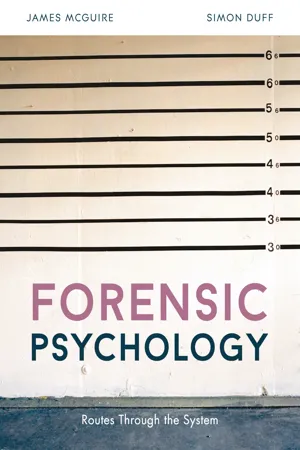
This brand new textbook provides a complete course in forensic psychology, covering the criminal justice system, law and legislation, and treatments and outcomes for offenders. It offers rigorous coverage of the major topics: from theoretical concepts and research methods to explaining criminal acts and patterns of crime. The authors, both from leading institutions and well-known in the field, guide readers through the interlocking systems of criminal justice, mental health and social service provision, providing a deeper critical appreciation of what motivates crime and how criminal behaviour can be understood, assessed and treated. This text will be core reading for upper level undergraduates and postgraduates studying forensic psychology, either as a module on a BSc Psychology degree or on an MSc for trainee Forensic Psychologists. It will also be ideal for early career practitioners.
- 464 pages
- English
- ePUB (mobile friendly)
- Available on iOS & Android
eBook - ePub
About this book
Information
Part 1
Forensic Psychology: Concepts, Methods and Theory
Forensic psychology is a broad and developing field which can have a significant impact not only on offenders but also on those who have been affected by their offences in the past or who might be at risk in the future. Part 1 introduces ideas that are central to the role of forensic psychologists when working with offenders and with colleagues in the criminal justice system.
1Forensic Psychology
Chapter 1 introduces the book’s main themes. As well as describing the field of forensic psychology and what forensic psychologists do, it looks at the subject’s relationship with the law and with other areas of psychology.
2Defining and Surveying Crime
Chapter 2 examines how crimes are defined, and what it means to break the criminal law. In discussing how often crimes occur and who commits them, it is important to understand and to interpret crime statistics from different sources.
3Researching Crime: Methods and Correlates
Chapter 3 turns to ways of analysing and understanding crime, and the different research methods used in studying the subject. It also reviews some key general findings about offenders and offending behaviour, and introduces the concept of ‘risk factors’.
4Explaining Crime: Theories and Perspectives
Chapter 4 surveys the principal theories of crime and the relationship between psychology and
criminology. What are the causes of crime? Criminological theory often focuses on different ‘levels of explanation’, from society as a whole down to the internal processes of the individual offender.
5Understanding Criminal Acts and Actors
Chapter 5 focuses on factors that may influence the individual offender and that may potentially contribute to delinquency, antisocial or criminal behaviour, and ultimately to a criminal lifestyle. Can we learn anything about individuals’ internal processes, both cognitive and emotional, as they respond to actual situations?
1
Forensic Psychology
This opening chapter is designed to provide an overview of the subject matter of the book as a whole. We introduce the field of forensic psychology in broad terms and give some background and history. We describe the kinds of work forensic psychologists do, and some of the issues that arise within the discipline. We discuss its relation both to the law and to other areas of psychology. To provide an organising principle for the areas covered in the rest of the book, we outline the journey we will make through the legal and penal system.
Chapter objectives

Not so very long ago, few people had heard of ‘forensic psychology’ and it would have been difficult to find someone who described his or her job using that title. The picture of what the role entails appears to have become implanted in the popular imagination through television dramas, most notably the popular and highly acclaimed 1990s series Cracker, in which a somewhat eccentric (not to say maverick) psychologist enables the police to solve serious crimes, and to track down dangerous people using what at times appear to be ingenious insights. Perhaps the image has been sustained, and even amplified, by real-life media reports, which tap into the public’s seemingly limitless fascination with violent and sexual crimes.
This depiction contains and perhaps also perpetuates a series of misconceptions. First, even today relatively few people who call themselves forensic psychologists work alongside the police, and those who do are unlikely to employ anything resembling the approach used by Eddie Fitzgerald, Cracker’s central character. The majority, in fact, work at what might be called the opposite end of the law-and-order process, in prisons and other penal agencies. Second, while bizarre crimes involv-ing extreme violence certainly do occur, media reports are likely to leave an exaggerated impression of how often that happens, and of the psychological make-up of the majority of people who commit them. Third, the recent portrayal of forensic psychology in fictional form suggests that it is a novel invention, a recent newcomer that struggles to convey an accurate picture of what it is about. By contrast, in some respects forensic psychology is actually well over one hundred years old. It can justifiably be described as the earliest form of applied psychology to make an appearance on what we might call the ‘public stage’.
This book adopts a particular approach in describing and explaining what forensic psychology comprises, what its various practitioners do, and what it can contribute to society. Given that this field is intrinsically bound up with the workings of the law, and particularly law relating to criminal behaviour and to mental health, we will follow the journey an imaginary individual might take through the intricate labyrinth of decision processes that the modern law has become. This moves in successive stages from the entry point (typically, being arrested by the police) to the exit (for example, being discharged from prison). But there are many possible entries and exits, and the transit from one to the other is by no means a uniform or linear process. The choice points and alternative pathways that might be taken along the way are numerous and multifaceted. Note that, while in the real world miscarriages of justice are known to occur, the metaphorical ‘journey’ examined in this book assumes that the hypothetical person we are imagining is indeed guilty of the offences that lead to her or him being prosecuted, convicted and sentenced.
The book’s subtitle, Routes Through the System, indicates the tasks that forensic psychologists might perform in this sequence of events. Perhaps not surprisingly, the process can be confusing for everyone involved. We acknowledge from the outset that the application of psychology to law can be a subject of considerable complexity, but our prime objective is to guide those new to the area on a familiarisation trip, by the end of which, to paraphrase an old joke, you may still be confused, but at a higher level.
To get us started, this opening chapter will attempt a series of key tasks:
»The first is to consider what we mean by the term ‘forensic psychology’, and to examine the ways in which various competing definitions overlap or differ from one another. This will involve us in identifying some of the ways in which, despite large contrasts between the two fields, the law already employs numerous constructs that are essentially psychological. This first task will also lead us to examine the kinds of behaviour with which forensic psychologists are most frequently concerned – which are usually forms of personal violence – and how their work is informed by psychology as a whole, is connected to other forms of applied psychology, and is linked to the work of adjoining professions.
»The second task is to place these concerns in the broader context of how psychology itself emerged as a scientific undertaking. This entails outlining some important historical developments and landmarks; and then focusing in more detail on the background, origins and history of the field of forensic psychology. We will look briefly at the work of some of the discipline’s earliest practitioners, which can illuminate some of its present concerns; and we will consider possible future directions in which forensic psychology may develop.
»Finally, we will look more briefly at how past trends converged into the principal ways in which most forensic psychologists work today; at how the process of ‘professionalisation’ within the discipline has taken shape; and at the organisational groups that have been established to support that process.
Along the way, we will also make reference to and provide a preliminary sketch of the range of work that forensic psychologists do. In the remaining chapters of the book, we will then address, expand upon and illustrate that work in the context in which it occurs.
Professional pre-qualification postgraduate training in forensic psychology has expanded enormously over the last twenty years or so, with respect not only to the numbers of people pursuing it but also to its coverage and ‘knowledge base’. Such training has become established at a number of universities in the United King-dom; in Germany, Sweden, Spain, Italy and many other parts of Europe; in the United States (where it had its origins), Canada, Australia and New Zealand; and in Japan, India and many other ‘non-Western’ countries. Hence it can be described as a genuinely international phenomenon, although as yet its practitioner groupings tend to be national or regional rather than worldwide in scope.
Forensic psychology: in search of a definition
Let us start from basics and consider the meanings of the constituent words. The English word ‘psychology’ contains two parts, both originally from the Greek language. Etymologists suggest that the word psyche (ψυχή) originally meant ‘breath’, but was metaphorically transmuted into the idea of ‘spirit’ or ‘soul’, and thereby ‘mind’. Logos (λόγος), from the same root as the word ‘lexicon’, originally meant simply ‘to speak’, or to give an account of something. The origins of the word ‘forensic’, on the other hand, are Latin and have the same roots as the word forum, referring to a ‘market’: a place of talk and discussion, hence the debating cham-ber we call the courtroom. Does this etymology inform our concepts of what these activities consist of today? In a sense it does. Forensic psychologists collect information on individuals’ behaviour and on their reported experience, and apply that information to questions that arise in the relationship between the individual and the operation of the law. What they find may then be taken into the arena of public discussion that is the courtroom. By extension, however, this could nowadays be any one of several types of legal hearing, such as a children’s panel, a family court, a criminal court, an appellate court, a hearing of the Parole Board, or a Mental Health Tribunal. In Chapters 14 to 17 we will examine the specifics of what happens in several of these loci.
An indispensable and powerful element to inject into this, however, is the adoption of a scientific approach. Contemporary forensic psychology is not based on guess-work or intuition – well, not more than minimally – but on the systematic process of asking questions, gathering evidence, testing hypotheses and constructing theories that has come to be known as the scientific method. Hunches may at times have their place, but we should always recognise them as such and check their usefulness and value. Some people have questioned the entitlement of psychology, our ‘parent discipline’, to be accorded scientific status. This book is firmly grounded in the position that the questions asked by forensic psychology can be addressed, and most appropriately are addressed, through the application of scientific thinking.
What has been offered so far by way of definition? Seeking to find clarity on this issue is not aided by the fact that as yet there is no firm consensus even amongst specialists in the subject; and the available definitions, while sharing some common elements, also have important differences of emphasis.
Thus most authors writing in this area recognise the difficulty of defining forensic psychology with a precision that can demar-cate it from other, related types of applied psychology. Davies (2008) used the metaphor of forensic psychology as a ‘broad church’ with two aisles, criminological and legal psychology. Howitt (2015) recognises a similar distinction by including both the words ‘forensic’ and ‘criminal’ in the title of his textbook. McGuire (2004a) suggested that there are three subdisciplines – legal psychology, criminological psychology, and forensic psychology – with partially distinctive but overlapping meanings, and represented this in a Venn diagram with three intersecting circles. What is now called ‘forensic psychology’ is fairly nuanced as there are subtle d...
Table of contents
- Cover
- Half Title
- Title Page
- Copyright
- Dedication
- Contents
- Editor Title
- List of Figures
- List of Tables
- ‘Focus On …’ Boxes
- ‘Where Do You Stand?’ Boxes
- Preface
- Tour of the Book
- Online Resources
- About the Authors
- Authors’ Acknowledgements
- Publisher’s Acknowledgements
- Abbreviations
- Part 1 Forensic Psychology: Concepts, Methods and Theory
- Part 2 Offences: Types of Crime and Influencing Factors
- Part 3 Offences: Investigation, Evidence and Sentencing
- Part 4 Forensic Psychology: Activities, Standards and Skills
- Glossary
- Bibliography
- Author Index
- Subject Index
Trusted by 375,005 students
Access to over 1.5 million titles for a fair monthly price.
Study more efficiently using our study tools.
Frequently asked questions
Yes, you can cancel anytime from the Subscription tab in your account settings on the Perlego website. Your subscription will stay active until the end of your current billing period. Learn how to cancel your subscription
No, books cannot be downloaded as external files, such as PDFs, for use outside of Perlego. However, you can download books within the Perlego app for offline reading on mobile or tablet. Learn how to download books offline
We are an online textbook subscription service, where you can get access to an entire online library for less than the price of a single book per month. With over 1.5 million books across 990+ topics, we’ve got you covered! Learn about our mission
Look out for the read-aloud symbol on your next book to see if you can listen to it. The read-aloud tool reads text aloud for you, highlighting the text as it is being read. You can pause it, speed it up and slow it down. Learn more about Read Aloud
Yes! You can use the Perlego app on both iOS and Android devices to read anytime, anywhere — even offline. Perfect for commutes or when you’re on the go.
Please note we cannot support devices running on iOS 13 and Android 7 or earlier. Learn more about using the app
Please note we cannot support devices running on iOS 13 and Android 7 or earlier. Learn more about using the app
Yes, you can access Forensic Psychology by James McGuire, Simon Duff in PDF and/or ePUB format, as well as other popular books in Psychology & Forensic Psychology. We have over 1.5 million books available in our catalogue for you to explore.