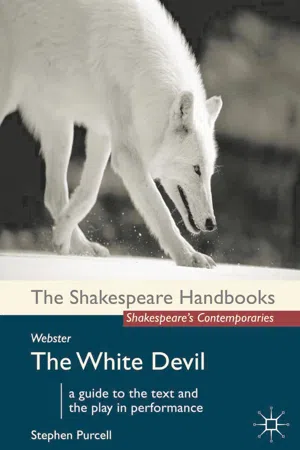
The White Devil is one of the great plays of the Jacobean era. In this vibrant Handbook, Stephen Purcell offers an in-depth, performance-focused exploration of John Webster's thrilling, unsettling and darkly comic tragedy. The Handbook includes:
- a scene-by-scene commentary on the play as it unfolds on stage
- an overview of the play's cultural context
- excerpts from historical sources
- case studies of four modern productions, featuring interviews with directors
- an outline of key critical writings on the play, from the seventeenth century through to today.
- 184 pages
- English
- ePUB (mobile friendly)
- Available on iOS & Android
eBook - ePub
Webster: The White Devil
About this book
Information
1 The Text and First Performances
The White Devil was first performed in early 1612, and published shortly afterwards. Its first performances were at the open-air Red Bull playhouse, where it was not particularly well-received: Webster’s own preface to the play notes that it was ‘acted in so dull a time of winter, presented in so open and black a theatre, that it wanted … a full and understanding auditory’. The Red Bull had a reputation for being ‘mostly frequented by citizens, and the meaner sort of people’ (James Wright, Historia Histrionica, 1699), and its audience was often characterized as being uncomprehending: Thomas Tomkis’s 1615 play Albumazar, for example, depicts a rustic clown who regularly frequents the Red Bull, ‘where I learn all the words I speak and understand not’ (Gurr 2004: 301, 274). Indeed, Webster described his Red Bull audience as ‘ignorant asses’ and ‘uncapable’, and in 1617, his writing was satirized by Henry Fitzjeffrey for being ‘so obscure, / That none shall understand him’. Webster was, at least, satisfied with the actors’ performances, which he commends in the play’s Epilogue – drawing particular attention to the ‘well approved industry’ of the actor Richard Perkins, who probably played Flamineo.
It is important to remember the layout of the theatre and the conditions of staging when reading the play. Webster himself described the experience of theatregoing in his ‘Character of an Excellent Actor’ in 1615: ‘Sit in a full theatre, and you will think you see so many lines drawn from the circumference of so many ears, whiles the actor is the centre.’ The White Devil would have been performed upon a stage which jutted out into a probably very rowdy audience of standing playgoers, surrounded on at least three sides (if not four) by audience members seated in raised galleries. Soliloquies would thus have been dynamic interactions with a live audience, and scenes like the trial (III.ii) must have involved some very real public display and crowd-stirring rhetoric. Though the play is set in sixteenth-century Italy, there must have been a sense in its original performances that it was also grounded in the here-and-now of Jacobean London; indeed, Webster makes several anachronistic references to such specifically English subjects as the showman ‘Wolner of England’ (III.iii.51), the nearby Bishopsgate ‘Artillery Yard’ (V.vi.160) and even the Tower of London (V.vi.266). Interestingly, it is nearly always Flamineo who makes these local and topical references, which implies that Webster allows him a significantly closer relationship with the audience than he does the other characters.
The printed play’s title page describes it as ‘The Tragedy of Paulo Giordano Orsini, Duke of Brachiano, with The Life and Death of Vittoria Corombona the famous Venetian Curtizan’. The play was based on the true story of Vittoria Accoramboni, who had been murdered 27 years previously in Padua, Italy, and she is probably the ‘white devil’ of the title: the phrase was understood at the time as referring to a seemingly innocent person who is in fact guilty, and Vittoria is the only one of the two characters referred to on the title page who fits this description (Bracciano’s guilt is fairly evident). She is also the character who is likened by the other characters to a ‘devil’ most frequently throughout the play. A sermon by the clergyman Thomas Adams, also written in 1612, hints at a possible alternative meaning, however. Titled ‘The White Devil, or, The Hypocrite Uncased’, Adams’s sermon focuses on Christ’s betrayer Judas, whom he describes as ‘a devil … black within and full of rancour, but white without, and skinned over with hypocrisy’ (1612: 221). ‘Of all earthly creatures’, he continues,
a wicked man is the worst, of all men a wicked Christian, of all Christians a wicked professor, of all professors a wicked hypocrite, of all hypocrites a wicked, warped, wretched Judas. Take the extraction or quintessence of all corrupted men, and you have a Judas. This then is a Judas: a man degenerate, a Christian corrupted, a professor putrefied, a gilded hypocrite, a white-skinned devil. (1612: 234)
Of all the characters in Webster’s play, the description is perhaps most applicable to Monticelso, a corrupted Christian who, in his role as Pope, would have been encased in white.
The first edition of the text was printed in 1612 by Nicholas Okes, and was probably supervised by Webster himself. Modern editions of the play are largely faithful to this, though most modernize the spelling, add punctuation, and insert act and scene divisions (the scenes are not numbered in the first Quarto). A notable feature of the original text is the large number of non-speaking characters: four are named (Little Jaques the Moor, Christophero, Guid-Antonio and Fernese), though they are never referenced directly in the dialogue itself, while many more are unnamed servants and attendants of various sorts. Martin Wiggins suggests that ‘the crowdedness of the play works to enhance our sense of the urban society in which it is set’, and argues that ‘the spectacular scenes help to define by contrast the quietness and simplicity of others with which they are juxtaposed’ (1997: 459, 461). Flamineo’s ‘final descent down the greasy pole of power’, for example, is emphasized in Act V by the number of courtiers who have been advanced ahead of him (1997: 460).
The play was reprinted three times over the century following its first publication, in 1631, in 1665 and in 1672. Each of these editions testifies to the play’s continued performance: the 1631 text records performances by Queen Henrietta’s company at the Phoenix, Drury Lane, while the 1665 text states that the play was being acted ‘at this present (by His now Majesties) at the Theatre Royal’. The 1672 edition confirms that it was still in performance by the King’s Company at Bridges Street. Samuel Pepys saw a performance of The White Devil in October 1661, describing it as ‘a very poor play’ and complaining that ‘I never had so little pleasure in a play in my life’. Oddly, this did not prevent him from returning to the production two days later, when it pleased him ‘worse than it did the other day’ (ii, 114, 116). The following century, Nahum Tate (who famously adapted King Lear to give it a happy ending) published a ‘much simplified and sentimentalized version’ of The White Devil in 1707 (Holdsworth 1984: 14). In this adaptation, titled Injur’d Love: or, The Cruel Husband, Isabella became a much more central character, Bracciano an unambiguous villain and Vittoria innocent. It was, according to its title page, ‘designed to be acted at the Theatre Royal’, but it was probably never performed. There are no further recorded performances of the play until the twentieth century.
2 Commentary: the Play in Performance
This chapter of the book offers a scene-by-scene, moment-by-moment commentary on the play as it might work in performance. Sometimes it explores the perspective of an audience seeing it for the first time, considering the play’s surprises, release of information and creation of tension. It frequently examines the play’s scope for choices by actors and directors, and weighs up potential staging or interpretative problems. It traces the development and interplay of the play’s themes. Elsewhere, it draws attention to some of the ways in which the play might have worked for its original audience. The commentary is designed to be read alongside the play itself, and is based on the Revels Student edition of the text (1996), edited by John Russell Brown.
Act I
Act I, scene i
The play opens in medias res, or ‘in the middle of things’ – the audience are required to work out where the scene is set and who its characters are, as they listen to a conversation about something that has evidently only just happened. To an audience new to the play, Lodovico may at first appear to be its protagonist, and although he takes a much less prominent role later on, he dominates its first scene. This scene also sets up some of the key thematic concerns of the play: in particular, the corruption and inequalities of the law, characters’ loss of control over their own destinies and, through Lodovico’s opening image of Fortune as a ‘whore’ (l. 4), the mistrust of female sexuality. The overcharged emotion and the very high number of shared lines imply that this short scene is probably played at a fast pace.
1 Lodovico responds to the news of his banishment. It may be that all three characters enter together mid-conversation, having heard the sentence offstage; alternatively, Antonelli and Gasparo may present Lodovico with a written decree. Either way, this opening constructs the stage as an unofficial space on the periphery of the court, and sets the tone for much of what will follow: this play will focus on the actions of figures lurking in the shadows of official political culture.
2–12 Lodovico is bitter and sarcastic. This important exchange states the twin factors which motivate many of the characters’ actions throughout the play: ‘Courtly reward, / And punishment’ (ll. 3–4). Lodovico curses the goddess Fortuna, the turning of whose wheel was thought, in classical philosophy, to bring about reversals in mortals’ luck. His description of her as a ‘whore’ is the first of many examples of misogynistic language (l. 4). Images of wolves and destructive thunder will also recur at important moments (see, for example, the moments when specific characters are likened to wolves at III.ii.180, IV.ii.91–2, V.i.154–5, and V.iv.35–6, and the moments in which thunder is used as a metaphor for violent destruction at II.i.63–73, III.iii.128, IV.i.22, and V.vi.276). In blaming his misfortune on ‘great enemies’ rather than his own actions, Lodovico evokes a world in which morality is secondary to power (l. 7).
12–30 Antonelli and Gasparo speak almost as one voice, completing one another’s sentences (indeed, some productions combine these roles into a single speaker). They link Lodovico’s self-destructive violence with potent images of disease and death (mummia was made from mummified flesh). Lodovico’s observation that they are like two buckets coming up and down from a well suggests one way in which this exchange might be staged, as well as mocking their observations as mechanical.
30–3 We learn the reasons for Lodovico’s banishment: he has committed several murders which Gasparo describes as ‘Bloody and full of horror’ (l. 32). Lodovico’s perspective, however, is entirely different: to him, the crimes were ‘flea-bitings’ (l. 32). Such an amoral view of murder, and the refusal to recognize its human consequences, recurs throughout the play in a variety of different characters.
34–53 Gasparo and Antonelli’s speeches here are full of sententiae: moral observations, often metaphorical, and frequently in the form of rhyming couplets. Their full lines and careful rhymes contrast with Lodovico’s much less patterned, more aggressive and unpredictable speech. The idea that ‘affliction / Expresseth virtue’ (ll. 49–50) was a convention of classical tragedy: though suffering, the hero would achieve ennoblement (see ‘Jacobean tragedy’, Chapter 3). Does the play prove Antonelli correct? Lodovico responds by suggesting that his friends’ sententiae are ‘painted comforts’ – superficial and false – and promises violent reprisal for his enemies (ll. 51–3).
38–44 These few lines introduce the play’s protagonists. Webster’s audience would probably have recognized these names, having heard the scandalous story of the characters’ real-life counterparts (see ‘Webster’s sources’ and ‘The Murder of the Signora Accaramboni’, Chapter 3). Lodovico’s complaint that Vittoria failed to solicit a pardon for him from the Duke suggests a motivation for his actions later in the play, but his expectation that it might have happened further implies a world riddled with political corruption. Lodovico’s reasons for expecting that Vittoria should have spoken up in his defence are not made clear, and are up to the actor to decide.
53–8 Line 53 is split between three speeches, emphasizing the violence of the exchange. Lodovico’s sarcasm becomes apparent once again: but is he referring to his enemies or to his friends as the ‘hangmen’ with whom he has ‘grown familiar’ (ll. 55–6)? The force of this passage may be stronger if Antonelli and Gasparo were indeed implicated in handing Lodovico his sentence at start of the scene.
58–63 Antonelli promises to attempt to persuade those in power to repeal Lodovico’s banishment. Lines 55 and 61 could be read as indications that Lodovico gives him some money to aid him in this purpose, though the second of these may be referring simply to Lodovico’s cynical closing couplet.
60 s.d. The scene is brought to an abrupt close by a ‘sennet’ – a trumpet fanfare accompanying a ceremonial entrance. We know that this scene has taken place on the periphery of power, a halfway-space between the political centre of Rome and the space to which Lodovico will be banished; perhaps the characters now flee as the stage is about to be filled with representatives of authority. The moment represents the sudden intrusion of official power into a scene, and play, which has heretofore been concerned only with the unofficial and the marginal.
Act I, scene ii
Having introduced some of the play’s central themes, Webster now plunges straight into the plot. This scene is long and dynamic, introducing the three main characters and depicting the events which will provoke the rest of the action. It begins as comedy, moves into intrigue, and then culminates in full-scale confrontation. The scene’s alternation of images of luxury with images of decay sets an uncomfortable tone which links the pleasures of the flesh with connotations of hell.
Particularly striking in this scene is the extent to which Flamineo (Vittoria’s brother and Bracciano’s secretary) commands the stage. Vittoria and Bracciano are, nominally at least, the central characters; the play’s original title page billed it as ‘The Tragedy of Paolo Giordano Orsini, Duke of Brachiano, With The Life and Death of Vittoria Corombona the famous Venetian Curtizan’. Here, however, Bracciano seems merely to respond to events rather than to instigate them, while Vittoria remains curiously unavailable to the audience, speaking very little until the second half of the scene. Flamineo, on the other hand, is onstage throughout, speaks at length, drives the action, and strikes up a rapport with the audience which will last until the final scene.
1–2 This economical opening establishes a great deal in just two lines. Bracciano’s words indicate that it is night-time, while Vittoria’s response makes it clear to the audience that he is a Duke, that he is her guest, and that she is also of an elevated social status. The arrangement of bodies on the stage is likely to show, furthermore, that she and Camillo are husband and wife, and that the Duke is well attended. Having heard about ‘The Duke of Bracciano’ in the previous scene, the audience are likely to identify this Duke immediately as that very man. They know already that he ‘seeks to prostitute / The honour of Vittoria Corombona’ (I.i.41–2), and indeed it rapidly becomes apparent that the female character onstage is also that woman.
Camillo and Vittoria depart the scene almost straight away, but not before some further hints at the likely success of Bracciano’s designs: Vittoria’s completion of his half-line of iambic pentameter and her echoing of his word ‘best’ imply some level of sympathy between the two. It is significant that it is she, not Camillo, who bids the Duke good night. Flamineo tells Bracciano that Vittoria was unable to take her eyes off him (l. 12): it may be that the audience see some evidence of this attraction as she leaves the stage.
3–9 The first exchange between Bracciano and Flamineo establishes an urgent tone and suggests the complicity between them: a single line of iambic pentameter is split between them three ways (l. 3). Note that Bracciano presents his situation as ‘quite lost’: the scene will go on to show him to be both out of control and morally ‘lost’, and indeed he will repeat the word towards the end (l. 208). There may also be an echo of Lodovico, who opened the previous scene by declaring himself ‘banished’. Flamineo’s whispered promise confirms Vittoria’s identity to the audience, and introduces an element of secrecy to the scene.
10–16 With the departure of the attendants and their torches, the stage suddenly empties and darkens: clearly the conversation between Flamineo and Bracciano is not one which should be overheard. Flamineo tells us that he has ‘dealt already’ with Vittoria’s chambermaid Zanche (l. 13); much later in the play, we will learn that Flamineo and Zanche have had a sexual relationship. The actor playing Flamineo might hint at this later development in his delivery of these lines.
17–25 With nobody left onstage to overhear them, Flamineo assures his employer that ‘We may now talk freely’ (l. 17). It is significant that both characters here abandon the formality of verse for casual prose. Webster’s audience would have recognized verse as the heightened language spoken by tragic figures of elevated social status, while this sort of prose would have been closer to the ‘unofficial’ language of ordinary people (including the audience themselves). Flamineo is dropping the outward appearance of nobility and aligning himself with the audience.
His cynicism and misogyny in this passage would also have identified him to the Jacobean audience as a recognizable dramatic type: the malcontent (see ‘Jacobean tragedy’, Chapter 3). Like many of Shakespeare’s malcontents – Iago in Othello, Edmund in King Lear, Richard III – Flamineo is a bitter, sarcastic outsider, who acts only for his own advancement and takes a perverse enjoyment in manipulating his unsuspecting victims. Like Shakespeare’s malcontents, too, he is the figure in the play...
Table of contents
- Cover
- Halftitle
- Title Page
- Copyright
- Dedication
- Contents
- Series Editors’ Preface
- Preface
- 1. The Text and First Performances
- 2. Commentary: the Play in Performance
- 3. Intellectual and Cultural Context
- 4. Key Performances and Productions
- 5. Critical Assessments
- Further Reading
- Index
Trusted by 375,005 students
Access to over 1.5 million titles for a fair monthly price.
Study more efficiently using our study tools.
Frequently asked questions
Yes, you can cancel anytime from the Subscription tab in your account settings on the Perlego website. Your subscription will stay active until the end of your current billing period. Learn how to cancel your subscription
No, books cannot be downloaded as external files, such as PDFs, for use outside of Perlego. However, you can download books within the Perlego app for offline reading on mobile or tablet. Learn how to download books offline
Perlego offers two plans: Essential and Complete
- Essential is ideal for learners and professionals who enjoy exploring a wide range of subjects. Access the Essential Library with 800,000+ trusted titles and best-sellers across business, personal growth, and the humanities. Includes unlimited reading time and Standard Read Aloud voice.
- Complete: Perfect for advanced learners and researchers needing full, unrestricted access. Unlock 1.5M+ books across hundreds of subjects, including academic and specialized titles. The Complete Plan also includes advanced features like Premium Read Aloud and Research Assistant.
We are an online textbook subscription service, where you can get access to an entire online library for less than the price of a single book per month. With over 1.5 million books across 990+ topics, we’ve got you covered! Learn about our mission
Look out for the read-aloud symbol on your next book to see if you can listen to it. The read-aloud tool reads text aloud for you, highlighting the text as it is being read. You can pause it, speed it up and slow it down. Learn more about Read Aloud
Yes! You can use the Perlego app on both iOS and Android devices to read anytime, anywhere — even offline. Perfect for commutes or when you’re on the go.
Please note we cannot support devices running on iOS 13 and Android 7 or earlier. Learn more about using the app
Please note we cannot support devices running on iOS 13 and Android 7 or earlier. Learn more about using the app
Yes, you can access Webster: The White Devil by Stephen Purcell in PDF and/or ePUB format, as well as other popular books in Literature & Modern Literary Criticism. We have over 1.5 million books available in our catalogue for you to explore.