- 216 pages
- English
- ePUB (mobile friendly)
- Available on iOS & Android
eBook - ePub
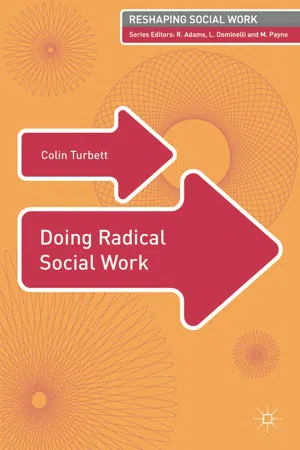
Doing Radical Social Work
About this book
This is the first book to provide social workers with an applicable model for radical practice. Through examining the current state of social work in the UK and looking at the radical approaches that have developed over the years, this book explores some of the opportunities that exist for a radical social work.
Information
chapter 1
The Context of Social Work
Overview
The reader looking for a history might want a book written by a historian rather than a social worker. However, the practice-based content that follows in other chapters has to be located in a context created by historical development, and so belongs in these pages. The short historical account (including the place of social work) given in this chapter is one consistent with the radical explanations that underpin this book. It assumes some agreement with the premise that social work service users find themselves the victims of oppression and disadvantage because of their place in society, rather than through individual failing – a theme that will be looked at in more detail in ensuing chapters. This historical overview is followed by some elaboration on the social problems that are generally found in contemporary society in the western democracies, and one of their most extreme negative manifestations – riots and social disorder. There are, of course, alternatives to economies based, like that in the UK, on neoliberal ideas, and these will be touched on very briefly at the end of the chapter.
The state and its functions
Before embarking on a brief history of social work’s place in the welfare states that characterize western democracies, a basic sociological view of the state and its function is required to provide context for this and following chapters of the book. The notion of ‘state’ has been much contested over time and a clear agreed definition is difficult to locate beyond the dictionary description of ‘an organized community under one government’ (Concise Oxford English Dictionary).
In his classic 1969 book, Ralph Miliband suggests that there are two principal accounts of the state in advanced capitalist countries: a post-war pluralist-democratic account and the Marxist view. Miliband describes as post-war pluralist-democratic view as one that suggests that the state is there to reconcile the differences between competing groups and to ensure the needs of all are served. This view assumes that there are no dominant groups in society but that competition between them (for instance, between those who own and manage businesses and those who work in them who might be organized in trade unions) ensures that power is shared and, ultimately, balanced; where elites exist, they lack the cohesion required to dominate and the job of the state and its organs is to ensure that this is the case. Thus, the judges who interpret the law, top-ranking military leaders and civil servants, and others who enjoy executive positions within the state and who are not subject to election are neutral and are there to serve all people, regardless of status and economic influence. This consensual view is the one shared by politicians from the social-democratic parties (such as the UK Labour Party) through to mainstream right-wing parties (such as the UK Conservative Party). This is also the view propagated through school-based education, the mainstream media and the view probably accepted by most of the population.
The Marxist view derives from the nineteenth-century accounts of Marx and Engels, who characterized the state in general terms as an essentially (if not literally) coercive force designed to serve the financial interests of the bourgeoisie (the class who owned the means of production and, therefore, the class with the greatest interest in capitalism). Together with their political descendants (including Lenin and Gramsci), Marx and Engels marshalled considerable evidence (although Marx never completed a full study of the state) to show how pre-capitalist societies had a lesser need for the sophisticated state required by capitalism: here, workers had to be educated, looked after to a certain degree and also kept in line by the law, police and judiciary. All this, they calculated, was based on capitalism’s requirements as a mode of production, and they traced the historical development of the modern state as a requisite element (see, for example, Engels work The Origin of the Family, Private Property and the State (1978 [1884])). As Lenin writes: ‘as the social division into classes arose and took firm root, as class society arose, the state also arose and took firm root’ (Lenin 1919: 10). Although in outward appearance free and, in its advanced capitalist form, proclaiming universal suffrage, the state’s purpose was to hold the lower classes in subjection (ibid.: 18). Ultimately, the inner-contradictions of capitalism – including the falling rate of profit, its tendency to go into periodic crisis, and the rising power of workers – would lead to its demise and a revolutionary transition to socialism and communism.
Critics will be quick to point out that Marx’s predictions might seem to have been ill-founded, as capitalism has shown resilience that has kept it buoyant through the nineteenth and twentieth centuries despite recurring crisis and world war. Its defenders (who are diverse in their interpretations of Marx) would argue, in return, that his basic premise remains in place and that his descendants have explained such matters. In particular, they would point to Gramsci’s notion of hegemony as demonstrating how consciousness is engendered by the class that dominates capitalist society so that even those who are most oppressed will, in most circumstances (but importantly not all circumstances), support the status quo (Forgacs 1999). Gramsci’s ideas are important for social workers: they demonstrate how personal and private lives are determined by the wider forces in a society that has been socially constructed by the dominant class. They also point to how real freedom to think, act and live might be achieved through the combined efforts of ‘intellectuals’ able to see through capitalism’s trickery (such as suitably equipped social workers) and workers fighting for justice (Garrett 2013). Gramsci updated Marx’s thesis, that workers would inevitably combine together to launch a full frontal assault on capitalism (as happened, for instance, in Russia in 1917), to one where class warfare (‘the war of manouevre’) evolved into a more subtle ‘war of position’ (Hay 2006). Although these are simplifications of Marxist theory and academic debates surrounding Marx’s work and his predictions continue to rage, all that follows in this and later chapters is based on an acceptance of a basic Marxist view of the state, updated by thinkers and idealists such as Gramsci. The Marxist view highlights the state’s contradictory nature in advanced capitalist society: the fact that it both oppresses as well as provides benefits for the workers whose labour creates the wealth enjoyed by the ruling classes. Such contradictions are known in Marxist terms as the dialectic, and its use in understanding the place of the welfare state in capitalist society and its meaning in regard to the exercise of discretion will also be explored further later in the book.
The emergence, rise and decline of the welfare state
UK and US social services provision has its most direct origins in the charitable organizations of the nineteenth century that were concerned with the worst effects of the industrial revolution on the poor and disadvantaged and their children (Rogowski 2010: 30–6). However, the growth of personal social services as part of broader welfare provision should be seen in the context of the development of the welfare state after World War II. This view sees social work’s fortunes as indivisibly linked with that of the welfare state. A discussion about the origins and the rise and fall of the post-war welfare state is therefore an essential starting point for locating the place of social services in contemporary society within the western democracies.
In the late eighteenth century, the wages of rural agricultural labourers in a number of English counties were so low that a top-up was provided from public funds – the ‘Speenhamland System’ – not unlike the tax credit system of recent times. This, however, proved a disincentive for the movement of people from the countryside to the newly industrializing cities (Esping-Anderson 1990). The result of such tensions was the Poor Law of 1834: effectively, this punished the poor who found themselves without work, by means of the workhouse system characterized in the novels of Charles Dickens. In the House of Lords, Lord Brougham defended the Poor Law in the following words:
| “ | the only evils against which society should protect people are those the prudent man could not forsee; he could forsee old age, illness, unemployment: against those he should make provision. On the other hand society might help him in the case of accidents and violent diseases. (Hammond and Hammond 1920: 218–19) |
His arguments, whilst couched in the values of nineteenth-century England, sound remarkably similar to those neoliberal politicians and theorists of our own time in their characterization of the deserving and undeserving poor: debates surrounding welfare provision have changed little in the past 180 years!
The rise of capitalism in the nineteenth century, with wealth dependent on industrial production and the exploitation of worldwide raw materials and eventual markets for produced goods, rested on the commodification of labour. Previously, wealth had typically been created by independent producers, but these now became property-less wage earners. The difference between what those in work could earn and what they and their dependants were considered to require in society at any given time has been the business of welfare, as have the needs of those who, for whatever reason, are workless.
The welfare state that emerged in the wake of World War II ran counter to the nineteenth-century approaches to welfare reform that are echoed today. Whilst some of its roots can be traced back to early twentieth-century Liberal reforms, such as the introduction in the UK of National Insurance and Old Age Pensions, its breadth and scale were the result of powerful social forces and competing ideologies in the wake of the defeat of Nazi Germany in 1945. Total war had necessarily involved total commitment on the part of most of the population. This was achieved through the promise of a brighter future for the ordinary masses who had suffered in the economic depression of the 1930s. In the words of Beveridge, whose 1942 report laid down the foundations of the welfare state: an end to the ‘five giant evils that barred the way to progress – Want, Disease, Ignorance, Squalor and Idleness’ (Bruce 1961: 72). This would be achieved through a welfare state based on a ‘general principal that governments both could and should assume responsibility for maintaining a decent minimum standard of life for all citizens’ (Mishra 1990: 18). Wealth redistribution, full employment and the decommodification of labour were fundamental to this design (Bruce 1961), leading to Keynesian economic policies that continued until the crisis caused by rising oil prices in the early 1970s. Soviet communism, which represented a much more revolutionary vision of wealth redistribution and whose influence had spread through the Red Army’s advance to encompass most of Eastern Europe by 1945, was held in check by formal agreement between the allies over post-war spheres of influence (Hobsbawm 1995). This, however, would not necessarily ensure social peace unless a new social order, at least on the surface, could be delivered at home, and this was to be the function of the welfare state (Clarke et al. 2001).
Whilst welfare state provision characterized post-war capitalist western Europe, with the UK as the model, bringing with it some state enforced wealth redistribution, this trend did not spread across the Atlantic to the United States. Here, the economy was vibrant and war damage almost non-existent. The onset of the Cold War following World War II ensured that US governments could characterize the welfare state as an alien communist concept and hold it at bay (Pauwels 2002). The post-war settlement in Europe was as much about a temporary resolution of the competing ideologies of capitalism and socialism/communism as it was about military might and conquest. The creation of welfare states and their subsequent fortunes rested on the outcome of that competition. As we shall see, the economic crisis of the 1970s gave impetus to a revival of neoliberal policies; so, too, did the collapse of the Soviet bloc in 1989–90. This meant the victory, as far as the neoliberals were concerned, of anti-collectivist ideas over the collectivist ideas represented by Soviet communism and the main bulwark against their spread: the post-war welfare states in Europe (Hobsbawm 1995). There is some irony in this: trade union strength and influence is associated with welfare state development and extension (Glyn 2006; Brady 2009). At the same time, Marxist historians have remarked that the diversion of trade union energy into disputes around the extent of the welfare state has saved capitalism from more revolutionary solutions that might have been sought had it not been in place in the western European democracies (Braverman 1974). This Marxist critique of the welfare state has influenced activists in the trade unions and the political movements of the left in the UK and elsewhere: that the welfare state is, when all is said and done, a means of social control to enable capitalism to work without the class conflict that characterized western societies in the first third of the twentieth century (ibid.). Gough (1979: 44–5), in a UK text aimed at radical social workers that characterizes this position, writes: ‘[the welfare state is] … the use of state power to modify the reproduction of labour power and maintain the non-working population in capitalist societies’. In agitational terms, this theme had, for long, been debated within the socialist movement, with no less a revolutionary than Lenin advising that those who argued against support for such reforms were suffering from an ‘infantile disorder’ (Lenin 1920). Would class conflict, blunted as conditions improved through the birth and growth of the welfare state, now be back on the agenda?
Those on the right of the political spectrum who viewed the birth of these welfare states in 1945 as moments of defeat were back in the ascendancy. Those social democrats who had viewed it in triumphal terms were now in full retreat and, from the 1990s onwards, their efforts were fully concentrated on accepting the main tenets of neoliberalism whilst trying to maintain welfare state provision within the newly-developing marketplaces (Cochrane et al. 2001). Marxists, as we shall see in relation to social work and state welfare provision within the welfare state, would have to rethink their position.
Social work in the welfare state
We now need to turn back to the post-war period in order to locate social work in the narrative of the welfare state. The framework of provision that emerged in the late 1940s in the UK included provision for personal social services. However, these were peripheral to other major changes, such as the creation of the National Health Service (NHS). Provision to ensure the general welfare of children was located in Local Authority Children’s Services, the care of older people and the disabled was located within Local Authority Welfare Departments, and services for learning disability and mental illness were placed under the responsibility of local Medical Officers of Health. Within all three services, a major emphasis was on institutional care, rather than on support within the community. Large areas of provision – including the protection of children; and welfare services for particular groups of the disabled, such as the blind – remained in the voluntary sector, often funded by local authorities. The poor fit of all these services with the giant NHS was, and has remained to this day, a major social policy issue.
By the late 1960s, it had become clear that personal social services had to take a more central position in the still-expanding and developing welfare state. Poverty persisted despite welfare state provision, and the ‘problem family’ emerged as an issue. In the public eye, homelessness and poverty had been exposed as a national scandal by the left-wing director Ken Loach’s 1966 TV Play Cathy Come Home and by a series of child abuse scandals (Ferguson 2008). Social work at that time was described by the social scientist Barbara Wootton as having a ‘lamentable arrogance of the language … in which social workers describe their activities … not generally matched by the work they do … . The pity is they have to write such nonsense about it’ (quoted in Davies 1991: 3). Greater coordination and direction were required to ensure that families in need received appropriate support (Clarke et al. 2001). Improved training to a universal standard was also considered fundamental to an emergent social work profession (Younghusband 1964).
The Seebohm Report (1968) for England and Wales and the Kilbrandon Report (1964) for Scotland led to legislative changes that created Social Services Departments (Social Work Departments, in Scotland) in each local authority which brought all the services together in single agencies and, in many cases, created actual generic social work teams. Looking back fr...
Table of contents
- Cover
- Title
- Copyright
- Contents
- List of Illustrative Material
- Acknowledgements
- List of Abbreviations
- Introduction
- 1 The Context of Social Work
- 2 Radical Theory
- 3 Finding Space for Radical Practice
- 4 Working with Children and Families
- 5 Working with Adults
- 6 Community Social Work in the ‘Big Society’
- 7 Radical Social Work with Individuals and Groups
- 8 Prospects for Radical Practice: Survival in the Front Line
- Appendix: A Manifesto for a Radical Social Work Practice
- Glossary of Keywords
- References
- Index
Trusted by 375,005 students
Access to over 1.5 million titles for a fair monthly price.
Study more efficiently using our study tools.
Frequently asked questions
Yes, you can cancel anytime from the Subscription tab in your account settings on the Perlego website. Your subscription will stay active until the end of your current billing period. Learn how to cancel your subscription
No, books cannot be downloaded as external files, such as PDFs, for use outside of Perlego. However, you can download books within the Perlego app for offline reading on mobile or tablet. Learn how to download books offline
Perlego offers two plans: Essential and Complete
- Essential is ideal for learners and professionals who enjoy exploring a wide range of subjects. Access the Essential Library with 800,000+ trusted titles and best-sellers across business, personal growth, and the humanities. Includes unlimited reading time and Standard Read Aloud voice.
- Complete: Perfect for advanced learners and researchers needing full, unrestricted access. Unlock 1.5M+ books across hundreds of subjects, including academic and specialized titles. The Complete Plan also includes advanced features like Premium Read Aloud and Research Assistant.
We are an online textbook subscription service, where you can get access to an entire online library for less than the price of a single book per month. With over 1.5 million books across 990+ topics, we’ve got you covered! Learn about our mission
Look out for the read-aloud symbol on your next book to see if you can listen to it. The read-aloud tool reads text aloud for you, highlighting the text as it is being read. You can pause it, speed it up and slow it down. Learn more about Read Aloud
Yes! You can use the Perlego app on both iOS and Android devices to read anytime, anywhere — even offline. Perfect for commutes or when you’re on the go.
Please note we cannot support devices running on iOS 13 and Android 7 or earlier. Learn more about using the app
Please note we cannot support devices running on iOS 13 and Android 7 or earlier. Learn more about using the app
Yes, you can access Doing Radical Social Work by Colin Turbett in PDF and/or ePUB format, as well as other popular books in Social Sciences & Social Work. We have over 1.5 million books available in our catalogue for you to explore.