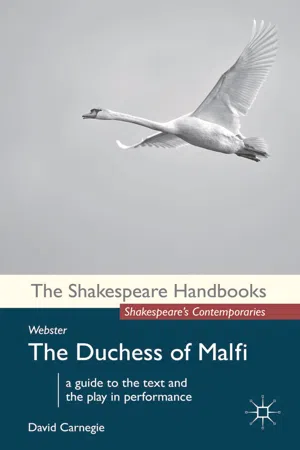
The Duchess of Malfi is generally regarded as John Webster's finest play, a masterpiece of tragic depth and emotional complexity. The conflict between private love and public political behaviour for a passionate but circumscribed woman is as theatrically pertinent now as when first performed. This timely Handbook:
- Examines the play's sources and its cultural context
- Offers a detailed theatrical commentary that aids visualisation of the underlying dynamics and structure of the play in performance, and explores performance possibilities
- Analyses influential productions on stage and screen, from when it was first performed by the actors of Shakespeare's theatre company, the King's Men, to the present day
- Presents key critical debates and assessments of The Duchess of Malfi
- 168 pages
- English
- ePUB (mobile friendly)
- Available on iOS & Android
eBook - ePub
Webster: The Duchess of Malfi
About this book
Information
1 The Text and Early Performances
I will entertain you with what hath happened this week at the bank’s side. The King’s players had a new play, called All is True, representing some principal pieces of the reign of Henry VIII, which was set forth with many extraordinary circumstances of pomp and majesty, even to the matting of the stage; the Knights of the Order, with their Georges and Garters, the guards, with their embroidered coats, and the like: sufficient in truth within a while to make greatness very familiar, if not ridiculous. Now, King Henry making a masque at the Cardinal Wolsey’s house, and certain chambers being shot off at his entry, some of the paper, or other stuff, wherewith one of them was stopped, did light on the thatch, where being thought at first but an idle smoke, and their eyes more attentive to the show, it kindled inwardly, and ran round like a train, consuming within less than an hour the whole house to the very grounds.
This was the fatal period of that virtuous fabric; wherein yet nothing did perish but wood and straw, and a few forsaken cloaks; only one man had his breeches set on fire, that would perhaps have broiled him, if he had not by the benefit of a provident wit put it out with bottle ale.
(Fire at the Globe Theatre, 29 June 1613; letter from Sir Henry Wotton)
THE TRAGEDY OF THE DUCHESS OF MALFI.
As it was presented privately, at the Blackfriars; and publicly at the Globe, by the King’s Majesty’s Servants.
The perfect and exact copy, with divers things printed that the length of the play would not bear in the presentment.
(Title page, Quarto 1, 1623)
The two extracts printed above have much to say about the theatrical conditions of composition, performance, and publication for both John Fletcher and William Shakespeare’s All is True (better known as King Henry VIII), and for John Webster’s The Duchess of Malfi.
Most immediately, the fire that razed the outdoor ‘public’ first Globe theatre to the ground in June 1613 meant that the King’s Men, the theatre company in which Shakespeare had acted until about this time, and for whom he had written most of his plays, had to adapt rapidly to performing only in their much smaller, elite, indoor, ‘private’ theatre, the Blackfriars. The rebuilt theatre, the second Globe, would take a year to complete, so in the meantime the King’s Men may well have been looking for playwrights to provide new plays suited to the somewhat different conditions of the Blackfriars (akin to the new Sam Wannamaker Playhouse at Shakespeare’s Globe in London, a reconstruction based on seventeenth-century plans for an indoor playhouse; it opened in 2014 with a production of The Duchess of Malfi, a fitting quatercentennial memorial).
John Webster would have been a likely candidate, as he was a playwright with experience of writing for the private theatres. He had collaborated with Thomas Dekker about ten years earlier on two plays for the Children of Paul’s, the boy company playing in a small indoor theatre in the precincts of St Paul’s Cathedral. He had also worked for the King’s Men about the same time, revising a boy company play called The Malcontent, by John Marston, for performance by the adult actors at the ‘public’ first Globe in 1604. The revision included an Induction for which he wrote parts specifically for the leading actors in the company: Richard Burbage, Henry Condell, John Lowin, and Will Sly. As we shall see, the first three of these were still in the company, and we know which roles Webster wrote for them when they performed The Duchess of Malfi in late 1613 or 1614. And only the year before the Globe fire Webster had complained in the published edition of his tragedy The White Devil, a major play also set in Italy, about the ‘ignorant asses’ who comprised his audience at the down-market Red Bull playhouse. His carefully and densely constructed plays required the sort of educated audience to be found in the expensive private playhouses.
We know that Webster was already writing The Duchess of Malfi in 1612, but that he did not finish it until well into 1613, or possibly as late as 1614, but we also know that William Ostler, one of the actors, died in late 1614 (see below), so the play was certainly being performed before then, probably first ‘privately, at the Blackfriars’ and only later ‘publicly at the Globe’, following the rebuilding after the fire.
We are fortunate to have several eyewitness reactions to those early performances. Commendatory verses by his fellow playwrights Thomas Middleton and William Rowley for the 1623 publication of the play are, as was required on such occasions, uncritically flattering. Nevertheless, it is instructive to note that Middleton focuses on the centrality of the Duchess, and the pathos of her death:
Write, ‘Duchess’, that will fetch a tear for thee.
For whoe’er saw this duchess live and die,
That could get off under a bleeding eye?
(16–18)
He is responding to performance: whoever ‘saw this duchess’ was moved to tears. Rowley’s attention is also on the Duchess ‘lively bodied in thy play’ (i.e., embodied, enacted), especially her speech in defence of Antonio, ‘her low-rated love’, against ‘Her brothers’ anger’ (27–8). For Rowley, Antonio’s low birth was sufficient explanation for the fatal revenge of the Aragonian brothers, and the Duchess’s speeches in Antonio’s defence impressive in performance.
A third eyewitness was less impressed. Orazio Busino, chaplain to the Venetian embassy in London, was citing the performance in order to report and complain to his masters in Venice how English antagonism to Roman Catholicism carried even into stage representation (see pp. 91–2). For our purposes here, and even allowing for his confusions and mistakes about the play, his recollection of the erection of an altar on stage, the impression made by costume in the transformation of the Cardinal from churchman to warrior, and his appearance ‘in public with a harlot on his knee’ give us useful evidence about specifics he presumably saw at the Blackfriars or Globe.
If it was at the Blackfriars, the private theatre practice of entr’acte music would have reinforced the neoclassical five-act structure of The Duchess of Malfi in which plot time elapses between each act. The play avoids large ‘trumpets and drums’ battle scenes that were so popular with the public theatre audiences, and the surviving music for the Madmen’s song seems intended for the indoor acoustic of the smaller private theatres. The fact that the private theatres, holding only about a sixth the number of audience members as the public theatres, charged up to six times as much for admission guaranteed a wealthy and educated audience such as Webster sought.
Nevertheless, we need to recall the play was also acted ‘publicly at the Globe’. Like most of the company’s plays at this period, it could be and was performed in both spaces. The theatres were alike, we think, in relying on an open platform stage on which the actors and their costumes and props, not scenery, provided the main spectacle. On a stage with certainly two doors, one at each end of the tiring-house facade behind the actors, and probably a central opening for spectacular entries, the choice of door could be significant for meaning. In Act I of The Duchess of Malfi Antonio and Delio observe the successive entrances of Bosola; the Cardinal; Silvio, Castruchio, Julia, Roderigo, and Grisolan; Duke Ferdinand; and then the Cardinal again, with the Duchess, Cariola, and Attendants. If they all enter from the same door, this reinforces Delio’s comment that ‘The presence [chamber] ’gins to fill’ (I.i.82). In other words, everybody is coming in by the same door to the Duchess’s presence chamber, or throne room, and the order of their arrival is the only emphasis: the Duchess arrives last, once everyone else is assembled. However, if everyone else arrives by one (or even both) of the doors to the side, and the Duchess and her entourage arrive by the more ceremonial central entry, her position as presiding in her own presence-chamber is strongly reinforced, especially if all her courtiers kneel to her, and even more so if there is a ‘state’, a dais with a canopied throne upon it, to which she ascends.
The identification of doors must be different by the end of the act, though, since we would not for a moment imagine that the private, secret wooing scene for which the Duchess has sent for Antonio takes place in the public presence chamber. Once we do not need a specific location, the doors, and indeed the space itself, can become neutral, only to become specific again as needed. When Antonio tells Bosola ‘this door you pass not: / I do not hold it fit that you come near / The Duchess’ lodgings’ (II.iii.48–50), we understand that ‘this door’ in the palace allows access to the ‘Duchess’ lodgings’. Sometimes, however, they are merely the theatre’s doors, not part of the fiction at all. When Ferdinand in Rome in III.iii sends Bosola away to get soldiers, the two men probably exit by different doors to indicate going in different directions. But the next moment two Pilgrims enter at Loretto through one of the same two doors; they have simply entered onto the stage and announced they are in front of the shrine. The doors are merely functional this time, though dramatically charged elsewhere. The dramaturgy is powerful because so simple and so fluid.
Covering the central opening, and perhaps even all the doors, were hangings or curtains: ‘place thyself behind the arras’ is the Duchess’s instruction to Cariola at I.i.357, using the arras as a place for secret listening, as do the King and Polonius in Hamlet. The arras was probably drawn aside to ‘discover’ (uncover, reveal) the waxworks in IV.i, and perhaps again to reveal the dead children in IV.ii. At a level higher than the doors and the main stage was an upper acting area known as the gallery or terrace (or because of Romeo and Juliet, often now as the balcony). Webster brings this into play in Act V when Pescara tells the audience he will descend (backstage) to assist the Cardinal; this makes visual sense of Bosola killing Antonio’s servant so that he cannot ‘unbarricade the door / To let in rescue’ (V.v.35–6).
Equally important on a bare stage is costume, as Wotton’s letter about All is True makes clear, especially the rich costumes of nobility and royalty. The Duchess of Malfi deploys visual codes of clothing to which the Jacobean audience was thoroughly attuned. Antonio, an Italian in Italy, appears in the first scene ‘A very formal Frenchman in your habit’ (I.i.3), an outsider in the cut of his clothes and the steward’s chain he wears about his neck. Bosola, another outsider in the play, may wear black throughout, to indicate his nature as a malcontent. The Duchess herself hides her pregnancy by wearing ‘a loose-bodied gown’, described by Bosola to the audience as ‘contrary to our Italian fashion’ (II.i.70–71).
Profession, social standing, and wealth are usually signalled by costume: the Cardinal’s robes (and subsequent ‘sword, helmet, shield, and spurs’ [III.iv.7.3–.41], and ‘soldier’s sash’ seen by Busino), the leather jerkins of the soldiers, the recognizable attire of pilgrims (in long gowns, carrying a walking staff, and wearing the distinctive scallop shell of pilgrimage), Castruchio’s probable lawyer’s gown and coif, the plain woollen clothing of servants alongside the extravagant silk, velvet, and jewels of Ferdinand and the Duchess, all will place the characters immediately in a recognizable context. Departures and arrivals from Malfi, Rome, Milan, and Ancona will be visually evident from cloaks and spurs worn by the men, and ‘safeguards’ worn by the women to protect their dresses when riding.
Even hair and masks are important: Ferdinand comments on the Doctor’s possibly comic eyebrows and beard, while the soldiers who capture the Duchess are vizarded (masked). Ferdinand had warned the Duchess earlier that ‘A visor and a mask’ are not employed ‘for goodness’ (I.i.334–5), and the masque (two versions of the same word) of Madmen reinforces the point. Bosola enters ‘as an old man’ at IV.ii.113.2, and describes himself sequentially as a tomb-maker, a bellman, an executor, a confessor, and an executioner; no doubt in long robes, probably cowled, he appears symbolic, the traditional figure of Time or Death.
Large properties, such as the ‘state’ discussed earlier, or the altar erected for the Cardinal at Loretto are also important. In this play they are particularly spectacular, including the elaborate, apparently waxwork, effigies of the dead Antonio and his children, and the tomb in V.iii. Antonio, as he listens to the final echo of the Duchess, tells Delio, ‘on the sudden, a clear light / Presented me a face folded in sorrow’ (V.iii.44–5). It is possible Webster asked for the same tomb he would have seen the King’s Men use in Middleton’s The Lady’s Tragedy (aka The Second Maiden’s Tragedy) in 1611, in which ‘the tombstone flies open, and a great light appears in the midst of the tomb; his Lady, as went out, standing just before him all in white’ (IV.iv.42.2–.5). We cannot be sure, but the possibility would fit with Webster’s dramaturgy, in which visual spectacle plays an essential role in telling the story.
Small props, often symbolic as much as functional, similarly help orient the audience in its reception of the play’s emotion and meaning. As in, for example, Hamlet or Julius Caesar, a book such as the Cardinal carries when he enters in the final scene signals melancholy; then Webster intensifies the characterization by telling us the content. Antonio sees within the Duchess’s wedding ring ‘a sawcy and ambitious devil’ (I.i.412), and the Duchess’s mirror reflects her signs of age, and even an instrument of death. Her marriage and death are jointly celebrated with gifts of coffin, bell, and strangling cords on stage.
Some props are conventional rather than functional, such as torches and Bosola’s dark lantern: audience and actors shared the available light at both the Blackfriars (candle-lit) and the Globe (daylight), so actors brought lights on stage not to increase the real illumination in the theatre, but to signal darkness in the fictional story, in the drama. This is especially important in considering the dead hand sequence in IV.i; it is very likely Webster intended the audience to recognize Ferdinand’s trick before the Duchess does. She displays sudden shock and horror at the discovery, but the audience has had time to absorb what is happening, and to think about the implications. Such is Webster’s dramatic method.
The playwright also had to structure the play so that the company’s usual complement of ten or so principal actors, six or so ‘hired men’ playing minor roles, and as many boys as needed to play women and children, could manage to play substantially more characters than they had actors; in other words, to double. We assume that the actors of such major roles as Bosola, Ferdinand, the Cardinal, and Antonio did not double, nor the boy actors playing the Duchess, Cariola, and Julia, but a list of actors and roles in the first edition of the play (see below) informs us that the actor of Delio doubled as a Madman, and we can assume that Rodorigo, Grisolan, and one other also doubled as Madmen.
Further investigation of casting and doubling suggests the likelihood that since Castruchio is written out after II.i, he may also have played Malateste and a Madman. With this in mind, we may compare the comedy of Castruchio and the figure of fun Malateste. Silvio disappears from the play after III.iii, cannot double either Malateste or Pescara (since they are also in III.iii), but would have been available to play the Doctor in V.ii. There were probably ten or so principal actors, with four to six ‘hired men’ playing the four Servants and Officers in II.ii and III.ii, as well as Churchmen in III.iv, Guards in III.v, extra Madmen and the Executioners in IV.ii, in addition to various other servants and attendants.
The seven roles for women and boys may have had individual boy actors, although that number could easily be reduced to six by having the Old Lady double as the ‘tedious lady’ of II.i, or even to five by having the actors of the two older children also playing both these ladies. But boys do not seem to have been in short supply for the stage.
The earliest publication of the play, in 1623, includes a remarkable l...
Table of contents
- Cover
- Title Page
- Copyright
- Contents
- Series Editors’ Preface
- Preface
- 1. The Text and Early Performances
- 2. Commentary: The Play in Performance
- 3. Sources and Cultural Context
- 4. Key Productions and Performances
- 5. The Play on Screen
- 6. Critical Assessments
- Further Reading
- Index
Trusted by 375,005 students
Access to over 1.5 million titles for a fair monthly price.
Study more efficiently using our study tools.
Frequently asked questions
Yes, you can cancel anytime from the Subscription tab in your account settings on the Perlego website. Your subscription will stay active until the end of your current billing period. Learn how to cancel your subscription
No, books cannot be downloaded as external files, such as PDFs, for use outside of Perlego. However, you can download books within the Perlego app for offline reading on mobile or tablet. Learn how to download books offline
Perlego offers two plans: Essential and Complete
- Essential is ideal for learners and professionals who enjoy exploring a wide range of subjects. Access the Essential Library with 800,000+ trusted titles and best-sellers across business, personal growth, and the humanities. Includes unlimited reading time and Standard Read Aloud voice.
- Complete: Perfect for advanced learners and researchers needing full, unrestricted access. Unlock 1.5M+ books across hundreds of subjects, including academic and specialized titles. The Complete Plan also includes advanced features like Premium Read Aloud and Research Assistant.
We are an online textbook subscription service, where you can get access to an entire online library for less than the price of a single book per month. With over 1.5 million books across 990+ topics, we’ve got you covered! Learn about our mission
Look out for the read-aloud symbol on your next book to see if you can listen to it. The read-aloud tool reads text aloud for you, highlighting the text as it is being read. You can pause it, speed it up and slow it down. Learn more about Read Aloud
Yes! You can use the Perlego app on both iOS and Android devices to read anytime, anywhere — even offline. Perfect for commutes or when you’re on the go.
Please note we cannot support devices running on iOS 13 and Android 7 or earlier. Learn more about using the app
Please note we cannot support devices running on iOS 13 and Android 7 or earlier. Learn more about using the app
Yes, you can access Webster: The Duchess of Malfi by David Carnegie in PDF and/or ePUB format, as well as other popular books in Literature & Modern Literary Criticism. We have over 1.5 million books available in our catalogue for you to explore.