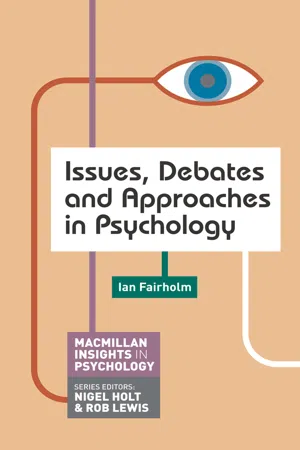
From where did the discipline of psychology originate? How has it evolved since its inception? These questions are at the heart of understanding the key debates that are central to psychology. In this highly approachable introduction, Fairholm tackles the big questions in psychology covering the ever controversial nature vs. nurture debate, free will and determinism, and other important topics. Whatever your level of study, this introduction will guide you through the most important issues that psychologists continue to dispute in the twenty-first century.
This title stands as part of the Insights series edited by Nigel Holt and Rob Lewis, containing well-rounded, quick guides to the cornerstone theories, main topics and theoretical perspectives of their subjects and are useful for pre-undergraduate students looking to find incisive introductions to subjects that they may be considering for undergraduate study or those looking for helpful preparatory reading for undergraduate modules in the subject.
- 232 pages
- English
- ePUB (mobile friendly)
- Available on iOS & Android
eBook - ePub
Issues, Debates and Approaches in Psychology
About this book
Information
Chapter 1
Introduction and Overview

As a general rule, issues, debates and approaches are not considered to be the most exciting aspects of psychology. For some people, issues and debates are purely abstract – the sort of thing that stuffy academics waffle on and argue about ad infinitum, with no hope of resolution and with absolutely no application to the real world.
Similarly, it is sometimes easy to imagine that different approaches in psychology, such as the school of behaviourism originally developed in America by John Watson, and the psychodynamic school that began with Sigmund Freud, are merely distant historical ideas with no direct relevance to students studying the subject today, or for people trying to live and improve their lives in the modern world.
Part of the aim of this book is to question those ideas, to show that issues and debates may have been around for a long time (in some cases for thousands of years) but that they still have direct relevance today, both to students and to the everyday man or woman in the street. The book will also try to establish that, although the various schools of psychology have somewhat distant origins (to varying extents), this does not mean that achieving an understanding of them is a pointless exercise. Far from it in fact: by understanding where psychology came from and how it has developed readers of this book should gain a richer understanding of the subject as a whole and what implications there might be for the future.
But it would be unwise to launch into this endeavour without first doing something that anyone studying a subject with any degree of seriousness should do and that is defining one’s terms.
By psychology I mean the science of mind, brain and behaviour, which is generally accepted to be the modern definition of the word. I will not discuss here what is meant by terms such as ‘mind’ or ‘behaviour’ because that will come up at various points later in the book, but I will use the two terms frequently throughout this introductory section and I will present working definitions of them below.
It is also worth saying that the science of psychology is relatively new – just over 130 years old – but the discussion of psychological issues, such as the mental processes and behaviours of human and non-human animals, goes back as far as the ancient civilisations of Egypt, Greece, China, India and Persia. I mention these ancient civilisations not to indicate just how old interest in psychology is, but rather to stress that psychology and psychological issues have always been popular and ‘hot’ topics – that people have always been fascinated by the mind, have always wanted to understand it and have been driven to solve problems such as mental illness, conflict between different people, dealing with troublesome behaviour, managing and motivating people so as to get the best out of them and so on.
One problem with psychology, which is perhaps less true for many other sciences and academic disciplines, is that we all feel that we are experts at it even if we have never received any formal academic, scientific or vocational training within the subject. It is a relatively uncontroversial thing to state that everyone reading this paragraph will have a ‘mind’ (a collective term for what goes on within our heads – thoughts, perceptions, memories, emotions and so on) and will display some form of behaviour, and that most if not all of the humans and animals you meet today will also have minds (of some form or another – they will demonstrate evidence of having emotions, perceptions and memories of some description) and will also display various forms of behaviour. Therefore we all consider ourselves experts in psychology because we spend pretty much all our time using our own minds and carrying out behaviour, and engaging with the behaviour of others. We may not always do it intentionally but we are constantly collecting data: about our own thoughts and behaviours and about the behaviours of all the people we see and interact with.
In fact, many social psychologists, starting with the influential work of Austrian psychologist Fritz Heider (Heider, 1958), argue that all human beings act like scientists, in that they are constantly forming hypotheses, or attributions, about why people do what they do. This enables us to know what people are like, based on what we attribute their past behaviour to (i.e., what kind of person we think they are), but much more crucially it also enables us to better predict their future behaviour (if this is what they did in the past, then they are likely to do something similar again).
Or at least we might like to think that this is the case – we all like to think that we are good judges of character and that we are able to correctly identify the causes or reasons for a person’s behaviour. However, Heider and other social psychologists have argued that although we act like scientists, by constantly making and revising hypotheses based on behavioural data, we tend not to be very good scientists. For example, we only take in a limited amount of data about a particular person or situation; we tend to focus on some details more than others due to preconceived notions or biases; we do not take written notes in the way that good scientists do so; we are purely reliant on our fallible memory system; and so on. The gist here is that we are all psychologists, because we all seek to know why people and animals carry out the behaviour they do, but the equipment we use to collect data for this purpose – our perceptual and memory systems – is biased due to past experience and can lead to various kinds of errors.
But what does this have to do with issues and debates in psychology? Clearly the problem when we make attributions about our own behaviour and the behaviour of others is that we bring personal biases to the data; for example if we have had a bad experience with someone in the past, then this may colour our future encounters with them; we will always see the worst in their behaviour even when their intentions are genuinely neutral or positive. Under circumstances like these, we are viewing the person’s behaviour – the behavioural data – primarily in a biased or subjective way.
In science, on the other hand, there is a notion that data should and can be treated in an entirely objective way. This notion is based on the idea that science is fundamentally value-free: that it reflects a truth or reality that is beyond mere opinion; that it relies on a method – the scientific method – that ensures objectivity rather than subjectivity. The data in science, and the way that they are viewed, can be differentiated from opinion because anyone who looks at them carefully, regardless of their sex, cultural, political or religious background, should come to the same conclusions. This often leads people to make a distinction between opinions: the subjective attitudes we form in everyday life that are based on our own limited and biased viewpoint, and facts: information collected via the objective methods of science that has been verified by other scientists (or is at the very least verifiable) and that reveals some ‘truths’ about the real world.
Or at least that’s the idea. It has become increasingly questionable whether science can be viewed so simplistically – whether this view, sometimes referred to as the positivist-realist position, can be accepted wholeheartedly and uncritically. The argument that people bring personal biases and subjectivity to their everyday personal encounters with others, whilst scientists are able to divorce themselves from such subjective baggage by focusing solely on carrying out the objective methods of science, is rather a weak one. At the very least, scientists bring some values to their research, even if they are only their theoretical background and training, although in some cases it may be much more than this.
It is not the aim of this book to argue that science does have a subjective element to it (this has been argued eloquently elsewhere, and if you’re interested in learning more I refer you to, for example, Chalmers, 1999; Collins & Pinch, 1998). However, the fact that we can argue that even scientists bring some degree of personal bias, opinion and subjectivity to their work goes some way to explaining what the issues and debates are in psychology and why they are so important.
As I suggested earlier, issues, debates and approaches have perhaps more of an impact for psychology than they do for some of the older sciences – those often referred to as natural or physical sciences (e.g., physics and chemistry). This is not because there are no issues, debates and approaches within those sciences, but rather for two reasons that I referred to earlier: psychology is a young science (certainly when compared with physics and chemistry), and it is a science where what is being studied is also the thing doing the studying – human minds studying the human mind.
The philosopher of science Thomas Kuhn argued that to understand science in general, or particular sciences, we must have an understanding of the theoretical frameworks in which the activity of science takes place. Following a historical study of various sciences, Kuhn (1962) argued that what established sciences such as physics and chemistry have in common is that they have a single paradigm: a set of practices and rules that define that science at a particular time. Scientific paradigms, or exemplars, determine what sorts of questions are asked, what sorts of things are studied, how they are studied and how the results of scientific investigations are presented and interpreted.
So, according to Kuhn, all established sciences have a single paradigm, and although having a paradigm does not mean there are no issues or debates in such sciences, it does mean that there is little or no disagreement about the fundamental laws, elements and theoretical assumptions in a particular science. Also, there are clear indications as to what form any ongoing research should take; that is, what theoretical puzzles need to be solved and what methods might be used to try and solve them. There may come a time when difficulties and problems emerge within a paradigm that become insurmountable – what Kuhn termed a crisis state. This crisis state finally ends when a new paradigm emerges that successfully deals with the problems of the old paradigm. The new paradigm attracts the support of more and more scientists whilst the old paradigm is eventually abandoned, and the cycle continues until the next crisis state emerges, although this may take decades or even hundreds of years to occur.
The sort of timeframe that we’re talking about here is important: sciences such as physics and chemistry have been around for hundreds of years and in that time there have been long periods of scientific research within particular paradigms, followed by a crisis state, the abandonment of one paradigm and the acceptance of a new one, and this is a process that may have repeated itself many times over. But what of a subject like psychology, where it has only been recognised as a science rather than as a branch of philosophy for a little over 100 years?
Newer sciences – what we might call fledgling, proto or even ‘wannabe’ sciences – might be considered to be examples of Kuhn’s model in action. Physics and chemistry are well established now, but even these sciences had stages when they consisted merely of a loose collection of research, ideas, speculation and theories. This stage of scientific development is referred to as pre-science or pre-paradigmatic within Kuhn’s framework and not surprisingly refers to any science that lacks a paradigm. Most commonly, when such labels are currently used they are applied to so-called social sciences; that is, sciences that explore aspects of human society, for example sociology, economics, political science and anthropology. However, social science is often used as an umbrella term, which broadly describes sciences that have emerged over the past 100 years or so that cannot be defined as natural sciences.
The complex history of psychology and its diverse subject matter (i.e., it doesn’t focus solely on human society and many psychologists never do any work that directly relates to this topic) means that it does not fit entirely comfortably into the social science category either. However, psychology is nevertheless often frequently regarded as having more in common with the social sciences than with natural sciences, partly because natural sciences tend to be older and have paradigms, whilst social sciences are younger and do not.
Different psychologists have applied Kuhn’s ideas about scientific development to psychology in an assortment of different ways (e.g., see Lambie, 1991) but, as you might have guessed from some of my earlier comments, the most common way to interpret psychology within a Kuhnian framework is that it is in the pre-paradigmatic stage. Put another way, psychology has no universally accepted way of deciding or conceptualising exactly what should be studied or how it should be studied. This interpretation is easily supported if one thinks about the huge variety of different approaches currently adopted within psychology. Within this book we’ll be focusing on only five key approaches – the biological, the behaviourist, the cognitive, the psychodynamic and the humanist – but, as we’ll see, there is so much diversity, debate and disagreement because of the contrasting positions of each of these approaches that it’s hard to see how psychology could easily become unified by a single paradigm. In Chapter 2, we’ll discuss the fundamental principles of each of these five approaches and how exactly they differ from each other.
Some psychologists have taken a rather different stance, agreeing that psychology does not currently have a single paradigm, but suggesting instead that in fact it has many paradigms. But when such psychologists identify these supposed paradigms they usually refer to a list not dissimilar from the one I presented above – the biological, the behaviourist and so on. Therefore, in these cases the term ‘paradigm’ is not being used in a strictly Kuhnian sense, where by default there can only ever be one dominant paradigm at a time. Two paradigms may compete for a short period of time if there are serious problems and anomalies within the current paradigm, leading eventually to a crisis state in the science, which may be resolved by the emergence of a new and very different paradigm which successfully addresses the problems and anomalies of its failing predecessor. But this is far from what is often described by some psychologists, where the science of psychology seems to be one that has been wrestling with three or more different paradigms for the best part of 100 years.
What seems to be happening in these cases is that authors are using the word ‘paradigm’, which has a very specific meaning within Kuhn’s framework of scientific development, to mean or be synonymous with words such as ‘approach’, ‘school of thought’ or ‘theory’ (Lambie, 1991). Whilst it’s certainly not wrong to suggest that there are multiple approaches within psychology, to state there are multiple paradigms suggests a fundamental misunderstanding of what Kuhn meant by the word.
So it seems that to best understand psychology within a Kuhnian interpretation, it should be viewed as a pre-paradigmatic science – and indeed that was the view held by Kuhn himself (Kuhn, 1970). There’s no doubt that during the history of psychology some of its approaches or schools of thought might have been considered as prospective paradigms by key advocates of those approaches. For some examples, see the ‘In focus box 1’.
In focus box 1
At various points in the history of psychology assorted individuals have suggested that their take on the discipline might create a unified science of mind and/or behaviour. For example, Wilhelm Wundt, arguably the founder of modern psychology, would probably have thought that he was synthesising and unifying various aspects of philosophy and the natural sciences to create a new science of consciousness that emulated the established sciences of the day, such as physics and physiology.
Sigmund Freud (1917) proposed that there had been three great shocks to the collective human ego – the Copernican discovery that the Earth was not at the centre of the universe but just one of many planets revolving around the Sun; the Darwinian demonstration that humans are not unique and separate b...
Table of contents
- Cover
- Title Page
- Copyright
- Contents
- Acknowledgements
- Note from series editors
- 1. Introduction and Overview
- 2. Approaches in Psychology
- 3. Ethical Issues in Psychology 1
- 4. Ethical Issues in Psychology 2
- 5. The Nature and Nurture Debate
- 6. Gender Bias
- 7. Cultural Bias
- 8. Determinism and Free Will
- 9. Reductionism
- 10. Conclusions
- Glossary
- References
- Index
- Reading Guide
Trusted by 375,005 students
Access to over 1.5 million titles for a fair monthly price.
Study more efficiently using our study tools.
Frequently asked questions
Yes, you can cancel anytime from the Subscription tab in your account settings on the Perlego website. Your subscription will stay active until the end of your current billing period. Learn how to cancel your subscription
No, books cannot be downloaded as external files, such as PDFs, for use outside of Perlego. However, you can download books within the Perlego app for offline reading on mobile or tablet. Learn how to download books offline
Perlego offers two plans: Essential and Complete
- Essential is ideal for learners and professionals who enjoy exploring a wide range of subjects. Access the Essential Library with 800,000+ trusted titles and best-sellers across business, personal growth, and the humanities. Includes unlimited reading time and Standard Read Aloud voice.
- Complete: Perfect for advanced learners and researchers needing full, unrestricted access. Unlock 1.5M+ books across hundreds of subjects, including academic and specialized titles. The Complete Plan also includes advanced features like Premium Read Aloud and Research Assistant.
We are an online textbook subscription service, where you can get access to an entire online library for less than the price of a single book per month. With over 1.5 million books across 990+ topics, we’ve got you covered! Learn about our mission
Look out for the read-aloud symbol on your next book to see if you can listen to it. The read-aloud tool reads text aloud for you, highlighting the text as it is being read. You can pause it, speed it up and slow it down. Learn more about Read Aloud
Yes! You can use the Perlego app on both iOS and Android devices to read anytime, anywhere — even offline. Perfect for commutes or when you’re on the go.
Please note we cannot support devices running on iOS 13 and Android 7 or earlier. Learn more about using the app
Please note we cannot support devices running on iOS 13 and Android 7 or earlier. Learn more about using the app
Yes, you can access Issues, Debates and Approaches in Psychology by Ian Fairholm in PDF and/or ePUB format, as well as other popular books in Psychology & History & Theory in Psychology. We have over 1.5 million books available in our catalogue for you to explore.