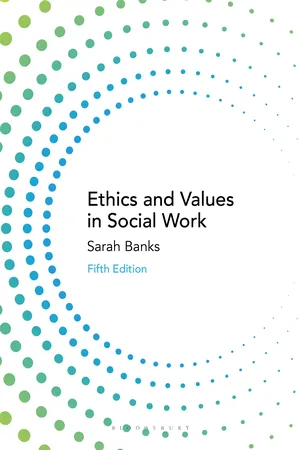
With over 40,000 copies sold across its lifetime, this is social work classic from a leading international author. Synthesizing the complex ideas and concepts that characterize social work's value base, Sarah Banks expertly provides a clear and systematic account of professional ethics in relation to social work practice, framed within a global context. Ethics and Values in Social Work is co-published with the British Association of Social Workers (BASW) and this fifth edition provides revised and updated analysis of professional regulation and codes of practice.
Written with Banks' trademark accessibility and theoretical rigour, this updated edition continues to be a relevant and invaluable resource for all students taking Ethics and Values modules at both undergraduate and postgraduate levels, as well as educators and practitioners of social work.
New to this Edition:
- Revised and updated analyses of professional regulations and codes of practices
- Updated case studies with an increased number of global examples of social work practice
- More cases featuring adults
- 315 pages
- English
- ePUB (mobile friendly)
- Available on iOS & Android
eBook - ePub
Ethics and Values in Social Work
About this book
Information
CHAPTER 1
ETHICAL CHALLENGES IN SOCIAL WORK
CHAPTER OVERVIEW
This chapter explores how we conceive of the domain of the ‘ethical’, including discussion of the distinctions and relationships between ethical, technical and legal matters. It then discusses the nature of the ethical challenges inherent in social work, and how and why questions of ethics arise, linked to the place of social work as a human services profession largely within state-organized systems of welfare. Finally, consideration is given to the guilt and anxiety often felt by social workers and whether the blame allocated to them for outcomes of what are essentially moral decisions is justified. The chapter ends with an exercise to encourage identification of ethical issues, and a case for discussion from Austria about a social worker who received a suspended sentence and fine for neglecting to perform her professional duties in relation to safeguarding a child.
Introduction
There is general agreement among social work practitioners and academics that questions of ethics, morals and values are an inevitable part of social work. The majority of social workers, when asked, have no difficulty in offering examples of ethical problems and dilemmas. The literature of social work is also very clear: ‘Moral issues haunt social work’, says Jordan (1990, p. 1), while for Reamer (2013a, p. 3), ‘Social work is among the most value based of all professions’.
In the Introduction, I discussed the meanings of the terms ‘ethics’ and ‘values’ and offered working definitions. I discussed the fact that religious and political values often form part of our sets of personal values and professional social work values. Before examining the nature of the ethical challenges that are inherent in social work, I will first consider how we demarcate the realm of the ‘ethical’ from related domains covering technical and legal matters.
The ethical, the technical and the legal
Frequently in the social work literature, values are distinguished from knowledge, and ethical/moral issues from legal and technical matters. Such distinctions can be useful, as long as it is not implied that knowledge can be value-free, or that legal and technical decisions can be made without recourse to ethics. For example, when considering what action to take in relation to a person with a severe psychiatric problem, a social worker might say: ‘It is essentially a legal question whether to detain this person in hospital under the mental health legislation.’ Yet, as Braye and Preston-Shoot (2016) point out, the law is rarely clear, and has to be interpreted by social workers. The law in the UK and many other countries tells us that if we make the technical (and ethical) judgement that the person concerned is suffering from a ‘mental disorder’, such that it is in the person’s interest to be detained in hospital, then we have the legal powers to bring that about. Laws do not tell us what we ought to do, just what we can do. The laws in operation nationally and internationally themselves reflect the particular values and norms prevalent in the societies where they apply, some of which certain people may regard as immoral, for example in the case of laws that regulate immigration, abortion or human cloning. Most decisions in social work involve a complex interaction of ethical, political, technical and legal issues, all of which are interconnected, and our values may influence how we interpret the law (see Dickens, 2013 for a discussion of the relationship between ethics, law and social work practice).
Giving another example, when asked to assess the needs of an older person with mobility problems for home care support with shopping and cleaning, a social worker might say: ‘It is a technical matter to decide whether this person is eligible for the home care service.’ The social worker assesses the person according to the defined criteria and makes a judgement using her professional skill and knowledge. The social worker might only judge that ethical issues were involved if she had to consider whether she ought to recommend a particular service even though the person did not quite meet the criteria. This is a helpful distinction between the technical and the ethical. However, a judgement might be regarded as a technical one not because only technical questions of measurement and assessment were involved, but because the social worker chose to see it in that way, as she might if it were a relatively straightforward case that did not present any ethical problems or dilemmas. However, the process of assessing needs for a home care service is not devoid of ethical content. The criteria of need that determine who should get the service will be based on ethical judgements about social duties to reduce some of the disadvantages caused by disability, or about how to distribute a scarce resource efficiently and fairly, for example. The social worker may judge that the criteria are not fair or do not result in resources being allocated to the most needy people. This is what Jordan (1990, p. 1) means when he says that ‘moral issues haunt social work’.
Ethical issues, problems and dilemmas
The preceding discussion suggests that all aspects of social work have ethical dimensions, even if they are not always identified as such. It is important that social workers recognize this and are aware not only of their own power in relation to service users, but also of the source of their power and their contradictory roles within society. Very often we associate professional ethics with dilemmas and problems – the making of difficult judgements and decisions in cases when the rights, needs and interests of different parties conflict. But it is also important to see ethical issues as deeply embedded in the construction of social work as an occupation, its location within state systems of welfare and the everyday practice of its members. Thompson et al. (2000, pp. 6–9), writing about nursing ethics, distinguish ethical problems (difficult choices have to be made, but it is clear what is the right action to take) and ethical dilemmas (difficult choices have to be made and it is not clear what is the right course of action). Many of the case examples in this book are constructed as problems and dilemmas. However, I would argue that it is important also to see the whole of social work as comprising ethical dimensions and to focus on the ethical issues in practice as much as the ethical problems and dilemmas (Banks, 2009a).
In the light of the discussion above, it may be useful to distinguish between ethical issues, ethical problems and ethical dilemmas, as outlined in List 1.1.
List 1.1 Ethical issues, problems and dilemmas
1. Ethical issues pervade the social work task (including what appear to be ‘legal’ or ‘technical’ matters), in that social work frequently takes place in the context of state systems of welfare, premised on principles of social justice and public good, where social workers have professional power in the relationship with service users. So, although making a judgement about whether to recommend home care services for a person with a disability in a case that is straightforward may not involve a social worker in agonizing over an ethical dilemma, it is not devoid of ethical content.
2. Ethical problems arise when a social worker sees a situation as involving a difficult moral decision, but is clear what is the right course of action, for example when she decides to turn down the application of a very needy person for home care services because this person does not fit the criteria.
3. Ethical dilemmas occur when a social worker sees herself as facing a choice between two equally unwelcome alternatives, which may involve a conflict of ethical values, and it is not clear which choice will be the right one. For example, should the social worker bend the criteria for allocating home care services in order to help a very needy person, or stick to the rules and refuse the application of someone who really needs support? She is faced with a conflict between the interests of this individual and the public interest in having rules and criteria that apply to everyone.
What is regarded as a technical matter for one person (simply applying the rules) may be an ethical problem for another (a difficult choice, but it is clear what action should be taken) or a dilemma for a third person (there appears to be no solution). It depends on how each person sees the situation, how experienced they are at making ethical judgements and decisions and how they prioritize different values (see Banks and Williams, 2006 for a detailed discussion of practitioners’ accounts of ethical issues, problems and dilemmas). As I have suggested elsewhere (Banks, 2018, pp. 56–7), social work could be described as occupying a ‘dilemmatic space’ (Honig, 1996), rooted in contradictory ideologies and values (individualism versus collectivism; care versus control; freedom versus responsibility), which every so often erupt to the surface to disrupt and challenge daily practice.
What are the ethical challenges in social work?
In collecting examples of ethical difficulties experienced by qualified and trainee social workers in the UK and various countries across the world, I identified four main themes, as summarized in List 1.2.
List 1.2 Ethical challenges in social work
1. Individual rights and welfare: service users’ rights to make their own decisions and choices; social workers’ responsibilities to promote the welfare of service users.
2. Public welfare: the rights and interests of parties other than service users; social workers’ responsibilities to their employing agencies and to society; the promotion of the greatest good for the greatest number of people.
3. Equality, diversity and structural oppression: balancing the promotion of equality with due regard to diversity; the social worker’s responsibility to challenge oppression and to work for changes in agency policy and in society; managing religious and cultural diversity, differences and conflicts.
4. Professional roles, boundaries and relationships: deciding what role the social worker should take in particular situations (counsellor, controller, advocate, assessor, campaigner, ally or friend); considerations of issues of boundaries between personal, professional and political life.
Any categorization is obviously artificial, and does not do justice to the complexity of the issues within each category and the overlap between them. Frequently there are conflicts between rights, responsibilities and interests both within and between these categories. However, this framework may be a useful starting point for exploring issues of values and ethics in social work practice. Short case examples from four practitioners talking about everyday issues in their practice may illuminate our discussion.
1. Rights and welfare of the individual
Practice focus
Case example 1.1: Should I persuade Mrs Brown to accept help? A student social worker’s dilemma
Mrs Brown, an 80-year-old woman, was referred to a social work agency by a local hospital after a fall at home. A student social worker visited her in her home to assess her needs and felt that Mrs Brown was finding it hard to look after herself – her house was dirty and untidy and it was clear that she was not eating much. She lived alone, and her son visited twice a week to deliver shopping. The social worker suggested to Mrs Brown that she should consider having a home care assistant to help her on a daily basis, but she categorically refused. The social worker met the son and it was clear he was not willing to offer any more support to his mother. The social worker visited Mrs Brown a second time, but Mrs Brown was still adamant she did not want any help. The social worker commented:
It was difficult to know how far to try to persuade or even coerce Mrs Brown to accept the offer of a home care assistant, or whether just to leave her alone and hope she would manage to survive. This was one of my first cases as a student social worker and I felt very concerned for Mrs Brown’s safety.
Here the focus of the student social worker’s concern is the service user’s welfare. The social worker wants to respect Mrs Brown’s own choices about how to live her life, yet the worker also wants to ensure that Mrs Brown feeds herself properly and is checked on regularly in case she falls again. The social worker experiences a conflict between the promotion of Mrs Brown’s welfare and her right to make her own choices.
2. Public welfare
Practice focus
Case example 1.2: Should we restrict visits and face-to-face contact for foster children in the interests of everyone’s safety? A difficult decision for a manager
During the COVID-19 outbreak in the UK in March 2020, the manager of a charitable fostering service became concerned about the prevalence of the virus in the community. The manager was also about to go on leave for a week and wanted to leave the service with instructions that would keep everyone safe. Although the UK government had not yet announced a ‘lock-down’ (severe restriction of people’s movements outside their homes, which was announced a week later), the manager decided to suspend home visits and face-to-face contact. Although children and birth parents have a right to contact visits, and it is important that social workers monitor foster placements and support the children and families involved, the manager’s assessment of the situation was that to continue would be unsafe, risking the parties concerned spreading or contracting the virus. The manager commented that: ‘it required me to be brave and do the right thing but I was also willing to be accountable for my decision and told my social workers to hand out my phone number to anyone who wanted to discuss my decision’. By making this decision, the manager was giving clarity to staff and foster carers.
The person making the decision in this case is a manager whose role is to take a broader perspective about the rights and interests of a range of people beyond individual service users, including staff and the general ...
Table of contents
- Cover
- Half-Titlepage
- Seriespage
- Titlepage
- Dedication
- Brife Contents
- Contents
- List of Figures, Lists and Tables
- List of Practice Focus Boxes
- Preface to the Fifth Edition
- Acknowledgements
- Introduction
- 1 Ethical challenges in social work
- 2 Principle-based approaches to social work ethics
- 3 Character and relationship-based approaches to social work ethics
- 4 Principles into practice: professionalism and codes of ethics
- 5 Service users’ rights: clienthood, citizenship, consumerism and activism
- 6 Social workers’ responsibilities: policies, procedures and managerialism
- 7 Ethical problems and dilemmas in practice
- References
- Index
- eCopyright
Trusted by 375,005 students
Access to over 1.5 million titles for a fair monthly price.
Study more efficiently using our study tools.
Frequently asked questions
Yes, you can cancel anytime from the Subscription tab in your account settings on the Perlego website. Your subscription will stay active until the end of your current billing period. Learn how to cancel your subscription
No, books cannot be downloaded as external files, such as PDFs, for use outside of Perlego. However, you can download books within the Perlego app for offline reading on mobile or tablet. Learn how to download books offline
Perlego offers two plans: Essential and Complete
- Essential is ideal for learners and professionals who enjoy exploring a wide range of subjects. Access the Essential Library with 800,000+ trusted titles and best-sellers across business, personal growth, and the humanities. Includes unlimited reading time and Standard Read Aloud voice.
- Complete: Perfect for advanced learners and researchers needing full, unrestricted access. Unlock 1.5M+ books across hundreds of subjects, including academic and specialized titles. The Complete Plan also includes advanced features like Premium Read Aloud and Research Assistant.
We are an online textbook subscription service, where you can get access to an entire online library for less than the price of a single book per month. With over 1.5 million books across 990+ topics, we’ve got you covered! Learn about our mission
Look out for the read-aloud symbol on your next book to see if you can listen to it. The read-aloud tool reads text aloud for you, highlighting the text as it is being read. You can pause it, speed it up and slow it down. Learn more about Read Aloud
Yes! You can use the Perlego app on both iOS and Android devices to read anytime, anywhere — even offline. Perfect for commutes or when you’re on the go.
Please note we cannot support devices running on iOS 13 and Android 7 or earlier. Learn more about using the app
Please note we cannot support devices running on iOS 13 and Android 7 or earlier. Learn more about using the app
Yes, you can access Ethics and Values in Social Work by Sarah Banks in PDF and/or ePUB format, as well as other popular books in Education & Education General. We have over 1.5 million books available in our catalogue for you to explore.