- 170 pages
- English
- ePUB (mobile friendly)
- Available on iOS & Android
eBook - ePub
Interpreting Shakespeare on Screen
About this book
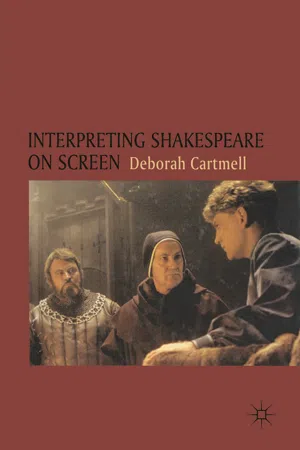
This book explores Shakespeare films as interpretations of Shakespeare's plays as well as interpreting the place of Shakespeare on screen within the classroom and within the English curriculum. Shakespeare on screen is evaluated both in relation to the play texts and in relation to the realms of popular film culture. The book focuses on how Shakespeare is manipulated in film and television through the representation of violence, gender, sexuality, race and nationalism. Cartmell discusses a wide range of films, including Orson Welles' Othello (1952), Kenneth Branagh's Much Ado About Nothing (1993), Peter Greenaway's Prospero's Books (1991), Baz Luhrmann's William Shakespeare's Romeo and Juliet (1996) and John Madden's Shakespeare in Love (1998).
Information
1 Shakespeare, Film and Violence: Doing Violence to Shakespeare
Introduction
Most studies of adaptation confine themselves to the novel, alerting us to the ways in which the nineteenth-century realist novel, especially, lends itself to cinematic reworking.1 Shakespeare on screen is normally considered on its own, without comparison to other literary adaptations, usually play-, director-, or film-centred.
The adaptation of the novel is more easily explained than the adaptation of Shakespeare. As the nineteenth-century novel paved the way, in part, for cinematic devices in the early twentieth century, the modernist novel borrowed from cinema, drawing attention to its filmic encoding processes. Writing, such as that of Virginia Woolf in the early twentieth century, undoubtedly shows the influence of the cinema in its translation of cinematic devices, such as zooms, close-ups, change of focus, flashbacks, dissolves and tracking shots, into literary equivalents.2 Sergei Eisenstein’s famous essay, ‘Dickens, Griffith and the Film Today’, shows how Griffith’s montage techniques employ close-up details in imitation of Dickens’s narratives.3 As film provided inspiration for the novelist, the novel, especially the nineteenth-century realist novel, was remarkably ‘filmic’ in its ability to transport the reader into a self-contained fictional world. Shakespeare, on the other hand, seems a peculiar choice for film.
Yet Shakespeare seems equally adaptable to cinema; many would agree with Laurence Olivier, who has repeatedly implied that Shakespeare would have written films, if only he had the chance. There may be some truth in his statement in his Foreword to ‘Hamlet’: The Film and the Play (1948) that ‘Nothing that we know of Shakepeare suggests that he actually enjoyed being “cabin’d, cribb’d, confined” by the rudimentary conditions of the stage for which he wrote.’4 Arguably, today, Shakespeare is known to teenagers as a screenwriter first and as a dramatist second, as an American television narrator concluded in a programme on Shakespeare studies: ‘Shakespeare is now Hollywood’s hottest screenplay writer.’5 The adaptation of Shakespeare, perhaps more than any other writer, inspires the fidelity debate and divides those who perceive the text as sacred and/or ‘timeless’ from those who see the text as an unstable entity which is best when freely adapted.
As Harriet Hawkins has demonstrated, there is no end to adaptations of Shakespeare, and perhaps ‘Shakespeare’s plays would necessarily have to be required reading for practically any course in the historical origins of popular modern genres.’6 In other words, Shakespeare’s plays are embedded in a host of popular forms:
‘Come to my bed’, says Angelo to Isabella, ‘or I’ll have your brother killed.’ ‘Come to my bed’, said J.R. to Sue Ellen in Dallas, ‘or I’ll have your innocent young lover jailed on a drug charge.’7
But this is Shakespeare without words – or the structure without the content. The question we need to ask, is if we lose the words do we lose ‘Shakespeare’? What distinguishes Shakespeare on screen from Shakespeare in the theatre, or Shakespeare on the page, according to Alan Dent, writing on Olivier’s film of Hamlet in 1948, is that one appeals to the eyes, the other to the ears:
The whole technique of the stage … is built on the fact that the ear, and therefore eventually the mind, are the things to be gratified and interested. What we see – or can see – in the theatre is, although important, much less important by comparison. What we hear is what matters.8
But we still haven’t answered the question: why film Shakespeare? Films of Shakespeare’s plays are different from adaptations of eighteenth- or nineteenth-century novels in that their success cannot be attributed to a nostalgic recreation of an age gone by; they are often set in different, even contemporary periods.9 Harriet Hawkins partially answers this question of why Shakespeare films have been so marketable by explaining how the narrative structures of Shakespeare’s plays lend themselves to popular forms; that is, the stories can be modernised or updated. Films of Shakespeare’s plays are not escapist representations of an idyllic past in the same way that films of Jane Austen’s novels can be. The need to ‘concretise’, to make the text ‘more real’, may be another reason for adapting Shakespeare to film.10 This may be part of the attraction behind the popular Shakespeare in Love (John Madden, 1998) which provides us with visualisations of the Rose Theatre, Philip Henslowe, Richard Burbage, Christopher Marlowe and the young John Webster, not to mention Shakespeare himself. But it is becoming increasingly the case that viewers have no prior knowledge of the text or its context and therefore nothing to make concrete; clearly there is an audience who will go to a film in order to see what a particular director made it look like, but there is also an audience who go to a film, wanting to see, for the first time, what Shakespeare is like. Another reason why adaptations of classic literature have proved so successful is that they provide the viewer with what French sociologist Pierre Bourdieu has described as ‘cultural capital’,11 in this case, a quick and easy way to become ‘cultured’. In their study of Vitagraph Pictures’ ‘quality’ films, produced between 1907 and 1913, William Uricchio and Roberta Pearson have argued how ‘engagement with certain cultural commodities’ ‘distinguish the participating subject from other members of social formations’.12 Adaptations of Shakespeare and Dante, for example – ‘films deluxe’ – capitalised on bringing ‘moral edification’ and/or ‘culture’ to the barely literate masses. This, it seems to me, is the reason behind the continued success of Shakespeare on film. Even though the adaptation may be a watered-down version of the original it is, somehow, culturally consecrated: we still come away with something special, something ‘Shakespearean’. There is embedded in our culture an almost religious need for Shakespeare, typified by comments such as those by Wilson Knight writing in the midst of World War II: ‘we need expect no Messiah, but we might, at this hour, turn to Shakespeare, a national prophet if ever there was one, concerned deeply with the royal soul of England’.13 What better way to spread the word than through film? This seems to be the aim of Kenneth Branagh, whose introduction to the screenplay of Hamlet (1996) reads like a conversion narrative. His first encounter with the play was a ‘road to Damascus’ experience:
I felt I had encountered a genuine force of nature, and that journey home and for sometime afterwards, its memory made me glad to be alive. But then I was fifteen.
Nevertheless … I believe that much of what has followed in my life was affected by that experience.14
Certainly the desire to convert others is the declared mission of those directors who loom largely in the Shakespeare-on-screen canon: Laurence Olivier, Franco Zeffirelli and Kenneth Branagh, who span the ‘three ages’ of Shakespeare on screen, that is, the 1940s, 1960s and 1990s.
Conversion to Shakespeare has itself become a popular cultural narrative; witness heart-warming family sitcoms or films such as Dead Poets’ Society (1989, directed by Peter Weir). An extremely common popular narrative is one in which a child resists reading or performing Shakespeare until he or she finally ‘sees the light’ and is liberated into a much more meaningful world. This mission – as well as the audience’s desire to be converted – is the subtext or the covert agenda of many films of Shakespeare. This conversion-to-Shakespeare narrative is ingeniously satirised in The Last Action Hero (1993, directed by John McTiernan). A schoolteacher, played by Joan Plowright (herself Mrs Laurence Olivier), shows a clip from Olivier’s Hamlet. Her eleven-year-old pupil, bored by Hamlet’s inertia, transforms Hamlet into his action-man hero, played by Arnold Schwarzenegger. This is a Hamlet who knows the answer to the question, ‘to be, or not to be’; ‘not to be’, he emphatically answers himself, tossing a grenade over his shoulder, nonchalantly blowing up the castle behind him. The film cuts to the boy watching a cartoon, suggesting how far we have come from Hamlet. In a similar way, an adaptation’s radical departure from the source is provocatively announced in Clueless (1995), Amy Heckerling’s ‘free’ adaptation of Jane Austen’s Emma, where the implication is that even a diluted and trivialised Emma – like the out-of-context quotations from Shakespeare and Dickens in the film – is better than no Emma at all. Cher’s/Emma’s unlikely correction of a more ‘cultured’ girl’s misattribution of ‘To thine own self be true’ to Hamlet instead of Polonius (Cher informs us that she might not know Hamlet, but she does know Mel Gibson) is, in many ways, the moral of the film. Cher has gained some useful ‘cultural capital’, thanks to Mel Gibson’s Hamlet.
This book will concentrate on how and why Shakespeare is appropriated in popular films; but rather than concentrating on specific texts or directors, it looks at how Shakespeare is used by the film industry to appeal to the masses in terms of the presentation of issues such as gender, sexuality, race, violence and nationalism. In order to do this, it is necessary to negotiate the differences (as far as it’s possible to do so) between the original conditions of the drama’s production and those of the film’s construction. Although the texts are, undeniably, appropriated for educational purposes in many cinematic reconstructions, these interestingly coincide with Hollywood ideology which, as James Monaco has described, is, in spite of the revolutionary form of film, fundamentally conservative:
Thus, two paradoxes control the poetics of film, on the one hand, the form of film is revolutionary, on the other, the content is most often conservative of traditional values.15
Shakespeare on film, at least for those who maintain that the dramatist is a spokesman for reactionary ideology, seems ideally suited for Hollywood adaptations, best borne out by the number of Shakespeare films claiming various degrees of fidelity.
A film or televisual adaptation can be distinguished from a play, as Luke McKernan has usefully noted: ‘a play is a text which may be performed on a stage, but a film is both text and performance’.16 When reading Shakespeare on screen, it is crucial that we distinguish the text from the adaptation in such a way as we separate story from plot,17 or stories told versus stories presented. The story (the play text) consists of the basic raw materials, whereas the plot (the film) is the way in which the story is constructed or creatively reshaped. The film can be examined in terms of its spatial and aural organisation, in which we are provided with a series of codes which manipulate our reaction to the source story. It is important to note that a film is not simply an adaptation of a play; the play is only one element of its intertextuality. Nonetheless, the source story (the play by Shakespeare) is interpreted through a number of cinematic and ‘extra-cinematic’ codes. These have been usefully suggested by Brian McFarlane, who attempts to avoid questions of value judgements or authenticity by ‘scientifically’ comparing narrative strategies:
cinematic codes: we come to know that ‘fade out/fade in’ announces a passage of time; a ‘cut’ indicates a change in narrative direction, blurred focus prepares us for a flashback or dream sequence language codes – for example, accents, tones visual codes – dress, colour, set, what is selected for viewing non linguistic codes – music, background noises cultural codes – set, historical, national, religious signifiers18
Although the words of the Shakespearean text may be retained in a film adaptation, film adds another ‘language’ to the text. Cinematic codes provide a filmic shorthand and are useful in reducing vast chunks of text. As Virginia Woolf observed, cinema has ‘within its grasp innumerable symbols for emotions that so far failed to find expression’ in literature.19 These codes both compete with and replace the words of the source texts.
Language codes – how people speak, whether they are American or British, loud or quiet – invariably influence our perception. The mixture of American and British actors in a Shakespeare film, for example, has a different effect than a purely British production. Kenneth Branagh’s Henry V (1989) is not an obvious Hollywood-styled production as its main cast consists solely of British actors. Adaptations of ‘classic novels’ tend to bear a British stamp of approval and, as such, distance themselves from Hollywood productions where we are accustomed to the British being the villains and the Americans, the heroes.20 The mixing of accents in Branagh’s Much Ado About Nothing (1993) and Hamlet or Parker’s Othello (1995), undoubtedly with an eye to the lucrative American market, makes Shakespeare appear more ‘universal’ and less British, and thus alters our perception of nationalism in Shakespeare. Nonetheless, the more mixed the accents, the less ‘authentic’ these adaptations appear. Branagh cunningly gets round the problem in Hamlet by assigning cameo roles to American stars while retaining a mainly British cast.
Visual codes provide us with another layer of text to take into account when evaluating an adaptation. Laurence Olivier’s English troops in Henry V (1944) shoot their arrows at the charging French army from left to right (the enemies – the French – moving from right to left). Left to right is a movement pleasing and ‘natural’ to the Western eye (as we tend to read a film, like a book, from left to right) and therefore implicitly sanctified as the right way. Elizabeth Taylor as Kate in Zeffirelli’s Taming of the Shrew (1967) gazes lovingly at Richard Burton’s Petruchio through a keyhole – we instantly know, in spite of what she says, that she’s playing hard to get. This radically reshapes our reading of the text from one which potentially challenges and exposes the subjugation of women into a play about a woman who secretly wants to be tamed. The colour of the actor, similarly, can influence our reading. Denzel Washington’s Don John’s proposal (or however you interpret, ‘Will you have me, lady?’)21 to Emma Thompson’s Beatrice in Much Ado About Nothing is more noticeable and problematic than it would be if the two actors were the same colour. Beatrice’s refusal, no doubt accidentally, can be interpreted as racist; a reading which is obvi...
Table of contents
- Cover
- Title Page
- Copyright
- Dedication
- Contents
- Preface
- Acknowledgements
- 1 Shakespeare, Film and Violence: Doing Violence to Shakespeare
- 2 Shakespeare, Film and Gender: Critical and Filmic Representations of Hamlet
- 3 Shakespeare, Film and Sexuality: Politically Correct Sexuality in Film Adaptations of Romeo and Juliet and Much Ado About Nothing
- 4 Shakespeare, Film and Race: Screening Othello and The Tempest
- 5 Shakespeare, Film and Nationalism: Henry V
- 6 Conclusions
- Appendix 1: Student Exercises
- Appendix 2: Evaluations
- Notes
- Further Reading
- Bibliography
- Filmography of Major Films Discussed
- Index
Trusted by 375,005 students
Access to over 1.5 million titles for a fair monthly price.
Study more efficiently using our study tools.
Frequently asked questions
Yes, you can cancel anytime from the Subscription tab in your account settings on the Perlego website. Your subscription will stay active until the end of your current billing period. Learn how to cancel your subscription
No, books cannot be downloaded as external files, such as PDFs, for use outside of Perlego. However, you can download books within the Perlego app for offline reading on mobile or tablet. Learn how to download books offline
Perlego offers two plans: Essential and Complete
- Essential is ideal for learners and professionals who enjoy exploring a wide range of subjects. Access the Essential Library with 800,000+ trusted titles and best-sellers across business, personal growth, and the humanities. Includes unlimited reading time and Standard Read Aloud voice.
- Complete: Perfect for advanced learners and researchers needing full, unrestricted access. Unlock 1.5M+ books across hundreds of subjects, including academic and specialized titles. The Complete Plan also includes advanced features like Premium Read Aloud and Research Assistant.
We are an online textbook subscription service, where you can get access to an entire online library for less than the price of a single book per month. With over 1.5 million books across 990+ topics, we’ve got you covered! Learn about our mission
Look out for the read-aloud symbol on your next book to see if you can listen to it. The read-aloud tool reads text aloud for you, highlighting the text as it is being read. You can pause it, speed it up and slow it down. Learn more about Read Aloud
Yes! You can use the Perlego app on both iOS and Android devices to read anytime, anywhere — even offline. Perfect for commutes or when you’re on the go.
Please note we cannot support devices running on iOS 13 and Android 7 or earlier. Learn more about using the app
Please note we cannot support devices running on iOS 13 and Android 7 or earlier. Learn more about using the app
Yes, you can access Interpreting Shakespeare on Screen by Hester Bradley,Deborah Cartmell in PDF and/or ePUB format, as well as other popular books in Letteratura & Critica letteraria nella poesia. We have over 1.5 million books available in our catalogue for you to explore.