- 196 pages
- English
- ePUB (mobile friendly)
- Available on iOS & Android
eBook - ePub
About this book
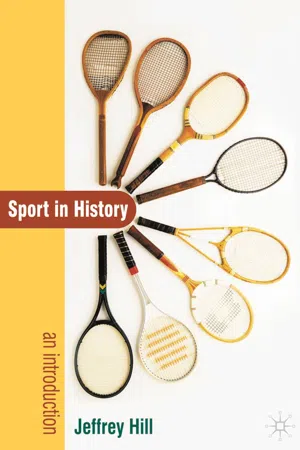
This wide-ranging analysis of the key themes and developments in sports history provides an accessible introduction to the topic. The book examines sports history on a global scale, exploring the relationship between sports history and topics such as modernization, globalization, identity, gender and the media.
Information
CHAPTER 1
Sport Matters
In a seemingly paradoxical statement the chief sports correspondent of the Times newspaper, Simon Barnes, has speculated that ‘perhaps sport matters because it doesn’t matter.’1 What he seems to have meant was that, compared with questions of world conflict, health, disease and the environment, the issues that so concern us in sport carry little weight. Thus, sport is something that can consume our attention as a distraction. Perhaps it serves as a valuable distraction from the worries of the world. It matters because it doesn’t matter.2 It is an interesting thought; an attempt to put things into proper perspective, by a writer who makes his living by communicating the issues of sport to us. Barnes’s comment, though, prompts further questions for readers in the early twenty-first century. What, in the last analysis, does matter? In a world beset by financial disorder, pathetic attempts to tackle climate change and a cultural climate that spreads much banal shallowness, we should perhaps be rethinking many of the conventional wisdoms that the later twentieth century has bequeathed to us: about economic growth and how it is to be attained, about our political systems and how democracy is to be fulfilled, about global relations and the relationship between rich and poor within and between societies. And perhaps about sport, where it is going, and what it means to us.
There is another point: at the beginning of the new century sport is very big business globally. In this way it matters a great deal to a great many people. Their jobs are tied up in it, and much of their leisure activities are consumed by it. A rough estimate would make sport a $500bn worldwide industry. In the United Kingdom it accounts for approximately 2 per cent of all workers (approximately 576,000) and some 2 per cent of GDP.3 Consider the staging of the Olympic Games in 2012. Securing this event involved much effort and expense by many people trained in economics and business, urban planning and transportation, architecture, and public relations, because it was assumed that being asked by the International Olympic Committee (IOC) to stage the Games in their city would bestow value, not only to the city but also to the country in which the city was located. When the decision was announced by the president of the IOC in Singapore in July 2005, London emerged as the winner, albeit by a narrow margin it seems. It was an outcome greatly desired not only by those in sport in Great Britain, but also by an institution whose involvement in sport was of fairly recent origin: Her Majesty’s Government. Some sixty years earlier London had staged the first Games after the end of the Second World War. Few other countries had expressed much interest, for obvious reasons, and Great Britain stepped in to claim some prestige for re-igniting the Olympic flame. The British government, and in particular its foreign secretary Ernest Bevin, was keen to give support, and lent both financial and moral backing to an event that by the standards of today seems low-key and rather cheapskate. (A recent book has described them as the ‘austerity Games’.) This was an unusual move at a time when governments in Britain considered that the organization of sport was a matter for private individuals and associations (much as later governments were to regard the economy). When the bid was being prepared for the 2012 Games, all this had changed. Sport was now seen as something that improved the nation’s physical and moral health, kept its youngsters off the street corners and which through ‘mega’ events like the Olympic Games might ‘re-generate’ depressed areas of the urban landscape such as the East End of London. The opportunity of 2012 was not to be missed, and a mark of its perceived importance was that the prime minister of the day, Mr Blair, went to Singapore at a crucial moment in the IOC’s deliberations to show the flag and press the flesh.
In a smaller way the growing sense that sport matters has been registered in the academic world by historians. Even as recently as the 1970s the idea that serious historians (especially those employed in academic jobs) should want to write about the history of sport seemed faintly ridiculous to many. It still is, though to a much lesser extent. Over the past 30 or so years there have been big changes. Sport history is now a buoyant branch of the discipline, with large organizations of scholars across the globe through whose auspices debate and discussion about the study of sport proceeds, and from which issues the publication of a steady stream of books now too numerous for any one individual to keep up with. It is important to retain a critical perspective on all this endeavour, and to ask whether much of what is produced is really worth reading. This might sound facetious, if not dismissive. It is not intended to be; it merely raises the question, which I believe is very important for anyone embarking on the study of sport at whatever level – why are we studying it, and how should we do it?
Let us try to offer an answer to this question. One of the complaints that critics of sport history have levelled against the subject is that its practitioners are simply ‘fans with typewriters’.4 In other words, they are people whose own love of sport has impelled them into writing about it. (Perhaps they are older historians who, instead of playing the game, now write about it). But should history be constructed simply out of such personal reasons? We should, I think, answer ‘no’ to this question, while at the same time acknowledging that much history – ‘respectable’ history, that is, which has not been subjected to the strictures that sport history has sometimes endured – has also been fashioned with personal likes and dislikes in mind. How many historians of religion and the churches have been practising believers? Have military historians been ex-servicemen? And historians of government and the central administration – have they not formed close associations with those in the corridors of power? To what extent have all these people been men? Be that as it may, we need to establish an intellectually convincing justification for placing sport on the historian’s agenda. My own manifesto would begin with the place sport occupies in society.
Social history
Some years ago, during an important phase in the development of British and, by extension, international historiography, a renowned historian, Eric Hobsbawm, sought to give direction to what was then a relatively new branch of the discipline. Social history, a part of the subject that had previously languished as a junior partner in what was known as ‘economic and social history’, suddenly came into its own in the 1960s. Social history deals with a wide range of topics related to how people live their lives; it includes, among other things, institutions (such as the National Health Service), social policy (the Poor Law), social relationships (class, gender, race), the family, consumption, lifestyle and population trends. As may be imagined from this potentially vast canvas, social history shades into various other subjects of history which have their own specialism: business, demography, economics, religion and intellectual matters to identify but a few. In recent years there has arisen a particular form of history that has close associations with social history. This is cultural history, a branch that is sometimes difficult to distinguish from social, but the principal characteristic of which is a concern with how things are understood by people through the ways in which they are represented to them.5 It is therefore not so much about what happened as what people thought happened, and how they reacted to it. The ‘revolution’ (if that is an appropriate term) in social history had, as is usual with revolutions, a combination of causes. Some of it had to do with the impact of a seminal (i.e. influential) book – EP Thompson’s The Making of the English Working Class (1963) – that quickly acquired a following among many younger scholars. Equally important, though, was the way in which British higher education was opening up at this time with the expansion of the ‘new’ universities.6 This development brought a new generation of students into the universities with a greater proportion than previously who were from a working-class background and female. When such students themselves moved on into research and eventually got jobs in universities, they often introduced new perspectives in their teaching, with greater emphasis on subjects such as popular culture and politics, women, and leisure and recreation.
In an influential article in Daedalus (winter, 1971) – the journal of the American Academy of Arts and Sciences – Hobsbawm attempted to orchestrate these new developments in social history. The article was entitled ‘From Social History to the History of Society’.7 Its purpose was to explain the rise of social history, which at that point had undergone the same kind of explosive growth that sport history has experienced over the past 20 or so years. Social history, said Hobsbawm, was ‘in fashion’ but its ‘copious development’ had proceeded in an ‘unsystematic’ way. In an attempt to give the subject coherence Hobsbawm argued for an approach in which social history would embrace the totality of society, and at the same time offer what its companion disciplines of sociology and economics had been unable to formulate, namely a satisfactory explanation of social change. A short while after the publication of this article Hobsbawm directed some of the same concerns to his own specialist area of study, labour history. In this article, also in an American journal – the Journal of Social History (summer, 1974) – Hobsbawm said that all historians should have a model of society in their mind, and be able to theorize about how society works and how it changes. He talked of labour historians being able to relate their own particular bits of specialist study to what was going on in the bigger picture. He particularly noted how the development of labour history, which had been started for polemical purposes outside the academy, had meant that much of the history of labour had been written ‘from within’ the labour movement, was concerned with ideological issues important to labour activists and tended to equate the working classes with the organizations that operated in their name. He called for a more broadly based history alert to aspects of labour which had previously been suppressed or neglected – women, the casual labour force, workers who did not support ‘progressive’ causes, and so on. Above all, he reminded his readers that ‘the history of labour is part of the history of society’.
For those inclined to take notice, these observations had a dual importance. They encouraged a reassessment of what the proper study of history should be, and they steered historians towards theory. The study of sport was one beneficiary of the reassessment. The first academic group of sport historians in Britain – the British Society of Sport History – was founded in 1982, taking its cue from a body established ten years earlier in the United States – the North American Society for Sport History – composed at that time mainly of men and women from physical education departments who wished to trace the origins of the sports they taught and coached. Though influenced by the Americans, the British initiative was prompted as much as anything by the appearance in 1979 of a book similar in stature in the world of sport to that of EP Thompson’s in the broader field of working-class history: Tony Mason’s Association Football and English Society 1863–1915 (1980). Mason’s was the first British book – and perhaps the first anywhere – to subject sport to rigorous academic method based upon a range of primary archival sources. It examines from a thematic perspective the development of association football in England from the 1860s, when the game was extensive but found in a variety of forms, until the time of the First World War, when it had become a commercialized mass spectator sport organized into regulated competitions and subject to the overall supervision of the Football Association. The book has continued to spawn a succession of studies based on either individual sports or, as in the more recent past, broader thematic studies of sport’s role as social practice.
Quite apart from its landmark status in opening up the study of sport, Mason’s work was (and remains) typical of a dominant method in history writing that has been called empiricism. This means the practice of collecting information from a range of primary and secondary sources, analysing it and writing up the findings as history. For many, in schools and universities, this approach is the hallmark of ‘doing history’; its validity is unquestioned. It has been and probably always will be the methodological orthodoxy. Yet some think this approach to be flawed; or to put it more accurately, the unquestioned faith in empiricism is thought to be flawed. Their scepticism is rooted in ideas about knowledge and truth that have come out of continental European philosophy, and which make of history a far more indeterminate and insubstantial process of knowledge formation and ‘truth validation’ than the orthodox method would have us believe. This is where theory comes in, and we should pause a while to consider it.
Theory
Hobsbawm’s concern for theory was mostly a reflection of his own Marxist approach to history, and a belief that in the work of Marx and Engels there was an indication of why societies change. What, indeed, did Engels assert in his graveside oration at Marx’s funeral in 1883? That Marx had uncovered the laws of movement in history just as Charles Darwin in his researches had laid bare the process of evolution in biology. Hobsbawm felt that, whether Marxists or no, historians should at the very least bring to their studies an appreciation of theoretical insights into this question of change. It has to be admitted though, that the take-up of theory among historians in general over the past 35 years has been very patchy. An illustration of this is provided if we consider the responses to the surge of what at the time was often referred to as ‘structuralism’: a set of ideas drawn mainly from continental European sources that first hit British historians in a big way during the late 1970s. The influences of philosophers such as Derrida and Foucault, sociologists such as Pierre Bourdieu, anthropologists such as Clifford Geertz, politico-cultural theorists such as Antonio Gramsci and literary theorists such as Stephen Greenblatt has varied enormously. In broad terms historians have been less interested in theory per se than have, for example, sociologists; for the historian the application of theory to the practice of writing history has been the key issue, and in this respect some theories have seemed more applicable than others. Thus some historians have been strongly persuaded by ideas coming from outside the discipline of history, while others (one might say the majority) have not. A harsh indictment of the latter might suggest that they have buried their heads in the sand, or at least retreated behind the ramparts of their citadel of orthodoxy. To be fair, though, there are few historians who have not imbibed at least something of these theoretical positions, but only relatively few historians have carried them very far.
How far have they been carried in the study of sport? As someone who has been involved in this business for some while I have noticed, especially over the past 20 years, an increasing awareness at conferences and in publications of theoretically informed approaches. They have been particularly in evidence in work done on sport and identity (especially gender), a subject that became quite modish in the 1980s. There is still, however, a firm commitment to what I have called ‘empiricism’. It is manifested in the tendency to see sport as a collection of fixed realities: the people who perform sport, those who administer it, and events and places where it all takes place. In this sense sport is a series of ‘things’ relating to physical activity of a competitive nature that takes place largely out of doors. It is an understanding of sport that has been fortified in the recent past by interesting developments in the representation of sport in museums and heritage sites.
The theoretically minded sport historian, however, has a different vision of the subject. The starting point is often an unease with the way sport is seen as something ‘shaped’ by other forces in society – politics, economics, demographic patterns, ideas, social customs, religion, and so on. To be sure, no one would deny that these forces have their influences in sport, but in acknowledging this it is the reverse process – the ability of sport itself to exercise a determining influence over the way people think – that is often overlooked. Far from being marginal things, mere entertainments that do not ‘matter’, sporting activities are cultural agencies with ideological significance; that is to say, they have the power to give meaning.
Whose theories we adopt is, to a large extent, a matter of personal inclination and interest. Personally I have found the work of the anthropologist Clifford Geertz (1926–2006) to be very illuminating for a historian interested in how people’s social and cultural rituals can reveal things about their society and its social relationships. Geertz’s method of analysis is also intriguing; he ‘reads’ customs and practices as a literary specialist might read texts, deconstructing them for what they say about matters that are not obvious from a cursory glance. His analysis, done in the cour...
Table of contents
- Cover
- Title
- Copyright
- Contents
- List of Illustrations
- Acknowledgements
- Preface
- 1 Sport Matters
- 2 The Transition to Modern Sport
- 3 Sport and Identity
- 4 Sport and Gender
- 5 Mediating Sport
- 6 Sport in a Globalized World
- Conclusion
- Notes
- Select Bibliography
- Index
Trusted by 375,005 students
Access to over 1.5 million titles for a fair monthly price.
Study more efficiently using our study tools.
Frequently asked questions
Yes, you can cancel anytime from the Subscription tab in your account settings on the Perlego website. Your subscription will stay active until the end of your current billing period. Learn how to cancel your subscription
No, books cannot be downloaded as external files, such as PDFs, for use outside of Perlego. However, you can download books within the Perlego app for offline reading on mobile or tablet. Learn how to download books offline
Perlego offers two plans: Essential and Complete
- Essential is ideal for learners and professionals who enjoy exploring a wide range of subjects. Access the Essential Library with 800,000+ trusted titles and best-sellers across business, personal growth, and the humanities. Includes unlimited reading time and Standard Read Aloud voice.
- Complete: Perfect for advanced learners and researchers needing full, unrestricted access. Unlock 1.5M+ books across hundreds of subjects, including academic and specialized titles. The Complete Plan also includes advanced features like Premium Read Aloud and Research Assistant.
We are an online textbook subscription service, where you can get access to an entire online library for less than the price of a single book per month. With over 1.5 million books across 990+ topics, we’ve got you covered! Learn about our mission
Look out for the read-aloud symbol on your next book to see if you can listen to it. The read-aloud tool reads text aloud for you, highlighting the text as it is being read. You can pause it, speed it up and slow it down. Learn more about Read Aloud
Yes! You can use the Perlego app on both iOS and Android devices to read anytime, anywhere — even offline. Perfect for commutes or when you’re on the go.
Please note we cannot support devices running on iOS 13 and Android 7 or earlier. Learn more about using the app
Please note we cannot support devices running on iOS 13 and Android 7 or earlier. Learn more about using the app
Yes, you can access Sport In History by Jeffrey Hill in PDF and/or ePUB format, as well as other popular books in Histoire & Histoire sociale. We have over 1.5 million books available in our catalogue for you to explore.