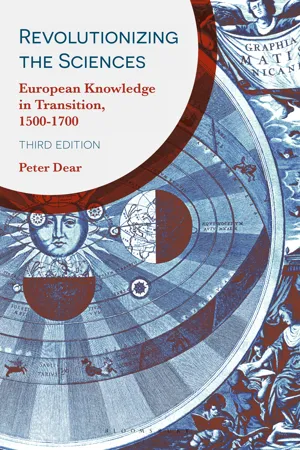
This heavily revised third edition of an award-winning text offers a keen insight into the development of scientific thought in early modern Europe. Including coverage of the central scientific figures of the time, including Copernicus, Kelper, Galileo, Newton and Bacon, this book provides a comprehensive overview of how the Scientific Revolution happened and why. Highlighting Europe's colonial and trade expansion in the sixteenth and 17th centuries, Peter Dear traces the revolution in scientific thought that changed the natural world from something to be contemplated into something to be used. This book is ideal for undergraduate and postgraduate students of Early Modern history, European history, history of medicine, history of science and technology and the history and philosophy of science. The first edition was the winner of the Watson Davis and Helen Miles Davis Prize of the History of Science Society. New to this Edition:
- Greater treatment of alchemy and associated craft activities, to reflect ongoing new scholarship
- More focus on geographical issues, especially relating to Spain and its New World territories, as well as Eastern Europe, but also further afield in Islamic territories including the Ottoman Empire, and South and East Asia
- New material on the themes of 'science and religion', gender and class
- More extensive treatment of the relationship in this period of medicine to the various sciences and especially to new natural philosophies
- Incorporation of new scholarship throughout
- A whole chapter dedicated to Francis Bacon
- Further discussion of the gendered elements of natural philosophy
- A brand new historiographical essay
- 220 pages
- English
- ePUB (mobile friendly)
- Available on iOS & Android
eBook - ePub
About this book
Information
Chapter One
‘What was Worth Knowing’ in 1500
I The universe of the university
In 1500 the universities reigned over European intellectual life. Their organizational structures were closely modelled on the thirteenth-century prototypes from which they derived, and the content of their philosophical instruction generally conformed to the tenets of scholastic Aristotelianism already described. Those tenets engaged with more than just the formal characteristics of explanation, however; they were also tightly entwined with a picture of the structure and make-up of the physical universe.
Aristotelian philosophy spoke of a spherical universe at the centre of which was found the spherical Earth. Aristotle’s world, rooted in sense-experience, was always addressed to the position of human observers, not to that of some transcendent, godlike being viewing the whole from the outside. Accordingly, the heavens, above our heads, displayed different regularities from those observed by things around us on the Earth’s surface. The heavens revolved around the central Earth, cyclically generating the periods of time that structured both the calendar and the daily round. The heavens did not fall down; nor did they recede from us. By contrast, on Earth we are surrounded by heavy bodies that tend to fall, and light bodies that tend to rise. Thus the characteristic motions found naturally in the terrestrial realm were either towards the centre or away from the centre; those of the heavens, by contrast, took place around the centre.
That way of perceiving things was integrated with a theory of matter. How do we know what things are made of? For Aristotle, the answer is that we see how they behave. On the surface of the Earth, there are bodies that fall. These bodies are therefore described as having the characteristic property of heaviness, or gravity. But not all bodies that fall are the same. Solid bodies that fall are said to be composed primarily of the element ‘earth’, while liquid bodies that fall are said to be composed primarily of the element ‘water’. Both move as they do when they are displaced from their proper locations in the universe. The natural place of earth is at the centre of the universe, whereas the natural place of water is around the natural place of earth – which is why the oceans tend to surround solid earth. Corresponding to the two heavy elements are two light elements, air and fire, which possess, rather than ‘gravity’, the property of ‘levity’, or absolute lightness. Thus we see that air-bubbles and flames rise. Air occupies the region above that of water, while fire occupies that above air. The four together exhaust the number of elements making up terrestrial matter.
This terrestrial onion, earth at the centre, water, air and fire in successive shells around it, occupies only a small proportion of the universe. The vast region beyond the sphere of fire constitutes the heavens, moving cyclically around the centre. Because of that characteristic motion, categorically different from that of the terrestrial elements, the heavens are said to be composed of a single element, the ‘aether’, the natural motion of which is precisely this circular rotation. Indeed, it is on the basis of this routinely observed motion of the heavens wheeling overhead that the existence of aether is inferred to begin with – a natural motion needs an element for which it is natural.
The celestial bodies, consisting of the moon, sun and five planets (those visible to the naked eye) are carried around the Earth by transparent, invisible spheres. These spheres continue the onion motif: they are nested one within the next around the centre, each celestial body being embedded in the side of a distinct sphere. The spheres revolve, carrying the visible bodies around. The stars are out beyond Saturn, the furthermost planet, on the surface of their own enormous sphere. The idea behind the arrangement, again, is to account for what we, inhabitants of the Earth’s surface, see. The invisible celestial spheres must be there, because the visible celestial bodies have to be moved somehow. Experience-based knowledge, for Aristotelians, is not just a matter of what can be sensed directly, but also a matter of what can be inferred from experience.
There were further, more consequential aspects of the heavens that flowed from these considerations. Elements, as we have seen, were characterized by their natural tendencies towards motion, whether up, down, or around. But they could also change into one another, because that is a commonly experienced behaviour: liquids become solids, solids burn to produce fire, and so forth. Part of the concept itself, therefore, implied the possibility of change – at least as far as the terrestrial elements were concerned. The heavens, however, were immune to this kind of transmutation. They were composed of a single element, the aether, a fact that necessarily precluded substantial change. Things made of aether could be denser or rarer, but there was no other celestial element for them to change into. Nothing in the heavens came into being, or ceased to exist; celestial motion itself was cyclical, and no genuine novelty had ever been observed beyond the confines of the terrestrial region. Such ephemera in the skies as comets were accounted, almost by definition, as terrestrial: Aristotle held comets to be meteorological phenomena in the upper atmosphere, below the lowest celestial sphere, which carries the moon around the Earth. Terrestrial and celestial were distinct regions, therefore, governed by different physical constituents and correspondingly different physical behaviours. Terrestrial and celestial physics were both part of natural philosophy, but they represented different domains (Figure 1.1).

Figure 1.1 The Aristotelian universe in the sixteenth century, from Petrus Apianus, Cosmographia (1539). The order of the planets in distance from the Earth is that due to the astronomer Ptolemy (second century AD), which differs slightly from that of Aristotle himself but which was the norm in medieval and early modern accounts of the Aristotelian cosmos.
This was the world promulgated by the university arts curriculum; the world seen, contemplated, and explained by the scholastic natural philosopher. It was a complex universe, but it was also finite in at least two senses. Not only was it of limited spatial dimensions – a huge but bounded globe enclosing all of Creation – but the kinds of things that it contained, and the ways in which it behaved, were also strictly limited. Aristotelian natural philosophy specified the categories of things contained in the world, and exhaustively catalogued the ways in which they could be understood. The reason for the absence of innovation and discovery as a significant part of this worldview is that there was no real sense of the natural world as a vast field to be explored; there was nothing genuinely and fundamentally new to be found in it.
It is therefore significant that in 1500, at the start of our period, Christopher Columbus’s first voyage was only eight years in the past and the Americas had not yet received their name. The availability of geographical discovery-metaphors became much greater in the sixteenth and seventeenth centuries than had been the case previously: Europeans began to look outwards on a world that no longer corresponded to the classical geography found in the much-reprinted standard ancient text on the subject, Ptolemy’s Geography from the second century ad. This emerging sense that the world was large, and largely unknown, was not, therefore, purely a matter of philosophy.
The sharply defined quality of Aristotle’s physics, which provided such a bounded field for natural philosophy, arose from the four causes into which he analysed the categories of human explanation. His basic question amounted to asking ‘How do we understand things?’ His answer was that, in practice, we understand or explain things according to four models, which he designated ‘causes’. Together, the four causes are intended to exhaust all the possible ways in which people explain or understand. Thus ‘final cause’ explanations make sense of the behaviour or properties of something by invoking its purpose: a ‘final cause’ is ‘that for the sake of which’ something occurs. Thus, I walk because I’m going towards a destination; a sapling grows because it strives to be a fully grown tree. In a different sense – this time not one relating to a process – a final cause can also serve to explain why something is the way it is. It does so by identifying what that thing is good for – such as explaining the arrangement of teeth in the mouth by reference to their use in chewing.
Another of the four, the ‘material cause’, explains by reference to what a thing is made of: my chair burns when ignited because it is made of wood, an inflammable material. The ‘efficient cause’ (sometimes translated as the ‘moving cause’) is closest to our modern understanding of ‘cause’: it is that by means of which something is done or brought about. Thus the efficient cause of a gun firing might be the pulling of the trigger; or, of a snooker ball shooting across the table, the preceding collision between it and the cue-ball. Again, less familiarly, the efficient cause of a (wooden) table could be the carpenter who made it.
The trickiest, and at the same time most characteristic, of Aristotle’s four causes is the ‘formal cause’. This provides for any kind of explanation that makes reference to the nature of something. Consider again the classic medieval syllogism:
All men are mortal
Socrates is a man
Therefore, Socrates is mortal.
The formal cause of Socrates’ mortality is the fact that he is a man – that is the kind of thing that he is – and it is in the nature of men to be mortal. Or, if I am asked why my dog stole the dinner from the table, I would explain by saying ‘because he’s a dog!’ This kind of cause is known as ‘formal’ because Aristotelians described the kind of thing that something is as its ‘form’.
The concept of forms is central to Aristotelian thought. It arose from a reinterpretation of a general philosophical problem considered by Aristotle’s teacher, Plato. How does one recognize what an individual thing is? How does one know, for example, that this tree is a tree rather than a bush, or even a helicopter? Plato’s answer, in which he was followed by Aristotle, was to say that one must already know what a tree is in order to recognize one. And what one already knows, namely what a tree is in general (that is, what sort of thing a tree is), Plato described as knowledge of a tree’s form. Forms, for both Plato and Aristotle, are in effect categories into which individual objects can be sorted. The category into which something fits (tree, bush, helicopter) represents what kind of thing that object is: Socrates, in the earlier example, is a man. Thus the world is seen as being made up of categories, or classificatory boxes, that can take account of everything that exists or could exist. Aristotle’s is a vision of the world that sees it as a taxonomic system, in which there is a place for everything. True philosophical knowledge amounts to putting everything in its place. The purpose of this scheme was to understand in the most fundamental way what things were and why they behaved as they did. And Aristotle’s taxonomy of causes determined, as taxonomies tend to do, what could and could not be said of natural phenomena, and what was worth saying. This is true, however, of any system of classification, and by extension true of any framework within which to organize knowledge of nature. It is not the case that Aristotelian philosophy restricted the sciences of nature whereas its replacements extended their scope. Any single system would have had these same structural characteristics, some of which we will see in later chapters. But the abandonment of scholastic Aristotelianism during the seventeenth century was accompanied by a proliferation of alternatives which, collectively, greatly expanded the possibilities – even if most of those different possibilities would have been rejected by their rivals. In the case of those systems which were presented as something quite new, there was in addition the prospect of unpacking their implications and following their precepts for the first time, in contrast to the well-surveyed territory of their Aristotelian predecessor.
II Natural knowledge and natural philosophy
The scholastic Aristotelianism prevalent in Europe at the start of the sixteenth century differed in some significant respects from the philosophy found in the writings of Aristotle himself. That philosophy, and particularly its natural-philosophical components, had first been assimilated into the academic world of Roman Catholic (or Latin) Europe in the twelfth and thirteenth centuries. The assimilation wrought its own changes, which sprang from the settings in which Aristotle was of most interest. Scholars tended overwhelmingly to be clerics, since those were the people most likely to be literate. The Church, as the dominant institution throughout Western and Central Europe, played a major role in determining intellectual priorities: Aristotle came to be valued because he could be used to illuminate matters of theological interest. After conflicts and disagreements during the thirteenth century, especially at the University of Paris, the works of Aristotle on a whole range of subjects from logic and rhetoric to meteorology were securely ensconced in the curricula of the new universities, even while official Church dogma still tended to circumscribe some aspects of their interpretation. The theological value of natural philosophy stemmed straightforwardly from its topical focus: interpreted from a Christian standpoint, it concerned God’s Creation. Learning about God by learning about what He had made, and understanding the whys and wherefores of its fabric, was seen by many as an eminently pious enterprise. Natural philosophy became a religious endeavour, and it remained so for many centuries. In the early eighteenth century, Isaac Newton wrote that ‘to treat of God from phenomena is certainly a part of natural philosophy’.1
This is not to say, however, that natural philosophy in medieval and early modern Europe was always understood to deal with the natural world as God’s Creation. Usually it was, but, as Newton’s protestation suggests, the connection was not a necessary one. In sixteenth-century Padua (a leading university centre not far from Venice), as previously in thirteenth-century Paris, so-called ‘Averroism’ caused great controversy by purporting to discuss Aristotelian natural philosophy in isolation from a Christian theological context. The twelfth-century Arabic philosopher Ibn Rushd, known in the Latin world as Averroës, had written extensive commentaries on Aristotle’s philosophical writings that attempted to explicate their content independently of extraneous religious doctrines (in Averroës’ case, Islamic doctrines). In the thirteenth century some Christian scholars at Paris followed Averroës’ lead, developing his interpretations of Aristotle in sometimes flagrant disregard of theological controversy. Their frequently condemned attempts to get away with this relied on the possibility of representing their endeavour as natural philosophy rather than theology; natural philosophy was not always seen as a study of the divine. The Averroist position was, however, opposed by such alternatives as that of Thomas Aquinas. Aquinas made a very influential attempt in the thirteenth century explicitly to disallow Averroism; his view of natural philosophy as a ‘handmaiden’ to theology quickly became commonly accepted, and coloured the conception of the discipline thereafter. In practice if not always in principle, natural philosophy and theology had become inextricably linked.
The university world of 1500 had expanded significantly since the foundation of the first universities in the later twelfth century. The word ‘university’ is an English version of the Latin universitas, a term routinely applied in the medieval period to legal corporations. Only over the course of centuries did ‘university’ come to be associated specifically with those corporations (whether of scholars or of students) devoted to educational purposes and offering various grades, or ‘degrees’, through which the student attempted to pass. The fifteenth century saw a rapid increase in the number of universities across Europe, largely due to the foundation of new institutions in the eastern parts of Catholic Europe, such as Poland (the astronomer Nicolaus Copernicus studied at the university in Krakow in the 1490s). The newer foundations retained the same basic organizational structure as their earlier prototypes: the basic unit was the so-called ‘faculty of arts’, the division that dealt with the ‘liberal arts’ of which philosophy (natural, metaphysical and moral) was the major component. Following successful passage through the two degrees of Bachelor and then Master of Arts, students aiming at a doctorate in a professional discipline went on to study in one of the three ‘higher’ faculties of medicine, law and theology. In the non-Italian universities, north of the Alps, theology was usually the most important of the three. This vocational direction tended to affect the treatment accorded to natural philosophy, reinforcing its perceived role as a handmaiden to theology.
A characteristic shared by all three of the higher faculties (in common with the faculty of arts) was that they served vocations that were closed to women. It is therefore unsurprising that there was virtually no place for women in the universities themselves; the basic purpose of the university was to train young men in one of the professions. The most characteristic, and important, vocation in the Middle Ages lay in the Church – perhaps the exemplar of a major social institution restricted to men. Clerics could in principle, and to varying extents did, come from all social classes; but they could never be female. This fact is probably too deeply rooted for its implications to be unequivocally traced, but it has been suggested that the longstanding domination of Western science by men may owe something to the clerical character of its academic and scholarly origins. What effect that may have had, in turn, on the conceptual and ideological structure of the sciences cannot be clearly stated, owing to the vast number of mediations that would have to be traced to make the relevant connections. Nonetheless, it will be important to bear in mind this basic social fact about the knowledge ente...
Table of contents
- Cover
- Half Title
- Title Page
- Copyright
- Contents
- List of Figures
- Preface
- Introduction: Natural Philosophy and Instrumentality
- 1 ‘What was Worth Knowing’ in 1500
- 2 Humanism and Ancient Wisdom: How to Learn Things in the Sixteenth Century
- 3 Paracelsus and Bacon: Philosophy as Practical Knowledge
- 4 Mathematical Practitioners and Mathematical Philosophers
- 5 Mechanism and Corpuscles: Descartes Builds a Universe
- 6 Extra-Curricular Activities: New Places for Natural Knowledge
- 7 Experiment: How to Learn Things about Nature in the Seventeenth Century
- 8 Cartesians and Newtonians
- Conclusion: What was Worth Knowing by the Eighteenth Century?
- Notes and References
- Documentation and Further Reading
- Dramatis Personae
- Glossary of Major Terms
- Index
Trusted by 375,005 students
Access to over 1.5 million titles for a fair monthly price.
Study more efficiently using our study tools.
Frequently asked questions
Yes, you can cancel anytime from the Subscription tab in your account settings on the Perlego website. Your subscription will stay active until the end of your current billing period. Learn how to cancel your subscription
No, books cannot be downloaded as external files, such as PDFs, for use outside of Perlego. However, you can download books within the Perlego app for offline reading on mobile or tablet. Learn how to download books offline
Perlego offers two plans: Essential and Complete
- Essential is ideal for learners and professionals who enjoy exploring a wide range of subjects. Access the Essential Library with 800,000+ trusted titles and best-sellers across business, personal growth, and the humanities. Includes unlimited reading time and Standard Read Aloud voice.
- Complete: Perfect for advanced learners and researchers needing full, unrestricted access. Unlock 1.5M+ books across hundreds of subjects, including academic and specialized titles. The Complete Plan also includes advanced features like Premium Read Aloud and Research Assistant.
We are an online textbook subscription service, where you can get access to an entire online library for less than the price of a single book per month. With over 1.5 million books across 990+ topics, we’ve got you covered! Learn about our mission
Look out for the read-aloud symbol on your next book to see if you can listen to it. The read-aloud tool reads text aloud for you, highlighting the text as it is being read. You can pause it, speed it up and slow it down. Learn more about Read Aloud
Yes! You can use the Perlego app on both iOS and Android devices to read anytime, anywhere — even offline. Perfect for commutes or when you’re on the go.
Please note we cannot support devices running on iOS 13 and Android 7 or earlier. Learn more about using the app
Please note we cannot support devices running on iOS 13 and Android 7 or earlier. Learn more about using the app
Yes, you can access Revolutionizing the Sciences by Peter Dear in PDF and/or ePUB format, as well as other popular books in History & European History. We have over 1.5 million books available in our catalogue for you to explore.