- 232 pages
- English
- ePUB (mobile friendly)
- Available on iOS & Android
eBook - ePub
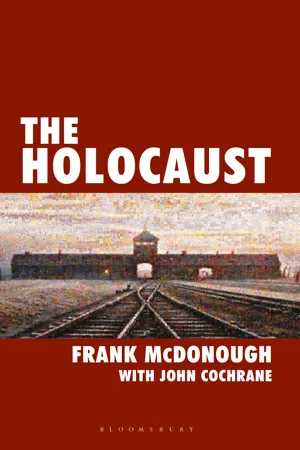
The Holocaust
About this book
The Holocaust is a subject of enormous historical importance. The murder of approximately 6 million Jews stands apart as a perhaps the most horrendous episode in world history. In this fresh introduction, McDonough examines the racial war-within-a-war, outlining controversies and examining how it has been popularised and institutionalised.
Information
Part I
The Road to the Final Solution
1
Hitler and ‘the Jewish Question’ before the Second World War
Few historians can agree about any aspect of the Holocaust. But what every historian can agree on is that Adolf Hitler held a dominant position within the Nazi Party and the governance of Nazi Germany. Any full and meaningful understanding of the Holocaust must begin with an assessment of Hitler’s views and policies on the Jewish Question before the Second World War. This approach may seem to corroborate the intentionalist view that Hitler’s views on the Jews displayed a remarkable consistency, and to reduce the ‘Final Solution’ to just another aspect of Hitler’s ‘master plan’ to dominate Europe and destroy the Jewish race. In reality the alternative functionalist position, which suggests that Hitler never planned the destruction of the Jews in advance, can be equally invigorated by examining evidence culled from his early life and political career. Indeed, when Hitler’s views on the Jewish Question are examined in detail it can be seen that there was no ‘straight road’ to Auschwitz. It was a much more complicated long and winding route. The so-called ‘essential continuity’ of Hitler’s views on the Jewish Question so beloved of intentionalist historians is immediately compromised by an examination of his early life.
In the small Austrian town of Linz where he lived as a teenager Hitler described himself as a ‘weak-kneed cosmopolitan’ with no ‘strong views’ on the ‘Jewish Question’. August Kubizek, his closest friend at this time, recalls that a virulent hatred of Jews was not a central obsession of the future rabble-rousing anti-Semite. Hitler had expressed heartfelt gratitude and respect towards Dr Bloch, a Jewish family doctor, who had looked after his mother while she endured terminal breast cancer. When Hitler moved to the cosmopolitan Austrian capital of Vienna in 1907 he came into contact with Jews of many nationalities for the very first time. Some historians have suggested that it was Hitler’s personal encounter with Jews in Vienna that brought the whole question of anti-Semitism to the forefront of his thoughts. In Mein Kampf, Hitler claimed that his personal contact with Jews on the streets of Vienna led him to take more notice of their ‘alien’ physical appearance. Hitler was soon avidly reading the anti-Semitic attitudes expressed in Austrian nationalist newspapers, political pamphlets and periodicals. It would seem – from this scant evidence – that there was a basic continuity between this initial hatred of Jews in Vienna and his later burning desire to ‘remove’ them from German society when in power. But Hitler’s time in Vienna is a very mysterious period. The real depth of his anti-Semitic thinking at this time is extremely difficult to fully establish, given the fragmentary nature of the evidence. It has recently come to light that Hitler, the young artist, always sold his drawings and paintings to Jewish dealers because he regarded them as by far the most trustworthy. He had many Jewish friends at the lodging house where he lived for several years. He regularly attended congenial musical evenings at the home of a local Jewish family. It seems Hitler’s anti-Semitic views were by no means radical or exceptional in the context of Vienna during the time when he resided there. The views Hitler expressed in Mein Kampf on the ‘Jewish danger’ were more self-serving rhetoric, which attempted to reveal a future vision of the ‘Jewish danger’ as seen by Hitler during his Vienna period, when in reality his overall behaviour in the Austrian capital does not indicate he had already developed an unchangeable view of the Jews that led all the way to Auschwitz.
Even Hitler’s period in the German army during the First World War does not appear to have brought forth any dramatic hardening of his alleged extreme anti-Semitic views. His fellow soldiers described him as a humourless, isolated, but patriotic soldier who was fully behind the German war effort. He was affectionately nicknamed ‘Uncle Dolf’ as he seemed more serious, much older (he was in his mid-20s) and less fun loving than most of his fellow comrades. No one remembers him talking about his views on ‘the Jews’ at all in the trenches. The one sure fact about his time as a soldier in the trenches we do know is that he was recommended for the award of an Iron Cross 1st Class by a Jewish officer. Only during the latter stages of the First World War did Hitler start to believe in the popular ‘stab in the back’ myth. This suggested the German war effort was being severely undermined by ‘Jewish socialists’ and ‘war profiteers’ on the home front. While on leave in Munich and Berlin, Hitler noticed that ‘most of the people in offices and banks were Jewish’, and after reading about most of the socialist agitators who opposed the war he also concluded they were Jewish too.
In November 1918, Hitler was not prepared for the German defeat. By his own admission, the news of the armistice which ended the First World War brought him anger, a flood of tears (the first he had shed since his mother’s death) and a bitter longing for revenge against Germany’s internal and external enemies. During his time at Pasewalk sanatorium, recovering from a mustard gas attack, the link Hitler made between the military defeat and the undermining of the German war effort at home by a ‘stab in the back’ grouping of what he called ‘Jews and Communists’ has been seen by some historians as an important factor in the remarkably strong and radical anti-Semitic stance he adopted after 1918. Rudolph Binion, in a psycho-history on the Nazi dictator, argues that Hitler’s ‘mission to remove Germany’s Jewish cancer’ actually derived from an hallucination Hitler had while at Pasewalk in which he equated the death of his mother, attended by her Jewish doctor, with Germany’s defeat in the war. He allegedly awoke from this dream determined to kill the Jews and avenge the German defeat in war.1
After 1918, a violent hatred of the Jews does occupy a dominant place in Hitler’s political outlook and thinking. The defeat – according to Hitler – was due to the Jews who had weakened German patriotism and incited Marxist revolution at a vital stage of the conflict. On his return to Munich, early in 1919, his growing interest in the ‘Jewish Question’ was augmented by attending an army-sponsored short course at Munich University. He made a great impression on his tutors and it was his passionate anti-Semitic opinions during the seminar discussions which were remembered. Many of his army superiors in Munich were also greatly impressed by his anti-Semitic and anti-communist political stance. Captain Karl Mayr, who at the time was in charge of a clandestine Reichswehr counter-intelligence project, which aimed to spy on left-wing fringe groups and encourage German workers to abandon support for socialism, quickly recruited Hitler to this project. Mayr initially asked Hitler to brief one of his army colleagues, Adolf Gemlich, on the ‘Jewish Question’. In a letter to Gemlich dated 16 September 1919, Hitler offers his first lengthy recorded opinion on the ‘Jewish Question’. He begins by describing anti-Semitism ‘as a political movement’, which ‘cannot be defined by emotional impulses but only by recognition of facts’. The ‘Jews were a race’, wrote Hitler, not a ‘religious association’, who maintained their racial unity and racial purity by owing their primary allegiance to their own ‘race’, not any country in which they lived. To Hitler, Jews were like ‘a racial tuberculosis’, and a critical opponent of national unity. They sought to manipulate public opinion towards cosmopolitan and international ideologies through their control of the press. According to Hitler, Jews were quite happy to promote racial inter-marriage, but they themselves only married people of their own ‘race’. For all these reasons, Jews had to be ‘removed’ from society, not in violent ‘pogroms’, but as part of a rational and unemotional programme of anti-Semitic legislation en route to what he called ‘the final objective’: the ‘removal’ (Entfernung) of Jews from Germany through a programme of emigration. Hitler claimed that only a government of ‘national vitality’ would be capable of achieving this ultimate goal.2 At the time it was written, this was a very routine letter, but in the context of the enormity of the physical annihilation of the Jews, it has been viewed by many intentionalist historians, most notably Lucy Dawidowicz, John Toland and Sebastian Haffner, as deeply significant. A major aspect of the intentionalist approach is to reveal evidence from Hitler’s writings and speeches to illustrate their influence on his later actions towards the Jewish Question as German leader. The letter to Gemlich is certainly evidence that shows how quickly anti-Semitism had come to dominate Hitler’s thinking at the end of the First World War. It is also possible to interpret Hitler’s ‘final’ aim of the ‘removal’ of the Jews from German society, mentioned in this letter, as containing the possibility of violence and even genocide. But the letter is open to an alternative interpretation as Hitler explicitly rules out violent ‘pogroms’ against the Jews in the same letter and he clearly emphasises that the removal of the civil liberties of Jews by legislation followed by emigration abroad are the policies he favours to deal with the ‘Jewish Question’.
Even so, during the early 1920s anti-Semitism was at the very core of Hitler’s political ideology. Most of Hitler’s earliest rabble-rousing speeches in the beer halls of Munich are full of bile and hatred towards Jews. On 13 November 1919, in his first major public speech, Hitler said: ‘We will carry on the struggle [against the Jews] until the last Jew is removed from the German Reich.’3 In a speech in Salzburg on 7 August 1920, Hitler said that ‘the poisoning of our people’ would not end ‘unless the cause [the Jews] are removed from our presence’. But in similar speeches during this period Hitler stressed that he did not want to create a ‘pogrom mood’ against ‘the Jews’. He mainly wanted his nationalistic audience to grasp the ‘evil’ aims of Jewish internationalism on German society and to see that the ‘expulsion’ of Jews from Germany would be the most ‘thorough’ solution to the Jewish Question.
Hitler was further influenced in the radicalising of his anti-Semitic views during the early 1920s by Dietrich Eckart, a poet and journalist with a serious alcohol problem. Under the influence of Eckart, Hitler’s speeches added new anti-Semitic phrases. Hitler increasingly called the Jews a ‘parasite race’ and portrayed Jewishness as a sort of ‘disease’, disrupting any possibility of racial purification within Germany. Eckart wrote many of the anti-Semitic pamphlets, in which these phrases frequently occur. Hitler claimed he drew great inspiration in the development of his own anti-Semitic thinking from Eckart’s best known anti-Semitic tract called That is the Jew, which Eckart handed to him at the end of one of the first Nazi Party meetings he attended.
The two books Hitler penned during the 1920s: Mein Kampf (1924) and the Secret Book (1928), offer a detailed outline of his views on the Jewish Question at this juncture. They outline how his radical anti-Semitism was an integral part of his drive to ‘purify’ the German race in preparation for his primary foreign-policy goal of making Germany the most dominant power in Europe through the acquisition of living space (Lebensraum) during a war of conquest in eastern Europe, against the ‘Jewish–Bolshevik’ Soviet Union. Mein Kampf, which has a very ramshackle structure, is in part selective autobiography, part ideological tract and part blueprint for future political action. At the very epicentre of Hitler’s often contradictory and confused ideas is a single theory which postulates that history is not, as Marx suggested, a class struggle but instead a struggle for existence between the strong and pure races over the weak and mixed ones. The principle of ‘natural selection’ suggested stronger races would impose their strength and will on weaker races. In Mein Kampf, Hitler divided the world into three hierarchical racial groups in which only the purity of blood determined the historical pecking order. At the top were ‘Aryans’, who were defined as those who created cultures; below them were ‘the bearers of culture’, defined as those who cannot create cultures of their own but who can copy them from Aryans; and at the bottom, ‘the inferior peoples’, who cannot create or copy cultures but can only destroy them. The primary goal for Hitler was to reconstruct the purity of the ‘Aryan’ German race, which would involve a far-reaching programme of racial purification that would take many decades to achieve. To rescue the Germans from years of the so-called ‘pollution of decadence’ was a central aim of Hitler’s world vision. The racist state he imagined would isolate and sterilise the ‘incurables’, the ‘alcoholics’, prostitutes and the ‘mentally and physically disabled’ and would subject them to sterilisation, thus ending their ability to procreate. Hitler said the ‘preservation of the nation is more important than the preservation of these unfortunates’. The aim was to create a society built on the principles of eugenics.4
But Hitler placed two enemies at the top of his hit list in his drive for racial purity: Marxists – a political enemy – and Jews – his key racial enemies. A passionate and violent hatred of Marxism runs through every chapter of Mein Kampf. Hitler wanted to ‘eliminate’ Marxism within German society. He constantly used words such as ‘extermination’ or ‘exterminating’ when speaking of what he wanted to do about Marxism in Germany. At his infamous trial for treason – following the bungled Nazi attempt to gain power in Bavaria, known as the Munich Beer Hall Putsch (1923), Hitler told the indulgent right-wing judge that he wanted to be remembered as ‘the breaker of Marxism’. But whenever Hitler mentioned Marxists he always implied they were either ‘Jews’ or were ‘controlled by Jews’. He often said Marxism was just a convenient internationalist ideology which was used by Jews to promote the political wing of the ‘world conspiracy’. This far-fetched conspiracy theory was supposedly outlined in The Protocols of the Elders of Zion, a faked document which originated from the Russian Tsarist government, which was itself fighting a growing communist threat. It outlines a very ambitious Zionist plan for world domination and was circulated widely among nationalist groups in Germany before 1914. Jewish organisations frequently pointed out that this was a fabricated document. But Hitler believed it was authentic. ‘If, with the help of the Marxist creed, the Jew is victorious over the other peoples of the world’, writes Hitler in Mein Kampf, ‘his crown will be the funeral wreath of humanity.’5 By ‘removing’ Jews from German society and waging a bitter ideological war against ‘Bolshevism’ in Germany, Hitler believed that he was ‘fighting for the work of the Lord’ and ‘acting with the will of the Almighty creator’.6
For Hitler, ‘the Jew’ was a universal scapegoat responsible for all the things he felt undermined the racial purity and racial unity of the German people. The Jews, defined as a ‘stateless race’, sought to exploit every nation in which they lived and hoped to promote cosmopolitan ideas that would lead to their domination of a stateless world. The language Hitler uses in Mein Kampf against Jews is filled with derogatory and hate-filled anti-Semitic rhetoric. Hitler blamed ‘the Jews’ for the German military defeat of 1918, the German revolution, the growth of socialism, economic problems, cultural degeneration and much else. He describes the Jews variously in Mein Kampf as ‘a maggot on a rotting corpse’, ‘not human’, a ‘germ carrier of the worst sort’, mankind’s ‘germ of disunion’, the ‘spider that slowly sucks the people’s blood’, or as ‘vermin’, ‘bacilli’ and ‘parasites’. Behind every ‘anti-patriotic force’ there lurked for Hitler ‘the Jew’, with ‘satanic joy on his face’ as he ‘replaced democracy by the more virulent ‘dictatorship of the proletariat’. He claimed Jews were seeking financial control over the stock market, contaminating art, literature and the theatre, and using the press to spread lies about patriotic nationalists. Even the long-cherished Jewish demand for a Palestinian homeland was denounced by Hitler as a means for Jews to establish a central organisation to promote what he called their ‘international world swindle’. These highly prejudiced views provided Hitler and the Nazi Party with an explanation for the political chaos in post-war Germany. The Jews also occupy a central place in Hitler’s foreign-policy aims. The Soviet Union was, according to Hitler, ‘Jew-dominated’ and communism had destroyed the old ruling classes and was Germany’s major enemy in a future war. France was Germany’s chief ‘hate-filled enemy’ in western Europe with a ruling elite that was supposedly ‘tied up with the Jews’ and had to be dealt with also in any future European war. Hitler held out some hope for better relations with Britain and Italy as he felt there was less Jewish domination over the political elites within these two nations. The battle to gain British friendship, however, would depend on whether the patriotic British could overcome the powerful Jewish influence in that nation. In Hitler’s fanatical mind, the struggle against the Jews was a defensive one as he believed that unless Jewish domination was ended, Germany could not survive as a nation and would inevitably be gobbled up by the so-called ‘Jewish–Bolshevik monster’ and the ‘Jewish world conspiracy’.
It can hardly be denied that in Mein Kampf and the Secret Book anti-Semitism occupied a central place in Hitler’s ideology and aroused considerable feelings of hatred within him. Whenever he spoke of the German defeat in 1918, Jews were at the forefront of his thoughts. The Jew was the barrier to racial purity within Germany and a key enemy of Hitler’s desire for a new world order. Hitler does use the words ‘removal’ and ‘elimination’ when describing how he will deal with Jews within Germany if he gained power. Yet there is no mention in either book of a desire to remove the Jews from Germany by killing them in a systematic fashion as occurred during the Holocaust. Hitler’s attitude to the Jews encompassed a homicidal element, but there is no evidence of an extermination plan. He proposed only to combat the Jews by legal means within Germany. The slogan ‘Jews out’ was used frequently in Nazi electioneering propaganda during the 1920s. In Hitler’s Secret Book, written in 1928 but not published in his lifetime, Hitler concedes at ...
Table of contents
- Cover
- Title Page
- Copyright
- Dedication
- Contents
- Acknowledgements
- Chronology
- Introduction
- Part I: The Road to the Final Solution
- Part II: The Impact of the Holocaust since 1945
- Conclusion
- Notes
- Who’s Who in the Holocaust
- Select Bibliography
- Index
Trusted by 375,005 students
Access to over 1.5 million titles for a fair monthly price.
Study more efficiently using our study tools.
Frequently asked questions
Yes, you can cancel anytime from the Subscription tab in your account settings on the Perlego website. Your subscription will stay active until the end of your current billing period. Learn how to cancel your subscription
No, books cannot be downloaded as external files, such as PDFs, for use outside of Perlego. However, you can download books within the Perlego app for offline reading on mobile or tablet. Learn how to download books offline
Perlego offers two plans: Essential and Complete
- Essential is ideal for learners and professionals who enjoy exploring a wide range of subjects. Access the Essential Library with 800,000+ trusted titles and best-sellers across business, personal growth, and the humanities. Includes unlimited reading time and Standard Read Aloud voice.
- Complete: Perfect for advanced learners and researchers needing full, unrestricted access. Unlock 1.5M+ books across hundreds of subjects, including academic and specialized titles. The Complete Plan also includes advanced features like Premium Read Aloud and Research Assistant.
We are an online textbook subscription service, where you can get access to an entire online library for less than the price of a single book per month. With over 1.5 million books across 990+ topics, we’ve got you covered! Learn about our mission
Look out for the read-aloud symbol on your next book to see if you can listen to it. The read-aloud tool reads text aloud for you, highlighting the text as it is being read. You can pause it, speed it up and slow it down. Learn more about Read Aloud
Yes! You can use the Perlego app on both iOS and Android devices to read anytime, anywhere — even offline. Perfect for commutes or when you’re on the go.
Please note we cannot support devices running on iOS 13 and Android 7 or earlier. Learn more about using the app
Please note we cannot support devices running on iOS 13 and Android 7 or earlier. Learn more about using the app
Yes, you can access The Holocaust by John Cochrane,Frank McDonough in PDF and/or ePUB format, as well as other popular books in History & World War II. We have over 1.5 million books available in our catalogue for you to explore.