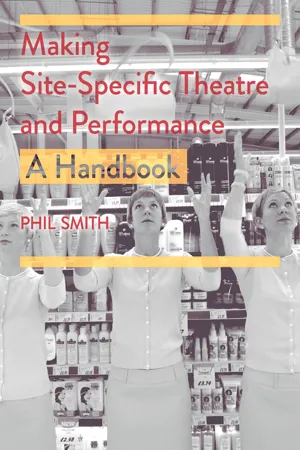
This practical, accessible and far-reaching guide to making site-specific theatre and performance emphasises the diversity of approaches to the practice, and explores key principles of space and site. Phil Smith draws on a wide range of interdisciplinary and international performance examples, and uses an innovative variety of exercises, to show students and aspiring performance-makers how to find a site and generate a performance beyond the theatre building.
- 264 pages
- English
- ePUB (mobile friendly)
- Available on iOS & Android
eBook - ePub
About this book
Information
Finding a Site
© Phil Smith, u der exclusive lice ce to Spri ger Nature Limited. 2019
Phil SmithMaking Site-Specific Theatre and Performancehttps://doi.org/10.26777/978-1-352-00318-5_11. Why Make Site-Specific Performance?
References
There is good cause to challenge any use of the word ‘site’. The word implies far more than, say, ‘space’ or ‘place’. It suggests that a human choice has already defined its boundaries, meaning and identity. A site is always the site of something; with the implication that it is a kind of container for what is really important, for the valuable property that is in it but is different from the space itself. It says that space accrues its meaning through its use by humans; which, in an overwhelmingly unhuman cosmos, is an odd way of describing things. …
A section headed ‘Finding a site’, particularly in a handbook, might be expected to begin with some inventive tactics for exploring cities and natural expanses. Instead, it is important to begin by getting at what the ‘whys’ of site-specific theatre are; if only to dispel the idea that sites are neutral, natural places, blank pages on which you can write with impunity. Site-specific theatre is often characterised in terms of an impulsive and instinctual break from the dead weight of intellectual, building-based arts traditions, an escape to the freshness of the outdoors, to the randomness of the everyday world, even to the shock of the wild; but it is also a choice with its own traditions and legacies.
Where did site-specific performance come from? Why did it appear at all? What were, and what remain of, the original impulses, motives and motivations for making theatre and performance that consciously refuses designated sites and heads off in pursuit of a something ‘more real’ than staged illusions? Why turn to the churning of everyday life? And what new drives, if any, are emerging now to sustain this momentum?
Una Chaudhuri is just one of any number of academic critics and historians who identify the origins of these impulses with ‘an experimentation that began with Dadaism’ and that climaxes with ‘finally, site-specific theater’ (1995, p. 22). The extraordinary ‘moment’ of Dada in 1916, with its products and performances made and shared by exiled anti-war artists gathered together in neutral Zurich, meeting regularly to create the Cabaret Voltaire in a small bar, was goaded by a transnationalist bloodbath and reinforced in its escalating radicalism by the influence of the artists, thrown together by total war, on each other.
Dada has become a touchstone for artworks that seek to break from existing conventions of staging, presentation and representation. Dada’s paintings escaped from their frames. The episodic structure of its cabarets was used to parody to death live presence and representational performance. Through blasphemous pseudo-rituals, trances, contrived outrages and confrontations, and grotesquely masked buffoonery, the Dadaists generated an assault on nationalistic common sense and ‘rationality’. They disrupted artistic individualism, incorporated everyday things into privileged aesthetic discourses and macerated the literal and metaphorical meaningfulness of words.
Dada’s precedence for site-specific performance is manifest in the ‘Dadaist excursions’, inspired by Baudelaire’s rhetorical query ‘does there exist anything more charming, more fertile and more positively exciting than the commonplace?’ These ‘excursions’ were anti-touristic visits to places that had struck their organisers as lacking any reason for existing; most famously a 1921 foray to the repeatedly adapted and repurposed Church of Saint-Julien-le-Pauvre in Paris where the Dadaists yelled gnomic slogan-poems at passers-by.
The ‘moment’ of Dada has become something of an event horizon for radical art, a phenomenon from before which little information is allowed to radiate. Dada’s principles of rupture, rootlessness, fragmentation, nihilistic repetition, anti-art, irony and parody have often prevailed both in subsequent cultural practice and in critical theory, and they continue to inform an important seam of site-specific performance which is often closer to live art than theatre. These principles, however, are not the whole story of site-specificity’s roots. There are other less iconoclastic, though perhaps equally radical, strands.
Some of the later influences on site-specific performance have come from art forms that seem far from performance. Sculpture, painting and drawing, particularly through the fusions of land art as practised by the likes of Kazuo Shiraga and the Gutai group, Robert Smithson or Ana Mendieta, have all informed site-specific performance. These artists, given their prioritising of sensitivity to and enthusiasm for materials – Gutai is Japanese for ‘concreteness’; Smithson used heavy machinery to make his installations; Mendieta sank her body into mud and snow – and their preference for immersion in and communion with terrains, over rupture and separation from them, showed that site-specific works could be just as critical and political as those based on modernist fragmentation and disruption.
Other strands of influence spring directly from building-based theatre. Most crudely this can consist of existing plays, often with naturalistic dialogue, linear narratives and psychological characterisations that are almost directly ‘lifted out’ of theatre buildings and restaged in spaces not usually designated for theatre. While theatre scholar Bertie Ferdman suggests that this is far from a recent phenomenon and that ‘Theater has a rich history of taking place outside the traditional theatre building … Long before modernism’ (2013, p. 16), her citing of individual productions (e.g., a 1934 staging of The Merchant of Venice in a Venetian street and a play about the anarcho-syndicalist Buenaventura Durruti performed in a French factory in 1964) suggests an impulse repeatedly re-found and practice re-invented rather than a coherent ongoing tradition incrementally built upon.
In such productions, there are varying degrees of adaptation of the play to their new ‘grounds’, and varying degrees of adaptation of the spaces themselves. Today, there are numerous examples of companies making such work: Changeling Theatre in Kent (UK), the Castle Tours of the American Drama Group Europe/TNT throughout Europe, the plays staged on the plaza of the Art Tower Mito in Japan by the Mito Yagai-Geki and those of the many affiliates of the Institute of Outdoor Theatre in the USA. While it is possible to question quite what it is about many of these performances that is ‘specific’ to their sites, a significant proportion of what is described as site-specific theatre, particularly by journalists, looks much like this.
More profoundly, however, though far less obviously, there is another building-based theatrical influence on site-specific performance. Long before Dada, there was a break from the burgeoning dominance of the binary of extravagant melodrama on the one hand and realist or naturalistic appearance on the other over nineteenth-century theatre; one that resonates in continuing attempts to represent things beyond and above appearance. This was Symbolist Theatre. Spectral and idealist, mostly now derided or ignored as reactionary or effete, its proponents set out to dissolve and transcend the same conventions and frames that Dada would smash, disrupt and escape. Their performances ‘ow[ed] much to the interdisciplinary fusions … arguably evolved from Richard Wagner’s Gesamtkunstwerk … and early Romantic arguments for the inherent unity of all the arts’ (Machon, 2013, p. 29); an explosive concoction that all the time threatens to burst the limits of the theatre building. So, when Sara, a renegade Gnostic nun in Villiers De L’Isle-Adam’s Axël (1890), plunges a dagger into a heraldic sign and ‘the entire mass of the wall section [of the castle] cleaves into a wide, vaulted opening, glides and sinks gradually underground’ (De L’Isle-Adam, 1986, p. 149), or when the avalanche at the end of Henrik Ibsen’s Brand (1867) swallows everything in ice, or when in his The Master Builder (1893) the steeple is built right up through the ceiling of the theatre, these are not just visual effects. They are questionings of the physical frame of appearance and representation itself. They point theatre out beyond the container of the theatre building – just as much as a work like Max Ernst’s Culture Mechanism: The Robing of the Bride (1924) is encouraging painting to escape from its frame, literally and prefiguratively – while retaining a deep commitment to the theatrical as a heightened form of life that is distinct from the everyday.
An example of the continuing resonance of this Symbolist theatre for site-specific theatre is evident in an immersive performance created by the American director Robert Wilson (much of whose stage work is suffused by Symbolist aesthetics) working with two young Dutch artists and theatre makers, Boukje Schweigman and Theun Mosk, for the Oreol Festival on the island of Terschelling. Walking (2008) required its audience/participants to walk for around three hours at half ‘normal’ pace, one by one, at intervals, along a designated path through dunes and bushes, encountering various portals, installations and soundscapes, both natural and artificial. While the attentive supervision of the participants by usher-guides, called ‘angels’, was suggestive to some participants of preparations for a trip through an ‘underworld’ or ‘otherworld’, Wilson and his collaborators were careful to leave literal space and symbolic ambiguity through which their ambulatory audience could explore their own associations with the augmented landscape by way of an altered moving and seeing.
These theatrical strands of influence share some things in common with older lineages of performance that were, or are, sited outside of designated or conventional performance spaces. As Anna Wilson observes, although groups like Punchdrunk have often been contextualised in academic writing as inheritors of a tradition from high modernist groups of the 1960s like The Performance Group led by Richard Schechner, in fact their ‘ancestry has more in common with … [an] aesthetic reframing of populist everyday forms such as that of the game or theme park’ (2016, p. 173).
In discussions about site-specific art, the influence of these older (and sometimes imagined) traditions has been dampened by critical discourses that privilege ‘modernism’ and by the event horizon of Dada. Nevertheless, these much older traditions are demonstrably inspirational to site-based performances, from one-off productions like the Krampus play or ‘Nikolausspiel’ performed in the Church of the Angels at Pasadena (USA, 2016) to significant and long-standing practices like that of Red Earth (UK, founded 1989 and ongoing) who draw on or appropriate iconography and rituals from other cultures and from other times to inform spectacular landscape events and processions and even the speculative imagining of ‘lost’ prehistoric performances: ‘Butoh dancer Atsushi Takenouchi … his flowing movement balancing the stillness of the landscape and the restless energy of the sheep. The enclosure is opened, and the sheep run down the valley, weaving around him’ (Prior, 2011, p. 26). The range of these influential traditional performances – often informed to some degree by re-creation, the finessing of repertoire, creative excavation of archives, reforms and speculative imaging – include plough plays, carnival parades, the devotional dancing of the Mevlevis, eighteenth-century freemasonic rituals performed on a chalked ground plan, the two ‘horses’ (with their teasers and supporters) of Padstow’s ’Obby ’Oss, and the processing of sacred Christian statues around cities and villages during Easter.
In the mid-1990s I attended a processing of church statues around the Andalusian town of Aracena (Spain). I was struck by the many modes of performance that were deployed that night; a multiplicity at odds with the narrow formal rigours that characterise much representational building-based theatre or even modern-day Catholic church services. Here was a rich resource of performance forms and discourses that a theatre, freed of its buildings, could draw upon or indulge itself in. There was the shattering physical labour of those lifting and carrying the pasos (floats), the hypnotic repetitions of simple creaky marching music, the thrill of the shaking ornaments each time the unsteady pasos were raised up, the randomness of a halt for one of the statues to be serenaded (with a secular aria) by a professional singer from the upstairs window of her home, and the high theatricality of the nazarenos (penitential robes) with their distinctive capirotes (pointed hoods) not quite fully explained by the requirement of anonymity.
Here, procedure stood in for dramatic plot; rather than the events unfolding in novelty, the mystery was excavated predictably and always ‘once again’, high emotion erupted without preparation or crescendo as if there was always something hot and molten beneath the surface that the ritual could directly tap into. I was struck by the ways that rich symbolism and ordinariness were woven very closely; how beneath the ornately decorated paso the men lifting and carrying were only partially concealed, their fluorescent trainers shining and their heavily muscled and hairy legs straining beneath the frills.
Cathy Turner, in her book Dramaturgy and Architecture (2015), has described how performance, having burst out from the theatre building in the early twentieth century (in ways prefigured by Ibsen and others), did not then abandon architecture in the flurry of idealism and abstraction. Instead, performance often redirected its straining against the limitations of the stage onto new material ‘grounds’. Through various arts and esoteric groups, there were stagings of masques, pageants and processions that tied varieties of collectivist politics and (often theosophy-based) idealism to the new architectural forms of innovative institutions and communities. Mass choreographed movement played a part in this; human beings performing as parts of a eurhythmic social machine. Turner shows how, alongside the Symbolist Theatre’s drive towards a realistic representation of the unreal (ambience, death, mystery) and a Gnostic aspiration to be realised in its own negation, something else was advanced that was far more material, at times even steely and scaffolded, informed by the Constructivist and Bauhaus movements’ exposures of the mechanics, forms and philosophies of design as agencies in themselves.
This particular influence has been represented, more recently, in the work of those small professional groups that were characteristic of post-1960s experimental performance. So, for example, in Brith Gof’s Gododdin (1988), a seventh-century Celtic ‘last stand’ against Anglo-Saxon invaders was staged in the engine room of a disused car factory, directly engaging with and protesting the London-controlled neo-liberal dismantling of the architecture of heavy industry in Wales through the material revenant of its fading history. Even more explicitly in tune with the architectural performances of the 1920s are the interventions of the Office of Subversive Architecture (1995 and ongoing), mostly in Germany and Austria. These range from performative installations to the erection of ‘permanent’ structures as parts of a continuum of production along which the company can disperse narratives, objects, ideas and activism. They call this entanglement of their physical and intellectual products the ‘fictionalisation’ of their sites.
Developments in technical, artistic and productive practices and a renewed attention to terrains have all been crucial to repeated ‘turns’ to site-specificity; but theoretical ideas have also been influential. Such ideas have included the idealisation of fluidity and the privileging of rhizomic dispersal over and against fixed, vertical rooting in the work of critical theorists such as Gilles Deleuze and Felix Guattari, the popularisation of neo-vitalism, the ‘lure of the local’ and the dematerialisation of the art object (as both theorised by Lucy ...
Table of contents
- Cover
- Frontmatter
- 1. Finding a Site
- 2. Generating Performance
- 3. Shaping a Production
- Backmatter
Trusted by 375,005 students
Access to over 1.5 million titles for a fair monthly price.
Study more efficiently using our study tools.
Frequently asked questions
Yes, you can cancel anytime from the Subscription tab in your account settings on the Perlego website. Your subscription will stay active until the end of your current billing period. Learn how to cancel your subscription
No, books cannot be downloaded as external files, such as PDFs, for use outside of Perlego. However, you can download books within the Perlego app for offline reading on mobile or tablet. Learn how to download books offline
Perlego offers two plans: Essential and Complete
- Essential is ideal for learners and professionals who enjoy exploring a wide range of subjects. Access the Essential Library with 800,000+ trusted titles and best-sellers across business, personal growth, and the humanities. Includes unlimited reading time and Standard Read Aloud voice.
- Complete: Perfect for advanced learners and researchers needing full, unrestricted access. Unlock 1.5M+ books across hundreds of subjects, including academic and specialized titles. The Complete Plan also includes advanced features like Premium Read Aloud and Research Assistant.
We are an online textbook subscription service, where you can get access to an entire online library for less than the price of a single book per month. With over 1.5 million books across 990+ topics, we’ve got you covered! Learn about our mission
Look out for the read-aloud symbol on your next book to see if you can listen to it. The read-aloud tool reads text aloud for you, highlighting the text as it is being read. You can pause it, speed it up and slow it down. Learn more about Read Aloud
Yes! You can use the Perlego app on both iOS and Android devices to read anytime, anywhere — even offline. Perfect for commutes or when you’re on the go.
Please note we cannot support devices running on iOS 13 and Android 7 or earlier. Learn more about using the app
Please note we cannot support devices running on iOS 13 and Android 7 or earlier. Learn more about using the app
Yes, you can access Making Site-Specific Theatre and Performance by Phil Smith in PDF and/or ePUB format, as well as other popular books in Media & Performing Arts & Performing Arts. We have over 1.5 million books available in our catalogue for you to explore.