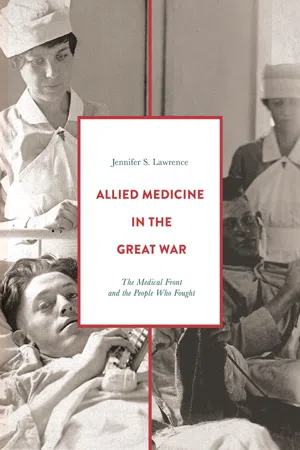
This book provides an overview of the history of allied medicine in the Great War. Based on both primary research and secondary literature, it offers a clear and concise account of medical treatment during the Great War, exploring the advancements of the period and the human experience of the medical war.As well as covering European medical work, the book draws on a range of American primary sources and texts in order to address the American medical experience of the First World War, an area that has been neglected by the existing literature.
This is an accessible exploration of the medical war, the people involved, and its impact. It is an essential text for undergraduate and postgraduate students of history taking courses on medicine in war, the history of medicine or the Great War.
eBook - ePub
Allied Medicine in the Great War
The Medical Front and the People Who Fought
- 175 pages
- English
- ePUB (mobile friendly)
- Available on iOS & Android
eBook - ePub
About this book
Information
© Jennifer S. Lawrence, under exclusive licence to Macmillan Publishers Ltd, part of Springer Nature 2019
Jennifer S. LawrenceAllied Medicine in the Great Warhttps://doi.org/10.26777/978-1-352-00420-5_11. The Great War
The Great War. The war to end all wars. Such brief statements are accurate and simple, but these also speak to the shock and disillusionment that World War I created. People needed these phrases to reflect the momentous nature of the conflict that upended their worlds. The concept of war changed from one focused on patriotism and heroism, though it was always darker than that. Instead, it became viewed as a man-made encounter that fosters brutality, suffering, and inhumanity. It was a beast that seemed to feed on itself, growing more difficult to stop as the months passed on. At no time was this ever more true than during the years of 1914 to 1918, when the Great War dominated world affairs. It was impossible to contemplate another war after this one.
This global conflagration burned up seemingly an entire generation of men. The war that was supposed to be so short, and was entered so hurriedly, dragged on for over four harrowing years. Approximately 65 million soldiers fought in World War I. This was an unheard-of sum at the time, and is difficult to grasp today. To put this in context, consider that the largest Western war in the decades immediately preceding World War I was the US Civil War. In that war, over 2.5 million Americans fought and over 600,000 died. More than 20-fold of that number fought in World War I.
In the Great War, nations faced the reality of industrial warfare writ large. The past European conflicts—the Austro-Prussian War, the Franco-Prussian War, or even the imperial fight of the British in the Boer War—each gave their own tantalizing hints of what industrial military might could mean. There had been new weapons: repeating rifles, accuracy at longer ranges, larger artillery shells, early versions of machine guns. But these conflicts bore more similarities to the military machinations of the Napoleonic era than to what warfare would mean in the twentieth century with the advanced weaponry that industrialization hath wrought.
In the years preceding the war, the possibility of armed conflict shadowed European nations such as France, Germany, and Russia. The system of alliances and balances of power that had held major warfare in check since the post-Napoleonic period began to teeter in the 1890s. This was in no small part due to the personalities of leaders and the, at times, moribund state of bureaucracy and government in several of the imperial governments. Paranoias, suspicions, and vacillations became the hallmark of government policy in more than one country. Diplomatic gamesmanship among the major powers of Europe continued through the quarter century prior to the start of the Great War, but with no clear hint that a full-out war was predetermined. Instead, outwardly, many of these countries diplomatically sought to avoid war. However, at the same time, Germany was building a naval fleet and new artillery guns that would be used in any coming conflict. Britain perfected its first dreadnought ship, revolutionizing naval vessels for all time and rendering irrelevant any combat ship design from the past. The arms race that occurred in the early 1900s did not happen by accident.
Although governments are often likened to monolithic institutions, the reality is that policy can be influenced by individuals. The personalities of some key people helped influence the eventual start and enlargement of the war. There were also psychological splits to be aware of between policy and personality. Germany was simultaneously portrayed as a warmonger in the years before 1914 and also praised for its love of peace. It was not a foregone conclusion that Germany would support a war in 1914.
The paranoia of Kaiser Wilhelm II, Germany’s monarch since 1888, contributed to the German perspective of its status in world affairs. The idea that Germany was encircled by its enemies held sway in the early twentieth century as Germany pointed toward both Russia and France as potential future opponents. The kaiser did not think he was respected as much as he deserved to be by fellow world leaders. Germany sought to increase its colonial holdings, taking a foothold in Samoa and eyeing other ports in the Pacific. Anxiety over German attempts to gain an Atlantic port in North Africa caused international incidents in 1905 and 1911.
In Austro-Hungary, the chief of the General Staff, General Franz Conrad von Ho¨tzendorf, dreamed of a European map without Serbia on it. Austria, he believed, needed to take over that problem territory, and he envisioned a small war should be able to accomplish that.
People spoke of a potential “Great European War” coming in the future, but for civilians that seemed to come as much from the fact that there hadn’t been a general conflict in so long that karma dictated that at some point there simply must be a war. Still, while tensions between European countries grew, few ordinary Europeans truly believed a large war was on the immediate horizon. In Dance of Furies, Michael Nieberg details how, rather, most Europeans took comfort in the fact that the Great Powers did compromise when crises arose and that they worked to maintain peace. This faith continued in 1914, and the onset of the war was truly a surprise to the ordinary person living in Europe, who expected yet another compromise would present itself at the last minute.
The Start of War
On June 28, 1914, Archduke Franz Ferdinand, heir to the throne of the Austro-Hungarian Empire, toured the city of Sarejevo, the capital of Bosnia-Herzegovina. Military maneuvers had been planned for his inspection outside of the city. This region had recently come under the administration of the Austro-Hungarian Empire despite the fact that many in it and in the region of the Balkans opposed the reach of the empire. A strike against the Austro-Hungarians was planned by a group of young pro-Serbian men who saw the policy of the Austro-Hungarian Empire as diametrically opposed to the existence of a strong, independent Serbia in the region. One of these young men, Gavrilo Princip, succeeded in shooting and killing Franz Ferdinand and his wife on this day.
The date, June 28, was a symbolic one for the Serbian people. It commemorated the Battle of Kosovo, fought in 1389, which saw the Serbians defeated by an encroaching Ottoman Empire. The battle, though, in many ways signified the beginning of the Serbians’ sense of national identity, and having the symbol of another encroaching empire in their backyard on this date seemed karmic.
There was great surprise at the assassination in the Austro-Hungarian Empire, though, perhaps, no real sorrow, as Ferdinand was not a popular person. But the government had to find out who was to blame for the assassination and who to punish. Serbia was at the top of the list because of a long-standing hatred by Austro-Hungarian officials of Serbia. These officials had long sought a war against Serbia. Serbia had been a thorn in the empire’s side as the empire sought to expand its reach through the Balkans. Subsequent investigations led to blaming the Serbian government for the assassination, but this was not a trumped-up charge. Specifically, Serbia was found to have been harboring a terrorist organization that planned the assassination. More recent research has confirmed that Serbian government officials did assist in the planning of the attack and even supplied the weapons, though it also seems that the Serbian officials did not believe the plan would work.1
Still, this was an issue between Serbia and Austro-Hungary to resolve at this point. It was a topic of conversation for Europeans that summer, but it cast no dark specter over events. People still took vacations, traveled, went to work, and made plans for the future. It was only in certain diplomatic circles that, as the weeks went by, something more serious loomed.
The diplomatic communiqués flew around the European capitals in the days of July as Sean McMeekin eruditely describes in his book July 1914. Austro-Hungary sent an ultimatum to Serbia that stated that the only way to avoid war was essentially for Serbia to give up its independence and allow Austro-Hungary oversight for a number of Serbian institutions. Although Serbia was willing to compromise on a number of issues, full adherence to this ultimatum was not something Serbia was prepared to do, so the crisis continued.
As Austro-Hungary prepared for war against Serbia, other countries stepped in to the argument to complicate matters. Russia did not want to see Serbia subsumed into the Austro-Hungarian Empire, and looked as if she might enter into the conflict. Austro-Hungary, who feared a war alone against Russia, turned to its historic ally of Germany for additional backing as preparations for war progressed in July of 1914.
The German foreign minister sent a message to Vienna, essentially giving Austro-Hungary a “blank check” in how it chose to proceed. Notably, there was little discussion over the wording, and the Kaiser himself was not aware at what this message “promised.” Although probably not intending to appear as giving a blanket endorsement of war, nevertheless Germany came to be seen as the aggressor nation that fanned the flames instead of one that imposed limitations on Austro-Hungarian dreams of vengeance. In the aftermath of the war, this decision is one of the elements used to peg Germany as being responsible for enlarging the conflict, and the “war guilt” clause of the Treaty of Versailles would confirm this international opinion. The punishment visited on Germany for this would be severe.
Focus now shifted to German military machinations. The German military had long believed that another war was likely, and when it happened, it would feature Germany fighting on two fronts in such a conflict—against Russia on one side and France on the other. Germany had long seen itself encircled by enemies. Therefore, military planners embraced a plan that would enable Germany to have success on two fronts. The plan involved a quick mobilization of forces that would head west, sweeping through Belgium and northern France to capture Paris. A tight timeline was necessary for this to work. Paris must be taken before Russia got her troops mobilized and in the field. The Germans expected that the Russian military would take at least six weeks to become mobilized. Russia managed to get mobilized in three weeks. Russian troops were poorly outfitted and did not perform well, but the German Army had to respond to the Russian threat and pull units from its western front to send to its eastern front ahead of schedule. And, in fact, others had got the jump on Germany with Russia mobilizing on July 31, France mobilizing (due to its treaty with Russia) on August 1, and Germany only ordering its own mobilization on August 2. The treaties and alliances that had helped to broker peace for the past decades now had the countries line up for war.
Additionally, the Germany Army had counted on an easy passage through the country of Belgium preceding the attack on France. This assumption proved faulty. The Belgium government, led by its king, realized they could not simply allow Germany to pass through its borders without in essence giving up their independence. Though with a significantly smaller contingent of troops, Belgium decided to fight Germany as German troops crossed the border. This slowed down the German advance as Germany now found itself unable to cross bridges that the Belgians blew up, and needing to expend artillery and soldiers to lay siege to and take Belgian cities. It proved to be a frustrating time for the German soldiers, who thought this part of the plan was supposed to be easy, and it led to numerous retaliations against Belgian civilians. This further cemented the viewpoint prevalent in Allied nations that Germany was behaving abominably.
As some German units made it into France that fall of 1914, French civilians saw and heard the war getting ever closer. Taxis in Paris were used to funnel reserve troops to the front. People in cafés in Paris could hear the artillery booming in the distance. At first it looked as if Paris might fall. But it was saved at the Battle of the Marne and continued to be safe for the remainder of the war.
These early weeks of war saw Allied (French, British, Belgium) armies in Western Europe moving significant distances to counter the German advance. The Germans too were marching over 150 miles in a short amount of time. At this time it was a war of movement. But in early fall, that all changed. German troops, after retreating from the Battle of the Marne, began to dig in, to dig their trenches. And so began that which is most associated with World War I—trench warfare.
The first trenches were hastily dug and not very deep. But they did offer a measure of earthen protection from the enemy artillery blasts, the sharp shooters, and the machine guns. The benefits of the trenches were clear. It was not long until both sides began building an extensive network of trenches to house their hundreds of thousands of troops. The German trenches were deeper, more organized, as if they meant from the beginning to be there for a substantial length of time.
The fighting that did result on the Western Front through Belgium and France shaped much of the world’s opinion on the war. Millions of troops from both the Allied and the Central Powers sides fought one another over a comparatively narrow strip of land. Due to the high concentration of soldiers and weaponry in this space, it took on a moonscape-like quality over the months. Trees were wiped off this fertile land, as were villages, and it became unrecognizable. The soldiers found themselves living in these new massive networks of trenches, which offered both protection and horror. Rains turned the trenches and countryside into dangerous mud; the confines of the trenches offered no easy routes of retreat; and to go on the attack meant climbing out of these trenches and exposing oneself to enemy machine guns before taking even one step of advancement against the enemy.
Battles took place again and again over nearly the same spot of land—the First Battle of Ypres, the Second Battle of Ypres, the Third Battle of Ypres, the Fourth Battle of Ypres. Throughout 1915, each side hoped for a breakthrough. The year 1916 saw months-long battles take place in a concentrated attempt to eat up the opposing army. The German Army attacked at Verdun, knowing that France would do anything in its power to save that historic place. Casualties for the French numbered over 337,000 by the time the battle was finished. The same number equally applied to the German side—something the Germans had not fully considered. The British attacked the Germans at the Somme that summer. Casualties for all sides involved totaled over 1 million.
And the front still did not move. And the war continued to drag on. Different commanders were appointed on both sides. Each government hoped that the new appointment would prove the masterstroke and that, if not a breakthrough, at least a turn of fortune would come their way.
US Entrance into the War
As 1916 wound down, one lingering question hovering over the combat was if the United States would join the Allies and formally enter the conflict. US citizens had embraced the neutrality stance of the country since 1914. People in the United States were shocked by the casualty numbers from the war that they read about in their newspapers, and they congratulated themselves on not being a part of the murderous chaos going on in Europe. This was a presidential election year in the United States, and Woodrow Wilson campaigned for reelection while his supporters touted his ability to keep the nation out of war. Wilson himself never said such, as he was no hypocrite on this issue at the time. Wilson had a number of negative traits and perhaps approached this subject more with an eye toward the public outrage that could come if he made such statements and then pivoted; nevertheless, he remained consistent on this issue in these months. He had already realized the great likelihood that the United States would find itself enmeshed in the war soon, not because it would be drawn into the war, but rather because the moralistic Wilson saw an opportunity to try to craft the peace that would follow. The only way to gain an invitation to a peace conference, however, was to be a participant in the conflict. In 1916, he already knew the war would not be far away for the United States.
This likelihood of war would prove true only a few weeks after the election. In January, Germany announced a new policy—unrestricted submarine warfare. This was a calculated risk on the part of Germany. Since 1914, the United States had claimed that as a neutral nation, it should be free to trade with whomever it wished. This included sailing in waters that were war zones as, obviously, a noncombatant. When American cargo or lives were lost because of German torpedoes, Wilson demanded apologies from the German government, which he got. The United States continued to sell supplies and make loans mostly to the Allied Powers rather than the Central Powers. The bias was already clear.
Unrestricted submarine warfare would target any ship sailing in a war zone, whether it flew the flag of a neutral nation or not. Germany knew this policy would enrage Wilson and offend the United States to such an extent that the United States might enter the war. But Germany also calculated that the United States would enter at some point anyway and that it was better for it to happen soon so that Germany’s victory over all of its enemies would be forthcoming. Germany was also gambling that it could extract a victory over Britain with this submarine policy before the United States would even arrive in Europe. Much of Britain’s supplies (and money) were coming across the Atlantic, and Germany meant to strangle the cargo bound for Britain and force her to surrender. However, the convoy system that the British implemented gave protection to her ships even before the United States would be fully engaged in the war.
Then, on March 1, 1917, US newspapers released transcripts of a German telegram to the government of Mexico in Mexico City. In the Zimmerman Telegram, as it was known, Germany offered an alliance with Mexico. If Mexico was willing to engage the United States on its northern border, thereby occupying US troops who would not be available for the Western Front, then Germany, on defeating the United States, would grant to Mexico large areas of the American southwest, including Texas, New Mexico, and Arizona. If the vague threat of unrestricted submarine warfare had not pushed some Americans over to the pro-war side, the Zimmerman Telegram certainly did. Indignation was great, and there was overwhelming support for a war resolution that was approved in the first week of April. The United States was joining the Allied effort. Troops would first reach Europe in July 1917, but the bulk of the large fighting force would not be in place for use until 1918.
The entrance of the United States into the war gave a boost to the morale on the Allied Western Front, which had suffered mightily over the past years. Fresh troops by ...
Table of contents
- Cover
- Frontmatter
- 1. The Great War
- 2. Allied Medical Innovations
- 3. Medical Personnel
- 4. Soldiers and the Medical Front
- 5. Effects of the Medical Front in the Great War
- Backmatter
Trusted by 375,005 students
Access to over 1.5 million titles for a fair monthly price.
Study more efficiently using our study tools.
Frequently asked questions
Yes, you can cancel anytime from the Subscription tab in your account settings on the Perlego website. Your subscription will stay active until the end of your current billing period. Learn how to cancel your subscription
No, books cannot be downloaded as external files, such as PDFs, for use outside of Perlego. However, you can download books within the Perlego app for offline reading on mobile or tablet. Learn how to download books offline
Perlego offers two plans: Essential and Complete
- Essential is ideal for learners and professionals who enjoy exploring a wide range of subjects. Access the Essential Library with 800,000+ trusted titles and best-sellers across business, personal growth, and the humanities. Includes unlimited reading time and Standard Read Aloud voice.
- Complete: Perfect for advanced learners and researchers needing full, unrestricted access. Unlock 1.5M+ books across hundreds of subjects, including academic and specialized titles. The Complete Plan also includes advanced features like Premium Read Aloud and Research Assistant.
We are an online textbook subscription service, where you can get access to an entire online library for less than the price of a single book per month. With over 1.5 million books across 990+ topics, we’ve got you covered! Learn about our mission
Look out for the read-aloud symbol on your next book to see if you can listen to it. The read-aloud tool reads text aloud for you, highlighting the text as it is being read. You can pause it, speed it up and slow it down. Learn more about Read Aloud
Yes! You can use the Perlego app on both iOS and Android devices to read anytime, anywhere — even offline. Perfect for commutes or when you’re on the go.
Please note we cannot support devices running on iOS 13 and Android 7 or earlier. Learn more about using the app
Please note we cannot support devices running on iOS 13 and Android 7 or earlier. Learn more about using the app
Yes, you can access Allied Medicine in the Great War by Jennifer S. Lawrence in PDF and/or ePUB format, as well as other popular books in History & European History. We have over 1.5 million books available in our catalogue for you to explore.