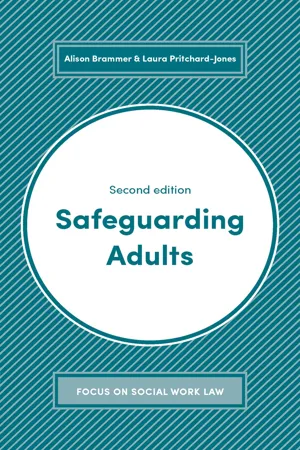
Working to safeguard adults is a complex area of practice that requires careful balancing of autonomy, protection and risk. In order to make good, lawful judgements about when and how to intervene, practitioners therefore need to have a comprehensive understanding of how the law applies to safeguarding adults. In this text book best-selling author Alison Brammer brings together the many strands of adult safeguarding to provide a succinct guide to the legal framework. Designed to equip practitioners with the relevant knowledge for practice, it lays out the current legislation and guidance and applies it to different areas of adult safeguarding, including defining 'abuse', assessing capacity and dealing with cases of criminal law. The book goes on to analyse key examples of serious case reviews, including the cases of Steve Hoskin and Michael Gilbert. Whether taking a module on Social Work Law or Safeguarding, or a qualified Social Worker, this concise guide to a key aspect of practise is essential reading. How do you apply the principles, structures and processes of the law to everyday practice? Drawing on a wealth of contemporary case examples, this handy pocket book provides a clear text which brings the many complex strands of safeguarding adults together in a succinct and accessible way. - Students taking Social Work qualifying undergraduate and postgraduate degrees.
- Qualifies Social Workers fulfilling their learning development requirements.
- Undergraduate and postgraduate students of other disciplines looking to understand the influence of law within professional decision-making (e.g. students of Youth Work, Community Work and Health) New to this Edition:
- Each chapter is updated and revised to ensure currency
- Includes the Care Act 2014Contains links/signposts to further learning to help illustrate how law is applied in practice
- 194 pages
- English
- ePUB (mobile friendly)
- Available on iOS & Android
eBook - ePub
Safeguarding Adults
About this book
Information
1
The legal and policy framework
At a glance this chapter covers:
• a brief overview of No Secrets, the guidance in this area prior to the Care Act 2014
• the National Framework for Safeguarding Adults
• discussion of the No Secrets Review
• the safeguarding provisions of the Care Act 2014
• Care and Support Statutory Guidance
• multi-disciplinary working
• communication and sharing information
This chapter focuses on the Care Act 2014, the key piece of civil legislation that now provides the legal framework for professionals working in adult safeguarding, and its Statutory Guidance. The demands of the legislation are great given the complexity of investigations into adult abuse. Penhale and Parker usefully summarize some of the challenges faced by those investigating adult abuse:
The sensitive nature of the issues involved; matters of capacity, consent, confidentiality and autonomy; continuing challenges presented in the search for effective interdisciplinary working; the absence of a reliable research base on which to sustain practice; the absence of close and effective collaboration linking different policy initiatives such as the tensions that exist between the welfare, legislative and regulatory models of protection.
Penhale and Parker, 2007:14
The chapter begins with consideration of the key guidance on adult safeguarding before the Care Act 2014 came in to force, No Secrets, (DH, 2000b). The chapter then goes on to consider key messages from its review, as well as a comprehensive overview of the adult safeguarding mechanisms now incumbent on local authorities under the Care Act 2014.
No Secrets: guidance on developing and implementing multi-agency policies and procedures to protect vulnerable adults from abuse
No Secrets was published in 2000 (DH, 2000b). Equivalent guidance existed in Wales entitled In Safe Hands: Implementing Adult Protection Procedures in Wales (National Assembly for Wales, 2000).
At the outset it is important to recognize the status of No Secrets. No Secrets was issued under s. 7 Local Authority Social Services Act 1970. The significance of s. 7 guidance was explained by Sedley J in R v London Borough of Islington ex parte Rixon [1997]:
Parliament in enacting section 7(1) did not intend local authorities to whom ministerial guidance was given to be free, having considered it, to take it or leave it … in my view parliament by s. 7(1) has required local authorities to follow the path charted by the Secretary of State’s guidance, with liberty to deviate from it where the local authority judges on admissible grounds that there is good reason to do so, but without freedom to take a substantially different course.
R v London Borough of Islington ex parte Rixon [1997] [71]
Unusually for s. 7 guidance, No Secrets did not specifically attach to a particular statute. Munby LJ remarked on the negative effect of such a position:
There is the remarkable fact that the formal safeguarding agenda in relation to vulnerable adults rests entirely upon Ministerial guidance and otherwise lacks any statutory basis – a state of affairs that, unsurprisingly, can leave local authorities uncertain as to their function and responsibilities in this vital area. (Munby, 2011: 34)
This criticism is also one that appeared in the review of No Secrets, and the Law Commission’s consultation into reforms of adult social care:
The existing legal framework for adult protection is ‘neither systematic nor coordinated, reflecting the sporadic development of safeguarding policy over the last 25 years. Unlike in Scotland, there is no single or coherent statutory framework for adult protection in England and Wales. Instead it must be discerned through reference to a wide range of law ... (Law Commission, 2011a: para 9.1)
National Framework for Safeguarding Adults
In 2005, ADSS published Safeguarding Adults: A National Framework of Standards for Good Practice and Outcomes in Adult Protection Work (the National Framework for Safeguarding Adults). The framework comprises 11 standards for good practice in safeguarding adults. This document saw the formal introduction of the term ‘safeguarding’ in an adult context, in preference to vulnerable adult and adult protection, explaining further:
This phrase means all work which enables an adult ‘who is or may be eligible for community care services’ to retain independence, wellbeing and choice and to access their human right to live a life that is free from abuse and neglect. This definition specifically includes those people who are assessed as being able to purchase all or part of their community care services, as well as those who are eligible for community care services but whose need – in relation to safeguarding – is for access to mainstream services such as the police.
ADSS, 2005:5
It also made connections with the MCA 2005 and recognized that principles in that Act would have an application in and inform safeguarding cases, including, importantly, the principles that adults with capacity can make ‘unwise’ decisions, and any decisions taken on behalf of an adult who lacked capacity had to be in their ‘best interests’ and the least intrusive option. This guidance has now been superseded by the Care Act 2014 and its Statutory Guidance; however, the standards set down in this guidance were indicative of the principles that now underpin adult safeguarding.
The standards were:
Standard 1 Each local authority has established a multi-agency partnership to lead ‘Safeguarding Adults’ work.
Standard 2 Accountability for and ownership of ‘Safeguarding Adults’ work is recognised by each partner organisation’s executive body.
Standard 3 The ‘Safeguarding Adults’ policy includes a clear statement of every person’s right to live a life free from abuse and neglect, and this message is actively promoted to the public by the Local Strategic Partnership, the ‘Safeguarding Adults’ partnership, and its member organisations.
Standard 4 Each partner agency has a clear, well-publicised policy of Zero-Tolerance of abuse within the organisation.
Standard 5 The ‘Safeguarding Adults’ partnership oversees a multiagency workforce development/training sub-group. The partnership has a workforce development/training strategy and ensures that it is appropriately resourced.
Standard 6 All citizens can access information about how to gain safety from abuse and violence, including information about the local ‘Safeguarding Adults’ procedures.
Standard 7 There is a local multi-agency ‘Safeguarding Adults’ policy and procedure describing the framework for responding to all adults ‘who is or may be eligible for community care services’ and who may be at risk of abuse or neglect. [original emphasis]
Standard 8 Each partner agency has a set of internal guidelines, consistent with the local multi-agency ‘Safeguarding Adults’ policy and procedures, which set out the responsibilities of all workers to operate within it.
Standard 9 The multi-agency ‘Safeguarding Adults’ procedures detail the following stages: Alert, Referral, Decision, Safeguarding Assessment Strategy, Safeguarding Assessment, Safeguarding Plan, Review, Recording and Monitoring.
Standard 10 The safeguarding procedures are accessible to all adults covered by the policy.
Standard 11 The partnership explicitly includes service users as key partners in all aspects of the work. This includes build-ing service-user participation into its: membership; monitoring, development and implementation of its work; training strategy; and planning and implementation of their individual safeguarding assessment and plans.
ADSS, 2005:3
Replacing No Secrets
The review of No Secrets was prompted by a number of factors. Since 2000 there had been major changes in the policy environment (such as the ADSS National Framework for Safeguarding Adults, discussed above), including the commitment to personalization. Weaknesses in the implementation of No Secrets had been identified, including inconsistent implementation across the country. A third prompt was the need to examine the case for legislative change given the identified lack of legal provisions compared to that in existence for safeguarding children.
Messages that emerged from the consultation supported revision of No Secrets and some statutory changes. A key emphasis of responses was the need to hear the voice of vulnerable people. That voice is evident in the four key messages identified in the document, namely: safeguarding requires empowerment – hearing the victim’s voice; empowerment is everybody’s business, but safeguarding decisions are not; safeguarding adults is not like child protection – there are differences; and participation/representation of people who lack capacity is also important (DH, 2008a).
Specific questions focused on the need for statutory reform. A significant proportion of respondents, 68 pe...
Table of contents
- Cover
- Title Page
- Copyright
- Contents
- Table of cases
- Table of legislation and statutory instruments
- Acknowledgments
- Abbreviations
- Using this book
- Introduction
- 1 The legal and policy framework
- 2 Support and prevention
- 3 Criminal law and safeguarding
- 4 Capacity and safeguarding
- 5 Regulation
- 6 Other legal provision
- 7 Messages from Safeguarding Adults Reviews
- 8 Conclusion: Key developments across the UK
- Useful Websites
- Glossary
- Bibliography
- Index
Trusted by 375,005 students
Access to over 1.5 million titles for a fair monthly price.
Study more efficiently using our study tools.
Frequently asked questions
Yes, you can cancel anytime from the Subscription tab in your account settings on the Perlego website. Your subscription will stay active until the end of your current billing period. Learn how to cancel your subscription
No, books cannot be downloaded as external files, such as PDFs, for use outside of Perlego. However, you can download books within the Perlego app for offline reading on mobile or tablet. Learn how to download books offline
Perlego offers two plans: Essential and Complete
- Essential is ideal for learners and professionals who enjoy exploring a wide range of subjects. Access the Essential Library with 800,000+ trusted titles and best-sellers across business, personal growth, and the humanities. Includes unlimited reading time and Standard Read Aloud voice.
- Complete: Perfect for advanced learners and researchers needing full, unrestricted access. Unlock 1.5M+ books across hundreds of subjects, including academic and specialized titles. The Complete Plan also includes advanced features like Premium Read Aloud and Research Assistant.
We are an online textbook subscription service, where you can get access to an entire online library for less than the price of a single book per month. With over 1.5 million books across 990+ topics, we’ve got you covered! Learn about our mission
Look out for the read-aloud symbol on your next book to see if you can listen to it. The read-aloud tool reads text aloud for you, highlighting the text as it is being read. You can pause it, speed it up and slow it down. Learn more about Read Aloud
Yes! You can use the Perlego app on both iOS and Android devices to read anytime, anywhere — even offline. Perfect for commutes or when you’re on the go.
Please note we cannot support devices running on iOS 13 and Android 7 or earlier. Learn more about using the app
Please note we cannot support devices running on iOS 13 and Android 7 or earlier. Learn more about using the app
Yes, you can access Safeguarding Adults by Alison Brammer, Laura Pritchard-Jones in PDF and/or ePUB format, as well as other popular books in Política y relaciones internacionales & Política social. We have over 1.5 million books available in our catalogue for you to explore.