- 292 pages
- English
- ePUB (mobile friendly)
- Available on iOS & Android
eBook - ePub
About this book
Social and Community Development is an essential introduction to the subject for students, potential practitioners, and activists interested in community action and emancipatory social change. It reflects on the underlying principles of development: what development is, why it is promoted and the implications for practice, indicating potential strategies and goals.
Information
1
Introduction
We have experienced directly, witnessed or heard of many situations which we want to change:
➢Not being treated fairly or being able to fulfil our hopes or potential.
➢Other people unable to fulfil their potential because of the direct or indirect actions of others, or self-destructive behaviour.
➢Seeing a child or adult who is abused, bullied or harmed.
➢Groups of people being blamed, victimised or not getting a fair chance.
➢Exploitation, harming or letting down the users, customers or workers of institutions such as companies, government agencies and charities through their goods and services or working practices.
➢Countries and regions at war internally or with other countries, or where lives are lost because of human actions or lack of protection from, or preparation for, natural disasters.
➢Ideas or slogans that belittle us or other people and which seek to justify brutal or discriminatory treatment.
Beyond asking ‘What can I do?’, we may ask ‘Why do these things happen?’, ‘What works to change these situations?’ This book is not an analysis of all these ‘ills’ or a guide to the campaigns or organisations that seek to ‘cure’ them. It is not a celebration or an evaluation of interventions. I have spent 40 years directly involved in trying to change some of these situations and teaching and researching with many more people who have been activists and practitioners. The book is a reflection on what should be the underlying principles of community or social development, and how they can be turned into practice.
The book is intended as an introduction for students and practitioners to an activity which they may see as part of a profession, as a paid job or as something they will do as a volunteer or an activist.
My central argument is that social change starts inside individuals and individual change often begins with social change. They are both achieved by people learning from each other, not a one-way process. Writing a book for people to absorb a single author’s knowledge and ideas might seem to contradict this. Two very different commentators perhaps help to explain the paradox. Lilla Watson, an aboriginal artist said, speaking on behalf of a group Australian activists:
If you have come here to help me, you are wasting your time. But if you have come because your liberation is bound up with mine, then let us work together.1
An Oxford philosopher said in the introduction to one of his books:
Primarily I am trying to get some disorders out of my own system. Only secondarily do I hope to help other theorists to recognise our malady and to benefit from my medicine.2
The book didn’t start off as therapy. I thought that the years of practice, thinking about the issues and teaching had challenged and taught me enough theory and enough about what works and doesn’t work in practice to know pretty much what I wanted to say. In fact, as the book argues, the process of reflection makes one question whether the theory-in-use is the espoused theory (the theory we say we are using). We often need to ask ourselves, are we really doing what we say we are, and is there another way of doing things?3
I hope that trying to sort out my ‘disorders’ will help other people in a number of ways:
➢To appreciate the things that they do know and understand, perhaps contributing a vocabulary and theory for some people and ideas about putting theory into practice for others.
➢To explore issues that people may not have thought about or may not have resolved.
➢By challenging more often than providing answers. As Paulo Freire says, the role of the educator is to ‘re-present the world, not as lecture but as a problem’.4
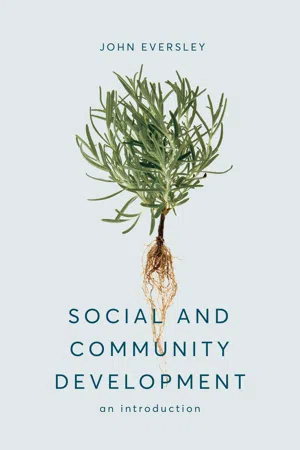
Two threads run through the book: roots and routes. By roots, I mean the origins of social and community development. This includes the history and the intellectual roots. The intellectual roots are the explanations and theories underlying the practices and some of the people and activities that have inspired or sustained practitioners. Exploring the roots may help answer questions about why things do or don’t happen: understanding the origins of inequality and oppression, for example. The linguistic roots of the word route lie in the indentation a wheel makes as it breaks the ground it covers – a ‘rut’. It has the same roots as rupture and rout (a crowd of people). In the following section, the implications of this are discussed.5 Routes in this book refer to both strategies and goals (where are you going and why). Roots and routes can be historical, intellectual and geographical or cultural.
The book argues that accounts of the roots and routes of social and community development have often been twisted to suit particular agendas. At the very least, activists and practitioners should know that this has happened.
Originally, I intended that one volume would cover both the theory, the principles and detail about the method. It would have made the book too long. This book therefore restricts itself to the general directions (‘compass points’) rather than a detailed guide (a ‘walking map’).
History
Throughout the book, the historical contexts of social and community development are explored. Often social and community development are presented as relatively new and/or Western concepts. They are also frequently presented as top-down planned strategies. Although the language currently used may have these specific origins and Western concepts inform much of what is promoted, it will be argued here that the substance has its roots in many places and over a long period of history.
Typical accounts of the development of community work start with its origins in nineteenth-century European social welfare and twentieth-century European (especially British) measures to rule its empire. In this account three responses to poverty and social unrest in England emerged. The first was a shift from a kind of compassionate or idealistic charity, philanthropy or almsgiving to a more ‘scientific’ assessment of individual cases which in turn led to the development or a model of social work as casework. The second development was social investigation or social research, particularly into the causes of poverty and what could be done to relieve it. The third strand was a more collectivist response which might be expressed in initiatives with, for or by groups or movements of poor people. The colonial tradition of community work is usually expressed as an evolution of ‘indirect’ rule, co-opting local elites and engaging local populations in activities in the interests of the empire (e.g. cash crops or raw materials extraction for export) through mass education facilitated by expatriate Colonial Development Officers and local assistants.6 It will be argued they are distorted and incomplete accounts.
The Party in George Orwell’s 1984 says:
Who controls the past controls the future: who controls the present controls the past.7
Even if the typical accounts are not the whole story they have become influential in how community development is perceived. They are ‘memes’ – ‘facts’, ideas or beliefs which are repeated or imitated and develop a life of their own.8 Thus the perception that social and community development are recent and Western or imperialistic in origin is widely held and is sometimes a barrier to adoption. A related idea is that ‘traditions’ can be and are invented. There are many well-established traditions which were the invention of an individual or group at a particular time and perhaps for a particular purpose.9 Culture and identity are very important to people, but they are not ‘set in stone’ or ‘sacred’.
Memes developed as an idea in relation to evolution. In public policy there are two similar concepts which are important: Path Dependency and Historical Institutionalism. Path dependency refers to the fact that because things have happened we make decisions today – they are ‘ruts’. The most frequently quoted example of this is that the latest English language smart-phones still have keypads which begin with the letters QWERTY. Originally it was to avoid mechanical arms sticking on the frequently used letters on typewriters. There are many instances of it in public policy: debates about whether to ban harmful drugs are based on beliefs about whether alcohol prohibition in the USA in the 1930s worked or not; the failure of appeasement of Hitler in the 1930s was used to justify the invasion of Suez in 1956 and Iraq in 2003.
Path dependency analysis often leads to a view that things only ever change incrementally. When the debate is specifically about the behaviour or capability of a particular institution, the assumption that past patterns will repeat themselves is called historical institutionalism.10 Against this view is the argument that sometimes people or circumstances can change the course of history – the rupture which is also partly the root of ‘route’. In 1915 the sociologist Max Weber wrote that:
material and ideal interests, directly govern men’s conduct. Yet very frequently the ‘world images’ that have been created by ‘ideas’ have, like switchmen [Railway signal switchers], determined the tracks along which action has been pushed by the dynamic of interest.11
More recently, Ashis Nandy has written about how the experience of colonialism has been internalised into the Indian Self. He also highlights that although Gandhi (a key thinker in community development) may have been an example of an ‘uncolonized mind’ he also valued Western education and ideas highly.12 People, institutions, communities and societies can follow more than one path at once or switch tracks. History is neither servitude nor freedom.13
Intellectual: Theory, theorists and practice
We all use theory (and evidence), whether we are conscious of it or not. If a light in the home is not working, we use our theoretical knowledge of electricity (however elementary!) to guess the cause. Consistent with the approach of this book, the change required may be an individual one of checking it is switched on or replacing the bulb (w...
Table of contents
- Cover
- Half Title
- Title Page
- Copyright
- Contents
- List of Figures
- List of Tables
- List of Boxes
- 1. Introduction
- 2. Beyond Society and Community
- 3. Development
- 4. Collective Action
- 5. Equality and Emancipation
- 6. Learning Together: What and Why
- 7. Conclusions and Getting Started …
- Notes
- Index
Trusted by 375,005 students
Access to over 1.5 million titles for a fair monthly price.
Study more efficiently using our study tools.
Frequently asked questions
Yes, you can cancel anytime from the Subscription tab in your account settings on the Perlego website. Your subscription will stay active until the end of your current billing period. Learn how to cancel your subscription
No, books cannot be downloaded as external files, such as PDFs, for use outside of Perlego. However, you can download books within the Perlego app for offline reading on mobile or tablet. Learn how to download books offline
Perlego offers two plans: Essential and Complete
- Essential is ideal for learners and professionals who enjoy exploring a wide range of subjects. Access the Essential Library with 800,000+ trusted titles and best-sellers across business, personal growth, and the humanities. Includes unlimited reading time and Standard Read Aloud voice.
- Complete: Perfect for advanced learners and researchers needing full, unrestricted access. Unlock 1.5M+ books across hundreds of subjects, including academic and specialized titles. The Complete Plan also includes advanced features like Premium Read Aloud and Research Assistant.
We are an online textbook subscription service, where you can get access to an entire online library for less than the price of a single book per month. With over 1.5 million books across 990+ topics, we’ve got you covered! Learn about our mission
Look out for the read-aloud symbol on your next book to see if you can listen to it. The read-aloud tool reads text aloud for you, highlighting the text as it is being read. You can pause it, speed it up and slow it down. Learn more about Read Aloud
Yes! You can use the Perlego app on both iOS and Android devices to read anytime, anywhere — even offline. Perfect for commutes or when you’re on the go.
Please note we cannot support devices running on iOS 13 and Android 7 or earlier. Learn more about using the app
Please note we cannot support devices running on iOS 13 and Android 7 or earlier. Learn more about using the app
Yes, you can access Social and Community Development by John Eversley in PDF and/or ePUB format, as well as other popular books in Social Sciences & Social Work. We have over 1.5 million books available in our catalogue for you to explore.