Start-Up is ideal for anyone looking to start a business – whether you are a student or a professional preparing to launch your own business or social enterprise. It covers the crucial business processes you need to consider when starting a new venture, and contains inspirational and educational cases of successful start-ups by young people from across the globe, including the UK, the US, Hong Kong and Romania. Drawing on the author's extensive practical experience, this book is a unique and invaluable guide to the world of start-ups.
Key features:
- Assumes no prior knowledge and covers essential finance skills.
- Firmly based in practice with detailed advice on carrying out market and industry research.
- Features an extensive range of international case studies and examples of start-ups.
This concise and lively book is the perfect resource for students and entrepreneurs alike.<
- 436 pages
- English
- ePUB (mobile friendly)
- Available on iOS & Android
eBook - ePub
About this book
Information
1
ENTERPRISE AND INDIVIDUALS IN SOCIETY AND THE ECONOMY

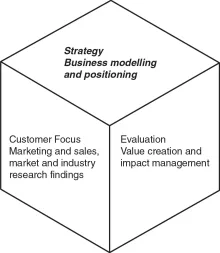
Figure 1.1 The Cube Strategy
Source: © Hill, 2012.
Summary
Chapter One introduces the book’s structure and focus, including the language that the book uses and the symbols. The symbol of the Cube serves to illustrate the six most important areas for a sustainable start-up, and principles and practices needed to realize this start-up (Figure 1.2). A discussion of the basics of business functions and business in the economy is followed by an introduction to the most important young entrepreneur case studies who are referred to throughout the book.
The chapter aims to create a common base to start from for all readers. Thus, the chapter’s discussions are aimed at those who may have little or no understanding of how a business works, what functions it needs to have to operate profitably and how it fits into society and the economy. It aims to include all readers who might not have read about basic business issues at all or not for a long time. Additionally, it outlines the structure of industries and illustrates with recent UK and international statistics, the situation of businesses in the economy, the role of start-ups and small and medium-sized enterprises.
1.1 About this book
1.2 Why a Cube?
1.3 Principles and practices to create the sustainable start-up
1.4 Describing and defining “business”
1.5 What is the role of business in the economy and society?
1.6 Business, charity or social enterprise − what is the difference?
1.7 Myths about start-ups and social enterprise
1.8 Meet the start-ups featured in this book
1.9 Concluding remarks and application of new insights
1.1 About this book
1.1.1 What this book offers
This book aims to be a process guide. Using the image of the Cube, it offers guidance on six facets of the start-up process, with associated principles and practices. There is not much academic research published yet that portrays in detail the pre-start-up phase and its success factors; and the research that is available has only been done for limited sectors. Similarly, there is not sufficiently useful guidance in drawing conclusions and decision-making during the pre-start-up process. The sequences of activities suggested in Start Up are only one possibility of how you could develop a start-up. They are based on my own experience of starting service businesses, alongside lessons gleaned from my involvement with hundreds of start-ups through my business support practice as well as my research. The good (or bad) news is that there is no one definite way or process that applies to all individuals, all business types and all sectors. It is possible, however, to identify a number of activities that ideally should be carried out, sometimes more than once, to create a sustainable start-up. In each chapter I briefly discuss when to carry out the suggested activities, how often and for what reasons. By exploring the pre-start-up process through the activities in this book, you will progress more quickly to the start-up launch. If you have created a new venture before, and as you feel familiar with some of the activities, you will be more confident in carrying them out.
Throughout this book I have included specific differences between for-profit and social enterprise start-ups. The social enterprise model is an exciting opportunity for more and more young people; I have been told over and over again that they wished they had learned more about it while at college or university.
1.1.2 Who should read Start Up?
Start Up offers an introduction to the most important processes and associated activities undertaken when exploring a business idea and preparing for new venture creation. It will take you on a journey from various starting points via finding and focusing a business idea and onward to actually getting up and running. Start Up is aimed squarely at first-timers deciding to engage in new venture creation and those with very little or no background in business. All the case studies are themselves students or recent graduates. Everybody, independent of age and education, can carry out the processes suggested.
While the processes themselves are suited to all sectors, they may need to be adjusted to the specific sector and national environment you are living and working in. It should be noted, however, that for manufacturing start-ups some additional processes are needed that are indicated only rather than described in detail, that being beyond the scope of this process outline. Other avenues for starting up in business include taking on a franchise or purchasing an existing business. If you follow the franchise start-up route, the journey and its processes are very different. Chapter Three contains a brief outline of using a franchise to start your first business (see Section 3.1.4). However, this process is largely beyond the scope of the book, as is entering into business by buying an existing business.
The book is also a great guide for newcomers to business advice or mentoring and career advisers, as it outlines one set of the processes an adviser can guide a mentee through. I have successfully used the processes and activities or variations of them many times since 2000; it is a joy to see a young person grow and develop their own venture.
1.1.3 Language used in Start Up
Throughout this book the word “product” is assumed to always include services as well. Similarly, when the word “goods” is used, this always includes services. Goods may also be called tangible goods, whereas services may be called intangible goods. In some chapters, services are addressed explicitly, where processes differ for services from those for tangible goods.
Throughout Start Up I write about my own experiences as a start-up business adviser and businesswoman using “I”. When I use “we”, then I am referring to you, the reader, and me, the author.
The language in Start Up tries to remain accessible by using as much commonly known terminology as possible and explaining business jargon wherever its use is worthwhile. I have tried to use the expanded form of phrases that are subsequently abbreviated even where it may be fairly commonly known. I prefer to lean toward the side of accessibility and ease of understanding.
1.1.4 Structure of Start Up
There are 16 chapters altogether in this book. While you are welcome to read the book from start to finish in sequence, I have written each chapter in such a way that you do not have to have read the previous chapters in order to be able to understand any one chapter. There are plenty of references to other chapters to show how the discussions link to each other, which may inspire you to follow up in that direction. I highly recommend reading the chapters that present most interest and relevance to your situation in the sequence that suits you. I would also recommend going back to the research chapters (Chapter Four and Chapter Five) as well as the business model chapter (Chapter Seven) and re-reading them before you get up and running. However, I do recommend reading every chapter at some point on your pre-start-up journey.


As pointed out earlier, this book aims to be a stand-alone resource and “process bible”. I want to bridge the gap often left by how-to-start-a-business books and university textbooks and offer a unique combination of practical insights, including both lists of practical ready-to-use resources, real-life tips and “how-to’s” and insight from recent research. It i...
Table of contents
- Cover
- Title Page
- Copyright
- Contents
- List of figures
- List of tables
- List of boxes
- Preface
- Acknowledgements
- About the Author
- 1. Enterprise and individuals in society and the economy
- 2. Personal career paths and motives to start an enterprise
- 3. Which idea is a business opportunity for you?
- 4. Scanning the environment – researching the industry
- 5. Finding or creating a market?
- 6. Operational design and set up
- 7. Business modelling that fits
- 8. Legal issues and governance
- 9. Where is the money?
- 10. Show me the money – financial planning and pricing
- 11. Opportunity modelling
- 12. Business planning and start-up – launch
- 13. Marketing planning and implementation
- 14. Public relations and sales
- 15. Getting up and running
- 16. Just started – risky?
- References
- Index
Trusted by 375,005 students
Access to over 1.5 million titles for a fair monthly price.
Study more efficiently using our study tools.
Frequently asked questions
Yes, you can cancel anytime from the Subscription tab in your account settings on the Perlego website. Your subscription will stay active until the end of your current billing period. Learn how to cancel your subscription
No, books cannot be downloaded as external files, such as PDFs, for use outside of Perlego. However, you can download books within the Perlego app for offline reading on mobile or tablet. Learn how to download books offline
Perlego offers two plans: Essential and Complete
- Essential is ideal for learners and professionals who enjoy exploring a wide range of subjects. Access the Essential Library with 800,000+ trusted titles and best-sellers across business, personal growth, and the humanities. Includes unlimited reading time and Standard Read Aloud voice.
- Complete: Perfect for advanced learners and researchers needing full, unrestricted access. Unlock 1.5M+ books across hundreds of subjects, including academic and specialized titles. The Complete Plan also includes advanced features like Premium Read Aloud and Research Assistant.
We are an online textbook subscription service, where you can get access to an entire online library for less than the price of a single book per month. With over 1.5 million books across 990+ topics, we’ve got you covered! Learn about our mission
Look out for the read-aloud symbol on your next book to see if you can listen to it. The read-aloud tool reads text aloud for you, highlighting the text as it is being read. You can pause it, speed it up and slow it down. Learn more about Read Aloud
Yes! You can use the Perlego app on both iOS and Android devices to read anytime, anywhere — even offline. Perfect for commutes or when you’re on the go.
Please note we cannot support devices running on iOS 13 and Android 7 or earlier. Learn more about using the app
Please note we cannot support devices running on iOS 13 and Android 7 or earlier. Learn more about using the app
Yes, you can access Start-Up by Inge Hill in PDF and/or ePUB format, as well as other popular books in Business & Corporate Finance. We have over 1.5 million books available in our catalogue for you to explore.