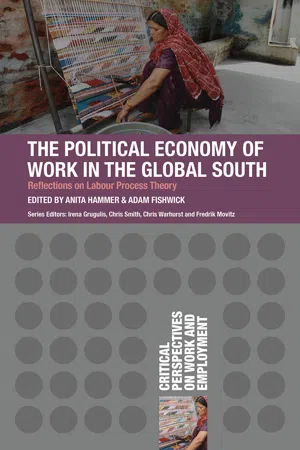
Part of the Critical Perspectives on Work and Employment series, this edited collection brings together contributions from leading international scholars to initiate an important dialogue between labour process analysis and scholarship on work in the Global South. This book characterises the forms of work and labour process that characterise globalising capitalism today and addresses core analytical concerns within Labour Process Theory and research on work in the South. It explores how a wide range of production relations in the Global South, ranging from formal to informal employment and self-employment, are embedded in wider social relations of gender, caste, religion and ethnicity, and are related to wider patterns of commodification and resistance. Drawing on cutting-edge research, the book's chapters consider a diverse range of working situations, covering migrant workers in the Middle East, commercial surrogacy work in India and cooperative garment workers in Argentina.
In offering a novel reading of the political economy of work in the Global South and shedding light on lesser-considered fields of work and worker organization, this volume will provide new insights for making sense of the changing world of work for students, scholars, labour activists and practitioners alike.
eBook - ePub
The Political Economy of Work in the Global South
- 292 pages
- English
- ePUB (mobile friendly)
- Available on iOS & Android
eBook - ePub
The Political Economy of Work in the Global South
About this book
Information
CHAPTER | ||
Introduction: Labour Process Analysis and Work in the Global South – A Dialogue | 1 | |
Anita Hammer and Adam Fishwick |
The objective of this volume is to initiate a dialogue between labour process analysis and scholarship on work in the Global South. Labour process theory (LPT) has established itself as a key approach to examining the changing dynamics of work and employment, critically reflecting important features of and tensions within the political economy of work as it emerged across, primarily, Europe and North America. In this process, however, LPT’s focus has reflected a specific context of developed economies. As the reality of work and workplaces is fragmenting, non-standard and contingent forms of work and employment (which have always existed and persisted) are increasingly coming into view in the Global North (see Taylor report, 2017; Moore et al., 2018; Hammer and Plugor, 2019). Work in the Global South, on the other hand, has always displayed a wider range of production relations and employment relations in its formal/informal economies, the diverse social relations they are embedded in as well as related forms of resistance (Barnes, 2012; Agarwala, 2013; Atzeni and Ness, 2018). While focusing on exploitation along complex and overlapping lines of production and social relations, scholarship on work in the Global South, however, has often taken the extraction of labour from labour power as a given. Our aim, in this volume, is to identify and advance fruitful areas of discussion between one of the leading bodies of work on the workplace and the concrete examination of the diverse forms of work, employer control and workers’ resistance in the Global South.
The central thrust of our volume and its contributions are the forms of work and labour processes that today characterise globalising capitalism –the rise in informal and precarious work, the processes decentring work from the workplace, a withdrawal of the state from social provisioning and the associated challenges for workers to organise collectively. Each of these dynamics has long informed the working lives and lived experiences of workers in the Global South (Bernstein, 2007; Breman, 2010). As our contributions show, they have also resulted in alternative analytical approaches as well as extraordinarily creative responses by workers to the challenges they face. An explicit turn to the experiences of those living and working in the Global South can offer LPT a means to better grasp how the heterogeneity of production relations, social relations and forms of exploitation shape workplaces, labour processes and working lives of labour across the world. It is our intention in what follows to open new discussions that sit at the intersection between these lived experiences, the analytical approaches that have been developed to understand them and the inestimable contribution of the methodological and conceptual tools of LPT.
The contributions in this volume address three core analytical concerns within LPT and research on work in the South. First, the existence and re-emergence of different production relations – from formal to informal employment to informal outwork, to dependent self-employment to petty commodity production, among others – need to be acknowledged as interconnected phenomena and investigated from a labour process perspective. (Re-)emerging forms of production relations are characterised by distinct modalities of extracting value and are not isolated; on the contrary, they frequently substitute other forms which are often key to rearranging the spatial organisation of production networks (Newsome et al., 2015; Barnes, 2018). Here, our chapters illustrate the diverse forms of work embedded within complex supply chains in industrial and extractive sectors in Latin America, within commercial surrogacy work in India or across networks of migrant workers employed in the Middle East.
Second, the fragmentation of core workforces emphasises differences in groups of workers along different social relations that constitute the basis for allocating workers to jobs and different disciplinary regimes. An example of this is the majority of poor people, women and marginalised castes and communities who labour in the lower rungs of the informal economy – for instance as casual labour, homeworkers and as unpaid family labour in own-account firms (Harriss-White and Gooptu, 2001). The contributions in this volume analyse the wide range of production relations that exist across formal/informal economies and consider how these production relations are embedded in wider social relations of class, gender, caste and religion. They show the complex interplay between community and workplace across Argentina, the differing pressures on domestic workers across Latin America, the challenges facing women reproductive workers in India and among skilled migrant workers travelling to Europe.
Third, as we look beyond the standard employment relationship, analysing the range of production relations and social relations in the labour process, as well as the different levels and forms of de-commodification, we also need to look beyond standard forms of reproduction and examine the intricate connections between the labour process and the sphere of reproduction (whether this concerns spatial arrangements as in dormitory labour regimes, welfare systems or social reproduction) (Federici, 2004; Pun and Smith, 2007; Bhattacharya, 2017a). Here, our chapters mobilise concepts such as ‘social reproduction zones’ and ‘labour regimes’ in South Asia and sub-Saharan Africa to integrate these concerns into understanding the political economy of work.
The core argument of this volume, therefore, is that engagement with the realities of work in the Global South provides an opportunity for LPT to expand beyond the formal space it originated in, that is, to move beyond limited definitions of the (waged) workplace to consider how the realm of reproduction, family and community relations, and the state are central to labour exploitation and class formation. The engagement between LPT and the South can help widen labour process analysis towards better theorising the ‘new’ realities of work, and help scholarship on the South to better appreciate the dynamics of value extraction in the labour process. Contributions to this volume attempt to privilege a materialist analysis, by offering concrete and situated examinations of working lives in the South, and to avoid reifying the Global South.
Debates in Labour Process Theory: Links with the Global South | ||
LPT, while stretching back to the 1970s, remains a central and coherent approach to the study of work and employment and is rooted in radical and Marxist political economy. The labour process is defined as that part of the mode of production in which workers’ productive capacity is deployed in order to produce use values and at the same time surplus value. Thereby, LPT has a key interest in the nature of the valorisation process and in the dynamics of struggle and exploitation (Braverman, 1974; Friedman, 1977; Edwards, 2007). In a more recent positing of the core principles of LPT, Thompson (2010) states that at heart LPT is concerned with how labour power as a commodity is converted to labour under the exigencies of capital accumulation. Following from this, four core principles necessary for LPT have been identified as: (1) the necessity of labour process for economic and human reproduction and hence the emphasis on labour and capital-labour relations; (2) the logic of accumulation or the economic imperatives that put pressure on capital to continually transform the production process; (3) the control imperative that leads capital to reduce the indeterminacy gap between labour power and labour; (4) the structured antagonism between capital and labour that underpins conflict and cooperation in the workplace (Thompson and Newsome, 2004, pp. 134–5; Thompson, 2010, p. 10).
Acknowledgement of this core framework, however, does not designate the outer boundaries of LPT. In fact, a number of long-standing debates on the analytical power of LPT echo important concerns that are central in scholarship on work in the Global South. First, there is increasing recognition within LPT of the neglect of ‘the larger political economy picture’ (Thompson, 2010, p. 8) and how it relates to the labour process, resulting in calls for a stronger emphasis on the analysis of capital-labour relations beyond the workplace (Thompson and Smith, 2010; Newsome et al. 2015). Rather than pointing to the interrelations and competition between finance and productive capital, or across the spatial and functional division of labour, ‘beyond the workplace’ in this volume constitutes a shorthand for analysing a range of relations of production as well as social relations that are mobilised in the labour process. At its core, however, the issue is not one of divergence between North and South. Many labour process studies have, in fact, gone beyond the workplace and emphasised the role of worker communities being located close to factories, or the way new greenfield sites allow the development of different labour processes that draw on different workforces. What the authors in this volume attempt is to theorise these relations with regard to the labour process, rather than treating them as just significant contextual factors. This is important, we argue, in order to situate established LPT in its particular historical and spatial context, and to highlight its relevance across the global political economy.
Second, an enduring – and somewhat contentious – debate within LPT has been on how to conceptualise the link between the labour process and class. That the focus on individual workplaces often neglects the broader processes of capitalist accumulation and competition, along the way losing its distinctiveness and its theoretical and political focus stemming from Marxist political economy, has led to persistent calls for a reintegration of class analysis and LPT. Emphasising the integral relationship between exploitation, labour process and class relations, a strand of LPT scholarship has consistently argued that changes in the organisation of production simultaneously lead to changes in social relations and hence class relations (Burawoy, 1985; Carter, 1995; Nichols, 1999; Spencer, 2014). Such work reflects Marx’s observation that labour processes occur not in the abstract but only under definite social relations in concrete societies. This debate becomes even more pertinent in the context of a wide range of production relations evident in the Global South. The lived experience of class – borne out in the dynamics of working-class struggle or the intractable pressures of inequality and oppression – renders it central to the scholarship represented by the authors in this volume. LPT can offer an important grounding for these lived experiences of class.
Third, a related debate is the insufficient attention paid to social relations beyond the concept of class, such as hierarchies of caste, ethnicity, community or gender in LPT. Nowhere is this more powerfully expressed than in feminist works and materialist postcolonial approaches in the South (Mohanty, 1984; Young, 2001; Kabeer et al., 2013). A number of contributions in this volume highlight the intersection of production and social relations and its implications for control at the workplace, for workers’ resistance and for class struggle across the Global South.
Finally, and importantly, following from and cutting across these critiques is the relative neglect of the realm of reproduction, its relations with production and the labour process, and the role of the state in these realms (Pearson, 2014). As Federici (2012, p. 92) remarks, it is important to recognise that ‘capitalism must rely on both an immense amount of unpaid domestic labor for the reproduction of the workforce, and the devaluation of these reproductive activities in order to cut the cost of labor power’. New forms of labour, new sites of work and commodification of n...
Table of contents
- Cover
- Titlepage
- Copyright
- Contents
- List of Illustrations
- Acknowledgements
- Notes on Contributors
- 1 Introduction: Labour Process Analysis and Work in the Global South – A Dialogue
- Part I Informal and Precarious Work, Social Relations and Class
- Part II Production, Reproduction and Social Reproduction
- Part III State, Capital and Labour Interactions
- Part IV Linking North and South
- Index
Trusted by 375,005 students
Access to over 1.5 million titles for a fair monthly price.
Study more efficiently using our study tools.
Frequently asked questions
Yes, you can cancel anytime from the Subscription tab in your account settings on the Perlego website. Your subscription will stay active until the end of your current billing period. Learn how to cancel your subscription
No, books cannot be downloaded as external files, such as PDFs, for use outside of Perlego. However, you can download books within the Perlego app for offline reading on mobile or tablet. Learn how to download books offline
Perlego offers two plans: Essential and Complete
- Essential is ideal for learners and professionals who enjoy exploring a wide range of subjects. Access the Essential Library with 800,000+ trusted titles and best-sellers across business, personal growth, and the humanities. Includes unlimited reading time and Standard Read Aloud voice.
- Complete: Perfect for advanced learners and researchers needing full, unrestricted access. Unlock 1.5M+ books across hundreds of subjects, including academic and specialized titles. The Complete Plan also includes advanced features like Premium Read Aloud and Research Assistant.
We are an online textbook subscription service, where you can get access to an entire online library for less than the price of a single book per month. With over 1.5 million books across 990+ topics, we’ve got you covered! Learn about our mission
Look out for the read-aloud symbol on your next book to see if you can listen to it. The read-aloud tool reads text aloud for you, highlighting the text as it is being read. You can pause it, speed it up and slow it down. Learn more about Read Aloud
Yes! You can use the Perlego app on both iOS and Android devices to read anytime, anywhere — even offline. Perfect for commutes or when you’re on the go.
Please note we cannot support devices running on iOS 13 and Android 7 or earlier. Learn more about using the app
Please note we cannot support devices running on iOS 13 and Android 7 or earlier. Learn more about using the app
Yes, you can access The Political Economy of Work in the Global South by Anita Hammer, Adam Fishwick, Anita Hammer,Adam Fishwick in PDF and/or ePUB format, as well as other popular books in Business & Human Resource Management. We have over 1.5 million books available in our catalogue for you to explore.