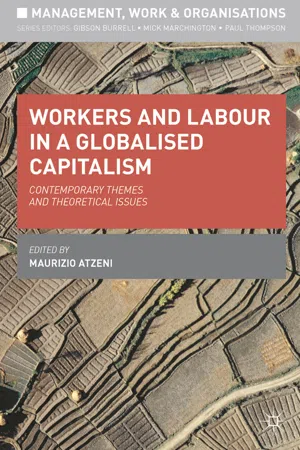
eBook - ePub
Workers and Labour in a Globalised Capitalism
Contemporary Themes and Theoretical Issues
- 264 pages
- English
- ePUB (mobile friendly)
- Available on iOS & Android
eBook - ePub
Workers and Labour in a Globalised Capitalism
Contemporary Themes and Theoretical Issues
About this book
An introduction to work and society for undergraduate and postgraduate students. This new text brings together international experts on work and employment from a range of disciplines to debate key themes and issues related to work in a globalised economy.
Information
part 1

THEORETICAL ISSUES: EXPLAINING THE CENTRALITY OF LABOUR WITHIN CAPITALISM
1
MARX AND MARXIST VIEWS ON WORK AND THE CAPITALIST LABOUR PROCESS
INTRODUCTION
The writings of Karl Marx and the Marxist tradition offer a profound analysis of work. Marx combined an analysis of work as a vital human activity, with a critique of the form of work under capitalism. Work, in Marx’s view, remained ‘alienating’ under capitalist conditions; however, it retained the potential to become a life-enhancing activity in a future communist society. The alienation of the worker from his or her work could not be overcome, according to Marx, without the abolition of capitalism, and the move to communism. Marx’s analysis of work has remained, and continues to remain, a source of inspiration for critical work researchers as well as political activists.
Marxist analysis of work was renewed and reinvigorated in the 1970s. The pioneering work of Harry Braverman (1974) and others brought about a fresh debate about the application of Marx’s original ideas to the study of the capitalist labour process. This debate has continued in the years that have followed (see Thompson and Newsome 2004). One of its fruits has been the development and promotion of ‘labour process theory’. The latter, while still incorporating Marxist concepts and language, has forged its own path and has become progressively more open to different perspectives and approaches. Labour process theory remains a prominent influence on critical scholarship on work in the sociology of work, industrial relations, and organisation theory (Thompson and Newsome, 2004; Thompson, 2010). It remains a matter of debate whether and in what ways the Marxist tradition can enrich the analysis of the capitalist labour process.
This chapter considers the contribution of Marx and some aspects of the Marxist tradition to the analysis of work. A few words of clarification need to be made at the outset. First, the writings of Marx on the topic of work are voluminous and cannot be fully considered in a single chapter. Readers interested in a fuller treatment of Marx’s writings on work should consult other more detailed sources (see, for example, Sayers 2011). They could also consider reading some of the original work-related writings of Marx. Second, the Marxist literature on work is large and is impossible to summarise here. For example, although not covered below, there is a literature associated with the autonomist or workerist tradition in Marxism that deals with issues relating to the capitalist labour process, the bifurcation between work and labour, and struggles over and against labouring activity under capitalism (Cleaver, 2000; Holloway, 2010). Readers could follow up discussion presented below with further reading that draws on literatures such as those just highlighted. For the purposes of this chapter, particular attention will be given to the labour process debate. Although the latter was initially based in the UK, it has become much more international in scope and contributors. In addition, the issues it discusses, such as the nature of conflict between labour and capital in the workplace and the transformation of work under the imperative of capital accumulation, have wide relevance and apply to many different national contexts.
The organisation of the chapter is as follows. The next section identifies the importance of work as an activity within Marx’s writings. The following section discusses Marx’s key concept of alienation. The section after that considers Marx’s discussion of exploitation and the organisation of work under capitalism. The subsequent section examines Marx’s vision of work in a future communist society. The next two sections address (i) the contribution of Braverman, and (ii) Labour process theory as a prominent example of modern critical scholarship on work. The final section provides a conclusion.
THE IMPORTANCE OF WORK IN HUMAN LIFE
The activity of work occupies a central place in Marx’s writings. Work is defined as an activity through which people engage with and transform nature in order to meet their material needs. It is necessary for people to produce things they need to live, and work has remained and will continue to remain a necessity. But work is so much more than just a route to consumption. As Marx emphasised, people are shaped and changed by the activity of work (Marx 1976: 283).
At one level, work is a social and communal activity. People forge important social connections via work and these have wider ramifications for the nature of society as a whole (Marx 1968: 80). Marx referred to the way that societies can be distinguished by the social organisation of work. How work is organised and how producers relate to one another has a direct bearing on the character of society. Marx’s attempt to define societies on the basis of the form or mode of work that predominates in those societies forms a central part of his materialist approach to the study of history.1
At another level, work affects the development and overall well-being of people. Who people are and able to become is influenced by the work they do. Marx referred to the way that people realise and develop their capabilities and identities through the activity of work. Work is not just a chore to be endured; it is also a potentially liberating activity that can improve the life experiences of people.
To see this last point, consider the below quote from the Grundrisse, in which Marx challenges Adam Smith’s depiction of work as ‘toil and trouble’. Smith had maintained that people would want to avoid work because its performance would deprive them of their freedom. He also maintained that the experience of work would be negative: people would prefer to spend their time doing activities other than work (see Smith 1976: vol. 1, 47).2 Marx responded to Smith in the following way:
It seems quite far from Smith’s mind that the individual, ‘in his normal state of health, strength, activity, skill, facility’, also needs a normal portion of work, and of the suspension of tranquillity. Certainly, labour obtains its measure from the outside, through the aim to be attained and the obstacles to be overcome in attaining it. But Smith has no inkling whatever that this overcoming of obstacles is in itself a liberating activity – and that, further, the external aims become stripped of the semblance of merely external natural urgencies, and become posited as aims which the individual himself posits – hence as self-realisation, objectification of the subject, hence real freedom, whose action is, precisely, labour.
(Marx 1973: 610)
Several aspects of the above quote can be commented upon. One aspect concerns the stress that is placed on work as a positive undertaking. The ‘overcoming of obstacles’ as a part of work is seen as a potentially ‘liberating activity’. Indeed, work can become so absorbing and interesting that it is pursued for its own sake, rather than just for the sake of its ‘external ends’. Marx was clear that work could be a means for ‘self-realisation’ and ‘real freedom’ and he disputed the attempt made by Adam Smith and other classical economists to draw a direct association between work and unhappiness. To be sure, as will be shown below, Marx recognised that work would be resisted by workers; however, he sought to link this resistance to the form of work evident under capitalism. The mistake of classical political economy was to miss the historical origins of work resistance and to omit consideration of possible ways to overcome the costs of work by the transcendence of capitalism.
To emphasise the importance of work even further, Marx categorised work as a part of the ‘species being’ of mankind. Through work, people could affirm and realise their humanity. Humans are not sloth-like, but rather are productive and creative beings, with an urge to shape and change nature. In Marx’s words: ‘the productive life is the life of the species. It is life-engendering life. The whole character of a species – its species-character – is contained in the character of its life activity; and free, conscious activity is man’s species-character’ (Marx 1977: 68).
To summarise, Marx stressed the positive sides of work. He dismissed arguments that work is universally a ‘bad thing’, and instead pointed to the way that society creates and reproduces an aversion to work. Work could be and indeed ought to be a fulfilling and satisfying activity (see Sayers, 2005). In Marx’s view, as argued below, the prime impediment to the achievement of work as a positive and fulfilling activity is the capitalist system of work.
WORK AND THE ALIENATION OF THE WORKER
Marx’s writings on work incorporated the idea of ‘alienation’. Marx first introduced this idea in the Economic and Philosophical Manuscripts, written in the early 1840s. It continued to figure in Marx’s later writings. Alienation, in essence, refers to the inability of people to exercise control over the work they do. While Marx argued that alienation had existed in slave and feudal societies, he felt it took on a particular form under capitalism. In capitalist society, the means of production are owned by the capitalist class, and the working class as the majority class must offer their labour services for hire in order to survive. The lack of control exercised by workers over the way that work is organised and conducted, Marx argued, has a profound negative influence on the quality of work life.
Marx identified four different dimensions of alienation under capitalism. First, workers are alienated from the product of their own labour because it is owned by the capitalists who hire them for a specified period of time. They are unable to use the things that they produce to sustain life, since these things are the property of capitalists. Marx stressed that the workers’ alienation would grow in proportion to the amount of commodities they create in production. Under normal circumstances, it would be expected that greater production would advance the welfare of workers, by enlarging the goods available to them. Yet, in capitalism, the reverse is the case. By adding to the volume of produced commodities, workers only increase the ‘hostile and alien’ force that dominates their lives (Marx 1977: 64). For Marx, increased production leads necessarily to the impoverishment of the working class:
It is true that labour produces wonderful things for the rich – but for the worker it produces privation. It produces palaces – but for the worker, hovels. It produces beauty – but for the worker, deformity. It replaces labour by machines, but it throws one section of the workers back to a barbarous type of labour, and it turns the other section into a machine. It produces intelligence – but for the worker, stupidity, and cretinism.
(Marx 1977: 65)
Second, it is argued that workers are alienated from the activity of work itself. In working for capitalists, workers relinquish control over the direction of their own labour within production. What and how work is done is decided upon by capitalists, not workers. Marx stressed that this loss of control over the labour process would mean that work itself would no longer exist as a creative force; rather it would be viewed by workers as a purely functional activity that is performed to earn wages. Marx indicated, too, that the power of capitalists in production would be used to the disadvantage of workers; under the pressure to make profit, capitalists would find it in their own interests to lengthen work time, and to intensify work (see below). In these ways, the alienation of workers from work itself would grow even more severe.
The third dimension of alienation is the estrangement of workers from their ‘species being’. As pointed out above, Marx viewed the ability to participate in creative work as an essential part of human nature. The fact that under capitalism workers are unable to exercise any direct control over the product and process of labour means that they are effectively denied the opportunity to work creatively. Work, instead of being the source of self-realisation, becomes a simple means to income and is associated with endless toil and drudgery.
Finally, Marx referred to the alienation of workers from their fellow human beings. Workers confront their own estrangement from their ‘species being’ in the lives of other workers who are equally degraded and dehumanised by the experience of work. Self-estrangement forms the basis for the ‘estrangement of man from man’ (Marx 1977: 69). Further, workers are alienated from one another by the fragmentation of tasks which undermines co-operation, by the imposition of a hierarchical work structure which pits workers against one another, and by the lack of any form of collective decision-making over the organisation and control of work.
Marx argued that alienation ultimately is the source of great misery to the working class as a whole and is the cause of opposition to the activity of work itself. According to Marx, under capitalism:
The worker . . . only feels himself outside his work, and in his work feels outside himself. He feels at home when he is not working, and when he is working he does not feel at home. His labour is therefore not voluntary but coerced; it is forced labour. It is therefore not the satisfaction of a need; it is merely a means to satisfy needs external to it. Its alien character emerges clearly in the fact that as soon as no physical or other compulsion exists, labour is shunned like the plague.
(Marx 1977: 66; emphasis in original)
Here we can note that Marx stresses the historical roots of the temporal divide between work and leisure, and argues that instrumental attitudes towards work, instead of being a ubiquitous feature of reality, are in fact the product of capitalism. Workers possess a positive preference for leisure and a negative preference for work, not because of their natural proclivity for idleness, but instead because of their ‘alienation’ in capitalist production. Marx argued that the commonsense view of work as an unpleasant necessity is symptomatic of the alienated experience of work under capitalism (see Sayers 2005). Indeed, such a view plays a vital role in justifying the suffering of the working class by denying that anything can be done to resolve the costs of work.
Marx contended that alienation would not just affect the working class; it would also impact on the capitalist class as well. Capitalists have no way of realising their true humanity, since their own needs are subordinated to those of capital accumulation. All members of capitalist society effectively are enslaved by the structures and processes of capitalism: their lives are governed by conditions that appear to exist independently of them, and over which they have no control. While commodities express definite social relations between people, as Marx (1976: 165) put it, these relations assume ‘the fantastic form of a relation between things’. Capital, value, money and so on command power over the lives of people and restrict the opportunity for free creative activity (see Fromm 1961: 49).
In The Holy Family, Marx and Engels indicated that while capitalists are alienated under capitalism they have material interests in not overcoming this situation:
The propertied class and the class of the proletariat present the same human self-estrangement. But the former class feels at ease and strengthened in this self-alienation, it recognises estrangement as its own power and has in it the semblance of a human existence. The latter feels annihilated in estrangement; it sees in it its own powerlessness and the reality of an inhuman existence.
(Marx and Engels 1975: 36; emphasis in original)
In spite of their alienation, capitalists would defend capitalism in order to ensure that their own material advantage over the working class is preser...
Table of contents
- Cover
- Title page
- Copyright
- Contents
- List of Abbreviations
- Notes on Contributors
- Introduction: Neo-Liberal Globalisation and Interdisciplinary Perspectives on Labour and Collective Action
- Part 1: Theoretical Issues: Explaining the Centrality of Labour within Capitalism
- Part 2: Classical Issues: Explaining Workers’ Resistance and Organisation
- Part 3: Contemporary Issues: Workers Organising in the Global World
- Index
Trusted by 375,005 students
Access to over 1.5 million titles for a fair monthly price.
Study more efficiently using our study tools.
Frequently asked questions
Yes, you can cancel anytime from the Subscription tab in your account settings on the Perlego website. Your subscription will stay active until the end of your current billing period. Learn how to cancel your subscription
No, books cannot be downloaded as external files, such as PDFs, for use outside of Perlego. However, you can download books within the Perlego app for offline reading on mobile or tablet. Learn how to download books offline
Perlego offers two plans: Essential and Complete
- Essential is ideal for learners and professionals who enjoy exploring a wide range of subjects. Access the Essential Library with 800,000+ trusted titles and best-sellers across business, personal growth, and the humanities. Includes unlimited reading time and Standard Read Aloud voice.
- Complete: Perfect for advanced learners and researchers needing full, unrestricted access. Unlock 1.5M+ books across hundreds of subjects, including academic and specialized titles. The Complete Plan also includes advanced features like Premium Read Aloud and Research Assistant.
We are an online textbook subscription service, where you can get access to an entire online library for less than the price of a single book per month. With over 1.5 million books across 990+ topics, we’ve got you covered! Learn about our mission
Look out for the read-aloud symbol on your next book to see if you can listen to it. The read-aloud tool reads text aloud for you, highlighting the text as it is being read. You can pause it, speed it up and slow it down. Learn more about Read Aloud
Yes! You can use the Perlego app on both iOS and Android devices to read anytime, anywhere — even offline. Perfect for commutes or when you’re on the go.
Please note we cannot support devices running on iOS 13 and Android 7 or earlier. Learn more about using the app
Please note we cannot support devices running on iOS 13 and Android 7 or earlier. Learn more about using the app
Yes, you can access Workers and Labour in a Globalised Capitalism by Maurizio Atzeni in PDF and/or ePUB format, as well as other popular books in Negocios y empresa & Negocios internacionales. We have over 1.5 million books available in our catalogue for you to explore.