- 288 pages
- English
- ePUB (mobile friendly)
- Available on iOS & Android
eBook - ePub
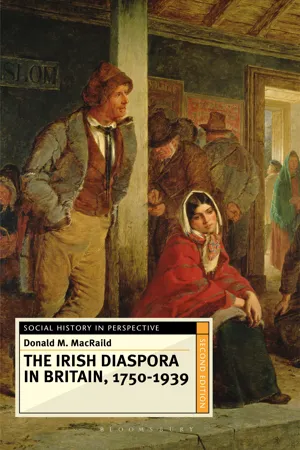
The Irish Diaspora in Britain, 1750-1939
About this book
This established study focuses on the most important phase of Irish migration, providing analysis of why and how the Irish settled in Britain in such numbers. Updated and expanded, the new edition now extends the coverage to 1939 and features new chapters on gender and the Irish diaspora in a global perspective.
Information
Chapter 1: Economy, Poverty and Emigration
Introduction
Since the early eighteenth century around eight million people have emigrated from Ireland.1 Of this number, perhaps five million left in the first seven decades of the nineteenth century. Indeed, by the middle of that century, the tradition of leaving Ireland had expanded so significantly that young Irish men and women had a one in three chance of emigrating, and by 1890 around 40 per cent of all Irish-born people were living outside their country of birth.2 While in most countries the passage of people was dwarfed by enormous natural increases in population, in the case of Ireland massive rates of departure were exacerbated by the effects of increased celibacy, a higher mean age at marriage and other lifestyle factors, which combined to ensure that its population fell into steep decline. Between 1841 and 1901, the Irish population halved from more than eight million to approximately four million. Mass emigration was a feature of Irish life long before other European countries. Ireland emitted a higher proportion of her people than any other country and a greater absolute number of emigrants than even much larger countries like England. As a consequence, whatever the impact of emigration upon European society in general, the overall effects were many times greater in Ireland’s case. The uniqueness of Ireland’s migratory story is also strengthened by the sheer volume of female emigrants. Few other countries, apart from perhaps Sweden, sent roughly an equal number of men and women abroad. By the later nineteenth century, and in the interwar period, women accounted for the larger share of emigrants from Ireland, and with the United States easing the flow of immigrants in the 1920s, and with the Depression making the trip across the Atlantic less attractive in the 1930s, many of these women found themselves heading for England, Scotland and Wales.3
The earliest significant migration from Ireland occurred in the early eighteenth century especially among Dissenting communities in Ulster. During the century before 1815, despite interruption by war and a legislation (such as the Passenger Acts of 1803) which improved conditions on board ships but deterred poor migrants with increased costs of passage, saw upwards of 300,000 Irish departed for the Americas. Towards the end of the century, large-scale migration was also directed towards the industrializing communities of west Scotland and north-west England. This trend intensified in the period after 1815, and, on the eve of the Famine, around one million had already departed for North America and perhaps 500,000 to Britain. Yet greater departures were still to come. The period of the Great Famine (1845–50) and its aftermath saw the greatest emigration in Irish history, with over two million departures in little more than a decade. Even in the 1860s and 1870s, when agriculture was more buoyant than it had been since 1815, people continued to leave. By the latter decade, emigration was so fundamental to Irish life that probably no Irish family was untouched by it.
Although the migrant stream carried resisting groups, such as Dissenters in search of religious freedoms and political rebels fleeing the gallows, the majority of those who headed for new lives outside the country of their birth left in search of economic opportunities. They also left for a variety of destinations. North America was an important journey’s end in the eighteenth century, although from 1815 to around 1840 Britain was by the far most important attraction for Irish migrants. Canada was also a more important centre of Irish settlement in this period than the United States. This is because legislation was introduced in Britain after the American Revolution to prevent the loss of human capital to the new republic. Successive British governments continued to encourage Irish and other migrants to travel to British North America, thus simultaneously bolstering the last North American colony and depriving American industry of much-needed labour. Although many settlers disembarked in Canada for these reasons, a large proportion of them are thought to have walked south along the coast of New Brunswick, crossing the border into Maine before reaching the growing American cities. When restrictions were relaxed and crossings became cheaper, especially in the late 1830s and 1840s, the United States quickly eclipsed Canada as a direct route for Irish settlers. In the same period, ‘chiefly, no doubt from their distance’ and ‘despite their fine climate’, the Australian colonies had not attracted migrants as the authorities had hoped. Indeed, as late as 1831, ‘shipowners had not thought it worth while to provide accommodation for a poorer class of emigrants.’4
In the second half of the century, however, these greater distances constituted less of a bar, and Australia, New Zealand, South Africa and Argentina attracted significant flows of Irish migrants. Meanwhile, across our entire period an underinvestigated emigration took thousands Irish soldiers, sailors and civil servants to promote and protect the British Empire, not least India.5 The vast majority of these population movements, however, can be viewed in the context of an expanding Atlantic economy in which Britain and the United States vied for supremacy and Ireland provided vast quantities of labour.
These migrants responded to a combination of ‘push’ and ‘pull’ factors. They were driven from Ireland by the chronic effects of meagre and unevenly distributed resources, perpetual hardship and by moments of acute crisis. But they were drawn to Britain or America by perceived opportunity and the prospect of sharing in the relative prosperity of those countries. Yet emigration does not easily fit into models or patterns. It neither selected one social group nor concentrated on only one region. Society’s poorest elements did not emigrate first, and the prosperous did not necessarily remain behind. The earliest large-scale departures came from the wealthier north and east during the eighteenth century, while the poorest province, Connacht, maintained disproportionately low emigration rates until well after the Famine. The decision to leave was not taken lightly or for the same reasons by different individuals and families. Even in the worst times, such as at the height of the Famine, the leaving was not simply desperate and unthinking. Emigration, in fact, must be seen as an element of the life cycle: a survival strategy as well as a means of adapting and improving the lives people knew. Moreover, emigration was an economically sensitive indicator of the state of the nation, rising and falling as crops failed or as harvests were good, as trade boomed or slumped and according to economic conditions in the receiving country. The decision to leave was intensely personal, often prompted by a letter from a friend or relative containing stories of milk and honey and a prepaid ticket.
Irish emigration was like that of no other country, except perhaps Sweden, in terms of its gender balance. Whereas men dominated most outflows from Europe, Ireland sent an equal number of women. Even before the Famine women constituted two-fifths of the Irish outflow. Moreover, near symmetry was achieved, later in the century, when family migration had weakened, other than in eastern Ulster.6 While married couples, Fitzpatrick has shown, accounted for around one-third of all English migration in the later nineteenth and early twentieth centuries, in Ireland single men and women aged between 20 and 24 accounted for two-fifths of all emigrants in this period. The traditional image is of women being pushed out of the labour market by men, although it has been suggested that technological innovation, by reducing the importance of muscle power, actually improved the woman’s position in rural work. A more likely explanation of the uniquely high rate of female migration, therefore, is the improved prospects for women in the receiving countries. These factors of gender, age and marital status were due not just to problems in Ireland but also to the migrant’s pursuit of a number of personal goals, especially a good job and improved status.7
The scale of emigration from Ireland caused a good deal of contemporary concern. The one-time Young Irelander John Mitchel, for example, argued that those who left were exiles rather than emigrants.8 Even at the time, however, it was not just activists such as Mitchel who viewed emigration as a cause for concern. For example, more conservative Irishmen would have endorsed David Ricardo’s view, expressed in 1816, that emigration was a cause for concern because ‘the young, the strong, the enterprising and industrious families leave us, whilst the idle and the indolent portion stay with us.’9 During the Famine, Richard Longfield of County Cork told a government commission, ‘Emigration would give some relief [from the worst effects of the Famine] ... The active and industrious might go; others would not.’10 This contemporary concern with depletion has led to debate in recent years among historians trying to assess the loss of ‘human capital’ which the emigrant trade involved.11
Whether we view emigration as the result of political injustice or of economic necessity, the fact remains that it derived from a deeply complex mixture of social, economic and cultural phenomena. Before we can begin to appreciate the nature of Irish communities in Britain, therefore, it is necessary to discuss the Irish preconditions of mass departure. No attempt is made to be totally inclusive.12 Instead, the focus rests firmly on the key ‘push’ factors which sustained Europe’s greatest migration, and an attempt is made to evaluate some of the elements of Irish life which explain both the nature and patterns of Irish emigration.
Ireland Before the Famine
‘By 1800’, Hoppen has argued, ‘a recognisably nineteenth-century Irish rural society was already in place, though the wealth, size, and experiences of its component parts were to change significantly during the succeeding hundred years.’13 At the top were the 10,000 or so landlords who owned the land; next came the farmers, who rented lands of varying values; the third category, those who worked the land, accounted for the overwhelming majority of the Irish population. In practice, these distinctions were blurred, with each group containing numerous gradations. Many landowners and large farmers were deeply in debt, while even the poorest members of rural society aimed to rent a scrap of land under the ‘Conacre system’. Land, nevertheless, conferred status in proportion to the size of the holding; ownership might provide a sense of security, although a saleable tenancy could just as easily finance migration. In a pastoral society, such as Ireland, the individual’s relationship with the land was paramount because ownership ‘marked out a crucial line of division between those enjoying some prospect of planning for the future and those who could merely live from one moment to the next’.14 Whether land was subdivided (as was increasingly the case among potato-dependent smallholders) or passed on to the eldest son (as was the case with the wealthier farmers and landowners), the prospect of inheritance determined an individual’s outlook on life. When population pressure pushed subdivision to crisis levels, or when younger sons or daughters had no prospect of inheriting their father’s farm, emigration became a likely option. These problems certainly came to bear in the 30 years after 1815.
The Great Famine has long been viewed as the turning point of Irish history: a series of events which, by promoting emigration, economic change and population decline, destroyed traditional society and created a new Ireland. W. F. Adams and later R. Crotty were first to suggest that the Famine, rather than setting new trends, actually enhanced demographic and economic patterns that were already noticeable in the generation after 1815 when the return to a peacetime economy ended a generation of rural prosperity.15 Evidence for this view is provided by reference to the contrasting economic fortunes of the Irish during and after the French Wars. Whereas the period from 1780 to 1815 had been characterized by increases in tillage, potato cultivation and population, conditions thereafter became favourable for a return to less labour-intensive dairy and pasture farming. From 1815 to the 1840s Ireland’s agricultural economy was marred by falling prices, banking collapses and failed speculations. The period also witnessed increasing pressure on the scant resources, especially of small farmers and farm labourers, with poverty becoming more marked.
It is this combination of factors which led Crotty, and others, to declare that 1815 and not 1845 was the great ‘watershed’ of Irish history.16 While Crotty’s argument is controversial because it plays down the Great Famine, which was by any measure a horrific social catastrophe, as well as an important symb...
Table of contents
- Cover
- Title Page
- Copyright
- Contents
- Acknowledgments
- Introduction
- Chapter 1: Economy, Poverty and Emigration
- Chapter 2: Concentration and Dispersal: Irish Labour Migration to Britain
- Chapter 3: Spiritual and Social Bonds: The Culture of Irish Catholicism
- Chapter 4: The Protestant Irish
- Chapter 5: Politics, Labour and Participation
- Chapter 6: Gender and Ethnicity
- Chapter 7: A Culture of Anti-Irishness
- Chapter 8: The Irish in Britain and the Atlantic Diaspora: Connections and Comparisons
- Chapter 9: Conclusion
- Notes
- Bibliographical Essay
- Index
Trusted by 375,005 students
Access to over 1.5 million titles for a fair monthly price.
Study more efficiently using our study tools.
Frequently asked questions
Yes, you can cancel anytime from the Subscription tab in your account settings on the Perlego website. Your subscription will stay active until the end of your current billing period. Learn how to cancel your subscription
No, books cannot be downloaded as external files, such as PDFs, for use outside of Perlego. However, you can download books within the Perlego app for offline reading on mobile or tablet. Learn how to download books offline
Perlego offers two plans: Essential and Complete
- Essential is ideal for learners and professionals who enjoy exploring a wide range of subjects. Access the Essential Library with 800,000+ trusted titles and best-sellers across business, personal growth, and the humanities. Includes unlimited reading time and Standard Read Aloud voice.
- Complete: Perfect for advanced learners and researchers needing full, unrestricted access. Unlock 1.5M+ books across hundreds of subjects, including academic and specialized titles. The Complete Plan also includes advanced features like Premium Read Aloud and Research Assistant.
We are an online textbook subscription service, where you can get access to an entire online library for less than the price of a single book per month. With over 1.5 million books across 990+ topics, we’ve got you covered! Learn about our mission
Look out for the read-aloud symbol on your next book to see if you can listen to it. The read-aloud tool reads text aloud for you, highlighting the text as it is being read. You can pause it, speed it up and slow it down. Learn more about Read Aloud
Yes! You can use the Perlego app on both iOS and Android devices to read anytime, anywhere — even offline. Perfect for commutes or when you’re on the go.
Please note we cannot support devices running on iOS 13 and Android 7 or earlier. Learn more about using the app
Please note we cannot support devices running on iOS 13 and Android 7 or earlier. Learn more about using the app
Yes, you can access The Irish Diaspora in Britain, 1750-1939 by Donald MacRaild in PDF and/or ePUB format, as well as other popular books in History & Social History. We have over 1.5 million books available in our catalogue for you to explore.