This essential textbook provides a comprehensive introduction to the Islamic business environment, exploring core concepts and practices in business administration from an Islamic perspective. Thorough and accessible, it covers the full range of Islamic business, including entrepreneurship, ethics, organizational culture, marketing, finance and decision making. Taking an integrated approach that aligns contemporary business practice with traditional Islamic literature, the book offers an engaging exploration of the key ways in which business activities can be organised to align with Islamic norms, rules and regulation. Developed from the teaching practice of an international range of leading scholars in the field, Islamic Business Administration includes topical case studies, practical business scenarios and comparative features, encouraging students to place their understanding of Islamic business within the wider global business context and to understand its practical implementation.
This is an invaluable companion for students studying a module in Islamic business or management at undergraduate, postgraduate and MBA level. It is also suitable for students of Islamic finance or banking looking to place their learning in the wider context of Islamic business.
eBook - ePub
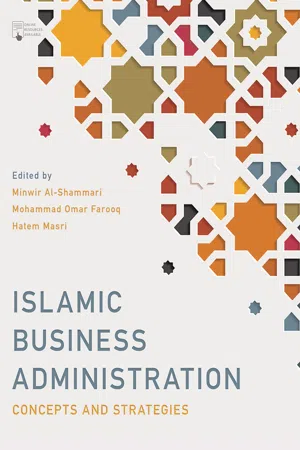
Islamic Business Administration
Concepts and Strategies
- 302 pages
- English
- ePUB (mobile friendly)
- Available on iOS & Android
eBook - ePub
Islamic Business Administration
Concepts and Strategies
About this book
Information
PART
1
ISLAMIC BUSINESS ENVIRONMENT
ISLAM AND BUSINESS: BELIEFS, VALUES, AND NORMS | 1 |
University of Bahrain, Bahrain
Learning Outcomes
LO1: Explain the role of business and resources used for it.
LO2: Describe the business environment, key stakeholders, and major types of decision making.
LO3: Understand the core beliefs and values of Islam pertaining to business and commerce
LO4: Recognize the emphasis of the Qur’an, as exemplified in the life of the Prophet (p), on trade and prosperity in human-centered, sustainable development
LO5: Explain the role trade has played in the history of Islamic civilization and the contemporary aspirations and initiatives to bring Islamic values to business and the economy
Contents
1.1 Introduction
1.2 Beyond Islamic banking and finance
1.3 Essential Islamic beliefs pertaining to business
1.4 Essential aspects of Islamic law
1.5 Essential values of Islam
1.6 Functional norms
1.7 Islamic business environment
Discussion Questions
Selected Bibliography
Notes
INSIGHT: Shared Prosperity
Chobani is a Greek yogurt maker, a privately owned multibillion-dollar company in the USA. Its CEO and founder is Hamdi Ulukaya, a Turkish immigrant to the USA.
On April 27, 2016, he declared that his company will offer shares to its 2000 full-time employees that are 10 percent of the company’s future value in the event of a sale or an IPO. This will make many of its employees millionaires.
This is commonly known as an employee stock ownership plan (ESOP), and the underlying value is called shared prosperity – a highly relevant approach to profit sharing.
From an Islamic viewpoint, what the owner of Chobani did is not a matter of law or legalistic exercise. Rather, this is Islam beyond the realm of law or mere legal considerations. In it there is vision, values, ethics, and, most importantly, care reflecting Islam. We may wonder what the world would look like if those who have the power, wealth, and privilege to embrace, promote, and practice the value of “shared prosperity.”
The Qur’an teaches that wealth should not circulate among the wealthy few [59/al-Hashr/7]! Beyond legality, this is a value-oriented approach.
Source: Chobani’s vision in the owner’s words: https://www.chobani.com/about/.
1.1 Introduction
An economy is a system that seeks to balance the resources of a country against the wants and needs of its people. The main activities in an economy consist of:
• Production (supply)
• Consumption (demand)
• Distribution (linking demand and supply).
Businesses participate in the economy to produce and supply what consumers demand. Businesses in a market economy serve as the growth drivers in a number of interrelated ways:
• Creating employment and income-earning opportunities for the working population
• Purchasing resources
• Supplying goods and services
• Fostering innovation
• Generating savings and capital
• Fulfilling the needs and wants of society.
In the Muslim world, businesses play roles similar to those played by businesses in the rest of the world where Muslims live and have businesses. Though businesses share certain features, Islam as a way of life brings certain beliefs, values, and norms in shaping and conducting business. A synopsis of these beliefs, values, and norms are explored in this chapter, which also presents the basics of business. Further, these beliefs, values, and norms underlie all aspects of business covered in this book.
Muslim societies throughout history have led, fostered, and facilitated trade and business around the world. That changed as the Western world embarked upon its colonizing enterprise throughout the world, including the Muslim world as the Ottoman Empire disintegrated. After the breakup of the Ottoman (Turkish) Empire (1299–1924 AD), the Muslim world emerged from the postcolonial period as nation-states. The Organization of Islamic Cooperation (OIC), an international organization established in 1969, consists of 57 member states and represents more than 1.6 billion people, with a combined GDP (at purchasing power parity, or PPP) $18.6 trillion (Euro zone: $12.39 trillion, NAFTA $20.1 trillion). These countries vary in area, demographics, stage of development, resources, and so forth. However, during the postcolonial era, only a few countries, among which are Malaysia and Turkey, have made significant progress in their industrial development.
1.2 Beyond Islamic banking and finance
During the postcolonial period, one of the key developments and contributions of the Muslim world that has gone mainstream and attracted significant attention from around the world is Islamic banking and finance (IBF). This niche industry is based on the avoidance of certain religious prohibitions, the most important of which is riba (traditionally equated with interest).
While there is no national economy that can be identified as an Islamic economy where business activities are conducted based on Islamic values and parameters, according to Islamic Finance Outlook 2018 by S&P Global Rating, the Islamic banking and finance industry has been growing at a robust pace and reached $2 trillion in assets. The development of this field has led to the establishment of:
• financial institutions (e.g. Al Baraka and Kuwait Finance House banks)
• standard-setting and other support institutions (e.g. Islamic Financial Services Board [IFSB], Accounting and Auditing Organization for Islamic Financial Institutions [AAOIFI])
• academic and professional research institutions (e.g. International Centre for Education in Islamic Finance [INCEIF], Islamic Shariah Research Academy [ISRA])1
• regulatory bodies as part of central banks.
However, there is little focus or emphasis on business in general or nonfinancial businesses in particular for which financial institutions and markets exist.
With the growth and expansion of the IBF industry, and for its sustainability and relevance, the focus needs to shift to the real world of business and help develop relevant knowledge, infrastructure, and competencies.
Whether it pertains to banking, finance, or economics, considering any of these from Islamic perspectives requires making explicit the underlying foundation of beliefs, values, and principles. The same is true of business from Islamic perspectives.
1.3 Essential Islamic beliefs pertaining to business
Islam as a practical, balanced, wholesome and comprehensive way of life (deen) is based on three core beliefs: tawhid (monotheism), risalah (prophethood, messengership), and aakhirah (afterlife). These beliefs constitute the foundation of every aspect of Muslim life, including business.
1.3.1 Tawhid (Monotheism)
Tawhid entails that there is a God, the one and only God, who created human beings as part of the universe. Even though humans share this universe with their fellow creations, God made human beings distinct as thinking and discerning creatures that are able to reason and make choices. Muslims are expected to acknowledge God in their lives by searching for and affirming his guidance and upholding it to the best of their ability.
1.3.2 Risalah (Prophethood, Messengership)
As part of our natural disposition, we human beings search for explanations of our life and existence, and if there is a Creator or God, it makes sense that mankind should receive communication from the Creator. God has sent divine revelations throughout history, and the last and final revelation is the Qur’an, received verbatim via the Prophet Muhammad (p).2 The Qur’an is the fountain of the beliefs, principles, and values of Islam. The life of the Prophet (p) e...
Table of contents
- Cover
- Titlepage
- Copyright
- Dedication
- Contents
- List of Figures
- List of Tables
- Preface
- Part 1 Islamic Business Environment
- Part 2 Management and Marketing
- Part 3 Human Resource Management and Decision Making
- Part 4 Finance and Accounting
- Glossary
- Index
Trusted by 375,005 students
Access to over 1.5 million titles for a fair monthly price.
Study more efficiently using our study tools.
Frequently asked questions
Yes, you can cancel anytime from the Subscription tab in your account settings on the Perlego website. Your subscription will stay active until the end of your current billing period. Learn how to cancel your subscription
No, books cannot be downloaded as external files, such as PDFs, for use outside of Perlego. However, you can download books within the Perlego app for offline reading on mobile or tablet. Learn how to download books offline
Perlego offers two plans: Essential and Complete
- Essential is ideal for learners and professionals who enjoy exploring a wide range of subjects. Access the Essential Library with 800,000+ trusted titles and best-sellers across business, personal growth, and the humanities. Includes unlimited reading time and Standard Read Aloud voice.
- Complete: Perfect for advanced learners and researchers needing full, unrestricted access. Unlock 1.5M+ books across hundreds of subjects, including academic and specialized titles. The Complete Plan also includes advanced features like Premium Read Aloud and Research Assistant.
We are an online textbook subscription service, where you can get access to an entire online library for less than the price of a single book per month. With over 1.5 million books across 990+ topics, we’ve got you covered! Learn about our mission
Look out for the read-aloud symbol on your next book to see if you can listen to it. The read-aloud tool reads text aloud for you, highlighting the text as it is being read. You can pause it, speed it up and slow it down. Learn more about Read Aloud
Yes! You can use the Perlego app on both iOS and Android devices to read anytime, anywhere — even offline. Perfect for commutes or when you’re on the go.
Please note we cannot support devices running on iOS 13 and Android 7 or earlier. Learn more about using the app
Please note we cannot support devices running on iOS 13 and Android 7 or earlier. Learn more about using the app
Yes, you can access Islamic Business Administration by Minwir Al-Shammari, Mohammad Omar Farooq, Hatem Masri, Minwir Al-Shammari,Mohammad Omar Farooq,Hatem Masri in PDF and/or ePUB format, as well as other popular books in Business & Management. We have over 1.5 million books available in our catalogue for you to explore.