- 160 pages
- English
- ePUB (mobile friendly)
- Available on iOS & Android
eBook - ePub
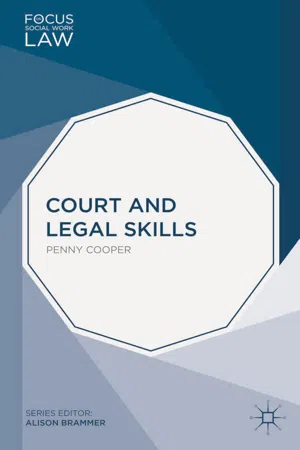
Court and Legal Skills
About this book
This book provides social workers with the theoretical and practical knowledge they need to effectively deal with courts and legal issues, which includes presenting evidence, supporting vulnerable service users in the legal system and developing good professional relationships.
Information
1
SOCIAL WORKERS IN THE ENGLISH LEGAL SYSTEM
AT A GLANCE THIS CHAPTER COVERS:

From day one in practice a social worker is required to work within the law, for example, to handle case files and information in accordance with the Data Protection Act 1998 and the Human Rights Act 1998. In practice it is not always obvious that departmental guidance and local authority policies are actually reflecting law and legal requirements. As a trainee social worker you will have learnt about aspects of law as part of your training. This book builds on that knowledge and tackles the practical detail of how to get things done in a way that will make dealing with lawyers and courts a more effective and rewarding experience for you and your service users. (I have used the term ‘service user’ throughout this book though I recognize that sometimes social workers will use other terms such as ‘client’ or ‘customer’.)
Most social workers will come into contact with the legal system as part of their professional practice; it is part and parcel of being a social worker. Once involved in a legal matter you play a key part in ensuring the court reaches a just result. It is not hard to think of examples of cases where social work evidence could be crucial to the outcome at court – a parent and child facing permanent separation, an elderly person requiring specialist residential care, a defendant facing conviction or a patient needing lifesaving treatment. The aim of this book is to ensure that social workers have the necessary knowledge and skills to understand procedure for court and present the evidence to the highest possible standard. We know that training is essential and can have a direct bearing on the case results.
[T]training social workers in the procedural and presentational aspects of courts improves their ability to produce a care case that is more likely to achieve best outcomes for the child or young person. (Munro, 2011:101)
It is envisaged that this book will be a training and a practice companion that will be read chapter by chapter and later dipped into as a quick reference guide as and when required.
This book begins with the law and best practice on record-keeping and information-sharing so that your files will pass muster at court and will be the basis of excellent evidence. Subsequent chapters cover statements for court, presenting your evidence effectively in court (even under cross-examination), supporting vulnerable service users in the legal system and getting the most out of working relationships with other professionals, such as police officers, intermediaries and expert witnesses. The final chapter is about dealing with the aftermath of hearings and future legal reforms.
Daunting as the legal system might be, it is also a tool for social workers to achieve better outcomes for their service users, for instance, by obtaining a court order to remove an abused child from harm, seeking an order to secure a residential placement for a mentally incapacitated service user, or going to court to give support for a vulnerable defendant in a criminal trial. Or it could be that the social worker has been required to respond to legal proceedings, for instance, providing a statement to the police as a witness to an assault, giving evidence at a public enquiry about the death of a child, responding to a request by the Crown Prosecution Service (CPS) for the disclosure of confidential service user records or supporting a vulnerable victim in a prosecution.
Invariably, being involved in a legal matter creates stress. Sometimes the media become involved and this ratchets up the pressure even more. Social work can create some of the most striking newspaper headlines. Serious case reviews, such as those in relation to the boys known as the ‘Edlington two’ (Carlile, 2012), the death of ‘Baby P’ (Haringey Local Safeguarding Children Board, 2009) and the death of Daniel Pelka (Coventry Local Safeguarding Children Board, 2013), are also reminders of the challenges facing social workers.
The Daily Telegraph on 30 November 2013 ran a story: ‘Child taken from womb then put into care. Exclusive: Essex social services have obtained a court order against a woman that allowed her to be forcibly sedated and for her child to be taken from her womb by caesarean section’ (Freeman, 2013). It related to ongoing legal proceedings and Essex County Council’s response on 2 December 2013 (an extract of which is below) provided a much needed counterbalance to the newspaper reports:
The Health Trust had been looking after the mother since 13 June 2012 under section 3 of the Mental Health Act [1983]. Because of their concerns the Health Trust contacted Essex County Council’s Social Services. Five weeks later it was the Health Trust’s clinical decision to apply to the High Court for permission to deliver her unborn baby by caesarean section because of concerns about risks to mother and child. The mother was able to see her baby on the day of birth and the following day. Essex County Council’s Social Services obtained an Interim Care Order from the County Court because the mother was too unwell to care for her child. Historically, the mother has two other children which she is unable to care for due to orders made by the Italian authorities. In accordance with Essex County Council’s Social Services practice social workers liaised extensively with the extended family before and after the birth of the baby, to establish if anyone could care for the child.
Essex County Council, 2013
The issues in this case show just how challenging and difficult casework decisions can be. Less than a month before those headlines about the Essex case, in the same national newspaper, Childline founder Esther Rantzen wrote ‘if we create an atmosphere of unforgiving rage around all social workers, we will never attract people of real talent’. (‘Sharon Shoesmith: villain? Victim? Or someone who got it wrong?’, Rantzen, 2013). Fortunately, judges do not permit ‘an atmosphere of unforgiving rage’ around social workers or anyone else in their courts. Judges have a duty to ensure that hearings are fair and in order for that to happen the evidence must be presented and considered in a calm and objective way.
Judges appreciate that most social workers are short on time and resources. The role carried out by social workers is constantly under scrutiny.
Social workers are among the most essential yet maligned of public servants. They are criticized to such an extent that their work is often discussed and their profession roundly disparaged by the public at large. In contrast, little, if anything, is ever heard of their successes. The reality, however, of social work in the United Kingdom, is far from the commonly held public perception.
All Party Parliamentary Group on Social Work, 2013:5
Cases where things have gone wrong are invariably the ones that hit the newspaper headlines despite the fact that they are not the norm of dayto-day practice; social work successes or failed actions against social workers do not tend to sell newspapers. This book in part will redress that as it aims to present key cases in a balanced way. Reading and reflecting on key cases, practice-focused examples and doing ‘on-the-spot’ questions will help demystify the legal system, reduce wasted time and make legal tasks more straightforward. As has been said many times about the law, it is a framework not a barrier, and this book’s goal is to illustrate how useful that framework can be.
On-the-spot questions
1 Have you experience of the legal system
2 Was it positive or negative?
3 What worked well?
4 What didn’t?
Social workers in the English legal system
The English legal system covers England and Wales (Scotland and Northern Ireland have their own legal systems; even Welsh law differs in some respects where the Welsh government has passed its own laws which differ from those in England). The supreme law of the land is an Act of Parliament, also called primary legislation. There is no single document which can be called ‘the constitution’ but the phrase is sometimes used to indicate the totality of laws, the various organs of government, the courts and the civil service. The ‘common law’ is made up of judicial decisions which have grown up over time, and which create ‘judicial precedents’. That is, if the Court of Appeal says ‘in these circumstances, the law is X’ then every judge in a lower court must interpret the law accordingly. One way to think of the difference between legislation and common law (judge-made law) is that common law fills the gaps left by legislation, i.e., where there is no legislation or how to interpret existing legislation is not clear, we look to case law for clarification of the law....
Table of contents
- Cover
- Title Page
- Copyright
- Contents
- Table of cases
- Table of legislation
- Acknowledgments
- Abbreviations
- Using this book
- 1. Social Workers in the English Legal System
- 2. Record-Keeping and Handling Personal Information
- 3. Producing Written Evidence
- 4. Being a Witness
- 5. Working With other Professionals in the Legal System
- 6. Giving Children and Vulnerable Adults a Voice in the Legal System
- 7. Dealing With Outcomes: The Results and the Aftermath of Court Hearings
- Useful Websites
- Glossary
- Bibliography
- Index
Trusted by 375,005 students
Access to over 1.5 million titles for a fair monthly price.
Study more efficiently using our study tools.
Frequently asked questions
Yes, you can cancel anytime from the Subscription tab in your account settings on the Perlego website. Your subscription will stay active until the end of your current billing period. Learn how to cancel your subscription
No, books cannot be downloaded as external files, such as PDFs, for use outside of Perlego. However, you can download books within the Perlego app for offline reading on mobile or tablet. Learn how to download books offline
Perlego offers two plans: Essential and Complete
- Essential is ideal for learners and professionals who enjoy exploring a wide range of subjects. Access the Essential Library with 800,000+ trusted titles and best-sellers across business, personal growth, and the humanities. Includes unlimited reading time and Standard Read Aloud voice.
- Complete: Perfect for advanced learners and researchers needing full, unrestricted access. Unlock 1.5M+ books across hundreds of subjects, including academic and specialized titles. The Complete Plan also includes advanced features like Premium Read Aloud and Research Assistant.
We are an online textbook subscription service, where you can get access to an entire online library for less than the price of a single book per month. With over 1.5 million books across 990+ topics, we’ve got you covered! Learn about our mission
Look out for the read-aloud symbol on your next book to see if you can listen to it. The read-aloud tool reads text aloud for you, highlighting the text as it is being read. You can pause it, speed it up and slow it down. Learn more about Read Aloud
Yes! You can use the Perlego app on both iOS and Android devices to read anytime, anywhere — even offline. Perfect for commutes or when you’re on the go.
Please note we cannot support devices running on iOS 13 and Android 7 or earlier. Learn more about using the app
Please note we cannot support devices running on iOS 13 and Android 7 or earlier. Learn more about using the app
Yes, you can access Court and Legal Skills by Penny Cooper in PDF and/or ePUB format, as well as other popular books in Politics & International Relations & Social Policy. We have over 1.5 million books available in our catalogue for you to explore.