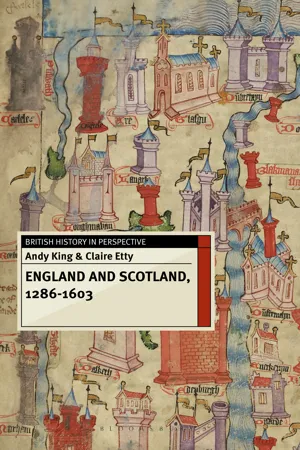
On a stormy night in 1286, a man fell off his horse and broke his neck, setting two kingdoms on a 300-year course of war. Edward I seized the opportunity to pursue English claims to overlordship of Scotland; William Wallace and Robert Bruce headed the 'patriotic' resistance. Their collision shaped the history, politics and nationhood of the two realms, and dragged in a third with the formation of the Franco-Scottish Auld Alliance. It also created a unique society on both sides of the Anglo-Scottish border. What prevented peace from breaking out? And how, at the dawn of the seventeenth century, could a Scottish king succeed, peacefully and unopposed, to the Auld Enemy's throne?
Andy King and Claire Etty trace the fractious relationship between England and Scotland from the death of Alexander III to the accession of James VI as James I of England. Spanning medieval and early modern history, this book is the ideal starting point for students studying Anglo-Scottish relations up to the Union.
- 256 pages
- English
- ePUB (mobile friendly)
- Available on iOS & Android
eBook - ePub
England and Scotland, 1286-1603
About this book
Information
Chapter 1: Hammer of the Scots? Edward I and Scotland, 1286–1306
i. The Scottish Succession and the ‘Great Cause’, 1286–92
On a stormy night in March 1286, a man fell off his horse and broke his neck. This unfortunate accident was to set in train a series of events leading to nearly three centuries of hostilities between Scotland and England. The man was Alexander III, King of Scots, and his unexpected death left Scotland in a state of uncertainty, for his two sons and his daughter were already dead. This left as his prospective heir his three-year-old granddaughter Margaret, daughter of King Eric of Norway, and now the only living descendant of the Scottish royal line as far back as William the Lion (1165–1214). Norwegian law excluded women from the succession, but no such rule applied in Scotland, although there was no precedent for the reign of a queen of Scots. Following the death of the second of Alexander’s sons, the kingdom’s magnates had sealed an undertaking recognizing the young Margaret as heir, should Alexander die without leaving a son or daughter. Scotland was now faced with the prospect of a long minority.
In the meantime, the country had to be governed; and a committee of six guardians ‘was chosen by the clergy and estates of the whole kingdom of Scotland, in a parliament held at Scone’.1 Despite this show of consensus, and although the guardians were carefully selected to represent a broad cross-section of the kingdom’s political elite, there remained the threat of factional dispute.
For much of the thirteenth century, Scottish politics had been dominated by the Comyns, the kingdom’s most powerful magnate family, and their allies. Their dominance left a number of rival magnates excluded; one of these was Robert Bruce of Annandale, who had a claim to the kingship. Despite having put his seal to the undertaking of 1284, Bruce now refused to accept Margaret as the heir. Together with his son, the earl of Carrick, he seized royal castles in Galloway, along with others belonging to John Balliol. The latter was singled out for attack because his claim to the kingship was as strong, or stronger, than Bruce’s; and because he was the brother-in-law of John Comyn of Badenoch, one of the leaders of the Comyn faction. Both Bruce and Balliol were descended from daughters of David, Earl of Huntingdon (d.1219), William the Lion’s younger brother. Balliol was the grandson of David’s eldest daughter; Bruce the son of his second daughter. Bruce argued that his claim was superior because, as David’s grandson, he was a nearer relative than Balliol, David’s great-grandson; and as a male he had a better right than Margaret. Nevertheless, his rebellion gained little support, and was subdued by early 1287, although the guardians lacked the power to punish him for it.
It was in these difficult circumstances that the guardians decided to approach Edward I of England for help and advice. With the benefit of hindsight, it may seem naïve of the Scots to have expected him to act disinterestedly, especially given that he had recently conquered Wales – another region of Britain over which the English had long claimed overlordship. Yet the Scots would not have recognized this as a precedent. Unlike Wales, Scotland was a long-established kingdom, whose kings and nobles shared England’s Francophile chivalric culture. Indeed, some Scottish nobles (including Bruce) had fought in Wales in their capacity as lords of English estates. Moreover, Edward had an international reputation as an arbiter of disputes; and he had a family connection, for he was Alexander III’s brother-in-law, and Margaret of Norway was his grandniece. Furthermore, Edward’s father, Henry III, had intervened in Scottish politics to protect the interests of the young Alexander III during his minority, and had conceded that this should not be taken as a precedent for English overlordship. Nor had Edward pressed the issue of overlordship in 1278, when Alexander had done homage for his English lands. And, like their king, many of the Scottish nobility held extensive lands in England, and were familiar with Edward as their lord (see Introduction, Section ii and Chapter 9, Section i).
In the event, Edward was more concerned with his own affairs than with Scotland’s difficulties; he left for France in May and did not return until 1289. It was then that negotiations began for the marriage of Margaret and Edward’s five-year-old heir, Edward of Caernarvon (the future Edward II). Who first proposed the match is not clear, but the initial negotiations seem to have been conducted between Edward and Eric of Norway. This presented the Scots with something of a dilemma. The continued absence of a king exacerbated disputes among the Scottish political community; however, the guardians were still maintaining a functioning government. Indeed, Margaret was generally referred to by the Scots only as their ‘lady’ and/or ‘heir’, rather than their ‘queen’, a reflection of the fact that a young girl could wield no real authority. There was therefore no pressing reason for them to bring her over from Norway, nor to invite further foreign interference by arranging her marriage.2 Nevertheless, a marriage alliance with England was by no means unacceptable to the Scots per se; both Alexander II and Alexander III had married English princesses.
Inevitably, the marriage of Margaret to the future king of England would open Scotland to English political influence, and the Scots demanded guarantees of their liberty. These demands were met by the treaty of Birgham (also known as the treaty of Northampton), a unilateral grant of terms to the Scots, ratified by Edward in August 1290.3 Among other concessions, Edward promised that the laws and customs of Scotland should be preserved; that no Scot should be tried outside Scotland for offences committed within that realm; and that no taxes or military service should be imposed on Scotland beyond those customarily imposed by previous kings of Scots for the needs of that realm. Crucially, the treaty included the promise that Scotland would remain ‘separated and divided and free in itself, without subjection, from the kingdom of England’. Nor were these concessions presented as contingent on the marriage. The Scots therefore believed they had been granted an unequivocal guarantee of Scotland’s independence from English overlordship.
Had the marriage gone ahead, and assuming that Edward and Margaret had produced an heir, then the union of the English and Scottish Crowns would have come about in the early fourteenth century, some three centuries before the accession of James VI, King of Scots, as King James I of England. But it all came to nothing, for the unfortunate Margaret died on her way to Scotland, in September 1290. For the Scots, the succession was now a straightforward dispute between Balliol and Bruce. Given the friction between the Comyns, who backed Balliol, and Bruce, who had his own partisans, they had little choice but to approach someone outside of Scotland with the necessary standing to arrange an authoritative settlement of the dispute. And Edward I of England was the only practical candidate, with the treaty of Birgham an apparent guarantee of his probity. But Edward had an agenda of his own. He had not raised the issue of English overlordship in the negotiations for Margaret’s marriage, for it had offered the prospect of the succession of a king of England as king of Scots, rendering the issue largely redundant. But while Margaret’s death had removed this prospect, the disputed succession offered a once-in-a-lifetime opportunity to realize a suzerainty which the English had claimed for centuries. As for the treaty of Birgham, Edward chose to regard it as irrelevant.
Edward was offered some encouragement in his ambitions by Bruce, in a letter which promised the obedience of both himself and his followers, and requested that Edward grant him his ‘right’. In effect, he was offering to recognize Edward’s overlordship in return for support for his claim to the kingship. At the same time, Florence, Count of Holland, arrived at Edward’s court, along with his son, who was betrothed to one of Edward’s daughters. Florence, who was descended from Ada, a sister of King William, put forward a claim to the kingship as Ada’s heir. In the event, he would fail to substantiate his claim; but by further complicating an already intractable dispute, he would strengthen Edward’s hand.4 Edward also commissioned some historical research. Various prominent English abbeys, priories and cathedrals were hurriedly ordered to search their chronicles for material relating to English overlordship, and to send relevant extracts to the king. The more pertinent – and favourable – were compiled into a dossier, to serve as precedents.5
Having prepared his ground, Edward summoned the Scots to a parliament to be held on 6 May 1291 at Norham castle, on the English bank of the Tweed. The Scots were reluctant to cross the river, concerned that appearing before Edward in his own realm might be construed as an admission of superior lordship. And their concern proved fully justified; when a delegation finally went to Norham on the 10th, it was informed that Edward desired ‘to do right to all those who can make any claim to the inheritance of the kingdom of Scotland’. To this end, he now requested recognition of this overlordship.6 The Scots, unaware of Florence’s claim, had expected that Edward would arbitrate between Balliol and Bruce; but Edward was offering judgement in court for all claims to the kingship which might be entered. The difference between arbitration and judgement was hugely significant. In legal terms, arbitration required an impartial arbitrator to arrange a settlement between two (and no more than two) disputing parties. Judgement, on the other hand, required the disputing parties to recognize the jurisdiction and authority of the judge, who would then impose a settlement. An arbitration was politically neutral; but a judgement was an exercise of lordship.
Unsurprisingly, the Scots were appalled, and only after an adjournment of three weeks did they make a reply. Addressing Edward in conciliatory terms, they argued that they had no authority to accept his demands, and that only ‘he who shall be king’ could consider them.7 This was a perfectly valid response according to contemporary legal theory, which held that guardians did not have the authority to grant away the rights of their ward. From this perspective, the question of overlordship could not properly be raised until the succession had been decided, and there was a king of Scots with the authority to settle the matter. Edward, however, turned to the claimants, one of whom could logically be counted as ‘he who shall be king’, and required them all to recognize his overlordship, and to grant him seisin of the kingdom and its castles, so that he could deliver the kingdom after making judgement.
By this stage, eleven men had put forward a claim, including Edward himself, on the grounds of his descent from Matilda, daughter of Malcolm III (d.1093). Alongside Balliol and Bruce, and Count Florence, was John Hastings, an English baron descended from the youngest daughter of David, Earl of Huntingdon. John Comyn of Badenoch was descended from a daughter of Donald Ban, King of Scots (1094–7), but specified that he did not wish his claim to prejudice that of his brother-in-law, John Balliol. The other five were descended from bastard daughters of Alexander II or William; and while their claims omitted to mention any taint of bastardy, they had no chance of success, for illegitimate offspring could not inherit. In fact, four of the five held lands in England (as indeed did all but three of the final fourteen claimants), while Florence was in receipt of a pension from Edward. Indeed, Edward may have encouraged some of them to put their claims forward, for the more claimants the easier it was to justify his demand to give judgement rather than arbitration; and the greater the number of his clients among the claimants, the easier it was to impose his will over them as a whole.
Bruce, who appears to have considered his claim to be weaker than Balliol’s, immediately accepted Edward’s overlordship, along with all the other claimants save Balliol and Comyn. The latter, fearing that judgement would proceed without them, had little choice but to follow suit, and on 5 June Edward was granted seisin of the kingdom by the claimants. Once the claimants had conceded overlordship, Edward quietly abandoned his own claim, as he could hardly judge a case in which he himself was a party. The record of these events subsequently drawn up by the notary John of Caen after 1296 omitted all reference to his claim, ignored the protestations of the Scots, and presented his actions straightforwardly as those of the rightful overlord of the Scottish realm. Edward would have considered such rewriting of history fully justified, on the grounds that the overlordship of Scotland was a longstanding right of the kings of England, and the record of the proceedings needed to be adjusted to reflect that historical reality. In this, he was only following the example of the Church, which had frequent resorted to the forgery of charters to make up for deficiencies in documentary records.
Having achieved recognition of his overlordship, Edward began the hearings to decide the succession (known to later historians as the ‘Great Cause’) at Berwick in August 1291.8 The case was to be heard before 104 auditors; and in an implicit recognition that they had been the only serious contenders all along, 40 were appointed by Balliol and 40 by Bruce, with the remaining 24 appointed by Edward. Nevertheless, the final judgement remained with Edward and his council. Leaving aside the complications introduced by the additional claimants, the succession hinged on whether the kingship should descend by primogeniture to Balliol, as the grandson of the eldest of David of Huntingdon’s daughters, or by degree to Bruce, the son of the second daughter, as a nearer relative to David. Bruce also argued that the succession should pass to the senior male in each generation, therefore bypassing his cousin Dervorguilla, and hence her son John Balliol. Balliol’s claim conformed to feudal law, while Bruce had a case under Roman law. Unfortunately, in the absence of any authoritative precedents, it was by no means clear what law should apply to the royal succession.
The proceedings began with a ten-month adjournment while Count Florence tried, and failed, to find proof to support his claim. In the meantime, Edward ruled as overlord. In fact, when the hearings were resumed in June 1292, such were the complexities of the case that the Scottish auditors were unable to offer much in the way of useful advice. After a month of hearings had settled nothing, Edward adjourned the case until October, so that he could call on a wider range of legal opinions, including experts from the universities of Oxford and Cambridge, and from Paris.
When the hearings resumed again in October, Edward’s preferred option was to proceed by feudal law. On 3 November, Edward’s councillors came to the unanimous conclusion that descent from the senior line trumped nearness of degree. On 6 November, this was accepted by the Scottish auditors, including those nominated by Bruce, and Bruce’s claim was therefore disallowed. Demands from Bruce and Hastings that the kingdom should be divided between the co-heirs were then dismissed on the grounds that the kingdom of Scotland should be considered indivisible; and those claimants remaining were disqualified either because their claims were invalid, or because they had failed to pursue them. This left Balliol as the only contender, and so finally, on 17 November, judgement was given in his favour.
The judgement made sense in political terms, for Balliol had the support of the Comyns, the most powerful noble faction in Scotland, while from Edward’s viewpoint, Balliol’s largely English background must have recommended him. Yet there is nothing to suggest that such immediate political considerations determined the judgement. Edward was concerned only to establish the principle of his overlordship, and not with imposing a particular candidate for the kingship. Edward’s rejection of Roman law met with little opposition, probably because most of Scotland’s political establishment were more familiar and comfortable with the customs of feudal law which had shaped Scottish common law. After 1306, Bruce’s grandson, King Robert I, would claim that Balliol had been imposed on the Scots by the king of England, against their will. Yet Bruce consistently acted as though he considered his claim to be weaker than Balliol’s; and he accepted the judgement, if not with good grace, then at least without overt opposition. Instead, he resigned his claim to his son; his son, in turn, resigned the earldom of Carrick to his own son (the future King Robert), leaving him with no Scottish lands, so that he would not have to do homage to Balliol, and could therefore leave the family claim uncompromised.
John Balliol was duly inaugurated as king of Scots at Scone on 30 November 1292. And then he came across the border to Newcastle upon Tyne, where, on 26 December, he did homage to Edward I as his sovereign overlord, for the whole realm of Scotland.
ii. English Conquest, 1292–1306
On 7 December 1292, just three weeks after the end of the ‘Great Cause’, and three weeks before John’s act of homage, Roger Bartholomew, a burgess of Berwick, appealed to Edward against judgements given against him in court by the guardians. Over the course of the thirteenth century, notions of sovereignty and overlordship had been increasingly closely defined and clarified by legal theorists, developing concepts derived from Roman law. It was now widely held that overlordship entailed the right of supervision of justice. So, as Edward saw it, the hearing of appeals from Scotland in the royal courts of England followed directly from the establishment of his overlordship, embodied in John’s homage. To the Scots, however, this was an intrusion which undermined the sovereignty of the Scottish realm, and a clear breach of the promises made by Edward in the treaty of Birgham. In fact, there were not many appeals to Edward from Scotland, just eight over the next two years. The most important was that of Macduff, a scion of the comital house of Fife. Macduff had already appealed to Edward in 1292, while the latter was acting as ruler of Scotland during the Great Cause. John subsequently gave a new judgement against him, so Macduff appealed again in 1293. Edward now summoned John himself to appear before royal justices at Westminster, where he was convicted of contempt of court – a gross humiliation for a reigning king.
Equally unwarranted from the Scottish viewpoint were Edward’s demands for military service. In 1294, war broke out between England and France over the issue of Gascony, held by Edward I, as Duke of Aquitaine, of Philippe IV of France. Edward summo...
Table of contents
- Cover
- Title Page
- Copyright
- Contents
- Preface
- Acknowledgements
- Abbreviations
- Maps
- Genealogical Tables
- Introduction
- Part 1
- Part 2
- Conclusion
- Notes
- Select Bibliography
- Glossary
- Index
Trusted by 375,005 students
Access to over 1.5 million titles for a fair monthly price.
Study more efficiently using our study tools.
Frequently asked questions
Yes, you can cancel anytime from the Subscription tab in your account settings on the Perlego website. Your subscription will stay active until the end of your current billing period. Learn how to cancel your subscription
No, books cannot be downloaded as external files, such as PDFs, for use outside of Perlego. However, you can download books within the Perlego app for offline reading on mobile or tablet. Learn how to download books offline
Perlego offers two plans: Essential and Complete
- Essential is ideal for learners and professionals who enjoy exploring a wide range of subjects. Access the Essential Library with 800,000+ trusted titles and best-sellers across business, personal growth, and the humanities. Includes unlimited reading time and Standard Read Aloud voice.
- Complete: Perfect for advanced learners and researchers needing full, unrestricted access. Unlock 1.5M+ books across hundreds of subjects, including academic and specialized titles. The Complete Plan also includes advanced features like Premium Read Aloud and Research Assistant.
We are an online textbook subscription service, where you can get access to an entire online library for less than the price of a single book per month. With over 1.5 million books across 990+ topics, we’ve got you covered! Learn about our mission
Look out for the read-aloud symbol on your next book to see if you can listen to it. The read-aloud tool reads text aloud for you, highlighting the text as it is being read. You can pause it, speed it up and slow it down. Learn more about Read Aloud
Yes! You can use the Perlego app on both iOS and Android devices to read anytime, anywhere — even offline. Perfect for commutes or when you’re on the go.
Please note we cannot support devices running on iOS 13 and Android 7 or earlier. Learn more about using the app
Please note we cannot support devices running on iOS 13 and Android 7 or earlier. Learn more about using the app
Yes, you can access England and Scotland, 1286-1603 by Andy King,Claire Etty in PDF and/or ePUB format, as well as other popular books in History & British History. We have over 1.5 million books available in our catalogue for you to explore.