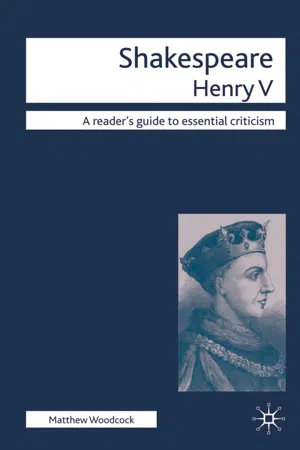
Matthew Woodcock provides a survey of the critical responses to this popular play, as well as the key debates and developments, from the seventeenth century to the present day. Leading the reader through material chronologically, the Guide summarises and assesses key interpretations, setting them in their intellectual and historical context.
This chapter examines several connected areas of critical controversy relating to how and when Henry V was composed and presented. There have been many conjectures about the date and initial context of performance, the sources Shakespeare used in the play’s composition and the relationship between the Quarto text of 1600 (and its subsequent reprints) and 1623 Folio. This chapter considers some of the more technical issues that underlie much of the play’s later critical history, for example, dating criteria and textual scholarship, which are often glossed over by students and commentators coming to the play for the first time. It sets out to elucidate different critics’ understanding of the story behind Shakespeare’s text and highlights the subjective, creative element frequently applied in reconstructing such a story. It provides, therefore, a series of salutary examples of how many of the tenets commonly accepted as incontrovertible facts about the play and its origins are grounded upon reasoned conjectures about textual and contextual materials, individual and collective value judgements and fervent critical debate.
DATE AND CONTEXT
Shakespeare’s Henry V is one of a number of plays about the English king to appear on the popular stage in the 1580s and 90s. The anonymous Famous Victories of Henry the Fifth (printed 1594, though first performed nearly a decade earlier) dealt both with Henry’s youthful wildness in London taverns and his successful reign as king, focusing especially upon victory at Agincourt. The play provided both the structure and selected narrative material for Shakespeare’s two Henry IV plays (1596–7) and Henry V. Pierce Pennilesse (1592) by the writer and pamphleteer Thomas Nashe (1567–1601) includes a comment celebrating earlier dramatic treatments of Henry’s reign: ‘[w]hat a glorious thing it is to have Henry the Fifth represented on the stage, leading the French king prisoner, and forcing both him and the Dolphin [Dauphin] to swear fealty’.1 (Neither the Famous Victories nor Shakespeare’s play includes such episodes.) The diary of theatre manager Philip Henslowe (c. 1555–1616) also mentions a new play about Henry V that appeared in 1595. As James Shapiro notes in his micro-history 1599: A Year in the Life of William Shakespeare (2005), Shakespeare obviously had it in mind to write a play on Henry V’s reign from 1596, when he made the decision to stretch the narrative materials found in the Famous Victories over three plays.2 Shakespeare promised to return to Henry’s story in the epilogue to 2 Henry IV: ‘our humble author will continue the story with Sir John in it, and make you merry with fair Katherine of France; where, for anything I know, Falstaff shall die of a sweat’ (Epilogue, 25–8).3 But as will be seen in later chapters, critics such as Samuel Johnson and A. C. Bradley were censorious about Shakespeare’s very limited treatment of Falstaff in Henry V.
The decision to write about Henry V, on the part of Shakespeare and his contemporaries, was perhaps understandable given the martial preoccupations of the 1590s, as Andrew Gurr writes:
It was a military decade, starting with vivid memories of the Armada of 1588 heightened by a renewed Spanish attempt at invasion in 1592, and marked by the long campaigns that had begun across the North Sea in the 1580s, where English armies were aiding the Protestants of the Netherlands against their Spanish masters.4
There is one particular military expedition that provides important contextual evidence for dating Henry V. The Chorus to Act five invites the audience to imagine Henry’s triumphant return following victory at Agincourt:
But now behold,
In the quick forge and working-house of thought,
How London doth pour out her citizens.
The Mayor and all his brethren, in best sort,
Like to the senators of th’antique Rome
With the plebeians swarming at their heels,
Go forth and fetch their conqu’ring Caesar in –
As, by a lower but high-loving likelihood,
Were now the General of our gracious Empress –
As in good time he may – from Ireland coming,
Bringing rebellion broached on his sword,
How many would the peaceful city quit
To welcome him!
(5.0.22–34)
The ‘General’ here has long been identified as the Earl of Essex, who left London on 27 March 1599 to put down the rebellion in Ireland headed by Hugh O’Neill, second Earl of Tyrone (c. 1540–1616). As such, it is the only explicit, non-dramatic reference to a contemporary event found anywhere in Shakespeare’s canon.5 By July 1599, however, it was clear that Essex was not living up to the hype and propaganda that his expedition initially generated, and he returned in disgrace on 27 September and was placed under house arrest for abandoning his command. He continued to receive limited favour from the queen until events came to a head in February 1601 with the abortive coup discussed earlier. The Chorus’s allusion thus allows us to date the composition and first performances of Henry V to between late March and late June 1599, when news of Essex’s limited achievements in Ireland – which certainly did not warrant such an effulgent comparison – started to reach London. The implications of Shakespeare’s controversial analogy between Henry and Essex have often informed historicist criticism of Henry V from the mid-twentieth century onwards, as will be examined further in later chapters. The Essex context also affects other areas of scholarship on the play. For example, Gurr identifies how The Mansion of Magnanimitie (1599) by Richard Crompton (c. 1529–99), a potential source for Henry V, recounted a series of historical English victories to provide lessons for the present and concludes with the defeat of the Spanish at Cadiz in 1596 led by Essex.6 Like Hayward’s History, Crompton’s work included a dedication to the earl encouraging future successes.
There have been two key areas of contention concerning the date and context of Henry V. The first relates to the venue in which the play opened. The Chorus’s apologetic, metadramatic references to the physical space in which the play is about to be performed – the ‘wooden O’ of the playhouse itself – have long invited popular speculation as to whether Henry V was the first play performed at the Globe theatre on the Thames’s south bank, to which Shakespeare’s playing company relocated from the Curtain in Shoreditch in 1599. Indeed, it was this line of argument that was pursued in 1997 when Henry V was chosen to be the first play staged at the new Globe theatre that now occupies London’s Bankside. Dover Wilson notes that it was even once conjectured popularly that Shakespeare himself had played the part of the Chorus.7 As Gurr observes, the Chorus could actually be apologizing for the inadequacy of the inferior old playhouse that would soon be surpassed by the new Globe.8 If the March–June window for the first performance is correct, and going on documentary evidence regarding when construction of the Globe began (late February at the earliest), then it seems unlikely that the Globe would be ready before July or August. Given Essex’s ignominious conduct by this point and bearing in mind the controversy surrounding historical analogies in Hayward’s History during the spring, it seems highly unlikely that Shakespeare’s company would have chosen to open their new playhouse with a play that alluded to the declining earl.9 As Steve Sohmer argues at length in Shakespeare’s Mystery Play (1999), drawing in part on astronomical and calendrical evidence, the Globe was more likely to have opened with Julius Caesar, which a Swiss tourist, Thomas Platter (1574–1628), records having seen there on 15 September 1599.
Periodically, the theory is also raised that the Chorus’s ‘General’ is not actually Essex at all, but rather the reference is to Charles Blount, Lord Mountjoy (1563–1606), Essex’s successor in Ireland, who landed there in February 1600 and defeated Tyrone at Kinsale the following year.10 The implication of such an argument is that the reference would be inappropriate until Blount’s victory at Kinsale, thus dating Henry V to 1601. The identification is questionable, however, as Blount was never really held in the same popular esteem as Essex, to the degree evoked by the Chorus. It is also unlikely that Shakespeare would have dwelt upon the French herald’s title, as in 3.6.136–7, if it preserved an onomastic echo of his intended Elizabethan hero. Proponents of the Blount argument also propose that the Chorus’s speeches were written by someone other than Shakespeare, possibly following publication of the Quarto version in 1600, though this view is undermined by the fact that the Chorus appears to draw on the same historical sources, in the same manner, as the main body of Shakespeare’s play.
SOURCES
The principal sources for the political material in Henry V were the chronicle histories of Edward Hall (c. 1498–1547) and Raphael Holinshed (d. 1580) that first appeared in 1548 and 1577, respectively, though Shakespeare mainly used the revised 1587 edition of Holinshed. In addition to the chronicles, Shakespeare drew upon the Famous Victories for more comic scenes, including the presentation of the Dauphin’s tennis balls, Pistol’s encounter with the French soldier Le Fer and Henry’s wooing of Katherine. The most comprehensive resource extracting and examining the relevant passages is volume four of Geoffrey Bullough’s Narrative and Dramatic Sources of Shakespeare (1962). The logic behind detailed source study has always been that through examination of how Shakespeare both manipulates and deviates from his sources one might obtain a better impression of the artist at work, perhaps even a greater sense of authorial intention, just as one might from watching a famous painter mix their colours and prepare their palette. Both Bullough and Taylor reveal the extent to which Shakespeare at times paraphrases Holinshed incredibly closely, as in the Archbishop of Canterbury’s Salic law speech (1.2.35–101, 130–5) and in the report of how many French and English soldiers were killed at Agincourt (4.8.74–104).11 Equally as significant are those things that Shakespeare elects to omit or downplay. There is no mention of Lollardy in the play, no hint of the madness of the French king Charles VI (1368–1422) that the historical Henry exploited so successfully, no reference to the importance of English archery at Agincourt and little more than a mumbled hint (in 2.2.155–7) that Richard, Earl of Cambridge’s title to the throne lay behind his treason. One of the most contentious episodes in both the chronicle sources and Shakespeare’s play is the scene where Henry orders his soldiers to kill their prisoners (4.6.35–7). Holinshed remains ambivalent about the precise motivation to kill the prisoners and in the play this is made manifest as Shakespeare distributes different perspectives on the order between several characters. Henry gives the order as a result of hearing that the French have regrouped (‘But hark, what new alarum is this same? / The French have reinforced their scattered men’ (4.6.35–6)), whereas the English captain Gower interprets the incident after the event as Henry’s revenge for the French attack on the baggage train (4.7.5–10). Shakespeare’s plural treatment of the most controversial scene in the entire play constructs the episode from the outset as an object of interpretation and debate. In doing so, Shakespeare sowed the seeds of the extensive critical controversy surrounding the episode, particularly from the twentieth century onwards, and what is interesting for purposes of the present study is the way in which there is a form of continuity between Shakespeare’s interpretation of events and the multiple positions that are taken up by later critics. Studies of Shakespeare’s manipulation of sources demonstrate that the playwright pays particular attention to three key issues he encounters in the chronicles: Henry’s title to the French throne and the argument justifying conquest; the human cost of the war; and Henry’s conduct both towards soldiers and civilians during the campaign in France. Again, all three issues are central to the play’s modern critical tradition.
Over the last 25 years Shakespeare source study has moved beyond a simple identification of ingredients, and the most productive form of such criticism now remains sensitive to how selection of source inflects the kind of play Shakespeare sought to create, as is exemplified by David Norbrook’s essay ‘Macbeth and the Politics of Historiography’ (1987).12 Norbrook’s comments on Shakespeare’s use of chronicles have particular resonance for Henry V:
The particular political complexion of Shakespeare’s plays can perhaps be determined by analyzing the confrontation between radical sources and the pressures imposed on the public stage by convention and censorship. The res...
Table of contents
Cover
Title Page
Copyright
Dedication
Contents
Acknowledgements
Notes on the Texts
Introduction
Chapter One: Making the Text: Date, Sources, Textual History
Chapter Two: The Seventeenth and Eighteenth Centuries: Neoclassicism and Early Editions
Chapter Three: The Nineteenth Century: Romantic and Victorian Interpretations
Chapter Four: The Early Twentieth Century: What Makes a Good King?
Chapter Five: The Mid-Twentieth Century: History, War and Epic
Chapter Six: The Mid- to Late Twentieth Century: Ambivalence and Play
Chapter Seven: The Later Twentieth Century and Beyond: Power, Subversion and Masculinity
Chapter Eight: A Play for the New Millennium: Nationhood, Memory and Just War
Conclusion
Notes
Select Bibliography
Index
Trusted by 375,005 students
Access to over 1.5 million titles for a fair monthly price.
Study more efficiently using our study tools.
Frequently asked questions
Yes, you can cancel anytime from the Subscription tab in your account settings on the Perlego website. Your subscription will stay active until the end of your current billing period. Learn how to cancel your subscription
No, books cannot be downloaded as external files, such as PDFs, for use outside of Perlego. However, you can download books within the Perlego app for offline reading on mobile or tablet. Learn how to download books offline
Perlego offers two plans: Essential and Complete
Essential is ideal for learners and professionals who enjoy exploring a wide range of subjects. Access the Essential Library with 800,000+ trusted titles and best-sellers across business, personal growth, and the humanities. Includes unlimited reading time and Standard Read Aloud voice.
Complete: Perfect for advanced learners and researchers needing full, unrestricted access. Unlock 1.5M+ books across hundreds of subjects, including academic and specialized titles. The Complete Plan also includes advanced features like Premium Read Aloud and Research Assistant.
Both plans are available with monthly, semester, or annual billing cycles.
We are an online textbook subscription service, where you can get access to an entire online library for less than the price of a single book per month. With over 1.5 million books across 990+ topics, we’ve got you covered! Learn about our mission
Look out for the read-aloud symbol on your next book to see if you can listen to it. The read-aloud tool reads text aloud for you, highlighting the text as it is being read. You can pause it, speed it up and slow it down. Learn more about Read Aloud
Yes! You can use the Perlego app on both iOS and Android devices to read anytime, anywhere — even offline. Perfect for commutes or when you’re on the go. Please note we cannot support devices running on iOS 13 and Android 7 or earlier. Learn more about using the app
Yes, you can access Shakespeare - Henry V by Matthew Woodcock in PDF and/or ePUB format, as well as other popular books in Literature & Modern Literary Criticism. We have over 1.5 million books available in our catalogue for you to explore.