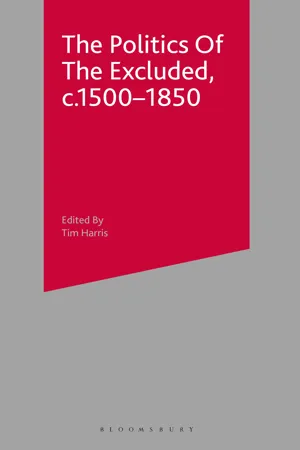
This collection of essays seeks to shed light on the politics of those people who are normally thought of as being excluded from the political nation in early modern England. If by political nation we mean those who sat in parliament, the governors of counties and towns, and the enfranchised classes in the constituencies, then the 'excluded' would be those who were neither actively involved in the process of governing nor had any say in choosing those who would rule over them - the bulk of the population at this time. Yet this volume shows that these people were not, in fact, excluded from politics. Not only did the masses possess political opinions which they were capable of articulating in a public forum, but they were alos often active participants in the political process themselves and taken seriously in that capacity by the governmental elite.
The various essays deal with topics as wide-ranging as riots, rumours, libels, seditious words, public opinion, the structures of local government, and the gendered dimensions of popular political participation, and cover the period from the eve of the Reformation to the Industrial Revolution. They challenge many existing assumptions concerning the nature and significance of public opinion and politics out-of-doors in the early modern period and show us that the people mattered in politics, and thus why we, as historians, cannot afford to ignore them. Politics was more participatory, in this undemocratic age, than one might have thought. The contributors to this volume show that there was a lively and engaged public sphere throughout this period, from Tudor times to the Georgian era.
- 296 pages
- English
- ePUB (mobile friendly)
- Available on iOS & Android
eBook - ePub
The Politics of the Excluded, c. 1500-1850
About this book
Information
1
INTRODUCTION
The title of this book needs explaining. This collection of essays is intended to shed light on the politics of those who are often thought of as being excluded from the ‘political nation’. If by ‘political nation’ we mean ‘the members of both houses of parliament, the governors of counties and towns, and the enfranchised classes in the constituencies’,1 then the ‘excluded’ might be said to constitute those who were neither actively involved in the process of governing nor had any say in choosing those who would rule over them – the bulk of the population in early modern England.2 In many respects this is a book about ‘popular politics’, although this is a term with its own intellectual baggage,3 whilst the notion of ‘the excluded’ potentially embraces those whom we might not readily regard as members of the popular classes. However, the essays in this collection seek to show that these people were not, in fact, excluded from politics. Not only did the mass of the population possess political opinions which they were capable of articulating – often powerfully – in a public forum, but they could also be active participants in the political process themselves. Many of those we think of as being excluded were actually included, either in a formal, institutionalized way, or in an extra-institutional sense.
Until recently, such claims would have been extremely controversial. When I began work on what was to become my first book, at the start of the 1980s, and proudly announced to interested enquirers that I was working on the politics of the London crowd in Restoration England, I frequently encountered sceptical responses, such as ‘did the London crowd have any politics worth talking about?’; or, ‘wasn’t the mob basically unpolitical?’ The view that politics was the preserve of the political elite, the top 3 per cent of the population, and that ordinary people were not only excluded from politics but did not have any politics (in a meaningful sense) that we could study, was still widespread. Indeed, there remained question marks, at this time, about the political sophistication of the provincial gentry, who were thought to be ‘surprisingly ill-informed’ about ‘wider political issues’ even on the eve of the English civil war.4 If such were the case for the landed elite, how could it make sense to ascribe political awareness to those below them?
Scepticism about the potential for political awareness amongst those below the level of the elite was so fundamental that it can be detected even in the works of those historians who were trying to broaden our conception of politics to allow some space for the excluded. Eric Hobsbawm, one of the pioneers in the study of what we now call ‘history from below’, writing in the late 1950s, claimed that the pre-industrial mob should be seen as a ‘pre-political phenomenon’, ‘the urban equivalent to social banditry’. Although he conceded it would be wrong to say the mob had no ideas at all about politics, the urban poor who engaged in mob activity, he affirmed, were ‘not committed to any king, ruler or system at all’ and ‘had no positive programme except the hatred of the rich and a certain sub-anarchist egalitarianism’.5 J. R. Jones, discussing the crowd disturbances that broke out in London at the time of the Glorious Revolution of 1688 in a book that appeared in 1972, suggested that ‘the London masses were not capable of independent and sustained political action’ themselves, but that ‘radicals’ might be able to mobilize ‘popular support’ when ‘there was a good deal of dislocation to trade, resulting in a shortage of employment and high prices for food and fuel’.6 Buchanan Sharp argued in 1980 that those who engaged in anti-enclosure riots in the west country during the civil war period (mainly propertyless wage-earners) manifested a ‘positive political indifference’; ‘the issues raised by the conflict between King and Parliament were of little or no concern to many ordinary people when weighed in the balance against such pressing local issues as disafforestation and enclosure’.7 Similarly, Keith Lindley, in his scholarly examination of the fenland disturbances of the period from the 1620s through to the 1650s, which was published in 1982, concluded that the fenland rioters ‘did not give expression to political feelings’, that ‘there is no real evidence that the generality of the fenmen’ were ‘politically educated by their experiences’, and that ‘the behaviour of the fenland commoners during the Civil War lends further strength to the view that the bulk of the common people were indifferent to the great issues raised at Westminster’.8 As recently as 1988, Roger Manning, in his study of social protest and popular disturbances in England between 1509 and 1640, found that the riots and insurrections of this period, not just in the countryside but even in the metropolis, evinced the same basic pattern of ‘sub-political behaviour’.9
Such scepticism, it is true, had never been universal. Indeed, the arguments cited above were often developed in response to the work of those who were thought to have been too uncritical in according a degree of political awareness to the unenfranchised classes. Students of English history had long shown an interest in forms of mass protest or political agitation out-of-doors, normally in the form of riots and demonstrations or political insurrection at the time of revolutionary upheaval. The study of political crowds or crowd politics in early modern England really began to pick up, however, from the 1950s and 1960s, thanks to the work of scholars such as George Rudé, Edward Thompson and Brian Manning. Both Rudé’s pioneering work on the crowd in eighteenth-century Paris and London and Brian Manning’s investigation of political demonstrations and riots during the English Revolution focused on forms of collective agitation that were ostensibly ‘political’ in the narrow sense of the term; Thompson went further, and showed that even rural forms of protest, such as the eighteenth-century food riot, were both ideological and political in nature.10
The problem that arose from focusing so heavily on riots and protest to gain insight into the politics of those otherwise excluded from the political nation, however, was that it gave us an episodic history of popular politics.11 What about when the people were not rioting? If there were no disturbances over a given 20-year period, say, did that mean that the people were not politically aware at that time, or that they had slipped into a lengthy phase of political indifference? Or what about the people who did not join in those political riots that did occur? Were these people unpolitical, or did they just not share the political views of those who rioted? And how do we trace change over time? When I first began my work on the politics of the London crowd it appeared from the existing historiography that the London crowd was pro-parliamentarian in the early 1640s, Presbyterian-royalist in 1647–8, anti-republican and pro-Charles II in 1659–60, anti-Charles II and pro-Whig in 1679–81, anti-James and pro-William in 1688, but pro-Tory and pro-Jacobite by the second decade of the eighteenth century. How do we explain this? Was the crowd fickle in its political allegiance? If so, did that not force us to question the political sophistication or awareness of those who comprised the crowd?
Interest in looking at politics out-of-doors, at exploring the political views, assumptions and activities of the mass of the population below the level of the governing elite, has grown considerably over the last couple of decades. As a result, our understanding of the nature and significance of the politics of the people has become more sophisticated and the ways in which we seek to recapture this politics have grown more refined. It was thought, therefore, that there might be some value in putting together a collection of essays to illustrate some of the latest trends, as a way both of highlighting where we have got to, as well as of raising questions about where we need to go from here.
The intent of this collection is not to present a comprehensive survey of popular politics in England from the early sixteenth to the early nineteenth century. Moreover, there is so much interesting and important work currently being done that it is impossible, even, to offer a complete sampling of the types of approaches currently being pursued in the space available. All that a volume of this nature can hope to do is illustrate some of the recent trends, and if certain empirical themes or analytical paradigms that are currently in vogue do not find expression here, one can only rejoice that this is a reflection of the current healthy state of scholarly enquiry. There is a rationale behind how the volume was put together, however, which it is worth making explicit here. The focus is on the early modern period – the three hundred or so years between the Reformation and the Industrial Revolution – which is broad enough to allow for considerations of change over time whilst at the same time presenting a logical and coherent unit for study. We felt that there needed to be chapters that dealt with rural as well as urban environments, institutional as well as extra-institutional forms of political activity, and which looked not just at the political concerns of the people but also at how the political elite responded to those concerns and whether they thought the people needed to be taken seriously. On top of this, we wanted the various chapters between them to ref lect as wide a range of approaches to the study of the politics of excluded, and as wide a variety of repertoires of and forums for popular political expression, as might be possible for a book of this size: hence why some of the chapters focus on crowds, but others focus on rumours, libels or seditious words. Beyond that, as editor I simply invited people doing interesting and cutting-edge research to write on whatever they thought most appropriate. There has been no attempt to impose an editorial line, or to ask contributors to write to a particular brief.
Rather than simply summarize the various arguments put forth by the different contributors, this introduction will seek to establish an appropriate context for what is to follow by addressing four broad interpretative questions. It will begin with a consideration of the extent to which the unenfranchised masses could have been politically aware, and if they were, how they achieved their political education. It will then examine whether these people really were excluded from politics and the ways in which they might have been included (or managed to include themselves) in the political process – and if so, with what impact: that is, did these people’s politics matter? A third section will look at women, and consider the question of whether or not they remained excluded from politics. A final section will address the theme of change over time.
I
Before we embark, however, we should discuss terminology, and ask what we should understand by the term ‘politics’. For an earlier generation of scholars who taught in (and often had a hand in setting up) politics departments in universities, politics tended to be rather narrowly defined, as something that took place in a particular arena and was participated in by those who worked in that arena. Thus politics was essentially about government, the arena was the institutions of government, and those who served in them were politicians. Such a view still retains much favour. John Horton, for example, has written that ‘Politics is paradigmatically concerned with government and legislation; the deliberating, deciding and implementing of the rules by which a state conducts its affairs’.12 Many political scientists nowadays, however, would regard such a definition as too restrictive. Thus Adrian Leftwich has stated that ‘politics comprises all the activities of co-operation and conflict, within and between societies, whereby the human species goes about organizing the use, production and distribution of human, natural and other resources in the course of the production and reproduction of its biological and social life’. What this means is that politics is everywhere and in everything. As Leftwich continues: ‘politics is at the heart of all collective social activity, formal and informal, public and private, in all human groups, institutions and societies, not just some of them, and … it always has been and always will be’. Politics is even to be found in informal or temporary groupings of people, and these informal groups might include ‘bus queues, football crowds, people meeting for the first time on a camp site’; indeed, we might even find politics ‘among children inventing and playing games’, or ‘among residents of a housing estate’.13
The broader definition has much to recommend it. Keith Wrightson has shown how ‘a great deal of the social history of early modern England written in the last twenty years has been quite centrally concerned with politics’, ‘if we did but realise it’, not just ‘in the sense of “micro-politics” or “local level politics”, but in its broader concern … with the political dimension of everyday life’.14 There is undoubtedly much to be gained from asking questions, say, about the politics of the household, or of the family, or the politics of gender. Such a broad definition is not particularly helpful for our purposes, however. To claim that there clearly was a politics of the excluded, because politics is (and always has been) everywhere, would not get us very far. The intent of this collection is to demonstrate that there was a politics of the excluded in the more narrow meaning of the term politics. It seeks to show that ordinary men and women did have opinions about how duly constituted authority was supposed to be exercised, and how those who governed – not just at the local but also the central level – were supposed to rule; that they often engaged in activity that was designed to influence how the political elite ruled over them; and that the ruling elite frequently found that they could not afford to ignore the political opinions and acts of the people they governed.
Our first task, then, must be to consider how those people not usually thought of as being part of the political nation came to be politicized. There is a widely held assumption that mass politicization is linked to the rise of the popular press, and is thus also dependent upon mass literacy. Because literacy rates were low in early modern England, the potential for mass politicization, it might be thought, was limited. David Cressy, in his analysis of subscriptions to the Protestation Oath, the Vow and Covenant, and the Solemn League and Covenant of 1641–4, found that at this time some 70 per cent of the adult male population was illiterate, as measured by the ability to sign one’s name – though it should be stressed that his sample was biased towards rural communities. An a...
Table of contents
- Cover
- Title
- Copyright
- Contents
- Abbreviations
- Notes on Contributors
- 1 Introduction
- 2 Rumours and Popular Politics in the Reign of Henry VIII
- 3 ‘Poore men woll speke one daye’: Plebeian Languages of Deference and Defiance in England, c.1520–1640
- 4 Libels in Action: Ritual, Subversion and the English Literary Underground, 1603–42
- 5 The Political Culture of the Middling Sort in English Rural Communities,c.1550–1700
- 6 The Unacknowledged Republic: Officeholding in Early Modern England
- 7 ‘Venerating the Honesty of a Tinker’: The King’s Friends and the Battle for the Allegiance of the Common People in Restoration England
- 8 Crowds and Political Festival in Georgian England
- 9 Domesticity is in the Streets: Eliza Fenning, Public Opinion and the Politics of Private Life
- Index
Trusted by 375,005 students
Access to over 1.5 million titles for a fair monthly price.
Study more efficiently using our study tools.
Frequently asked questions
Yes, you can cancel anytime from the Subscription tab in your account settings on the Perlego website. Your subscription will stay active until the end of your current billing period. Learn how to cancel your subscription
No, books cannot be downloaded as external files, such as PDFs, for use outside of Perlego. However, you can download books within the Perlego app for offline reading on mobile or tablet. Learn how to download books offline
Perlego offers two plans: Essential and Complete
- Essential is ideal for learners and professionals who enjoy exploring a wide range of subjects. Access the Essential Library with 800,000+ trusted titles and best-sellers across business, personal growth, and the humanities. Includes unlimited reading time and Standard Read Aloud voice.
- Complete: Perfect for advanced learners and researchers needing full, unrestricted access. Unlock 1.5M+ books across hundreds of subjects, including academic and specialized titles. The Complete Plan also includes advanced features like Premium Read Aloud and Research Assistant.
We are an online textbook subscription service, where you can get access to an entire online library for less than the price of a single book per month. With over 1.5 million books across 990+ topics, we’ve got you covered! Learn about our mission
Look out for the read-aloud symbol on your next book to see if you can listen to it. The read-aloud tool reads text aloud for you, highlighting the text as it is being read. You can pause it, speed it up and slow it down. Learn more about Read Aloud
Yes! You can use the Perlego app on both iOS and Android devices to read anytime, anywhere — even offline. Perfect for commutes or when you’re on the go.
Please note we cannot support devices running on iOS 13 and Android 7 or earlier. Learn more about using the app
Please note we cannot support devices running on iOS 13 and Android 7 or earlier. Learn more about using the app
Yes, you can access The Politics of the Excluded, c. 1500-1850 by Tim Harris in PDF and/or ePUB format, as well as other popular books in History & British History. We have over 1.5 million books available in our catalogue for you to explore.