This hands-on guide to advanced critical analysis and argumentation will help readers to communicate in way that is orderly, rigorously supported, persuasive and clear. It demonstrates how criticality can be paired with creativity to produce an insightful and engaging piece of research, and explores how narrative styles and rhetorical devices can be used to boost the persuasiveness of an argument. Chapters blend theory with practice and contain a wealth of activities designed to help students put new skills into practice or revitalise those they already have. This is an essential resource for postgraduates and advanced undergraduates looking to hone their skills in critical analysis and communicate their ideas with precision and clarity.
- 179 pages
- English
- ePUB (mobile friendly)
- Available on iOS & Android
eBook - ePub
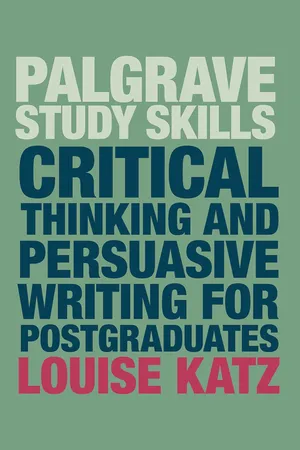
Critical Thinking and Persuasive Writing for Postgraduates
About this book
Information
Chapter
1
Everyday Criticality and Thinking Well
Chapter overview
This chapter will:
•Survey some of the main theories of critical thinking throughout history, so as to arrive at a working definition
•Focus on select critical thinking theories and practice
•Consider ways to develop critical strength and, conversely, to ruin it
•Provide exercises towards enhancing critical skills.
There is no fixed definition of critical thinking. There are scholars who dislike the idea of attempting to find a generic ‘definition’ at all. Yet some embrace it and also suggest attributes that a critical thinker exhibits; some will stress traits that another authority on the subject might understate – the emphases vary. There are respected proponents of critical thinking in universities who present it simply as a means of sorting what is true from what is false – looking at it as ‘the art of being right’. This is a definition that I see as problematic. While critical thinking is a truth-seeking activity, to describe it this way evokes a level of competitiveness at odds with the spirit of enquiry. It also seems to oversimplify it, implying that criticality begins and ends with analytical work, when it also involves reflection (including self-reflection) and needs to be applicable to the workaday world. This book sees criticality as a mental attitude that can be used to guide both specialised and everyday thinking – far more than a utilitarian argumentation tool or a simple skill set. While the ability to think critically will certainly improve academic results, that’s just the tip of the iceberg.
This first chapter locates what we now think of as critical thinking within its historical context. I’ve chosen notables from a range of disciplines and backgrounds, but the possible list is vast and this one little chapter is no ‘catalogue of critical thinkers throughout history’. It simply includes an outline, or survey, that highlights some of those that this writer considers important, and whose work contributes to how we understand and practice critical thinking. Most of the exemplars included possess particular cognitive traits other than critical ability – creativity, imagination, and intellectual sympathy for instance – making these people truly original thinkers. As I briefly mentioned in the introduction to this book, a point that is sometimes overlooked in texts on critical thinking is that it is but one aspect of thinking well.
This chapter also considers what is involved in improving critical skills in a very practical sense, specifically in today’s world, and provides exercises or intellectual games that clarify notions of critical thinking and strengthen critical acumen.
Please note, before you continue reading, I suggest that you arm yourself with a pencil, because as you read it will be useful for you to take note of any particular details that you think might go towards your own working concept of critical thinking. As some readers may not have a great deal of background in the concept, below are some ideas that will help. Some emphasise its scholarly aspects, others its emancipatory possibilities or social relevance. There are also more definitions and conceptions on page 11. The notes you make now will help you in an exercise suggested towards the end of the chapter.
Author | Critical thinking |
John Dewey (1933, p. 118) | ‘Active, persistent, and careful consideration of any belief or supposed form of knowledge in the light of the grounds that support it and the further conclusions to which it tends.’ |
Peter Facione (cited in ‘Critical Thinking on the Web’ 2007, n.p.) | ‘The ability to properly construct and evaluate arguments.’ |
The Critical Thinking Community, criticalthinking.org | ‘Critical thinking is that mode of thinking – about any subject, content, or problem – in which the thinker improves the quality of his or her thinking by skillfully analyzing, assessing, and reconstructing it … It entails effective communication and problem-solving abilities, as well as a commitment to overcome our native egocentrism and sociocentrism.’ |
Sarah Benesch (1993, p. 546) | ‘A search for the social, historical, and political roots of conventional knowledge and an orientation to transform learning and society.’ |
Simon Gieve (1998, p. 126) | ‘For students to think critically, they must be able to “examine the reasons for their actions, their beliefs, and their knowledge claims, requiring them to defend themselves and question themselves, their peers, their teachers, experts, and authoritative texts”.’ |
John McPeck (cited in Seigel and Carey 1989, n.p.) | ‘Critical thinking requires the judicious use of skepticism, tempered by experience, such that it is productive of a more satisfactory solution to, or insight into, the problem at hand.’ |
A necessarily (very) brief survey of critical exemplars
Classical Greece
One of the earliest and most compelling, but little known, figures in 5th-century Greek philosophical dialogue was Aspasia of Miletus. We only know of Aspasia through secondary sources, yet her distinction as a philosopher and as an orator is cited in Plato, Xenophon, Cicero, Athenaeus, and Plutarch (Glenn 1994). Although, like Socrates, she recorded none of her thoughts for posterity, there is evidence that not only was she Pericles’ political adviser, but also a teacher of Socrates himself (Henry 1995). Socrates is recognised as an exemplar of rationality, critiquing ideas, drawing distinctions, and encouraging others to do the same. Socratic questioning is a critical thinking tool, and also a teaching method used as a device in classrooms to discourage adherence to unfounded or misconceived ideas, and to encourage students’ reasoning faculties. A Socratic dialogue as categorised by Richard Paul could include:
1.questions geared to clarify (achieved by asking why or how)
2.interrogating assumptions
3.evidentiary enquiries (e.g. asking for examples or analogies)
4.questions that require consideration of alternative views or perspectives
5.invitations to examine implications and/or consequences of particular assumptions.
Below is an example of an exchange between ‘Anna’ and ‘Bella’ that attempts to use Socratic techniques to complexify a statement that Anna uncritically accepts as true. So as to encourage ‘Anna’ to engage more carefully with the ideas and possibly even rethink her proposition, ‘Bella’ tries to focus the discussion by asking questions that will invite consideration of the broader implications of Anna’s original and very large claim, and to summarise the discussion at intervals for the sake of clarity.
“Anna (states her position): Man-made objects are inferior to the products of nature.”
“Bella (expresses curiosity with a question): Why do you say that?”
“Anna (now needs to explain why she thinks natural goods are better than synthetic goods): Because nature has an elemental wisdom that seeks balance. Humans have selfish desires that throw us off balance. So we can’t create things that are perfectly balanced, like nature can. That is why nature, and its works, are essentially superior to humans, and our works.”
“Bella (focuses on a detail – an important one – so that A has to start examining her assumptions): That’s an interesting proposition. I’d never thought of nature having ‘wisdom’.”
“A (has probably never doubted this claim, and expresses her certainty): It is self-evident.”
“B (asks for that evidence): Can you give me some examples of the wisdom of nature?”
“A (supplies what she considers evidence of nature’s wisdom): The tides are guided by the moon. The seasons follow a cycle of life. You know the sun will rise each morning.”
“B (questions A’s terms of reference, inviting her to reconsider her claim): Is this actually wisdom, or patterns of natural cycles?”
“A (backs up her position, yet arguably fails to demonstrate how nature is ‘wise’): These natural cycles enable the existence of life on the planet.”
“B (concedes a point so as not to be arrogant or to cause A to become overly defensive, then asks a question geared to clarify how this can be considered ‘wisdom’): It is true that natural cycles enable life on Earth. But I’m still not convinced that that is the same as wisdom. Wisdom is often considered to be a human attribute, based on thought rather than instinct. Can you say more about what wisdom is, and why nature has it but people do not?”
“A (is quite articulate in addressing B’s question, yet her reasoning may still be flawed): When I say ‘wisdom’, I am speaking figuratively. I mean that what is natural is not affected by the pettiness of humanity. In nature, there is no desire to win, to control, to overcome a perceived enemy. Nature just is. And therefore the products of nature are superior.”
“B (makes a further evidentiary enquiry): For example?”
“A attempts to defend her position with a rhetorical question): Vegetation, animals, rivers … how can these be faulted?”
“B (now requires A to consider alternative views or perspectives): I cannot fault them. But there is also a lot to be said for unnatural objects produced by human agency, like medicine for curing natural diseases, or knives for pruning natural fruit trees to help them thrive, or human impulses like the love a mother feels for her child that drives her to protect him.”
“A: There is virtue in these things, but they can also be used for evil purposes.”
“B (asks another question geared to clarify): Can you be more specific?”
“A: Poison instead of remedy, killing rather than pruning, taking advantage of love through bribery and blackmail. Nature doesn’t do that. As I said, once a human comes into the equation, corruption follows. It is what we do. Look, there’s crime, there’s war, there’s betrayal, there’s …”
“B (attempts to summarise the ideas explored so far for the sake of clarity): Just a minute. Slow down. Let me just try and organise the ideas we’ve covered: Nature is (figuratively) wise. Humans are essentially corrupt – or at least corruptible. Therefore the products of humans will be inferior to natural ones. But while it’s probably fair to say that human actions can be, and often are, tainted by selfish desires – I do agree with that statement – does it follow that humans will inevitably corrupt goodness?” “A: It is inevitable, because of human nature.”
“B (now l...
Table of contents
- Cover
- Half Title
- Abbreviation
- Title Page
- Copyright
- Contents
- Introduction
- Chapter 1 Everyday Criticality and Thinking Wel
- Chapter 2 Critical Reflection
- Chapter 3 Critical Analysis of Texts
- Chapter 4 Creative Critical Thinking
- Chapter 5 Research Practices
- Chapter 6 Developing Habits of Strength as a Postgraduate
- Chapter 7 Negotiating the Literature and Joining the Conversation
- Chapter 8 Persuasive Writing: Rhetorical Techniques Words are magic – literally and in reality
- Chapter 9 Persuasive Writing: Developing a Narrative Structuring your text as an ongoing story, written as you research Academic writing is a sociable activity Ways of constructing a persuasive text by conversational means ‘Summary and response’
- Chapter 10 Some More Experimental, Playful Forms of Academic Writing
- Concluding Remarks
- References
- Index
Trusted by 375,005 students
Access to over 1.5 million titles for a fair monthly price.
Study more efficiently using our study tools.
Frequently asked questions
Yes, you can cancel anytime from the Subscription tab in your account settings on the Perlego website. Your subscription will stay active until the end of your current billing period. Learn how to cancel your subscription
No, books cannot be downloaded as external files, such as PDFs, for use outside of Perlego. However, you can download books within the Perlego app for offline reading on mobile or tablet. Learn how to download books offline
Perlego offers two plans: Essential and Complete
- Essential is ideal for learners and professionals who enjoy exploring a wide range of subjects. Access the Essential Library with 800,000+ trusted titles and best-sellers across business, personal growth, and the humanities. Includes unlimited reading time and Standard Read Aloud voice.
- Complete: Perfect for advanced learners and researchers needing full, unrestricted access. Unlock 1.5M+ books across hundreds of subjects, including academic and specialized titles. The Complete Plan also includes advanced features like Premium Read Aloud and Research Assistant.
We are an online textbook subscription service, where you can get access to an entire online library for less than the price of a single book per month. With over 1.5 million books across 990+ topics, we’ve got you covered! Learn about our mission
Look out for the read-aloud symbol on your next book to see if you can listen to it. The read-aloud tool reads text aloud for you, highlighting the text as it is being read. You can pause it, speed it up and slow it down. Learn more about Read Aloud
Yes! You can use the Perlego app on both iOS and Android devices to read anytime, anywhere — even offline. Perfect for commutes or when you’re on the go.
Please note we cannot support devices running on iOS 13 and Android 7 or earlier. Learn more about using the app
Please note we cannot support devices running on iOS 13 and Android 7 or earlier. Learn more about using the app
Yes, you can access Critical Thinking and Persuasive Writing for Postgraduates by Louise Katz in PDF and/or ePUB format, as well as other popular books in Aides à l'étude & Guides d'étude. We have over 1.5 million books available in our catalogue for you to explore.