Through its use of conversational and supportive tones, this popular guide puts readers at ease, assisting the transition to academic study. With clear explanations, summaries and exercises, it is an invaluable companion for the mature student. This third edition has much new content including a new chapter on writing a dissertation proposal.
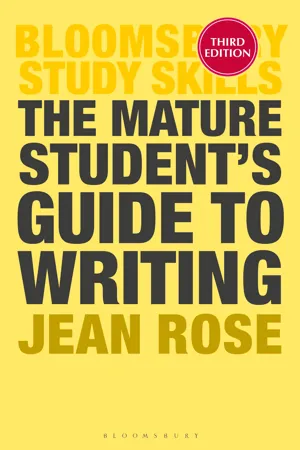
- 344 pages
- English
- ePUB (mobile friendly)
- Available on iOS & Android
eBook - ePub
The Mature Student's Guide to Writing
About this book
Information
Part One
The Big Picture
1Taking Notes
This chapter explains how to:

INTRODUCTION
In lectures, some of us hope to rely on our memories and some of us try to write down absolutely everything. But unless you have a brilliant memory, the first method won’t work, and if you try the second, you’ll exhaust yourself and your notes might not make much sense. You need a method that picks up key points without having to write too much.
Note-taking from written materials involves a different procedure. You’ll be taking notes for an assignment and aiming to find just those things that will serve your purpose. So you need to analyse what you’re reading as you go along. The better you become at understanding a text, the better your notes will be and, consequently, the better your essays.
NOTE-TAKING IN LECTURES AND CLASS SESSIONS
In any class or lecture session, you need to spend some time considering what’s being said. Lecture sessions sometimes include brief periods of discussion too, so your mind needs to be free to follow these. What you need is a set of notes that give you outline information in a very readable format. So notes written in sentences aren’t going to make things easy for you. You’ll need to get into the habit of writing down individual words and phrases. Listen out for names, dates, technical terms and other key words. This might take a bit of practice.
*note down names, dates, technical terms and key words and phrases
Watch, first of all, for the way a lecture is structured. Some tutors start by telling you what will be covered. So if you’re told there will be three sections, mark them out as you go along. Your syllabus may also give you some clues as to the important areas to concentrate on, so check it out before the lecture and then listen out for key topics.
You might be given a hand-out showing the main areas of the day’s lecture. This is an invaluable guide. There may even be spaces for you to fill things in as you go along.
*think about the structure of a lecture and put headings in your notes
Quite often, the way a lecturer speaks can give a clue to important points: a tutor’s voice might rise, he or she might stress certain words very strongly, he or she might pause before an important point or even repeat a phrase or two. Note these down and either underline or ring them as you go along. You’ll probably want to leave out extras such as full descriptions and details of examples, because there just isn’t time to record everything.
It’s possible to use your page rather like a drawing-board, ignoring the printed lines if you find that easier. Spreading out your notes and leaving space on each page is especially important. After the lecture, or even months later or when you’re revising, you might come across something else you need to add. It’s infuriating if there’s no space. Not only that, a cramped page can be hard to read later. It can look very daunting, too, and there’ll be no clear sense of an overall structure.
*watch for clues from the way a lecturer stresses points
Here’s how Helen might have begun to make notes from a lecture on the Founding Fathers from her course on American Studies before she’d learnt some new and easier methods of note-taking:
Founding Fathers – America
Country gents / upper class / those in commerce – had influence & power – e.g. Thomas Jefferson (7,500 acres) & wife (11,000 acres).
The colony was governed separately from Britain – the Governor appointed by the Crown.
Governor app. a Council. Council app. local assemblies.
There was more representation of the people than in Britain because more land available.
N. States – 75% males voted
S. States – 50% ""
Most colonists were loyal to the British Crown. When there were difficulties, they blamed Parliament (not the King).
There were some tensions over taxes. Britain passed acts to recoup expenses – e.g. for British troops in N. America – to protect against Indians & French.
Colonists resisted the Stamp Act and the Townsend Act (which led to problems in Boston).
Below, you can see what Helen actually did, because, by the time she took these notes, she’d had a bit of practice in using a clearer layout that gives space to add things later:

The main things to notice here are:
•only a few key words are written down
•lines are drawn to link points
•there’s space to add more later
•these notes are very easy to read
It’s also possible to use mind maps (see Chapter 2), where you start in the middle of the page and work outwards. There can be a problem with using mind maps for lecture notes, however: it can be hard to link to a second page when you’ve filled one up. For this reason, I tend to favour Helen’s method of working down the page. Diagrams are good, too. Whatever method you use, you can add colour after the lecture to make things stand out. If you’re comfortable with drawing, it’s even worth adding pictures, since visual cues are really good memory-joggers. By the way, mind maps are very useful for other tasks.
It’s important to find a method that works for you in relation to the course you’re on and the type of lectures you attend. Trying out some new methods should help you discover what’s going to be best. Taking notes can be quite hard work, so it’s useful to adopt a good posture during lectures. Sit upright and you’ll remain alert and more able to spot crucial points in what you hear.
*try out different methods of note-taking in lectures
Before a lecture, it can be useful to devise a few questions about what will be covered. This can be especially helpful for getting your brain in gear so that it’s easier to absorb the material.
There will always be things you miss. So go over your notes on the same day if you can to fill in any blanks. You’re likely to be able to remember things while your memory is still fresh. If there’s time for a brief study session with a friend, you’ll probably come up with all the important points between you.
Here are some tips for getting the best value from a lecture:
beforehand:
•check your syllabus to see how this lecture fits in
•do some pre-reading on the topic
•write down three questions on the topic before the lecture
•talk to other students about likely topics
during:
•note key headlines on any handouts provided
•pay special attention to t...
Table of contents
- Cover
- Title Page
- Copyright
- Contents
- Acknowledgements
- Who Is This Book For?
- How to Use This Book
- If You Think You Might Be Dyslexic …
- Part One: The Big Picture
- Part Two: Writing for Different Purposes
- Part Three: The Nuts and Bolts of Good Writing
- Part Four: Moving On
- Appendix 1: Spelling Strategies
- Appendix 2: Common Confusions
- Answers
- Bibliography
- Index
Trusted by 375,005 students
Access to over 1.5 million titles for a fair monthly price.
Study more efficiently using our study tools.
Frequently asked questions
Yes, you can cancel anytime from the Subscription tab in your account settings on the Perlego website. Your subscription will stay active until the end of your current billing period. Learn how to cancel your subscription
No, books cannot be downloaded as external files, such as PDFs, for use outside of Perlego. However, you can download books within the Perlego app for offline reading on mobile or tablet. Learn how to download books offline
Perlego offers two plans: Essential and Complete
- Essential is ideal for learners and professionals who enjoy exploring a wide range of subjects. Access the Essential Library with 800,000+ trusted titles and best-sellers across business, personal growth, and the humanities. Includes unlimited reading time and Standard Read Aloud voice.
- Complete: Perfect for advanced learners and researchers needing full, unrestricted access. Unlock 1.5M+ books across hundreds of subjects, including academic and specialized titles. The Complete Plan also includes advanced features like Premium Read Aloud and Research Assistant.
We are an online textbook subscription service, where you can get access to an entire online library for less than the price of a single book per month. With over 1.5 million books across 990+ topics, we’ve got you covered! Learn about our mission
Look out for the read-aloud symbol on your next book to see if you can listen to it. The read-aloud tool reads text aloud for you, highlighting the text as it is being read. You can pause it, speed it up and slow it down. Learn more about Read Aloud
Yes! You can use the Perlego app on both iOS and Android devices to read anytime, anywhere — even offline. Perfect for commutes or when you’re on the go.
Please note we cannot support devices running on iOS 13 and Android 7 or earlier. Learn more about using the app
Please note we cannot support devices running on iOS 13 and Android 7 or earlier. Learn more about using the app
Yes, you can access The Mature Student's Guide to Writing by Jean Rose in PDF and/or ePUB format, as well as other popular books in Study Aids & Study Guides. We have over 1.5 million books available in our catalogue for you to explore.