- 224 pages
- English
- ePUB (mobile friendly)
- Available on iOS & Android
eBook - ePub
Studying Shakespeare in Performance
About this book
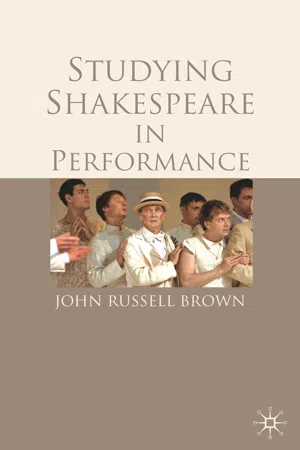
John Russell Brown is arguably the most influential scholar in the field of Shakespeare in performance. This collection brings together and makes accessible his most important writings across the past half-century or so. Ranging across space, words, audiences, directors and themes, the book maps John Russell Brown's search for a fuller understanding of Shakespeare's plays in performance. New introductory notes for each chapter give a fascinating insight into his critical and scholarly journey. Together the essays provide an authoritative and engaging account of how to study Shakespeare's plays as texts for performance. Drawing readers into a wide variety of approaches and debates, this book will be important and provocative reading for anyone studying Shakespeare or staging one of his plays.
Information
Part I
Study
1
Theatrical Study and Editions of the Plays*
With this first attempt to understand the consequences of trying to study Shakespeare in performance, I considered a number of approaches and came to a positive conclusion. I identified describing and analysing a production’s use of time and space as basic and necessary tasks and introduced two phrases that were to recur frequently in my writing: the ‘progressive experience’ of an audience and the ‘journey’ undertaken by actors. I had also begun to consider a ‘theatrical event’ as the complex outcome of everyone’s contribution to a performance, on stage, back stage and in the audience, both before and during a performance. These personal and shared experiences are influenced by the location and timing as well as the nature of a production. I was learning new ways of grappling with Shakespeare’s plays in performance but not finding the task any easier.
Believing that Shakespeare set down words so that a company of actors would perform his plays before very varied audiences, readers have sought to respond to the texts as if in performance and have taken whatever opportunity arises to see them in the theatre. In both efforts they are often frustrated but critics and scholars provide further assistance by reporting on reviews and records of earlier productions and writing detailed accounts of performances they have witnessed. They also listen to actors, directors, and designers talking about their work and then try to distinguish between intention and achievement. Writing about performances of Shakespeare’s plays has become such an accepted and often industrious academic pursuit that it may be profitable to stop to consider exactly what the “theatrical dimension” in Shakespeare studies entails.
The basic questions are: “To what are we giving our attention, and what do we bring to this experience?” Neither “hearing” nor “seeing” a play are satisfactory words for this activity, because attending a performance involves far more than sight and hearing, and more than simple cognition of fixed signs. All our senses, instincts, and memories may be involved and will interact with each other. Both words and everyday actions can be given unexpected and exceptional powers in the theatre and so any full account of performance must go beyond mere quotation or factual description and call upon impressionistic and personal memories. Two other questions arise immediately: “How can we best describe or report on a theatre experience, and what do we gain by this exercise?”
In recent years, the study of what constitutes performance has occupied many scholars in university Departments of Theatre, Anthropology, Linguistics, and Sociology. In 1980 Keir Elam’s The Semiotics of Theatre and Drama was the first book to provide analyses of speech-acts and so demonstrated the interweaving of many modes of perception and reception called upon by the performance of a dramatic text.1 Later critics have built on this, giving more emphasis to the physical and corporeal elements of performance, to the actors’ modes of preparation, to social and political contexts for performance, and to all the reactions and interactions that occur among individual members of an audience as they share the occasion and, in some measure, help to create it. It must seem strange to scholars in this new discipline of Performance Studies that so little writing about Shakespeare has made use of the distinctions and terminology that are now available. Perhaps one reason is that so much cannot be assimilated rapidly, especially at this time when new forms of literary, as well as theatrical, criticism are already busying more adventurous minds. Another reason for neglecting this new form of study may be that “Performance,” as Marvin Carlson has put it, “by its nature resists conclusions, just as it resists the sort of definitions, boundaries, and limits so useful to traditional academic writing and academic structures.”2 To consider Shakespeare’s plays in the light of recent Performance Studies is to enter forbidding territory in which perception must always be open to question.
The critical challenge, nevertheless, remains: we should respond to the plays as works for performance and therefore need to know how best to do this. Shakespeare’s imagination was not simply full of words or speeches, but of men and women in action; his art was to write down what actors should speak while representing those imaginary individuals as if they were fully alive in continuous action on a stage before an audience. Necessarily such a performance is more difficult to comprehend than any number of written words. Much of it will contain a great deal which Shakespeare could not have foreseen and, even when he was alive, could not control. Moreover every single performance will be different from all others, even if the same actors are involved and use the same theatre building. Faced with describing such complex and ever-changing phenomena, a critic must decide, consciously or unconsciously, which incidents on stage and which impressions made upon him- or herself—and on other critics—should be given most attention. To notice everything is impossible but, even if it were not, the task of describing and assessing everything would remain. The critic’s own mind and personal history are of crucial importance because they will control both the selection of material for study and the perception of it. The best person to describe performances would be someone of strong sensibilities but without conscious predilections or foreknowledge of the play’s stage history; such a person might give attention to the show, entirely and openly, as it evolves moment by moment, seeing clearly and responding wholeheartedly and imaginatively. Yet, on the other hand, another person who is experienced enough to be on the lookout for what is new and what has been achieved with special power or in closest accord with Shakespeare’s words might be the more useful, if more biased, critic.
* * *
Among the wide range of methods used in writing about Shakespearian performances some may be considered provocative rather than essential, because they fasten on modern stage techniques that would have been impossible in Shakespeare’s day or are interpretative in ways alien to thought and perception at that time. So, for example, Jay L. Halio’s volume on A Midsummer Night’s Dream for the Shakespeare in Performance series has a concluding chapter which details the innovations of Robert Lepage and his designer, Michael Levine, in a production for the National Theatre in London in 1992:
A large circular pool of water, about 25mm deep over an area of 120 square metres, surrounded by a bank of mud (made of Bentonite mixed with lignite and water), dominated the set from the first scene to the last … [T]his Dream was meant to take us back to the beginnings of life and to suggest connections between the primitive world and the civilised one; hence, the primordial mud, a violent coupling between an androgynous Puck and a blue-faced fairy …, the “group sex” in muddy water, and the “noisy rutting” of Titania and Bottom.3
The critic is objective for the most part, noting, almost in passing, that Titania “does not lie asleep in her bower but hangs above it, upside down suspended by a rope” (121). However, he also allows himself a few marks of approval, so he describes “some very nice touches … that somewhat softened the effect of the ‘mud-wrestling’” (122–3). These are comparatively simple actions that might have been found in almost any twentieth-century production.
This review gives reasons for recounting much that has little direct connection to the dialogue which Shakespeare wrote:
the theatre often resorts to new, hitherto unimagined—even unimaginable—ways of presentation …: “what works” [on stage] translates into what illuminates for us things we did not see or hear or feel, and therefore did not comprehend as fully in previous productions. (26)
The critic recounts and marvels at new devices of theatre production and the results of long, idiosyncratic, and painstaking rehearsals because his imagination had been aroused and had jolted his previous perceptions of the play. The result was that he was able to sense the “ghosts of Freud and Jung inhabit[ing] the production” and to find a “liquidity in the text” that Shakespeare wrote centuries before (119).
One thought must occur to any reader: could not these perceptions have derived as well from a present-day reading of the text by someone who was familiar with the same books and had had much the same “lived experience” as this director and his designer? We shall never know, but the production had given their ideas a palpable quality, a “local habitation and a name” for those who witnessed it without too much resistence to its innovations. Theatre is a place for seeing and Halio is claiming that this production showed its audience qualities that have always been inherent in the text and had illuminated it for them at this time.
The very new, especially in scenic and extravagantly non-realistic stage activity, is the easiest part of any production to document and critics often give most attention to it, even when they disapprove of the treatment of a text. As chronicles of Shakespeare’s plays on the stage in our time, such writing about performances has its value, even at the cost of considerable length as its words limp behind the spectacle they try to describe. Of course, a stubborn question remains: is this, indeed, “our” Dream or is it, less interestingly, that Dream which a few theatre people had judged appropriate for themselves and their particular kind of theatrical pleasure? The critic cannot sufficiently answer that question by asserting a personal interest in the contrivance. The task of writing about performances of Shakespeare is not complete until the critic has taken into account their effect on audiences. Any striking invention should be judged according to its particular value as entertainment or as an illumination of life or thought outside the theatre.
Other critics are wary of new and obviously contrived stage effects and take refuge in fixing their attention on the words of the text, noting what the actors make them “mean” for a hearer, as if reference to a printed edition provided sufficient understanding of any effect and was a mark of authenticity in performance. Others try to “look” beyond words at what the actors do, pretending that they are performing on some unlocalized Globe-like stage, without twentieth-century embellishments and trickery. They pay heed to the “presence” of actors and assess the individuality and interactions of the play’s characters. Both kinds of discourse have a great deal to document and many small details to compare between one production and another. So extensive and so various is the material to be dealt with, that criticism of this kind can never be complete and, therefore, seems incidental, governed by accident in choice of what it considers and, consequently, in any judgement that it makes. Not surprisingly, these critics tend to write at length and in conclusion are liable to note the “infinite variety” of interpretation that Shakespeare’s “characters” give rise to in performance, forbearing to express any preference between them. This does not take their readers very much further than a slow and thoughtful reading of the text itself might achieve, although descriptions of actual behaviour can awaken sense-responses and so be a spur to fresh perception.
Any writing about how a performance deals with the words of Shakespeare’s text is an endless task, always limited by its author’s selectivity. Even Marvin Rosenberg’s huge accumulations of careful detail in his books about four of the tragedies are limited in scope, as he has been the first to confess. As the volumes followed each other over the years from 1961 to 1992 comparisons were supplied ever more generously and scrupulously together with frequent and minutely careful reference to Shakespeare’s texts. But their principal shortcomings are those of selectivity and not incompleteness: Rosenberg is star-struck and so pays attention only to leading actors or, for present times, to what directors have encouraged their actors to do. His scope includes star performers from all centuries since Shakespeare’s and from theatres other than the English-speaking, but he does not give to any one performance of a play an attention that follows its entire action, and so he is unable to consider its overall shape and impact. He tells readers what his chosen performers have done to bring their roles alive on stage but only at one moment and then at another. While he uses every possible means to say how they spoke particular words of the texts and what they did while doing so, much is inevitably missing. The more ground he has been able to cover in his studies of single plays, the more inadequate has become the engagement with any single performance as a response to the whole play in one unique time and place, his concentration on the leading actors notwithstanding. Because his method is to create a patchwork out of small observations, he has no scope to consider either the material substance, shape, or impact of any one of the productions from which the shreds and patches have been taken.
Rosenberg’s latest volume on The Masks of Hamlet is exemplary of much other writing about performance when it centers attention on the actors of the principal characters of a play. The “Prologue” tells us the reason for undertaking this task:
the words [of the text] were written to be clothed in the unmistakably physical, recognizable human forms of Shakespeare’s players. Live people. Hamlet is only part of himself on the page; he is complete only as realized on stage or in the imagination.4
In line with this approach, the book’s last section spends thousands of words on how various Hamlets have, or might have, said “The rest is silence” and, possibly, the Folio’s “O, o, o, o.” as well. An earlier section considers the other figures on stage in this scene, but briefly, and mostly in their relationship to Hamlet. The focus of the book is unmistakable: “What may Hamlet be trying to convey?” (924). That the critic cannot answer with any certainty is the message that he reiterates time and again; for example:
All the words about Hamlet, almost three centuries of words, and as many of stagings, and the adventure into the depths of the play has hardly begun. (924)
But we should remember that this play has width as well as depth because it mirrors life as Shakespeare lived it and thought about it in the context of an entire nation and among people in all their variety of mind, feeling, and activity. These social and political concerns are expressed in narrative, action and interaction, dramatic structure and timing, stage images of all kinds and in many combinations, whole casts of characters and supernumeraries, and the entire text of each play—which all together needs a “fellowship” of actors to perform and not just a few star actors. Rosenberg’s star-centered observations about moments of performance do not take his readers very far towards an understanding of these essential aspects of the plays.
This form of study—the creation of a patchwork from details about how Hamlet and others around him behave—has other shortcomings. Because no one performance is considered as a continuous action, description always lacks an important ingredient: the actor’s response to his or her whole journey through a play, which involves changes in relationship to other characters and actors, and in selfawareness. How any one moment is arrived at will always be part of that moment in theatre performance. In outwardly visible and audible signs, the past is always marked indelibly in the present on the bodies and minds of the performers and so no moment ca...
Table of contents
- Cover
- Title
- Copyright
- Contents
- Acknowledgements
- Introduction
- Part I Study
- 1 Theatrical Study and Editions of the Plays
- 2 Research in the Service of Theatre
- 3 Writing about the Plays in Performance
- Part II Words and Actions
- 4 The Nature of Speech in the Plays
- 5 Acting in the Plays
- 6 Unspoken Thoughts and Subtextual Meanings
- 7 Using Space
- Part III Productions
- 8 Free Shakespeare
- 9 Representing Sexuality
- 10 Violence and Sensationalism
- Part IV Directors
- 11 Franco Zeffirelli’s Romeo and Juliet
- 12 Three Kinds of Shakespeare
- Part V Audiences
- 13 Playgoing and Participation
- 14 Asian Theatres and European Shakespeares
- Conclusion: Anyone’s Shakespeare
- Index
Trusted by 375,005 students
Access to over 1.5 million titles for a fair monthly price.
Study more efficiently using our study tools.
Frequently asked questions
Yes, you can cancel anytime from the Subscription tab in your account settings on the Perlego website. Your subscription will stay active until the end of your current billing period. Learn how to cancel your subscription
No, books cannot be downloaded as external files, such as PDFs, for use outside of Perlego. However, you can download books within the Perlego app for offline reading on mobile or tablet. Learn how to download books offline
Perlego offers two plans: Essential and Complete
- Essential is ideal for learners and professionals who enjoy exploring a wide range of subjects. Access the Essential Library with 800,000+ trusted titles and best-sellers across business, personal growth, and the humanities. Includes unlimited reading time and Standard Read Aloud voice.
- Complete: Perfect for advanced learners and researchers needing full, unrestricted access. Unlock 1.5M+ books across hundreds of subjects, including academic and specialized titles. The Complete Plan also includes advanced features like Premium Read Aloud and Research Assistant.
We are an online textbook subscription service, where you can get access to an entire online library for less than the price of a single book per month. With over 1.5 million books across 990+ topics, we’ve got you covered! Learn about our mission
Look out for the read-aloud symbol on your next book to see if you can listen to it. The read-aloud tool reads text aloud for you, highlighting the text as it is being read. You can pause it, speed it up and slow it down. Learn more about Read Aloud
Yes! You can use the Perlego app on both iOS and Android devices to read anytime, anywhere — even offline. Perfect for commutes or when you’re on the go.
Please note we cannot support devices running on iOS 13 and Android 7 or earlier. Learn more about using the app
Please note we cannot support devices running on iOS 13 and Android 7 or earlier. Learn more about using the app
Yes, you can access Studying Shakespeare in Performance by John Russell-Brown in PDF and/or ePUB format, as well as other popular books in Literatura & Crítica literaria moderna. We have over 1.5 million books available in our catalogue for you to explore.