Now in its second edition, this engaging text introduces readers to all the key developments in American history between 1900 and 2000. Combining factual coverage with an analysis of professional historians' most recent interpretations of major domestic and foreign affairs, it fully explores dramatic events such as the Wall Street Crash, Pearl Harbor, the Cuban Missile Crisis and the Watergate Scandal. Chapters are enriched by presidential profiles and supported by stimulating source material and exam-style questions to reinforce learning. This text will be essential reading for students undertaking courses in American History at college, foundation and undergraduate level. It is also the ideal companion for anyone with a general interest in the American history of the twentieth century. New to this Edition:
- Two brand-new chapters on African-American History
- A new 'American Lives' feature which gives insight into a wide range of cultural figures including the Wright Brothers, Rachel Carson, J.D. Salinger and Muhammed Ali
- 482 pages
- English
- ePUB (mobile friendly)
- Available on iOS & Android
eBook - ePub
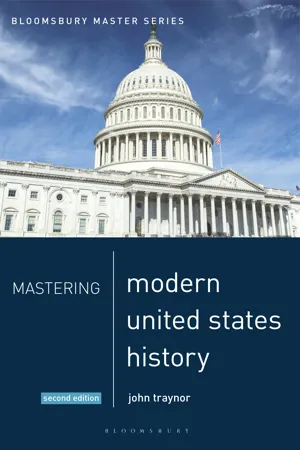
Mastering Modern United States History
About this book
Information

1.1 Introduction – A simpler age
Mark Twain (Samuel L. Clemens) was a man of letters, a humourist without parallel, regarded by many as the finest American writer of the nineteenth century. The Adventures of Tom Sawyer, published in 1876, evoked magical memories of Clemens’ own childhood. Adventures of Huckleberry Finn (1884) was his masterpiece, ‘the great American novel’. He began the first draft of his autobiography in 1877. In so doing, Mark Twain evoked a picture of an age that now seems long gone.
I was born the 30th of November, 1835, in the almost invisible village of Florida, Monroe County, Missouri. I suppose Florida had less than three hundred inhabitants. It had two streets, each a couple of hundred yards long; the rest of the avenues were mere lanes, with rail fences and corn fields on either side. Both the streets and the lanes were paved with the same material – tough black mud, in wet times, deep dust in dry.
Most of the houses were logs – all of them, indeed except three or four; these latter were frame ones. There were none of brick, and none of stone. There was a log church … Week days, the church was a schoolhouse …
There were two stores in the village. My uncle … was proprietor of a very small establishment, with … a few barrels of salt mackerel, coffee and New Orleans sugar behind the counter, stacks of brooms, shovels, axes, hoes, rakes and such things…and at the other end of the room was another counter with bags of shot on it, a cheese or two, and a keg of powder; in front of it a row of nail kegs and a few pigs of lead; and behind it a barrel or two of New Orleans molasses and native corn whisky on tap.
Source: Mark Twain, Autobiography of Mark Twain: Volume 1 (University of California Press 2010)
A long life included work as an apprentice typesetter at the age of 12, a formative period as a steamboat pilot on the Mississippi River and a less fruitful spell as a mining prospector. In February 1863 he signed himself Mark Twain for the first time, not long before he moved to San Francisco to avoid prosecution for duelling. As his literary reputation grew he travelled the world giving lectures, writing a prodigious number of letters and newspaper articles and compiling a body of work so impressive that the writer William Faulkner called him ‘the father of American literature.’ He died at the family home in Redding, Connecticut on 21 April 1910.
The small-town world Mark Twain so vividly described was one in which he recalled:
[a] great prairie which was covered with wild strawberry plants, vividly starred with prairie pinks, and walled in on all sides by forests. The strawberries were fragrant and fine, and in the season we were generally there in the crisp freshness of the early morning, while the dew-beads still sparkled upon the grass and the woods were ringing with the first songs of the birds … Doctors were not called, in cases of ordinary illness; the family’s grandmother attended to those. Every old woman was a doctor, and gathered her own medicines in the woods, and knew how to compound doses that would stir the vitals of a cast-iron dog. (Twain, 2010, pp. 214–15)
The small-town, agrarian world he left behind with its artisan craftsmen, handmade goods and simple way of life was already embarking on a spectacular and transformative journey. Massive trends of urbanisation, immigration and industrialisation would effectively change the identity of the American nation itself. At the centre of that story was an unprecedented rise in population.
1.2 Population
In 1900, the United States covered a total area of more than 3 million square miles. In that space lived a population of 76,212,168 people. More than 66 million of that total were white (87 per cent), with 8.8 million black people (11.9 per cent). The average male life expectancy was 46.3 years and the average female life expectancy 48.3 years. Each of the closing decades of the nineteenth century had witnessed a rapid increase in population. Between 1880 and 1890 the decennial increase was 25.5 per cent; in the last decade of the nineteenth century it was 20.7 per cent.
Population comparison between 1900 and 2000
Just a century later, in 2000 the US population was calculated to be 281,421,906. The most rapidly growing regions are now in the South and the West, with the single most notable growth hotspot around Austin, Texas, making it the nation’s capital for population growth. In terms of numeric growth, 13 of the 15 cities that added the most people at the end of the twentieth century were in the South or West. The exception to this general trend was New York City, which ranked first in numeric population growth. New York maintained its position as the nation’s most populous city by some margin, with just over 8 million residents in 2000, followed by Los Angeles and Chicago.
1.3 Women in America at the turn of the twentieth century
The rapid rise of American society at the turn of the twentieth century was based, not least, on the foundation stone of female fertility. With the American economy ready to become the most powerful in the world, a rapidly growing, youthful population was instrumental in what was to come. The average family size throughout the nineteenth century was five and as late as 1910 it stood at 4.5. This cultural drive to raise a family was the single most important factor behind the nation’s rapid population growth.
But raising children could represent an almighty struggle. Infant mortality in 1870 was 176 per 1,000. Poor sanitation, contaminated milk and the fact that most American births still took place at home placed a huge burden on mothers. The dangers posed by outbreaks of illnesses such as typhus, scarlet fever, measles and whooping cough lay in wait for young children.
While it is obvious that women played the central role in bringing babies into the world and then taking the prime responsibility for their well-being and upbringing, the rewards for females in American society were more difficult to discern. In almost every sense, women were regarded and treated as second-class citizens even though the society they were building was remarkable for its modernity.
From the outset, young girls were raised in the expectation that they would play second fiddle to their male siblings. The importance of being feminine, learning how to perform domestic chores, assuming a passive role in education, and then, when the time came, finding an appropriate partner and husband were all given paramount importance. Qualities of piety, virtue, domesticity and submissiveness were key ingredients in raising a God-fearing young woman. As Linda Simon puts it: ‘The prospect of motherhood shaped every facet of their identity.’ (Simon, 2017, p. 37)
Changing perceptions of the role of women
Young women who enthusiastically displayed their housekeeping and maternal skills were more likely to be seen as suitably deferential and spiritually devout. The important legacy of the Puritan outlook meant that religious and domestic duties were put before any potentially suspect intellectual activity. Prestigious companies, schools and universities were largely dominated by men and by male thinking.
Yet remarkably, while women were treated less favourably than their male counterparts it is now clear that many people at the time believed the role of women in society was quickly changing and to some (chiefly male) observers, this was the cause of great concern. For example, in 1901, Edward Alsworth Ross, an academic from the University of Nebraska, gave a series of lectures in which he
blamed women for turning away from motherhood – partly because of the physical toll it took on their bodies and the risk of death in childbirth; partly because, availing themselves of higher education, they felt restive. ‘Society has put maternity out of fashion,’ wrote Eliza Lynn Linton, ‘and the nursery is nine times out of ten a place of punishment, not of pleasure, to the modern mother.’ (In Simon, 2017, p. 39)
As we will see, rapid changes in dress, social interaction and the behaviour of women divided American society between those who were appalled by and those who applauded the changing role of the ‘new woman’.
Women and suffrage
The impact of modernity was not necessarily universally reflected in attitudes towards women in general and towards the issue of female suffrage in particular. Two organisations led the way in demanding the vote for women. In 1869 Elizabeth Stanton and Susan Anthony established the National Woman Suffrage Association. The American Woman Suffrage Association led by Julia Ward Howe and Lucy Stone immediately followed. In 1890, the two groups acknowledged the value of joining forces and created the National American Woman Suffrage Association (NAWSA). Despite their efforts, by the turn of the century only four states (Idaho, Colorado, Utah and Wyoming) had given women the same voting rights as men. Those who opposed female suffrage claimed that women lacked the intellect to understand complex political issues and did not need the vote as they were effectively represented by their menfolk. Others claimed that the moral standing of women in general would be degraded by their involvement in the sordid world of politics. Finally, a widely held view was that it was the place of women to devote their time and energy to raising a family, leaving no time for the distractions of politics.
1.4 The Hispanic population
Why did people flock to the United States in such numbers at the start of the twentieth century? It may be that a look at the experience of people from Mexico can reveal some of the characteristics that applied to other immigrant groups as well. Firstly, in common with other sources of migration, the population of Mexico was rapidly increasing, from about 7 million people at the time of the Mexican War with the United States in 1846 to more than 14 million people by 1915. This rapid population growth was not accompanied by a corresponding rise in living standards or employment opportunities.
Across the border in the United States, the picture looked very different. A burgeoning economy, a hunger for cheap labour, employment ‘opportunities’ in mining, agriculture, fruit harvesting and industry all acted as a magnet to the Mexican people in the same way that this brought in millions of people from Eastern Europe. Sadly, the reality of the reception given to many Mexican migrants was rather different to the one they may have hoped for. Many of the new arrivals from Latin America were Catholic and so prejudice against Hispanic people and their religion was combined by those who saw Protestantism as fundamental to the character of the United States. From the hostility of the American Protective Association in the 1890s at a time of American imperialism, to the Ku Klux Klan in the 1920s during the Red Scare, anti-Catholic sentiment was seldom far from the surface.
Mexicans who entered the United States hoping for a new start were often the victims of ‘frontier justice’ at a time when Social Darwinism and naked racism went hand in hand. From the 1890s discrimination was applied to Mexican schoolchildren in states such as Texas and California and in courts and policing in Texas, Arizona and Colorado. An example of this thinking was displayed by Senator Albert Beveridge of Indiana when he told Congress in 1900: ‘God … has made us the master organizers of the world … that we may administer government among savage and senile peoples.’ (In Fernandez-Armesto, 2015, p. 629) Historian Felipe Fernandez-Armesto offers this analysis:
Discrimination kept Hispanics mired in poverty and excluded from the social and economic opportunities of the ‘American Dream’ … More significant for the long-term history of the United States than all the migrants’ suffering and all the peculiarities of border life was the diffusion of Hispanics, especially of Mexicans, in the wider territory of the United States … Migrants penet...
Table of contents
- Cover
- Title Page
- Copyright
- Dedication
- Contents
- List of Tables
- List of Presidential Profiles
- List of Great American Lives
- Acknowledgements
- 1 The beginning of the American twentieth century: 1900–20
- 2 Foreign policy 1900–20
- 3 The 1920s
- 4 FDR: The Great Depression and the New Deal
- 5 Roosevelt’s foreign policy, 1933–45
- 6 African Americans 1900–45
- 7 Post-war America
- 8 The 1950s: Affluence and anxiety
- 9 John F. Kennedy, 1961–63
- 10 LBJ: The Great Society and Vietnam
- 11 The shift to the right
- 12 African Americans 1945–2000
- 13 The end of the American century: 1980–2000
- Questions and Exercises
- References
- Index
Trusted by 375,005 students
Access to over 1.5 million titles for a fair monthly price.
Study more efficiently using our study tools.
Frequently asked questions
Yes, you can cancel anytime from the Subscription tab in your account settings on the Perlego website. Your subscription will stay active until the end of your current billing period. Learn how to cancel your subscription
No, books cannot be downloaded as external files, such as PDFs, for use outside of Perlego. However, you can download books within the Perlego app for offline reading on mobile or tablet. Learn how to download books offline
Perlego offers two plans: Essential and Complete
- Essential is ideal for learners and professionals who enjoy exploring a wide range of subjects. Access the Essential Library with 800,000+ trusted titles and best-sellers across business, personal growth, and the humanities. Includes unlimited reading time and Standard Read Aloud voice.
- Complete: Perfect for advanced learners and researchers needing full, unrestricted access. Unlock 1.5M+ books across hundreds of subjects, including academic and specialized titles. The Complete Plan also includes advanced features like Premium Read Aloud and Research Assistant.
We are an online textbook subscription service, where you can get access to an entire online library for less than the price of a single book per month. With over 1.5 million books across 990+ topics, we’ve got you covered! Learn about our mission
Look out for the read-aloud symbol on your next book to see if you can listen to it. The read-aloud tool reads text aloud for you, highlighting the text as it is being read. You can pause it, speed it up and slow it down. Learn more about Read Aloud
Yes! You can use the Perlego app on both iOS and Android devices to read anytime, anywhere — even offline. Perfect for commutes or when you’re on the go.
Please note we cannot support devices running on iOS 13 and Android 7 or earlier. Learn more about using the app
Please note we cannot support devices running on iOS 13 and Android 7 or earlier. Learn more about using the app
Yes, you can access Mastering Modern United States History by John Traynor in PDF and/or ePUB format, as well as other popular books in History & Modern History. We have over 1.5 million books available in our catalogue for you to explore.