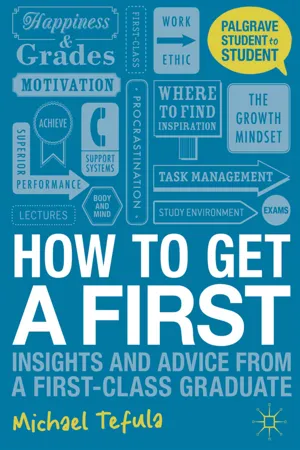
Written by a first-class graduate, this text is for every student looking for realistic guidance on how to achieve their potential and graduate with a top degree. Divided into two sections, the first familiarises students with the building blocks to academic success, including degree choice, work ethic and support systems, while the second sets out strategies that students can apply immediately to boost their grades. Packed with practical tips and inspirational insights from other students, this is a relatable and engaging read which will help students to get the most out of their studies. This resource will be an invaluable source of guidance to all undergraduates who have set their sights on getting a first.
- 120 pages
- English
- ePUB (mobile friendly)
- Available on iOS & Android
eBook - ePub
About this book
Information
Part 1
The Fundamentals
1
Degree Choice
Interview snippet
First-class degree student: Hannah Kelly1
Degree: Chemistry
Institution: Oxford University
Degree: Chemistry
Institution: Oxford University
‘At 17 years old I had no idea what to do with my life so I simply picked a subject I enjoyed. Over the past four years I’ve had a love–hate relationship with chemistry but following my final year spent in research, I’d have to say I loved it.’
1 This student chose not to be named, so an alias has been used.
The easy degree vs the hard degree
Numbers, and in particular statistics, can reveal much about university degrees, yet they are also incredibly easy to misinterpret. For instance, did you know that mathematical sciences have the highest percentage of students graduating with first-class degrees? In the academic year 2009/10, a whopping 30 per cent of maths students graduated with a first (HESA, 2011). Does that mean that the subject is as easy as the numbers imply? I’m sure you would agree that maths is no piece of cake, so why do so many maths students get a first?
One reason could be that in many areas of maths answers are more categorical than in other disciplines, and this makes it easier to achieve higher marks in exams and coursework. In maths, your answer can be explicitly asserted to be either right or wrong. In subjects like business studies and other social sciences, things aren’t always quite as clear, so in these instances, merit is usually given to how a case is built and there is less emphasis on the one true and correct answer. Bluntly put, in maths you can get 100 per cent in an exam; in other subjects such as law, no matter how brilliant your answer is, you can never get 100 per cent.
I know at first hand how hard law is as a subject. In the law modules I studied, I know of only one student who managed to get a first in the exams. Despite cramming with what we thought were perfect answers and using as many case examples as we could, the majority of the class came out with 2:2s. It is no surprise, then, that in 2009/10 only 7 per cent of law students got a first. The statistics suggest that law is a very difficult subject.
Nevertheless, the idea that law is a lot less definitive than maths and that therefore that is why fewer law students get a first seems somewhat simplistic. It may be impossible for students to score 100 per cent in law, but this should not stop an equal number of students from scoring at least the minimum mark (usually 70 per cent) required to attain a first. I believe that something else is at play here. In this chapter I will dig a little deeper and discuss what we can learn from maths students in order to help with degree choices.
Popularity, passion and prior knowledge
Looking at university applicants for 2010, it is interesting to find that over 100,000 students applied to do a law degree, making it one of the most popular courses. Maths, on the other hand, was only slightly more popular than accounting; the degree received less than half the number of applications for law, approximately 41,000 students applying to do maths in 2010 (UCAS, 2011).
In short, then, it seems that whereas maths is quite an unpopular discipline, yet one where a huge proportion of its students graduate with first-class degrees, the opposite is true of law. A number of factors may be responsible for this phenomenon, but of all these, I suspect that two play a particularly important role in determining how well students perform. The factors are: a genuine interest in the subject area; and prior knowledge of the subject.
Lots of people want to do a law degree, but are they all as passionate about the subject itself as they are about the exorbitant graduate starting salaries – known to have peaked at £100,000 in 2000 (Verkaik, 2000)? I doubt it. Maths, on the other hand, has fewer such incentives. It requires a higher level of commitment and passion to want to do it at university level. There is less glamour to the subject and this in itself acts as a filter in applications – only students who are truly committed to the subject apply to do it. These students have a true passion for the subject, and they are prepared to put in the effort to do well.
But surely, if law students work very hard, they too can perform just as well as maths students, can’t they? Not quite so. Like maths students, law undergraduates do work hard. They know that their course and career path will be no walk in the park. In fact, in one survey, 90 per cent of all students applying for law expected to work in a high-stress environment, with long working hours (Birchall, 2007). Even so, while they are prepared to work hard (and many of them do work diligently), the majority start their degree with a clear disadvantage. Remember the friend I mentioned earlier, the only one who got a first in a law module in my class? Guess what? He came to university having already done law as an A-level!
At most universities, you cannot do a maths degree without having an A-level in maths. In fact, a number of universities require students not only to do the standard A-level, but to supplement it with a more advanced version, further mathematics. These students are better prepared for their degree. Moreover, in 2011, 44.7 per cent of students taking an A-level in maths got an A grade or higher (Joint Council for Qualifications, 2011). This sets them up well for further success in higher education. In contrast, law degrees are less stringent in their requirements. In most cases, you don’t need law at A-level to do it at university and many students have a range of non-related A-levels when they start their course. Although many universities argue that this is not particularly disadvantageous, there are clear differences in performance between students who have some prior knowledge of the subject and those who do not. Not surprisingly, only 18.4 per cent of students taking law at A-level got an A grade or higher. This means that even among the fraction of students who have a law A-level when they start their law degree, a smaller percentage of them got an A than those in maths.
Your choice
So you can see that a genuine interest in the subject and having prior knowledge are key to attaining a first. Therefore, in choosing a degree, you should first ensure that it is one for which you have such a passion that you are willing to expend a great amount of effort in mastering it. Many maths students show both of these characteristics: they love challenges and solving problems, and they are prepared to put in the work. They chose a maths degree because, frankly, they enjoy maths. And for this, they are more likely to be rewarded with a first than students in other subject areas.
In the case of law, we saw that things are very different. Indeed, it is rare to find a lazy lawyer – hard work is imbued in their persona – but if I may speculate for a moment, a good number of law students do not have the same level of interest in their subject as maths students, and they do not enjoy their course as much. No wonder depression is rife in law schools; it has been reported that up to 40 per cent of law students may experience depression as the result of the law school experience itself (McKinney, 2002). In a later chapter you will see that happiness affects academic performance, but for now we will simply say that, unfortunately, effort with no passion makes it harder to achieve higher grades. So what can you do?
Forging passion
So as we have seen, to be academically successful you should have some passion for your chosen subject area. This is a necessary foundation for success. If, however, you are already on a course and you find that it is rather boring and uninspiring, it is worth noting that a number of options are open to you. Two of these are top of my list (although there are many more).
First, attempt to forge some kind of zeal for the subject. Many things can be made interesting and fun if you try hard enough. For example, one of the modules I was required to complete was accounting policy. On the surface, this seemed very boring. This was until I discovered that the module was essentially about the tensions between various interest groups. All of a sudden, accounting policy turned into something more interesting: conflict resolution. Many subjects have such underlying themes and ideas that are captivating but tend to be overlooked, masked by a plethora of facts that at first sight can make the topic boring. Find these underlying themes and you will be surprised how much more interested in the subject you can become.
The second option could be considered to be among a set of last-resort strategies. And I say this because sometimes students are surprised at how much more they can enjoy a subject only after they become good at it. But if all else fails, you could look at course alternatives within your department to see if anything else interests you. I advise that you seek support, speak to your tutors and learn more about what the options are before you really consider changing course.
Prior knowledge
Maths students have an advantage at university: as already discussed, virtually all of them did maths at A-level and nearly half of them got an A or higher in it. So you may be wondering, how can you have the same edge if your A-levels are not quite so related to your degree? There is not a significant amount that you can do here, but one of the ways in which you can make a better degree choice is by basing your decision around not only your interests, but also your strengths.
Do you have a way with words or numbers? Are you a great analytical thinker? Do you love or hate coursework? These are some of the questions you can ask yourself while researching what degree you would like to do. Given time, you could also prepare for your degree over the summer by looking at some introductory textbooks. Yes, this is a very geeky thing to do, but it allows you to hit the ground running once you start your course.
Summary
The first fundamental step to academic success is to make sure that you take a suitable degree. In this chapter, we looked at how many law students work very hard but fail to achieve a first because they seem to lack a genuine interest in the subject and do not have sufficient levels of prior knowledge to be successful. Maths students, on the other hand, are in shorter supply as only those who are really passionate about the subject tend to apply for the course; that, combined with a similar work ethic to law students and, importantly, prior knowledge of their course, means that a much greater proportion of these candidates gain a first-class degree – 30 per cent compared to only 7 per cent of law graduates. In light of this, I suggest that your degree choice should take into account three factors in particular: a genuine interest in the subject, prior knowledge of the course and your individual strengths. So whether you are applying for English Literature, Art, History or Engineering, think about your motivations and consider building on your knowledge of the subject area before you enter higher education.
2
The Growth Mindset
Interview snippet
First-class student:Sabial Hanif
Degree: Economics
Institution: University of Birmingham
Degree: Economics
Institution: University of Birmingham
‘I have been fortunate enough to value the importance of education from an early age. I learnt that a good education would open doors for a better future for myself. I also recognised the importance of always challenging myself to reach the potential I believed I possessed as an individual. It was this mindset that helped me attain good grades throughout my academic education.’
Beliefs make a difference
7th graders
In a New York City public school, the progress of 373 students entering the 7th grade (year 8 in the United Kingdom) was followed over a period of two years by researchers from Stanford University and Columbia University (Blackwell et al., 2007). The 7th grade marks the transition from elementary school to junior high and is often challenging because the difficulty of the academic content goes up a notch – very much like the transition in the United Kingdom from GCSEs to A-levels, and from A-levels to university. In the study, students answered a questionnaire at the start of the year that assessed their goals and beliefs about intelligence and effort. Views varied widely, with two notable extremes. Some students believed that you have a fixed level of intelligence and there is nothing you can do to change it, while others believed that you could significantly change how intelligent you are.
The researchers conducting the study then went on to track the maths test scores of the students by obtaining their grades twice a year for two years. While the quality of teaching at the school remained fairly consistent and was not – as the researchers put it – ‘particularly progressive or innovative’, by the end of the study the contrast in results was stark. Students who believed that they could change their level of intelligence significantly outperformed those who believed that they were born with a fixed level of intelligence.
In another study, the same researchers assessed whether a positive change in beliefs and attitudes could lead to higher levels of achievement. This time a different school was used, with a sample of relatively low-achieving students. In the experiment, two structured workshops were delivered to the students. One group was taught that intelligence was something they could develop (using analogies such as muscles becoming stronger), while the other group was merely given lessons on memory and the opportunity to discuss academic topics of interest to its members. The maths grades of the two groups were tracked over the course of the study and once again the results were clear-cut: the students who were taught that intelligence could be developed showed the greatest improvement in maths grades, while those who were not showed little change. Which group of students do you think that most first-class degree students would be in?
The stereotype threat
Do boys perform better than girls in sciences and technology-based subjects? It turns out that if you are a girl, the mere consideration of such a thought could impair...
Table of contents
- Cover
- Title
- Copyright
- Contents
- Introduction
- Part 1 The Fundamentals
- Part 2 The Strategies
- The Book in a Nutshell
- Acknowledgements
- Bibliography
- Index
Trusted by 375,005 students
Access to over 1.5 million titles for a fair monthly price.
Study more efficiently using our study tools.
Frequently asked questions
Yes, you can cancel anytime from the Subscription tab in your account settings on the Perlego website. Your subscription will stay active until the end of your current billing period. Learn how to cancel your subscription
No, books cannot be downloaded as external files, such as PDFs, for use outside of Perlego. However, you can download books within the Perlego app for offline reading on mobile or tablet. Learn how to download books offline
Perlego offers two plans: Essential and Complete
- Essential is ideal for learners and professionals who enjoy exploring a wide range of subjects. Access the Essential Library with 800,000+ trusted titles and best-sellers across business, personal growth, and the humanities. Includes unlimited reading time and Standard Read Aloud voice.
- Complete: Perfect for advanced learners and researchers needing full, unrestricted access. Unlock 1.5M+ books across hundreds of subjects, including academic and specialized titles. The Complete Plan also includes advanced features like Premium Read Aloud and Research Assistant.
We are an online textbook subscription service, where you can get access to an entire online library for less than the price of a single book per month. With over 1.5 million books across 990+ topics, we’ve got you covered! Learn about our mission
Look out for the read-aloud symbol on your next book to see if you can listen to it. The read-aloud tool reads text aloud for you, highlighting the text as it is being read. You can pause it, speed it up and slow it down. Learn more about Read Aloud
Yes! You can use the Perlego app on both iOS and Android devices to read anytime, anywhere — even offline. Perfect for commutes or when you’re on the go.
Please note we cannot support devices running on iOS 13 and Android 7 or earlier. Learn more about using the app
Please note we cannot support devices running on iOS 13 and Android 7 or earlier. Learn more about using the app
Yes, you can access How to Get a First by Michael Tefula in PDF and/or ePUB format, as well as other popular books in Study Aids & Study Guides. We have over 1.5 million books available in our catalogue for you to explore.