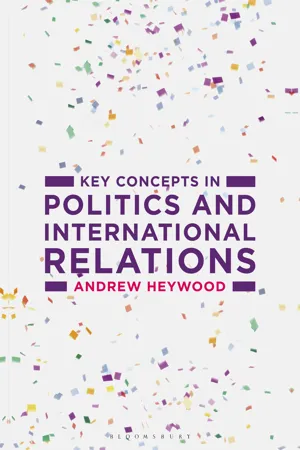
Concepts have a particular importance for students of politics and international relations. Political argument often boils down to a struggle over the legitimate meaning of terms and enemies may argue, fight and even go to war, each claiming to be 'defending freedom', 'upholding democracy' or 'supporting justice'. The problem is that words such as 'freedom', 'democracy' and 'justice' have different meanings to different people, so that the concepts themselves come to seem problematic. This book provides an accessible and comprehensive guide to the major concepts encountered in political analysis. Each term is defined clearly and fully, and its significance for political argument and practice is explored. The text has been updated and expanded to take account of the increasing influence of globalization on politics and now features 70 additional concepts. Renowned for its lively, engaging style and user-friendly approach, the second edition is an invaluable companion to the study of politics and international relations.
- 280 pages
- English
- ePUB (mobile friendly)
- Available on iOS & Android
eBook - ePub
Key Concepts in Politics and International Relations
About this book
Information
KEY CONCEPTS: THEIR MEANING AND SIGNIFICANCE
ABSOLUTISM
Absolutism is the theory or practice of absolute government. Government is ‘absolute’ in the sense that it possesses unfettered power: government cannot be constrained by a body external to itself. The most prominent manifestation of absolute government is the absolute monarchy. However, there is no necessary connection between monarchy and absolute government. Unfettered power can be placed in the hands of the monarch, but it can also be vested in a collective body such as the supreme legislature. Absolutism nevertheless differs from modern versions of dictatorship, notably totalitarianism. Whereas absolutist regimes aspire to a monopoly of political power, usually achieved by excluding the masses from politics, totalitarianism involves the establishment of ‘total power’ through the politicization of every aspect of social and personal existence. Absolutism thus differs significantly from, for example, fascism.
Significance
Absolutism was the dominant political form in Europe in the seventeenth and eighteenth centuries. It was usually linked to the claim that sovereignty, representing unchallengeable and indivisible legal authority, resided in the monarchy. Absolutist rule was justified by both rationalist and theological theories. Rationalist theories of absolutism, such as those of Jean Bodin (1530–96) and Thomas Hobbes (1588–1679), advanced the belief that only absolute government can guarantee order and social stability. Divided sovereignty or challengeable power is therefore a recipe for chaos and disorder. Theological theories of absolutism were based on the doctrine of divine right, according to which the absolute control a monarch exercises over his or her subjects derives from, and is analogous to, the power of God over His creation.
However, absolutist theories are now widely regarded as politically redundant and ideologically objectionable. They are politically redundant because the advance of constitutionalism and representation has fragmented power and resulted in a strengthening of checks and balances, and because, where dictatorship has survived, it has assumed a quite different political character. It is ideologically objectionable because absolutism serves as a cloak for tyranny and arbitrary government, and is, by definition, irreconcilable with ideas such as individual rights and democratic accountability. Nevertheless, a form of constitutional absolutism can be seen to survive in political systems based on respect for the principle of parliamentary sovereignty.
ACCOUNTABILITY
Accountability means answerability; it implies a duty to explain one’s conduct and be open to criticism by another. Accountability requires that the duties, powers and functions of government bodies are defined in such a way that the performance of subordinate ones can be monitored and evaluated by ‘higher’ bodies. In this sense, accountability can operate only in a context of constitutionalism; being accountable does not mean being subject to arbitrary authority or capricious punishment. However, accountability may also amount to a weak form of responsibility, since it establishes a duty to answer and explain one’s conduct, but not necessarily to bear guilt and accept punishment.
Significance
Accountability is an important feature of limited government, effective policy-making and democracy. It limits government power by establishing mechanisms of political control through which one institution oversees the working and performance of another. It can promote the quality of public policy by ensuring that policy proposals are carefully scrutinized and political performance is rigorously monitored. When this is achieved through regular and competitive elections, it amounts to a system of public control, public accountability being the practical face of democratic rule. However, accountability is effective only under certain circumstances. These include that the mechanisms for monitoring performance are rigorous; that ‘higher’ institutions or bodies have sufficient access to information to make critical and informed judgements; and that appropriate sanctions can be applied in the event of blunders or under-performance. The main drawback of accountability is that it may constrain independent judgement and action. For example, the accountability of civil servants to ministers can lead to politicization and allow bureaucratic power to be harnessed to the needs of the government of the day.
ANARCHISM
Anarchism is an ideology that is defined by the central belief that political authority in all its forms, and especially in the form of the state, is both evil and unnecessary (anarchy literally means ‘without rule’). Anarchists believe that the state is evil because, as a repository of sovereign, compulsory and coercive authority, it is an offence against the principles of freedom and equality, the core value of anarchism being unrestricted personal autonomy. The state and the accompanying institutions government and law are therefore rejected as corrupt and corrupting. However, the belief that the state is unnecessary is no less important to anarchism. Anarchists reject ‘political’ order but have considerable faith in ‘natural’ order and spontaneous social harmony, ultimately underpinned by optimistic assumptions about human nature. Government, in other words, is not the solution to the problem of order, but its cause.
Nevertheless, the anarchist preference for a stateless society in which free individuals manage their own affairs through voluntary agreement and cooperation has been developed on the basis of two rival traditions: socialist communitarianism and liberal individualism. Anarchism can thus be thought of as a point of intersection between socialism and liberalism, the point at which each ideology generates anti-statist conclusions. Anarchism has therefore been thought of as a combination of ‘ultra-socialism’ and ‘ultra-liberalism’, taking the form, respectively, of collectivist anarchism and individualist anarchism. Collectivist anarchism (sometimes called ‘classical’ anarchism or ‘social’ anarchism) is rooted in the idea of social solidarity, or what Pyotr Kropotkin (1842–1921) called ‘mutual aid’, the belief that the natural and proper relationship among people is one of sympathy, affection and harmony. Collectivist anarchists have typically stressed the importance of social equality and common ownership, supporting Pierre-Joseph Proudhon’s (1809–65) famous assertion that ‘Property is theft’, most radically expressed in the form of anarchocommunism. Individualist anarchism is based on the idea of the sovereign individual, the belief that individual conscience and the pursuit of self-interest should not be constrained by any collective body or public authority. Individualist anarchism overlaps with libertarianism and is usually linked to a strong belief in the market as a self-regulating mechanism, most obviously manifest in the form of anarcho-capitalism.
Significance
Anarchism is unusual among political ideologies in that it has never succeeded in winning power, at least at a national level. As no society or nation has been remodelled according to anarchist principles, it is tempting to regard anarchism as an ideology of lesser significance. As a political movement, anarchism has suffered from three major drawbacks. First, its goal, the overthrow of the state and all forms of political authority, is often considered to be simply unrealistic. The most common criticism of anarchism is that it is an example of utopianism in its negative sense, in that it places excessive faith in ‘human goodness’ or in the capacity of social institutions, such as the market or social ownership, to maintain order and stability. Second, in viewing government as corrupt and corrupting, anarchists have rejected the conventional means of political activism, such as forming political parties, standing for election and seeking public office, and have relied instead on the willingness and capacity of the masses to engage in spontaneous rebellion. Third, anarchism does not constitute a single, coherent set of political ideas: apart from anti-statism, anarchists disagree profoundly about the nature of an anarchic society and particularly about property rights and economic organisation.
However, the significance of anarchism is perhaps less that it has provided an ideological basis for acquiring and retaining political power, and more that it has challenged. and thereby fertilized, other political creeds. Anarchists have highlighted the coercive and destructive nature of political power, and in so doing have countered statist tendencies within other ideologies, notably liberalism, socialism and conservatism. In this sense, anarchism has had growing influence on modern political thought. Both the New Left and New Right, for instance, have exhibited libertarian tendencies, which bear the imprint of anarchist thinking. Indeed, the continuing importance of anarchism is perhaps merely concealed by its increasingly diverse character. In addition to, and in some ways in place of, established political and class struggles, anarchists address issues that range from ecology, transport and urban development to sexual relations, and they have been in the forefront in the campaign against neoliberal or ‘corporate’ globalization. To argue that anarchism is irrelevant because it has long since lost the potential to become a mass movement perhaps misses the point. As the world becomes increasingly complex and fragmented, it may be that it is mass politics itself that is dead.
ANARCHY
Anarchy literally means ‘without rule’, the absence of a supreme or sovereign power. In domestic politics, anarchy suggests there is no authority higher than the individual (or, possibly, the group). In international politics, anarchy suggests there is no authority higher than the nation-state. The term nevertheless generally carries heavily pejorative connotations, implying chaos, disorder and, not uncommonly, violence. In sharp contrast, within anarchism, anarchy is not only viewed as compatible with order, but it is taken to be the very foundation of stable and peaceful existence.
Significance
The concept of anarchy has played an important role in both mainstream political theory and international relations theory. In the former, it has been used to establish the legitimacy of the state and provide a basis for political obligation. Social-contract theorists, dating back to Thomas Hobbes (1588–1679) and John Locke (1632–1704), have argued that citizens should behave as though the state had arisen out of a voluntary agreement, or social contract, made by individuals who recognized that only the establishment of a sovereign power could safeguard them from the insecurity, disorder and brutality of the ‘state of nature’ (a stateless or anarchic society). Without a state, individuals abuse, exploit and enslave one another; but with a state, order and civilized existence are guaranteed and liberty is protected. The obligation to obey and respect the state thus arises, ultimately, from self-interest and the awareness that anarchy would degenerate into a ‘civil war of each against all’ (Hobbes).
In a tradition that can be traced back to Thucydides (c. 460–406 bce), such thinking about the link between anarchy and disorder has been applied to relations between societies and not merely within societies, becoming a major component of international relations theory through the influence of realism. It nevertheless gained greater prominence from the 1970s onwards through the rise of neorealism or ‘structural realism’. Neorealists shifted their attention from the state to the international system, and placed primary emphasis on the implications of anarchy. The characteristics of international life were thus taken to stem from the fact that states (and other actors) operate within a domain that has no formal central authority. Neorealists argue that international anarchy necessarily tends towards tension, conflict and the unavoidable possibility of war, for two main reasons. In the first place, as states are separate, autonomous and formally equal political units, they must ultimately rely on their own resources to realize their interest. International anarchy therefore results in a system of ‘self-help’, because states cannot rely on anyone else to ‘take care of them’. Second, relationships between states are characterized by uncertainty and suspicion. This is best explained through the security dilemma. Uncertainty about motives therefore forces states to treat all other states as enemies, meaning that permanent insecurity is the inescapable consequence of living in conditions of anarchy.
ANIMAL RIGHTS
Animal rights are rights to which all animals, or certain categories of animals, are entitled. The idea underpinning animal rights is that the grounds for allocating rights to h...
Table of contents
- Cover
- Halftitle page
- Dedication page
- Series page
- Title page
- Contents
- Uses and Abuses of Political Concepts
- Key Concepts: Their Meaning and Significance
- List of Figures
- Glossary of Key Political Thinkers
- Bibliography
- Index
- eCopyright
Trusted by 375,005 students
Access to over 1.5 million titles for a fair monthly price.
Study more efficiently using our study tools.
Frequently asked questions
Yes, you can cancel anytime from the Subscription tab in your account settings on the Perlego website. Your subscription will stay active until the end of your current billing period. Learn how to cancel your subscription
No, books cannot be downloaded as external files, such as PDFs, for use outside of Perlego. However, you can download books within the Perlego app for offline reading on mobile or tablet. Learn how to download books offline
Perlego offers two plans: Essential and Complete
- Essential is ideal for learners and professionals who enjoy exploring a wide range of subjects. Access the Essential Library with 800,000+ trusted titles and best-sellers across business, personal growth, and the humanities. Includes unlimited reading time and Standard Read Aloud voice.
- Complete: Perfect for advanced learners and researchers needing full, unrestricted access. Unlock 1.5M+ books across hundreds of subjects, including academic and specialized titles. The Complete Plan also includes advanced features like Premium Read Aloud and Research Assistant.
We are an online textbook subscription service, where you can get access to an entire online library for less than the price of a single book per month. With over 1.5 million books across 990+ topics, we’ve got you covered! Learn about our mission
Look out for the read-aloud symbol on your next book to see if you can listen to it. The read-aloud tool reads text aloud for you, highlighting the text as it is being read. You can pause it, speed it up and slow it down. Learn more about Read Aloud
Yes! You can use the Perlego app on both iOS and Android devices to read anytime, anywhere — even offline. Perfect for commutes or when you’re on the go.
Please note we cannot support devices running on iOS 13 and Android 7 or earlier. Learn more about using the app
Please note we cannot support devices running on iOS 13 and Android 7 or earlier. Learn more about using the app
Yes, you can access Key Concepts in Politics and International Relations by Andrew Heywood in PDF and/or ePUB format, as well as other popular books in Study Aids & Study Guides. We have over 1.5 million books available in our catalogue for you to explore.