Studying Law introduces students to the fundamental legal skills that they will need to successfully study the subject, such as case analysis, legislative interpretation, problem solving and essay writing, and to the core Law subjects themselves and the distinctions between them.
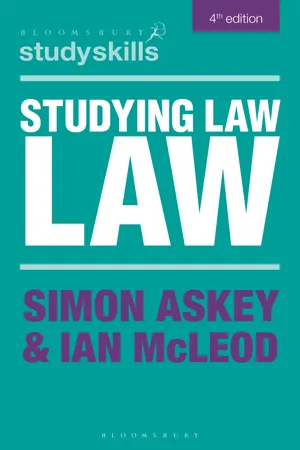
- 264 pages
- English
- ePUB (mobile friendly)
- Available on iOS & Android
eBook - ePub
Studying Law
About this book
Information
1 Studying Law: What’s It All About?
Having studied this chapter you should be able to explain:


What is law about?
The best way to approach the academic study of anything is to ask: what is this subject about? This question may be important for two reasons.
First, those who start to study a subject like law without giving at least some thought to its nature are likely to find themselves adrift upon a vast ocean of apparently random – and therefore confusing – detail. Some knowledge of the nature of law, even if only in outline, will help to provide a framework within which you can organise and understand as much of that detail as possible. More particularly, this understanding will enable you to see how the detail contributes (or, in some cases, fails to contribute) to the coherence of the body of law as a whole.
Secondly, it will give you an important insight into how you will be required to think and the intellectual skills you will need if you are to study the subject successfully.
So, returning to the initial question, what is law about? We will approach this question by asking two further questions:

We will consider these questions in turn.
What does law do?
Although there is a great deal of academic debate about the nature of law, for the moment we can assume that law consists of a body of rules. In practice, of course, those rules will need to be made. Additionally, having been made, the rules will need to be interpreted, applied and enforced in a wide variety of factual contexts; and they may need to be changed from time to time. It follows, therefore, that there must also be a set of institutions whose function it is to make, interpret, apply, enforce and change the law. There are many such institutions, with Parliament, the courts, central government and local authorities being among the most obvious examples.
The fact that law involves both rules and institutions still leaves open the question of what it is that law actually does. An outline answer to this question is that law regulates social conduct with a view to enabling (or at least helping) people to live peaceably in a well-ordered society. In practice, this means that the law must identify the duties and powers of both government and individuals, as well as enforcing the duties and regulating the exercise of the powers in both cases.
More specifically, constitutional law deals with the allocation of power between different institutions (such as central government departments like the Home Office) and local authorities (such as county councils and London borough councils) as well as a range of other public bodies (such as the Environment Agency). Once constitutional law has allocated public powers to various institutions, administrative law seeks to control the way in which those institutions exercise their powers.
Moving to the level of relationships between individuals, the range of law is truly vast. For example, at random, the law regulates matters as varied as:
Of course, these categories are by no means watertight. (For example, marriage may well affect existing property rights, or bring new ones into being, or both.) However, the vastness of the law’s range is seldom reflected in the way students are introduced to it, which generally relies very heavily on a few traditional categories.
Of all the categories of law which regulate relationships between individuals, the two which you are most likely to encounter at an early stage are contract and tort, which may sometimes be put together to form the bulk of a single subject called obligations. (The idea of contract is probably obvious even to non-lawyers, but it may be worth saying that the word tort describes particular kinds of unlawful conduct, such as trespass, negligence, libel and so on, where the legal relationship between the parties arises simply as a matter of law, rather than arising from an agreement between them.) The placing of these subjects at an early stage within your studies is far from arbitrary. The fact of the matter is that they underpin many of the specialised subjects which you will encounter later on. They are, therefore, literally foundational in nature.
So far, we have approached the question ‘What is law about?’ in terms of ‘What does law do?’ but this is only a partial answer because it still leaves the more practical question of ‘How does law do it?’.
How does law do it?
Introduction
One useful way of approaching the way in which law functions is through the distinction between criminal law and civil law.
The distinction between criminal law and civil law
Criminal law prohibits certain types of anti-social conduct such as murder, rape, theft and dangerous driving. By way of contrast, civil law deals with conduct which, while still anti-social, is rather less so, such as breaching contracts and trespassing on other people’s land.
The policy decision as to whether a specific type of conduct should be classified as criminal or civil will depend on how harmful to society and its members the conduct in question is thought to be. In order to understand how this policy decision is made, it will help if you first understand the practical consequences which flow from something being classified as either criminal or civil.
The first practical consequence is that, in the case of criminal law, the state itself (acting mainly through the police and the Crown Prosecution Service, but sometimes through other institutions such as local authorities) will investigate allegations of illegality and also bring legal proceedings. On the other hand, where conduct is classified as a civil wrong, it is left entirely up to the victims to assemble the evidence and formulate the legal arguments which will be necessary in order to support their claims, and to decide whether to bring proceedings in the courts.
The second practical consequence is that where guilt is either admitted or proved in criminal proceedings, the court will impose sanctions which will be enforced automatically. Moreover, these sanctions will usually be intended, in principle, to be either punitive (such as fines), or reforming (such as probation) or perhaps even an uneasy combination of the two (such as imprisonment). The fact that the courts exercising criminal jurisdiction may also be able to award compensation for financial loss represents only a small exception to the general nature of criminal sanctions. In practice, they make such awards only in very straightforward cases, leaving the victims of crime to pursue more complicated claims by way of civil actions.
On the other hand, where judgment has been obtained in civil proceedings, it is left entirely to the victims to decide whether to enforce whatever orders the courts may make. Moreover, these orders will very seldom be intended to be either punitive or reforming, but will focus instead on compensating claimants or protecting them against further wrongdoing; or, sometimes, both.
By way of an example, suppose your neighbour erects a fence in such a way that it trespasses on your garden. If you choose not to enforce your rights, no official or agency of the state will force you to do so, or do so on your behalf. Suppose, however, that you have chosen to enforce your rights and that the court has made orders in your favour, requiring your neighbour to remove the fence from your garden and pay you damages. Although you have obtained two remedies, you may well decide that all you really want is to have the use of your garden back. If this is so, you may well decide to require your neighbour simply to move the fence, without also requiring the payment of damages. The law leaves this choice entirely up to you.
As a final footnote to the distinction between criminal and civil law, it is worth saying that a single piece of unlawful conduct may be both criminal and civil. For example, suppose A assaults B. A may be successfully prosecuted in a court exercising criminal jurisdiction, where the result may be some kind of penalty such as a fine. Whether or not there is a successful prosecution, B may sue A in a court exercising civil jurisdiction and, if successful, obtain damages.
If you think it strange that a claim for damages may succeed where a prosecution has failed, you may be immediately congratulated on having read the text carefully and critically. However, the answer is quite straightforward. In a criminal case the prosecution needs to produce evidence which is convincing enough to prove that the defendant is guilty beyond a reasonable doubt. In civil cases, on the other hand, claimants can succeed on evidence which is significantly less convincing, because the standard of proof in civil cases is only the balance of probabilities. In other words, claimants in civil cases need only show that it is more likely than not that what they allege to have happened did actually happen.
Introduction
The proposition that law is about enabling (or, at least, helping) people to live peaceably in a well-ordered society, is only a starting point. Much depends on how peace and good order are established and maintained. Societies that are based on abuses of fundamental human rights will often use law as an instrument of violence and oppression against their citizens. These societies will undoubtedly be peaceful and well-ordered, but they can scarcely be called just. Thus, within a few, short sentences – and taking only one example – we have identified the need to consider not only law but also justice.
At this stage two further questions arise. First, how do we identify what we mean by justice; or, in other words, what is the content of justice? Secondly, once we know what we mean by justice, we need to ask what is the relationship between law and justice?
The content of justice
Introduction
We will begin our consideration of the content of justice with the importance of respecting and protecting fundamental human rights. The difficulty is that, although this can reasonably be considered to be at least one aspect of justice, what it actually requires in any given case may be a great deal less clear.
For example, does it follow that a society which prohibits racial discrimination in the field of employment must prohibit the proprietors of Chinese restaurants from employing only Chinese waiting staff, where they think this form of racial discrimination is necessary in order to provide their establishments with the ambience which their customers enjoy?
Similarly, although admittedly by way of a more extreme example, most people would say that they support freedom of religion and worship. However, suppose a group of people chooses to revive the religious beliefs which formed the foundation of the Central American Aztec civilisation before the European conquest. These beliefs required the offering of human hearts and blood as nourishment for the sun god. Does a commitment to respecting and protecting freedom of religion mean that we must accept the right of this group to practise human sacrifice? When answering this question, is it relevant to ask whether the victims are themselves followers of the faith who are happy to die in the service of their god?
Even leaving aside questions involving fundamental human rights, it is not difficult to imagine situations where the requirements of justice are less than obvious. Suppose a thie...
Table of contents
- Cover
- Title Page
- Copyright
- Contents
- Preface
- 1. Studying Law: What’s It All About?
- 2. The Sources of English Law
- 3. The Constitutional Context of English Law
- 4. The Jurisdictions of the Principal Courts
- 5. The Protection of Human Rights and Fundamental Freedoms
- 6. Finding and Citing the Sources of Law
- 7. Legal Method
- 8. Reading Law Reports and Statutes
- 9. Written English
- 10. Answering Essay Questions
- 11. Answering Problem Questions
- 12. Oral Skills
- Appendices
- Index
Trusted by 375,005 students
Access to over 1.5 million titles for a fair monthly price.
Study more efficiently using our study tools.
Frequently asked questions
Yes, you can cancel anytime from the Subscription tab in your account settings on the Perlego website. Your subscription will stay active until the end of your current billing period. Learn how to cancel your subscription
No, books cannot be downloaded as external files, such as PDFs, for use outside of Perlego. However, you can download books within the Perlego app for offline reading on mobile or tablet. Learn how to download books offline
Perlego offers two plans: Essential and Complete
- Essential is ideal for learners and professionals who enjoy exploring a wide range of subjects. Access the Essential Library with 800,000+ trusted titles and best-sellers across business, personal growth, and the humanities. Includes unlimited reading time and Standard Read Aloud voice.
- Complete: Perfect for advanced learners and researchers needing full, unrestricted access. Unlock 1.5M+ books across hundreds of subjects, including academic and specialized titles. The Complete Plan also includes advanced features like Premium Read Aloud and Research Assistant.
We are an online textbook subscription service, where you can get access to an entire online library for less than the price of a single book per month. With over 1.5 million books across 990+ topics, we’ve got you covered! Learn about our mission
Look out for the read-aloud symbol on your next book to see if you can listen to it. The read-aloud tool reads text aloud for you, highlighting the text as it is being read. You can pause it, speed it up and slow it down. Learn more about Read Aloud
Yes! You can use the Perlego app on both iOS and Android devices to read anytime, anywhere — even offline. Perfect for commutes or when you’re on the go.
Please note we cannot support devices running on iOS 13 and Android 7 or earlier. Learn more about using the app
Please note we cannot support devices running on iOS 13 and Android 7 or earlier. Learn more about using the app
Yes, you can access Studying Law by Simon Askey, Ian McLeod in PDF and/or ePUB format, as well as other popular books in Manuali di studio & Guide di studio. We have over 1.5 million books available in our catalogue for you to explore.