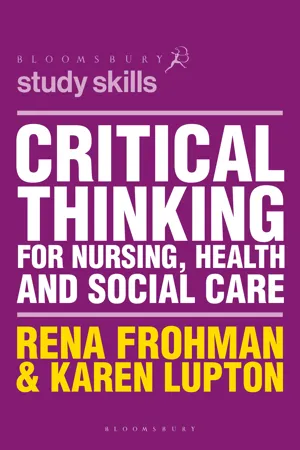
This practical book will equip students with the critical thinking, reading and writing skills required to succeed both on their course and in their professional placements. It takes readers through the core stages of working on an assignment, from finding and evaluating sources through to critically reading material and demonstrating critical analysis in their writing. With chapters featuring content-specific examples and engaging exercises, this book is an essential resource for undergraduate students of Nursing, Health, Social Care and related disciplines.
- 190 pages
- English
- ePUB (mobile friendly)
- Available on iOS & Android
eBook - ePub
Critical Thinking for Nursing, Health and Social Care
About this book
Information
CHAPTER
1
What Is Critical Thinking?
This chapter:
• Briefly introduces definitions and explanations for critical thinking commonly used in health and social care education
• Links critical thinking skills to working in health and social care professions
• Provides examples of critical thinking models that can help you understand what academics mean when they talk about critical thinking.
One of the key factors for success at university is being able to show that you can not only describe what you’ve learnt from course materials and independent research, but also show how well you can analyse, question and evaluate this information. These thinking processes, often called cognitive processes, belong to a set of skills and attitudes that form critical thinking.
Being critical means being thoughtful and analytical about what you hear, see, read and experience.
To demonstrate critical thinking in your assessments and in professional contexts, you need to choose appropriate and relevant sources of information to support your ideas, opinions or answers for health or social care problems. This means you need to avoid being biased in your thinking and recognise that, in complex situations, health and social care practitioners need to consider a range of opinions and options based on high-quality and reliable evidence that come from trustworthy sources.
As you progress through your course you may observe academics and professionals in your field referring to critical thinking using different language and ideas. Here are some examples of how critical thinking can be defined and explained (Cottrell, 2017; Bottomley and Pryjmachuk, 2018):
• Identifying other people’s ideas and comparing different ideas and evidence without bias
• Evaluating the strengths and weaknesses of evidence
• Reflecting on the evidence to see if there are missing ideas or facts
• Pulling different ideas together (synthesising) to create new ideas
• Applying evidence to real situations
• Justifying ideas, decisions and opinions with evidence from synthesised sources of information
While there is no single definition of critical thinking, in this book we define critical thinking as applying all of those thinking skills listed above in order to come to a judgement on an argument or idea. Critical thinking belongs to a set of skills that we use every day, but it may often happen subconsciously without reflection. After all, we make thousands of judgements, opinions and decisions about what we see, hear and read, but we don’t often stop to consider the process which led to those decisions. One way to develop better critical thinking skills is to consciously think with an internal dialogue. This is called metacognition, thinking about how you are thinking. In other words, metacognition happens when you reflect and become aware of how you make decisions. Let’s test the waters with a short activity.
ACTIVITY 1A
Forming opinions
Imagine your classmates are discussing the topic of caring for People Living with Dementia at home. Based on your knowledge and experiences, make a list of factors that family members who care for a relative living with dementia might need to consider before they decide the best place for their family member to live (e.g. at home, with a family carer, in an aged care facility?).
• How many ideas did you come up with?
• Where did your ideas come from?
• Where could you look for more information to help fill in gaps in your knowledge?
The length of the list will be influenced by various factors:
• Your depth of knowledge about People Living with Dementia
• Your experiences of interacting with People Living with Dementia in real life through family or friends’ experiences
• The media
• Underlying attitudes or beliefs and values that you have about caring for a relative.
Now read another student’s opinion. Think about how her knowledge, experiences and values may influence her future approach as a health or social care professional when discussing care strategies for People Living with Dementia.
“I’ve always believed that when people get older they naturally become more forgetful. At this stage in their lives, after they have worked so hard and contributed to the family, it is the family’s ethical duty to care for the older relative at home. I believe putting somebody into an “old people’s home” is shameful for the family and based on recent news reports aged care home residents are poorly treated. Everybody in my family thinks that personal health matters are private and decisions, such as caring for an elderly relative, should not be discussed with outsiders.”
One helpful strategy for developing critical thinking processes is to recognise that we have gaps in our knowledge and need to continually question where our information comes from and how we evaluate the information we have. In the example above, the student needs to recognise not only her personal, subjective...
Table of contents
- Cover
- Titlepage
- Copyright
- Contents
- List of Figures
- List of Tables
- List of Activities
- Acknowledgements
- Introduction
- Chapter 1 What Is Critical Thinking?
- Chapter 2 What Is Academic Writing?
- Chapter 3 How Do You Get Started on Assessments? Using a Five-Step Process to Begin Thinking Critically
- Chapter 4 How Do You Read with a Critical Eye?
- Chapter 5 How Do You Use Evidence? Building a Logical System to Organise and Analyse Sources
- Chapter 6 How Do You Refer to the Evidence Effectively in Your Writing?
- Chapter 7 How Do You Put It All Together? Building Logical Academic Paragraphs That Demonstrate a Critical Voice
- Chapter 8 How Can You Apply Critical Thinking to Write Reflections and Develop Lifelong Learning Behaviours?
- Chapter 9 How Can You Demonstrate Critical Thinking and Effective Communication on Placement?
- Glossary
- References
- Index
Trusted by 375,005 students
Access to over 1.5 million titles for a fair monthly price.
Study more efficiently using our study tools.
Frequently asked questions
Yes, you can cancel anytime from the Subscription tab in your account settings on the Perlego website. Your subscription will stay active until the end of your current billing period. Learn how to cancel your subscription
No, books cannot be downloaded as external files, such as PDFs, for use outside of Perlego. However, you can download books within the Perlego app for offline reading on mobile or tablet. Learn how to download books offline
Perlego offers two plans: Essential and Complete
- Essential is ideal for learners and professionals who enjoy exploring a wide range of subjects. Access the Essential Library with 800,000+ trusted titles and best-sellers across business, personal growth, and the humanities. Includes unlimited reading time and Standard Read Aloud voice.
- Complete: Perfect for advanced learners and researchers needing full, unrestricted access. Unlock 1.5M+ books across hundreds of subjects, including academic and specialized titles. The Complete Plan also includes advanced features like Premium Read Aloud and Research Assistant.
We are an online textbook subscription service, where you can get access to an entire online library for less than the price of a single book per month. With over 1.5 million books across 990+ topics, we’ve got you covered! Learn about our mission
Look out for the read-aloud symbol on your next book to see if you can listen to it. The read-aloud tool reads text aloud for you, highlighting the text as it is being read. You can pause it, speed it up and slow it down. Learn more about Read Aloud
Yes! You can use the Perlego app on both iOS and Android devices to read anytime, anywhere — even offline. Perfect for commutes or when you’re on the go.
Please note we cannot support devices running on iOS 13 and Android 7 or earlier. Learn more about using the app
Please note we cannot support devices running on iOS 13 and Android 7 or earlier. Learn more about using the app
Yes, you can access Critical Thinking for Nursing, Health and Social Care by Rena Frohman, Karen Lupton in PDF and/or ePUB format, as well as other popular books in Study Aids & Study Guides. We have over 1.5 million books available in our catalogue for you to explore.