Integrating theory with practice, this core textbook provides a structured and sequential introduction to motor learning and motor control. Part 1 begins by introducing what motor learning is and how movement is controlled, before exploring how a learning environment may be manipulated to assist in the learning and performance of movement skills. Part 2 explores motor control from neural, behavioural and dynamic systems perspectives. Part 3 provides an overview of considerations in applying motor learning and skill acquisition principles to physical education, exercise and sports science. Chapters are illustrated with flowcharts and diagrams to aid students' understanding, and include activities and end-of-chapter review questions to consolidate knowledge. Motor Learning and Skill Acquisition is essential reading for all Physical Education, Exercise and Sports Science and Sports Coaching students. New to this Edition:
- New and updated chapters on skill acquisition approaches, talent identification and development, and performance analysis and feedback as well as separate chapters on practice design and task modification, and practice organisation and planning
- Contains additional content on decision-making, tactical and strategic skills, traditional and constraints-led skill acquisition approaches, practice design, and skill-drill and game-based practice for skill acquisition
- Supported by a bank of online lecturer resources, including PowerPoints, MCQs and lab activities
eBook - ePub
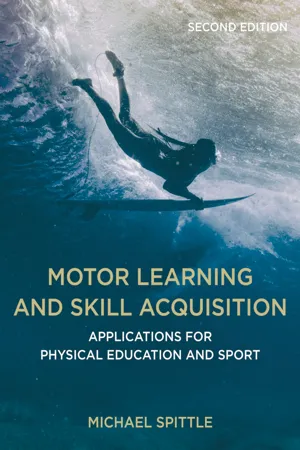
Motor Learning and Skill Acquisition
Applications for Physical Education and Sport
- 495 pages
- English
- ePUB (mobile friendly)
- Available on iOS & Android
eBook - ePub
About this book
Information
PART 1
Motor learning
1
Introduction to motor learning and skill acquisition
After studying this chapter, you should be able to:
■ Define the disciplines of motor control, motor learning and skill acquisition, and motor development
■ Discuss the influence of other academic disciplines on motor learning and skill acquisition
■ Articulate the place of motor learning and skill acquisition in physical education and exercise and sport science
■ Distinguish between laboratory, applied and natural setting research
■ Describe what motor learning specialists do
Motor learning and skill acquisition explores how we learn (or acquire), improve and enhance skills in movement. one of the main goals in physical education and sport is to assist the acquisition of skills. Thus, understanding motor learning and skill acquisition is important for individuals involved in instructing, teaching or coaching movement skills, such as physical education teachers, primary education teachers, coaches and exercise and sports scientists. As an instructor, the learning environment that you create will influence whether your students, players or clients develop the skills necessary to be successful. understanding how people learn and how they control their body when performing movement skills will help you make decisions, such as how to present the skill, how to structure practice conditions, how to provide feedback to learners and how you should modify the learning environment for different age groups and with different types of skills.
Being an instructor in physical education and sport is an art, and the topics covered in the textbook should provide instructors with a research and theoretical basis on which to make decisions about how to set up learning environments to help learners achieve success.
This chapter introduces the discipline of motor learning and skill acquisition, and focuses on how it applies to physical education and sport. It also provides an overview of the types of research prevalent in motor learning and skill acquisition, and looks at career-related activities of motor learning and skill acquisition specialists.
Motor behaviour
Motor behaviour: The study of movement and the processes that underlie motor performance.This comprises three closely related disciplines: motor control, motor learning and motor development.
Before we begin our exploration of the application of motor learning and skill acquisition, we need to develop an understanding of what motor learning and skill acquisition entail, and how they relate to physical education and exercise and sports science. The area of study we are exploring lies within the field of motor behaviour. Motor behaviour is the study of movement and processes that underlie motor performance; it comprises three closely related disciplines: motor control, motor learning and skill acquisition, and motor development. These three processes combine to influence our learning and performance of motor skills in movement contexts, such as physical education and exercise and sports science.
Motor control
Motor control: The study of how behavioural and neurophysiological processes affect the control of movement
Motor control studies the behavioural and neurophysiological processes that affect the control of movement. Put simply, it is the study of how movements are controlled. This involves investigating how we produce movements and how the neuromuscular system functions in this role. Essentially, in performing a motor skill in sport, we must control and coordinate our body to be successful in the movement – motor control explores how we do this. Example questions for researchers in motor control include: How do we control motor skill? How do we coordinate all our body parts in performing a motor skill?
Motor learning and skill acquisition
Motor learning: The study of the processes involved in skilled movement through practice or other learning-related variables
Skill acquisition: How we improve and enhance skill
Motor learning is the study of the processes involved in the skilled movement through practice or other learning-related variables. Skill acquisition focuses on how we improve and enhance skill. Thus, motor learning and skill acquisition focus on understanding how we learn, improve and enhance skills in movement, and then applying this understanding to practice. This includes understanding how we acquire new motor skills, as well as the enhancement of well-learned or highly practiced motor skills at a high-performance level and the re-acquisition of skills that need to be relearned due to injury or disease or changes in movement technique or strategy. Part of this is exploring how a learner becomes better adapted to a specific performance environment and can produce more effective performance in that context (Araujo & Davids, 2011; Renshaw, Davids, Newcombe, & Roberts, 2019). We investigate the changes that a person goes through in learning a motor skill and how specific variables, such as practice and feedback, influence these changes. Example questions for researchers in motor learning and skill acquisition include: How does practice influence the learning of a motor skill? Does providing a demonstration help in learning a motor skill?
Motor development
Motor development: The study of how the learning and control of motor skills change across the lifespan
Motor development looks at how the learning and control of motor skills change across the lifespan. This includes understanding the processes underlying these changes, as well as the factors that influence the changes. Researchers in motor development explore these changes in learning and control across the lifespan (in infancy, childhood, adolescence, adulthood and older adulthood). An understanding of motor development is critical for all professionals working in a movement context. For example, having knowledge of the developmental aspects of movement allows us to design developmentally appropriate activities, which should allow for better teaching and learning environments for participants. If we understand differences in how a child learns and performs motor skills and how an adult learns and performs motor skills, we will be better at tailoring practice and instruction to facilitate learning. In addition, understanding motor development should help movement professionals to identify developmental problems.
The focus of this textbook is on motor learning and skill acquisition; however, given the close relationship between motor control, motor learning and motor development, it is crucial that we also have some understanding of motor control and motor development. This is because factors that influence how we control a motor skill and factors related to level of motor development will influence how we learn a motor skill. For example, understanding how someone controls or performs a motor skill (motor control) is central to understanding how someone would learn to perform the skill. That is, if you do not have some theoretical understanding of how someone controls a motor skill, then it will be difficult to help learners improve their motor control of that skill. Similarly, understanding how learning changes for dif...
Table of contents
- Cover
- Half-Titlepage
- Titlepage
- Copyright
- Contents
- About the author
- Preface
- PART 1 Motor learning
- PART 2 Motor control
- PART 3 Skill acquisition
- Answers to end of chapter questions
- Index
Trusted by 375,005 students
Access to over 1.5 million titles for a fair monthly price.
Study more efficiently using our study tools.
Frequently asked questions
Yes, you can cancel anytime from the Subscription tab in your account settings on the Perlego website. Your subscription will stay active until the end of your current billing period. Learn how to cancel your subscription
No, books cannot be downloaded as external files, such as PDFs, for use outside of Perlego. However, you can download books within the Perlego app for offline reading on mobile or tablet. Learn how to download books offline
Perlego offers two plans: Essential and Complete
- Essential is ideal for learners and professionals who enjoy exploring a wide range of subjects. Access the Essential Library with 800,000+ trusted titles and best-sellers across business, personal growth, and the humanities. Includes unlimited reading time and Standard Read Aloud voice.
- Complete: Perfect for advanced learners and researchers needing full, unrestricted access. Unlock 1.5M+ books across hundreds of subjects, including academic and specialized titles. The Complete Plan also includes advanced features like Premium Read Aloud and Research Assistant.
We are an online textbook subscription service, where you can get access to an entire online library for less than the price of a single book per month. With over 1.5 million books across 990+ topics, we’ve got you covered! Learn about our mission
Look out for the read-aloud symbol on your next book to see if you can listen to it. The read-aloud tool reads text aloud for you, highlighting the text as it is being read. You can pause it, speed it up and slow it down. Learn more about Read Aloud
Yes! You can use the Perlego app on both iOS and Android devices to read anytime, anywhere — even offline. Perfect for commutes or when you’re on the go.
Please note we cannot support devices running on iOS 13 and Android 7 or earlier. Learn more about using the app
Please note we cannot support devices running on iOS 13 and Android 7 or earlier. Learn more about using the app
Yes, you can access Motor Learning and Skill Acquisition by Michael Spittle in PDF and/or ePUB format, as well as other popular books in Education & Education Curricula. We have over 1.5 million books available in our catalogue for you to explore.