Whatever stage of the peer mentoring journey your students are at, this engagingly-written book will help them to get the most out of their peer mentoring experience. It explains the role of peer mentors in universities and shows students exactly what's involved in providing academic and pastoral support to other students. The book also contains a helpful trouble-shooting chapter, packed with supportive guidance on dealing with challenging scenarios. The final chapters of the book prompt students to reflect on the skills they have developed through peer mentoring, and help them to articulate these skills to prospective employers. This book will be an essential companion for both aspiring and current student mentors, and an invaluable reference point for staff involved in facilitating peer mentoring schemes.
eBook - ePub
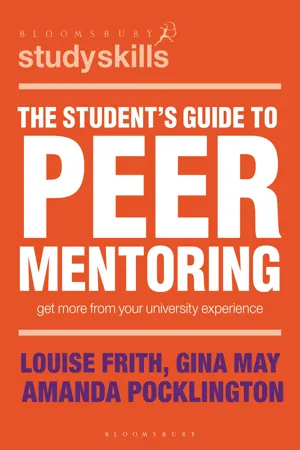
The Student's Guide to Peer Mentoring
Get More From Your University Experience
- 120 pages
- English
- ePUB (mobile friendly)
- Available on iOS & Android
eBook - ePub
The Student's Guide to Peer Mentoring
Get More From Your University Experience
About this book
Information
Chapter 1
Introduction
As you start to read this book, try to think about the people throughout your education who have been influential. They might have been a classroom assistant or a teacher during your early years as a child at school; a sports or music teacher who inspired you; or possibly a friend or older family member who supported your development or encouraged you to persist when you felt like giving up. The role other people play in your educational journey can have a huge impact on your development, so the role of peer mentor is of great importance. This book is aimed primarily at peer mentors in higher education settings. It will provide you with a context, and framework for mentoring and give you specific guidance on some of the common issues and tricky aspects of being a mentor so that you get the most out of the experience and your mentees find your input helpful.
We know that peer-led learning is a growing and vital area in higher education that has the potential to transform the way in which learning takes place. We also hope that academic skills practitioners and others who support the development of mentoring activities in universities will find this a useful handbook to refer to. Although there is a logical progression through each of the chapters, it is not necessary to read this book from cover to cover. Each chapter has exercises within it to enable you to pause and think about your response to what you have read. These exercises can be done individually, but they also lend themselves to group work, so the book can be used in training or other mentor support programmes. Hopefully it is something you will dip in and out of during your time as a mentor, and it may also be useful to you after you finish mentoring as an aide-memoire for the experiences you had as a mentor. It may also help you to reflect on and communicate the skills you have developed to others, such as employers or admissions tutors. Although this book can be used to support mentor training, it is not a training manual and it certainly should not be used instead of targeted mentor training. It is a student guide to mentoring, which we hope will enhance your understanding of the role mentors play and help you to reflect on your experience of mentoring.
What is peer-led learning?
Peer-led learning, also referred to in this book as peer mentoring, has been around since the 1990s in the UK higher education sector. It is known by a wide variety of terms. The most common of these are peer-assisted learning (PAL) and peer-assisted study sessions (PASS), but there are many other terms that are used to describe the study and academic support that students give to students. This type of mentoring derives from supplemental instruction, which was developed in the in the 1970s at the University of Missouri Kansas City. Peer-led learning is now a common feature in many UK universities and is also becoming widespread in other European and Pacific universities. The concept of mentoring draws on educational research from a number of different perspectives, which emphasises, first, the importance of students feeling connected at a personal level to their university; second, collaborative learning pedagogy, which fosters links and interconnections between students to improve their learning; and, finally, mentor support for students to embrace their new academic identity.
Why is peer-led learning growing in popularity?
Peer-led learning is gaining momentum, nationally and internationally. It is now found in nearly all UK universities and across a broad range of disciplines. Peer-led learning schemes are often attached to specific modules which students find difficult, the emphasis being on support for difficult modules rather than targeting weak students. Mentoring can also be focused on social support functions. These types of mentoring scheme are often termed buddying. Many peer-led learning schemes are targeted at specific groups of students, such as international students, BME students, mature or part-time students, and students on placement, and there is also a growing practice of online mentoring. In addition to these targeted forms of mentoring there are an increasing number of universities that are able to offer mentor-development opportunities to work as a mentor for more than a year. This gives experienced mentors the chance to support incoming mentors and get involved in their training. The context of higher education has changed dramatically; during the past 20 years the numbers of students entering university has increased significantly. University can be a daunting experience for some new students because programmes of study can be very large, meaning that they may not necessarily have a personal relationship with their lecturers, especially in core first-year modules. Mentors play an important role in bridging the gap between new students and academic staff. Therefore an essential element of peer-led learning is that students make a personal connection and feel supported to study and persist at university.
What are the benefits of mentoring?
If you are considering mentoring you should know that there is a lot you can get out of the experience. It is now widely accepted that all stakeholders in the mentoring relationship benefit from building active partnerships between staff and students, institutions and students, and among students themselves. Mentors are sometimes described as the ‘real winners’ in mentoring schemes. This is because the evidence suggests that you get significant benefit from working in a mentoring role (Keenan, 2014). For example, it increases your confidence in both an academic and a social context; you consolidate your learning by revising course materials and explaining study techniques and it gives you opportunities to improve your interpersonal skills. All of this results in mentors generally doing better in their studies and going on to graduate employment afterwards (Kent, Student Success Conference 2016). For mentees there are also significant benefits: they have an opportunity to learn in small groups in a supportive environment with peers. The focus of PAL groups is discussion, so mentees have a chance to ask questions and air views, which can then help them to participate more confidently in seminars and lectures. There are also significant social benefits for mentees because, through their mentor, they can make connections with others on their course. This is often a crucial factor in new students’ sense of belonging and persistence at university. Academic staff are generally supportive of mentoring schemes. The benefit for them is that some of the administrative questions that would have been directed at them are fielded by mentors. In addition to this, mentors can reinforce good study messages to new students about attendance, time management and keeping up with reading. Finally, from the point of view of the institution, the benefits are clear: mentors embody values which universities are eager to promote, such as caring for students, student-centred learning and inter-cultural communication.
Who are peer mentors?
There is no ideal type for mentoring, but, as you will read in Chapter 4, there are common characteristics and values which mentors tend to have. Mentors are generally motivated by a wish to help other students and put something back into their university experience. Anyone can become a mentor; you do not need to be a first-class student or to have had any particular experiences of university study. In fact, it is quite often the case that students who have overcome difficult experiences during their studies make great mentors because they have developed resilience and worked out strategies to succeed at university that they can pass on. A basic requirement is an enjoyment of study and a wish to pass that on to others. Mentors often have an eye on their own employability profile and are motivated to become a mentor because they can see that it is an opportunity for them to develop and demonstrate skills that are hard to acquire in other contexts. This often attracts students who may be interested in a future role that involves teaching, training, managing or coaching.
What skills do you need to have?
As a mentor you will develop in the role, but there are some skills you should either already have or have an interest in acquiring. Good communication skills are really a cornerstone in any successful mentoring relationship. It is not easy to support others while also studying yourself, so some of what you learn as a mentor is how to prioritise your own work, and how to set and maintain clear boundaries. As well as this, you need to be organised, and to work well both individually and in a team. These skills are highly prized by employers so it is important that as a mentor you record the work that you do so that you are able to give concrete examples to show that you have these skills. Chapters 8 and 9 give you lots of direction relating to this, and you may also find that your university students’ union or careers advice service will be able to give you further support in identifying your skills before and after mentoring.
Chapter summaries
The book is divided into three sections. The first section explains mentors’ roles, motivations and characteristics. Chapter 2 gives a detailed explanation of the roles that peer mentors play in universities and how they fit into university structures. It explains different common models of peer mentoring and asks you to think about the model in your own university. There is discussion of the cross-cultural role that mentors can play and information on the limitations of peer-led learning. Chapter 3 presents research into what motivates students to become mentors. It includes case studies from a variety of students about why they wanted to become a peer mentor and encourages you to reflect on your reasons for becoming a mentor. Chapter 4 draws on Terrion and Leonard’s (2007) typology of ten characteristics for successful peer mentors. It also includes a self-evaluation questionnaire so that you can evaluate your own characteristics and assess your suitability for mentoring.
In the middle section, Chapters 5 and 6 provide detailed examples of the types of academic and social support that peer mentors provide. Chapter 5 gives an introduction to academic support skills for mentoring, such as learning styles, small group teaching, participation and feedback. It includes case studies and examples from different subjects. This provides some contrasts between mentoring practice in the disciplines. It gives advice on how to deliver support and when to draw the line between support and dependency. Chapter 6 looks in more detail at the types of social support situations that peer mentors may encounter. It gives an introduction to communication skills such as active listening, confidentiality and reflective practice. It includes case studies and advice on how to offer support while maintaining boundaries to protect both the mentor and the mentee.
The last section of the book examines some of the difficulties that mentors may encounter, as well as identifying the academic and employability skills you derive from mentoring and how you can articulate these to others. In Chapter 7 the power relationships between mentors and mentees, and between mentors and the university, are considered. It looks at different models of power and voice, and puts mentoring into the context of contemporary higher education that emphasises student satisfaction. The chapter provides a series of difficult scenarios which mentors may face within their role. It considers particularly the issue of mentees not engaging with mentoring and what solutions there are for this, with the focus on online mentoring. There are suggestions as to how a mentor can deal with these types of situation and where to seek further sources of support. Chapter 8 looks at the academic confidence and enhanced study skills that students gain from being a mentor. It also considers the employability skills that mentors gain from their experience, giving short statements from alumni and students who have been mentored on placement or in voluntary work about the value of mentoring, and how the skills they gained as a mentor have helped them in their life after university. Chapter 9 uses reflective practice models to enable you to reflect on your experience of being a mentor and to start to articulate it. It features questions to help you write about your experience. The last section of the book, comprising Chapter 10, draws some conclusions.
We hope that you will find the book a useful companion during your time as a peer mentor. Although, at first, mentoring might seem overwhelming because you might have high expectations of what you want to achieve, as time progresses and you get to know your mentees and the role you play in their development, we hope you will find that it is a useful and enjoyable experience. Previous mentors have described their experience of mentoring as ‘intense and very rewarding’. We hope that you will derive similar emotions from your mentoring experience, which will develop your confidence and enhance your skills.
Chapter 2
The Role of Peer Mentoring in Universities
By the end of this chapter you will:
•have an overview of the position of peer mentoring in universities
•have an understanding of the role, responsibilities and boundaries of being a peer mentor
•have an understanding of the connections between peer mentoring and other university services
•have an appreciation of the different models and delivery formats
•have a range of case studies exemplifying different models to compare to your own experience.
Mentoring in some form has existed for as long as human beings have interacted with each other. It is common knowledge that parents guide their children, who in turn support their friends, but employers, teachers and coaches, to name but a few, also offer support to others. You have no doubt provided informal mentoring to friends without classifying it as such; it is just part of a normal friendship. Peer mentoring programmes in universities are more structured than a friendship relationship. They generally have goals and objectives which might pertain to similar benefits as friendship but they are not intended as replacements for normal friendship support. Generally, as a peer mentor you tread a fine line between being a friend/confidante and a tutor, taking on neither role in its full form but assuming some aspects of each. Understanding the intricacies of the role of peer mentor and the role of peer mentoring in higher education will take time and effort to master.
Peer mentoring in higher education has been expanding for a number of years. The number of peer programmes in existence worldwide has not been formally identified but their existence is certainly evident in all countries that have a formal education system. This can be seen from a review of university websites and other online media. Another indication is the growing number of texts and papers published worldwide in the field of peer mentoring and its associated areas. The breadth and depth of the types of peer support programme have unsurprisingly followed a similar expansion path. There are various reasons for this. Many institutions view peer programmes as part of the menu of strategies to address the wider issues they face, including widening participation, retention, achievement, graduate destinations, student wellbeing and the student experience (Ody and Carey, 2013). In light of this range of purposes you may not be surprised to find that the location of peer mentoring within university structures varies greatly across institutions, from large central programmes to small student-led groups. Similarly, the role of the peer mentor also varies across departments, institutions and countries. The one thing tying them all together is that the role of the peer mentor is to help and support their fellow students.
This chapter will look at various aspects of the role in its difference contexts, along with the connections with other services and will help ...
Table of contents
- Cover
- Halftitle
- Title Page
- Copyright
- Contents
- Acknowledgements
- 1 Introduction
- 2 The Role of Peer Mentoring in Universities
- 3 Why Become a Peer Mentor?
- 4 What Characteristics Are Needed to Be an Effective Peer Mentor?
- 5 Academic Support
- 6 Social Support
- 7 Troubleshooting
- 8 What Skills Do Mentors Gain?
- 9 Reflecting on the Experience of Being a Mentor
- 10 Conclusion
- Appendix
- References
- Index
Trusted by 375,005 students
Access to over 1.5 million titles for a fair monthly price.
Study more efficiently using our study tools.
Frequently asked questions
Yes, you can cancel anytime from the Subscription tab in your account settings on the Perlego website. Your subscription will stay active until the end of your current billing period. Learn how to cancel your subscription
No, books cannot be downloaded as external files, such as PDFs, for use outside of Perlego. However, you can download books within the Perlego app for offline reading on mobile or tablet. Learn how to download books offline
Perlego offers two plans: Essential and Complete
- Essential is ideal for learners and professionals who enjoy exploring a wide range of subjects. Access the Essential Library with 800,000+ trusted titles and best-sellers across business, personal growth, and the humanities. Includes unlimited reading time and Standard Read Aloud voice.
- Complete: Perfect for advanced learners and researchers needing full, unrestricted access. Unlock 1.5M+ books across hundreds of subjects, including academic and specialized titles. The Complete Plan also includes advanced features like Premium Read Aloud and Research Assistant.
We are an online textbook subscription service, where you can get access to an entire online library for less than the price of a single book per month. With over 1.5 million books across 990+ topics, we’ve got you covered! Learn about our mission
Look out for the read-aloud symbol on your next book to see if you can listen to it. The read-aloud tool reads text aloud for you, highlighting the text as it is being read. You can pause it, speed it up and slow it down. Learn more about Read Aloud
Yes! You can use the Perlego app on both iOS and Android devices to read anytime, anywhere — even offline. Perfect for commutes or when you’re on the go.
Please note we cannot support devices running on iOS 13 and Android 7 or earlier. Learn more about using the app
Please note we cannot support devices running on iOS 13 and Android 7 or earlier. Learn more about using the app
Yes, you can access The Student's Guide to Peer Mentoring by Louise Frith, Gina May, Amanda Pocklington in PDF and/or ePUB format, as well as other popular books in Study Aids & Study Guides. We have over 1.5 million books available in our catalogue for you to explore.