eBook - ePub
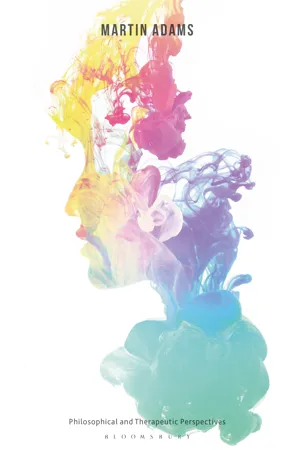
An Existential Approach to Human Development
Philosophical and Therapeutic Perspectives
- 229 pages
- English
- ePUB (mobile friendly)
- Available on iOS & Android
eBook - ePub
About this book
This textbook reviews for the first time the thinking of six major existential philosophers; Søren Kierkegaard, Friedrich Nietzsche, Martin Heidegger, Jean-Paul Sartre, Maurice Merleau-Ponty, and Simone de Beauvoir with respect to their ideas about human development. Martin Adams presents a philosophical and psychological analysis, and critically evaluates the different ways that existential philosophy can illuminate the way we all strive for meaning and purpose in life. Written in a detailed, well-structured manner, this text offers a fundamentally different way to understand not only life in general but the practice of psychotherapy in particular.
Information
1
A Short History of Human Development
The questions addressed by human development are the questions that human beings have asked themselves ever since they were able to reflect on their existence. They are,
Who am I?
How shall I live?
What happens after I die?
The way an individual responds to these questions goes towards answering the overarching question, What is the story of my life?
All the world’s cultures and religions have stories, we could call them myths, about how humans came to be, what their life task is and what happens after death.
It is worth considering here what is meant by myth. Armstrong (2006) notes that myths are ways of making existence comprehensible and meaningful in human terms and that they can be thought of as overdetermined, or thick narratives, which explain the fundamental dilemmas of life.
They are ways of thinking about experiences that cannot easily or perhaps ever be put into language. They are not meant to be objectively true, but rather have a temporary sense of truth that resonates with experience. Their purpose is to make life seem coherent and understandable. They are living stories, readers’ stories, and in this sense they are forms of theory in the sense that they fulfil the three criteria that a theory needs to have: to make sense of the past, to inform present understanding and to have some predictive power. They are about what really matters to all human beings; they are about issues of birth, life and death. Myths, as ways of making sense of experience, have narrative truth; history on the other hand aspires to having objective scientific truth.
Since myths are products of constant human interpretation it would be more accurate to refer to them not with the familiar noun, i.e. ‘myth’, since this gives them a status that does match their true nature, but with the more unfamiliar verb, ‘to myth’, since this emphasises not only the human action involved in making sense of life but also that they can change. Myths are not things separate from us that we have; they are stories we make up that help us to live with meaning and purpose. They are parts of our autobiography. In an analogous way, life, and self, can be changed into ‘living’, which is familiar, and ‘selving’ which is not. We make myths that try to answer our existential questions about the dilemmas and paradoxes of life.
Human development in mythology
The earliest known surviving written story is the Assyrian epic of Gilgamesh, written and recorded anonymously and in poetic form by different authors about 4,000 years ago. In examining the human desire for eternal life of some sort, it is about one person’s path through life to wisdom. It charts how in our struggle against the inevitability of death and the desire to leave something behind us, we come to be formed by our choices and values as much as our successes and failures.
That there are so many variations on the Greek myths is testament to the idea that myths are used to understand experience and each one was an alternative understanding. The Greek myths used a metaphorical language that all Greeks were familiar with and all eras, our own included, produce stories cast in the preoccupations of the time and place.
One of the greatest writers of the Roman period, Ovid, wrote and recorded stories about the intensity, passion and ambiguity of love and the capriciousness of the gods of chance, and his timeless stories about the continuity of change have been a source of inspiration for writers through the ages from Shakespeare to Bob Dylan.
It seems to be a human tendency to anthropomorphise both the givens of existence and also the human qualities. The ancient Greeks had many different myths about the beginning of the world and by extension the beginning of each individual person’s world, and the Gods who were immortal, embodied these. One such myth is that at the dawn of creation. Out of Chaos, the formless void, came Gaia, earth; Tartarus, the space under the earth; and Eros, desire.
In another, Chronos, individual time, age, became distinguished from Aion, eternal time. The latter is usually translated into aeon, and taken to refer to a very long time, when being eternal, it is unmeasurable. Only age can be measured; eternal time cannot be measured. The cyclical nature of eternal time – creation and destruction, birth and death – is represented in many cultures as well as the ancient Greeks by the ouroboros, a serpent eating its own tail.
Another way the life cycle is represented in Greek mythology is in the myth of the Moirai. The Romans knew them as the Parcae. The Moirai – the three Fates, Clotho, Lachesis and Atropos – were above both the gods and men, and controlled the life of every mortal. Using the then familiar metaphor of spinning, Clotho was called upon in the ninth month of pregnancy to give a skein of wool to Lachesis who spun and measured the length of the thread of life – the length of each person’s life – and when their time was up Atropos chose the manner of each person’s death and she cut their thread of life with her shears. A more contemporary version of Atropos is the Grim Reaper.
Another representation of the life cycle is the better known Oedipus myth, and it is represented by the riddle that the Sphinx, who terrorises Thebes, poses to Oedipus, a man who is trying to find out his origins and what his purpose in life is. The riddle is, ‘What being, with only one voice, has sometimes two feet, sometimes three, sometimes four, and is weakest when it has the most?’ (Graves 1960: 10)
As we know, the answer that Oedipus gets, fresh from murdering the person he later discovers is his father Laius, is mankind and the Sphinx, who represents the arresting of development and therefore of time, dies as a result of its riddle being solved and Oedipus is feted as the saviour of Thebes. The plot, as told by Sophocles (1947), who lived to be ninety years old, does not mention the riddle or the solution, and unfolds in a series of flashbacks, which is just the way insight occurs: after the event, in hindsight. As Kierkegaard said, life is lived forwards but understood backwards.
While there were powers over which even the Gods had no influence, we should not get the idea that Oedipus’ fate was unavoidable once it had been announced by the oracle at Delphi; this would destroy his tragic dignity as a person who brought his misfortune upon himself by his human frailty. His is the familiar story of a good person coming to a bad end by an error of judgement. Oedipus might have said, as most of us have said at one time or another, it seemed like a good idea at the time. The omni-presence of tragedy tests our faith, and this is a tension that is with us throughout life.
In Oedipus’ case, his demand for and subsequent acquisition of knowledge about his past gave him both power and an enormous responsibility. The tragic and universal element of the story is that the idea of the future can only be grasped by an understanding of our connectedness to the past. When Nietzsche writes in The Birth of Tragedy (1993) about life being tragic he means it in the sense that life is perpetually poised between form and order on the one hand, and formlessness and chaos on the other. Life is tragic because it is about persevering against the forces of formlessness in the full knowledge that we will sooner or later return to formlessness.
The medieval period
The Middle Ages in Europe was a time when numerical systems were used to bring order to many different areas of human understanding. One was Gothic architecture. Another was human development and there were many different schemes that divided life into three, four, five, six, seven, ten or twelve parts or phases, both linear and circular, of varying sophistication and complexity, but their portrayal all followed the same pattern (Sears 1986). Because verbal literacy was not widespread and printing did not emerge until the late medieval period the schemes were invariably represented visually. Art and sculpture were the mass media of the day. All the schemes covered the time from birth and infancy to decline and death, and each age was represented by the figure of a man, rarely a woman, who revealed his ‘age’ through his physical appearance and actions, illustrated by the symbolism of the time. This visual language would have been understood by all who saw them. Many of the schemes were a combination of a number of different cultural influences and Christianity was only one of these influences. Although post-dating the medieval era, Nicholas Poussin’s (1636) painting A Dance to the Music of Time is one such. It is also the inspiration for Anthony Powell’s sequence of novels of the same name.
Although best known for The Divine Comedy, one such system is referred to by Dante Alighieri (1265–1321). In the Convivio (1308) he talks about the life cycle in the language of Hippocrates: the four humours, and also the metaphor of the cycle of the year representing a single life. The life cycle is spilt into four parts; the seasons, up to age seventy. In this he borrowed from Psalm 90: 10. The first period (0–25) he calls adolescence, and it corresponds to spring and is hot and moist. The next (25–45) is adulthood. This is maturity and corresponds to summer and is hot and dry. This is followed by old age (45–70), which corresponds to autumn and is cold and dry. The final period is senility (70–death) and corresponds to winter and is cold and wet. Dante’s final part is what we now call the third and fourth ages (Laslett 1989; Higgs and Gilliard 2015). The peak age for Dante then is the middle of maturity, about thirty-five, which incidentally is also the age when the main character in The Divine Comedy, also called Dante, enters his own crisis of meaning, wondering what the story of his life will turn out to be. It is ultimately from Dante that we get the contemporary idea of the mid-life crisis. Significantly he also describes a period of eight months prior to these four, which corresponds to gestation in the womb. Something also interesting about this is his idea of the length of the life cycle, about eighty years. He arrived at this for two reasons: firstly, it was that it was the age Plato was alleged to have died at, and secondly, it was the age that Christ would have lived to had he not been crucified. It is a contemporary misconception that it is only recently that people have lived into and beyond the seventh decade (Thane 2005). The average longevity in previous eras may well have been much lower than now but this was primarily because of high infant mortality. People were more familiar with death; it happened to all ages, not just the old. That it was not that unusual that people lived into old age is shown by the painting and literature of the time. Perhaps it is the nature of the people of every era to rewrite history with themselves as special and different and in some way not just more than everything that came before but also the most that could ever be.
The idea of a post-infancy childhood is also relatively recent. For example, until the end of biological dependence in the medieval period, people were distinguished only by their physical ability to work. At age seven a boy was expected to look after the village geese, at eight the pigs, and at nine he helped with the oxen, and so on (Hagen 2001: 24). Ariès (1962) agrees that children were given no special attention, affection or care by older members of the family or community.
Shakespeare
Shakespeare (1564–1616) makes a number of references to the life cycle but he is best known for his often quoted Seven Ages of Man from As You Like It. While to contemporary readers these ages may have some resonance even from 500 or so years away, it is important to contextualise this classification for it gives a particular spin to the life cycle. This is emphasised by the start of Jacques’ speech which is,
All the world’s a stage,
And all the men and women merely players;
They have their exits and their entrances,
And one man in his time plays many parts, (2: VII)
This suggests determinism and that ‘the script of our lives has been written and the parts are all fixed’ (Neiman 2014: 212). While the ideas would certainly have been current, we must be careful not to see the speech as Shakespeare’s own view, or as fact, or as representing mainstream sixteenth-century English thinking about human development. This is because the speech is spoken by Jacques whose description of his own melancholy throughout the play is so extreme that no one else takes him seriously. An alternative view is put earlier on in the play by the older servant Adam, who describes his own ageing as, ‘a lusty winter, Frosty, but kindly’ (2: III) and this provides a counterbalance to Jacques’ view of ageing as ‘second childishness and mere oblivion, Sans teeth/ sans eyes, sans taste, sans everything.’
Whereas Jacques is speaking from the position of relative youth not knowing how to use the time remaining to him, and anxious about his own death, Adam is speaking from other end of life and of knowing how to use time well. Nevertheless Jacques’ view often matches how the life cycle is represented in our current era. It is certainly a way to make sense of the inevitability of ageing, but not the only way, as is shown by some of Shakespeare’s other older characters like Falstaff, Lear, Prospero and Shylock. Shakespeare wanted us to ask questions, not to give us answers. He wrote for readers.
Slightly prior to but known to Shakespeare and anticipating the Enlightenment was the philosopher Michel de Montaigne (1533–1592). In his essay Of the Education of Children (1580), he notes both the importance and the difficulty of educating children. In words that contemporary policy makers could do well to acknowledge, he said that ‘we often take very great pains, and consume a good part of our time in training up children to things, for which, by their natural constitution, they are totally unfit’.
And turning the tables on the question of who is teaching whom, he says, anticipating Kierkegaard, that ‘They begin to teach us to live when we have almost done living.’
The Enlightenment
What became known as the Enlightenment was a philosophical movement that dominated Europe in the eighteenth century with different national emphases. For example, in France it became associated with individual liberty, scientific empiricism and with the questioning of religious authority. One of the Enlightenment philosopher Jean-Jacques Rousseau’s best-known works is Emile, or On Education (1979) and in it he considered the physical, emotional and social development of the child for perhaps the first time in European history and in direct contrast to the prevailing orthodoxy; it was not popular with the French government of the day, who had it burnt.
Rousseau split what we now call the period between birth and early adulthood into five ‘Ages’. The first (0–12) was the Age of Nature, and emphasised the value of the development of the physical senses and free play. The second (12–15) was the Age of Reason and was characterised by the disciplined application of physical abilities gained earlier. The third (15–20) was the Age of Force, Energy and Vitality of Life and was when formal, but child-centred education should begin and sexuality be discovered. The fourth (20–25) was the Age of Wisdom in which the person began to understand the meaning of complex human emotions, relationships and citizenship. The fifth (25–death) was the Age of Maturity and would follow on naturally if the needs of the previous four Ages were addressed.
William Blake came from a tradition of radical dissent and had a complex relationship with the Enlightenment but he shared Rousseau’s view of childhood. Whereas children were previously thought about as deficient adults who needed to be taught the ways of the world, Blake repositioned the child as openness and innocence and constrained by adulthood and adult institutions.
Although the Enlightenment marked a change in attitude that acknowledged the existence of children and childhood, for example in the establishment of Foundling Hospitals in eighteenth-century Europe, and in Wordsworth’s 1807 poem that contained the line ‘The child is father of the man’ (1994: 91, l.7) change was gradual and it was not until 1870 that the UK Education Act brought in compulsory education for children between five and ten.
Modernism
In the nineteenth century, science, and its application in technology and industrialisation, was seen as offering a brighter futur...
Table of contents
- Cover
- Title Page
- Copyright
- Dedication
- Preface
- Contents
- Acknowledgements
- Introduction
- Part I
- Part II
- Part III
- Conclusion
- References
- Index
Trusted by 375,005 students
Access to over 1.5 million titles for a fair monthly price.
Study more efficiently using our study tools.
Frequently asked questions
Yes, you can cancel anytime from the Subscription tab in your account settings on the Perlego website. Your subscription will stay active until the end of your current billing period. Learn how to cancel your subscription
No, books cannot be downloaded as external files, such as PDFs, for use outside of Perlego. However, you can download books within the Perlego app for offline reading on mobile or tablet. Learn how to download books offline
Perlego offers two plans: Essential and Complete
- Essential is ideal for learners and professionals who enjoy exploring a wide range of subjects. Access the Essential Library with 800,000+ trusted titles and best-sellers across business, personal growth, and the humanities. Includes unlimited reading time and Standard Read Aloud voice.
- Complete: Perfect for advanced learners and researchers needing full, unrestricted access. Unlock 1.5M+ books across hundreds of subjects, including academic and specialized titles. The Complete Plan also includes advanced features like Premium Read Aloud and Research Assistant.
We are an online textbook subscription service, where you can get access to an entire online library for less than the price of a single book per month. With over 1.5 million books across 990+ topics, we’ve got you covered! Learn about our mission
Look out for the read-aloud symbol on your next book to see if you can listen to it. The read-aloud tool reads text aloud for you, highlighting the text as it is being read. You can pause it, speed it up and slow it down. Learn more about Read Aloud
Yes! You can use the Perlego app on both iOS and Android devices to read anytime, anywhere — even offline. Perfect for commutes or when you’re on the go.
Please note we cannot support devices running on iOS 13 and Android 7 or earlier. Learn more about using the app
Please note we cannot support devices running on iOS 13 and Android 7 or earlier. Learn more about using the app
Yes, you can access An Existential Approach to Human Development by Martin Adams in PDF and/or ePUB format, as well as other popular books in Psychology & Psychotherapy. We have over 1.5 million books available in our catalogue for you to explore.