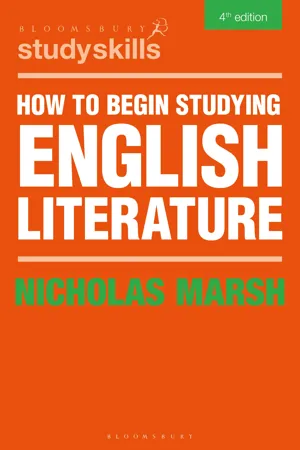
How to Begin Studying English Literature has established itself as one of the most successful and popular introductory student guides in the field. This fourth edition has been fully revised and expanded throughout, and now includes more examples and commentary on texts as well as a third essay-writing chapter, tackling critics and context. This book shows the reader how to approach novels, plays and poems, featuring chapters on themes, characters, structure, style, irony and analysis. In addition, sections on revision, exams and further development of study skills make this book an invaluable companion for anyone beginning to study English literature.
- 184 pages
- English
- ePUB (mobile friendly)
- Available on iOS & Android
eBook - ePub
How to Begin Studying English Literature
About this book
Information
Chapter 1
Finding a theme
Making a start
THE first problem every student of literature faces is a feeling of blankness. I have read the text, now I am supposed to study it: how do I start? Teachers and critics sometimes make this stage more difficult by pretending that literature is a special subject which only experts can understand. Nothing could be more misleading. Great writers and poets write because they want to communicate with ordinary readers like you and me: they do not write for experts. They are not writing on a specialised subject, either. Literature is about the same things you and I are concerned with: life and living. Be confident, therefore. Every student finds the first step in studying literature difficult, but there is nothing mysterious or specialised about it. The difficulty you face at the beginning is simply one of choosing what to focus on out of the rich mass of details, characters, events and so on, which you have met in reading the text. You are faced with the intricate complexity of a literary work: as soon as you can decide what to study first, and where to start, you can make a start.
What will obviously help you is if you have a method which tells you how and where to start. The method I will be explaining in this book can be applied to any of the texts you have to study, whether they are novels, plays or poems. I shall be showing how you can think about the text, and go on to study important passages, so your understanding develops fruitfully and is supported by the detailed analysis you need when you come to write essays or examinations. The way to overcome the first difficulty is really quite straightforward: you can make a start by finding a theme.
What is a theme?
A theme is simply this: a subject which interests the writer, and which is discussed in the text or portrayed in it in some way. Finding a ‘subject’ in a book may sound difficult, but when you know the kind of subject you are looking for you will see that it is quite easy. A theme is not a summary of the story: that is not what the text is ‘about’; nor is it a special subject you have to search for. Literature is about ordinary life, so the big themes in literature are the important subjects and experiences of our public and private lives: they are the ordinary and common words in our everyday thoughts and conversations, like love, death, marriage, freedom, hope, despair, power, war, revenge, evil, and so on. This list of the big common experiences of life could go on and on, because anything which is a subject in life can become a theme in literature. The first thing you can say about a text is that it is about one of these common subjects, so the first thing you say is startlingly simple. You might think it even too obvious, but it is a very important step forward because you have left the feeling of blankness behind: you simply say ‘There is a lot in it about love’, or ‘It is about hope and despair’. Then you have made a start.
There is one more point to make about themes. They are big ordinary subjects, but they are complex. The texts you study focus on the problems people face, their contradictory feelings, and the complex moral and social entanglements which confront people and make our experience of living so complex. So the big ideas in a text are not simple opinions: they are full of complexity like our experience of life itself.
Choosing a passage to study
The writer weaves his themes into every aspect of the life of the text. Because these major concerns are portrayed throughout the text, you still have the problem of choosing a part to look at more closely. What is more, the part you choose must be short enough for you to think about without confusion; at the same time, it must be important enough to reveal something significant about the text when you study it. How can you be sure of choosing an important passage, which will be really revealing to study? The answer is to look for a crisis in the text. A crisis is a place where there is a sudden event like a murder or a wedding or a confession or a quarrel or a battle. In a crisis there is sudden action or change. It shakes up the life of the text, so the feelings, ideas and important issues are thrown into particularly sharp relief. In a crisis, then, the big issues are portrayed most openly and forcefully, so choosing a crisis to study will tell you a lot about the text as a whole.
It is worth pausing at this stage to gain a clearer idea of how the crises in life and literature happen. All the big labels we use for themes or feelings stand for complex experiences: they are made up of many different elements. For example, the big label ‘love’ may stand for a mixture of feelings including admiration, lust, or even fear or hatred. These different feelings and ideas manage to rub along together most of the time, so our lives are usually fairly calm. In a crisis, however, something puts the complex mixture under pressure, upsetting its balance and making its different elements struggle against each other in conflict. The tensions and worries which are usually kept under control are therefore brought to the surface in a crisis. In a novel, for example, a character might have feelings of love and jealousy about his wife, but they live happily together because his jealousy is under control. Suddenly he has to go away without his wife, and the pressure of separation makes his jealousy grow out of proportion. When he comes home he questions her suspiciously, they argue and he hits her. Their life will never be the same again. Notice that this character had complex jealous feelings all the time, but it was the extra pressure of being away which brought about a crisis, making his feelings lose balance and explode into sudden and revealing action.
Look for the crises in the text you have to study, then, because the crises are places where the themes and everything else about the text come out into the open. Again, however, try to make your choice logically: look for the kind of crisis that will tell you about the theme you have already found. Think about the theme and choose a crisis which is bound to be about that theme. For example, if you have found a theme of love, look for a crisis about love. What are the sudden and drastic things that happen to lovers? Look for proposals of marriage, weddings, quarrels, separations, the death of a loved one, betrayals of love. If you have found a theme of war, look for the most important or shattering things that happen in war: battles, an armistice, a character’s first experience of action, or a character being wounded or killed. Choose a theme first, then think about it so you can choose what sort of crisis is likely to bring out that big issue most directly and forcefully.
How to study
I have said quite a lot about how you can make a start in studying a text. The two main points you should grasp to see the logic of this approach are that themes are big ordinary subjects in life, and that life throws up sudden crises which are revealing. If you are still unsure how these ideas are going to work when you actually try to use them, do not worry: in the rest of this chapter I will be showing how to apply them in detailed, step-by-step examples. Before we move on to the examples, however, here is a brief summary of the three logical steps in studying that I am going to apply to the examples throughout this book.
1Think about the text
This is the step I have been describing already. When you have finished reading a text, think about it and ask yourself what common experiences it is dealing with: is it about love, war, marriage or revenge? Then choose a crisis passage from the text to look at more closely. By thinking logically and positively, use this step to help you overcome the first problem and find a way into understanding the text.
2Analyse the text
You have chosen an important short passage from the text. Now look at it closely, analysing in detail to see exactly how it portrays the theme or other aspect you are studying. In this step your ideas become more precise and detailed because you concentrate on finding the complexity of different elements which make up the major theme you are interested in. This step also gives you the kind of exact evidence you will need to support your ideas when you come to write essays.
3Relate the part you have studied to the text as a whole
Finally, work out how the part you have studied in detail fits into the work as a whole. This step should confirm that the detailed ideas you have found are an important part of the text as a whole; and because you broaden your outlook again, you develop an understanding of how the complexity of the theme lives and develops through the whole extent of the text.
All three steps are necessary. You have to make decisions about what is important at first, or you will be left in confusion asking ‘How can I start?’ You must analyse a part of the text in detail to make your ideas precise, and to make sure your arguments are sound and well-supported so your essays will stand up to an examiner’s scrutiny. You have to relate your detailed study to the whole text, or you may be stuck with only a narrow or partial understanding. Like a machine, a book will only work when all its bits and pieces are working together; so you will only fully understand the part you are concentrating on when you fit it into its place in the whole text. The three steps I have described can be used to examine every aspect of a text, and any kind of text. Indeed, the examples which make up the rest of this chapter show how to apply them to both a long, complicated novel, and a short poem.
Wuthering Heights by Emily Brontë
1Think about the text
This first example shows how to find and study a major theme in a long, complicated text. Wuthering Heights is a 400-page novel crowded with events which span two generations of two families. Here is a brief summary of the plot, so that you can imagine you have read the novel and are just starting to study it.
Mr Earnshaw, owner of Wuthering Heights, brings home and adopts a beggar-boy he found wandering the streets, and calls him Heathcliff. Mr Earnshaw’s two children, Hindley and Catherine, react very differently to the boy. Catherine becomes very close to Heathcliff and they are constant companions, while Hindley is jealous and hates the newcomer. When Mr Earnshaw dies, Hindley becomes master of Wuthering Heights and uses his new power to revenge himself on Heathcliff by separating him from Catherine and making him live as a servant. Heathcliff runs away. When he returns three years later he finds Catherine already married to the rich Edgar Linton and sets about taking his revenge on Hindley, Catherine and Edgar. First, he marries Edgar’s sister Isabella to spite Catherine. Catherine herself dies in childbirth, leaving a daughter, also called Catherine. Heathcliff continues his revenge by becoming the master of Wuthering Heights. He brings up Hareton, Hindley’s son, to be an illiterate labourer, and completes his revenge by kidnapping and blackmailing young Catherine into marrying his own sickly son Linton, thus making sure he will be master of the Lintons’ property as well. Isabella is dead, having run away from Heathcliff, Edgar Linton dies, Hindley dies, and the sickly boy Linton dies. Eventually Heathcliff also dies after being haunted for years by the ghost of the Catherine he loved but never married. At the end of the book Hareton (Hindley’s son) and young Catherine fall in love, and happiness returns to Wuthering Heights.
This is the barest outline of the story, but as you can tell it is a very complicated plot. The problem of starting to study is at its most difficult here: there are several relationships, several characters and a lot of incidents. Given such complications, how can you choose where to start in your study of the text? Remember, first of all, that you cannot explain the whole text at once. In most of the texts you study you are likely to find several main themes, but for now I only want to find one so that I can make a start. Secondly, you are studying so that you will eventually be able to write essays on the text. This means that you have to find a theme and equip yourself with some close understanding of how it is portrayed in the text, and you have to find evidence, that is, quotations and close references, which show how the theme is portrayed. However, you do not need to trace the theme through the whole text. Set your sights realistically: you cannot explain the whole text at once, so find a theme and then choose a part of the text to look at more closely.
Start by considering the story as a whole. What sort of a story is Wuthering Heights? It is not about war, or politics, or learning or travelling. It is a love story: the plot depends on marriages, relationships between men and women, jealousies and betrayals of love. I have now found a theme, because I can make a statement about Wuthering Heights: there is a lot in it about love. I have already warned you that the first move in studying might seem too obvious to be worthwhile. Remember, however, that it is a very important move because I no longer face the endless complications of the whole of the text. Now we are only dealing with one subject: love.
The next task is to find a crisis which is about love. A crisis is a place where events and feelings come together into a sudden or violent experience which changes the plot and characters. I want to find a crisis which will portray the theme of love, so I begin by thinking about love, to work out the kind of crisis I am looking for. In this case, events like the death of a lover, a wedding, a quarrel between lovers, or a separation of lovers, would all be crises likely to tell me about how love is shown in the text. If you had just finished reading Wuthering Heights, you would have a choice of several episodes which are crises about love. I have chosen a quarrel between young Catherine and Hareton, which occurs near the end of the story. I am going to look at this quarrel in detail in order to discover how Emily Brontë portrays the theme of love in this crisis. Now I have completed Step 1: I have found a theme by thinking about the story and by saying there is a lot in the text about love; and I have chosen Catherine and Hareton’s quarrel near the end as a crisis to look at in more detail.
2Analyse the text
The first task in this step is to re-read the crisis you have chosen to analyse. Here is an outline of the quarrel I have chosen to study. Catherine and Hareton quarrel in Chapter 31 over Hareton’s attempt to learn how to read. Catherine discovers that he has stolen some of her books, and she ridicules his illiteracy. She teases him until he hits her, throws the books on the fire and rushes out. In the next chapter Hareton is sulking, and Catherine wants to be friends with him. She tries to charm him into speaking to her and talks to the servant Nellie about how she wants to be friends with Hareton. Eventually she kisses Hareton when he does not expect it, makes a parcel of some books as a present for him, and promises to teach him how to read. Catherine g...
Table of contents
- Cover
- HalfTitle
- Title Page
- Copyright
- Contents
- General editors’ preface
- 1 Finding a theme
- 2 Looking at characters
- 3 Structure and setting
- 4 Style and imagery
- 5 Irony
- 6 Writing an essay I: Answering the question
- 7 Writing an essay II: How to write paragraphs
- 8 Writing an essay III: The critics and the context
- 9 Exam revision and practice
- 10 Taking study further
- How to study a text: A quick reference guide
- Further reading
- Index
Trusted by 375,005 students
Access to over 1.5 million titles for a fair monthly price.
Study more efficiently using our study tools.
Frequently asked questions
Yes, you can cancel anytime from the Subscription tab in your account settings on the Perlego website. Your subscription will stay active until the end of your current billing period. Learn how to cancel your subscription
No, books cannot be downloaded as external files, such as PDFs, for use outside of Perlego. However, you can download books within the Perlego app for offline reading on mobile or tablet. Learn how to download books offline
Perlego offers two plans: Essential and Complete
- Essential is ideal for learners and professionals who enjoy exploring a wide range of subjects. Access the Essential Library with 800,000+ trusted titles and best-sellers across business, personal growth, and the humanities. Includes unlimited reading time and Standard Read Aloud voice.
- Complete: Perfect for advanced learners and researchers needing full, unrestricted access. Unlock 1.5M+ books across hundreds of subjects, including academic and specialized titles. The Complete Plan also includes advanced features like Premium Read Aloud and Research Assistant.
We are an online textbook subscription service, where you can get access to an entire online library for less than the price of a single book per month. With over 1.5 million books across 990+ topics, we’ve got you covered! Learn about our mission
Look out for the read-aloud symbol on your next book to see if you can listen to it. The read-aloud tool reads text aloud for you, highlighting the text as it is being read. You can pause it, speed it up and slow it down. Learn more about Read Aloud
Yes! You can use the Perlego app on both iOS and Android devices to read anytime, anywhere — even offline. Perfect for commutes or when you’re on the go.
Please note we cannot support devices running on iOS 13 and Android 7 or earlier. Learn more about using the app
Please note we cannot support devices running on iOS 13 and Android 7 or earlier. Learn more about using the app
Yes, you can access How to Begin Studying English Literature by Nicholas Marsh in PDF and/or ePUB format, as well as other popular books in Study Aids & Study Guides. We have over 1.5 million books available in our catalogue for you to explore.