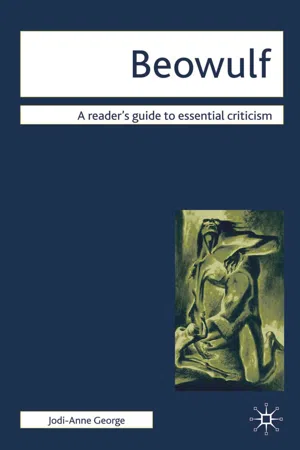
Of unknown authorship, Beowulf is an Old English epic poem which incites contentious debate and has been endlessly interpreted over the centuries. This Reader's Guide provides a much-needed overview of the large body of Beowulf criticism, moving from 18th century reactions to 21st century responses. Jodi-Ann George: - Charts the changes in critical trends and theoretical approaches applied to the poem. - Includes discussion of J. R. R. Tolkein's pioneering 1936 lecture on Beowulf , and Seamus Heaney's recent translation. - Analyses Beowulf in popular culture, addressing the poem's life in film versions, graphic novels, music and comics.
Clear and engaging, this is an indispensable introductory guide to a widely-studied and enigmatic work which continues to fascinate readers everywhere.
Poetry has been always classed among the most interesting productions of the human mind; and few topics of human research are more curious than the history of this elegant art, from its rude beginning to that degree of excellence to which it has long been raised by our ingenious countrymen.1
Signe M. Carlson, in ‘The Monsters of Beowulf: Creations of Literary Scholars’ (1967), rather mischievously quipped that ‘Since the Beowulf poet is the earliest acknowledged scholar connected with the poem, we should review his work first.’2 As we have seen in the introduction to this guide, however, there are no concrete facts about the Beowulf poet and, as such, little can be said about the possible overall corpus of his work. Readers, therefore, must be content to assign the ‘rude beginning’ of Beowulf scholarship to the year 1705 (though some have argued for 1815 as the year in which the poem was rescued from obscurity).
JOHN EARLE
The significance of 1705 to the history of the reception of the Anglo-Saxon epic was identified in the nineteenth century, for example by John Earle in The Deeds of Beowulf: An English Epic of the Eighth Century Done Into Modern Prose (1892). Douglas D. Short, in Beowulf Scholarship: An Annotated Bibliography (1980), describes this volume as including ‘an introduction which features a detailed history of previous scholarship, a summary of the poem, and [Earle’s] own interpretation; Beowulf is a political allegory written in the last quarter of the eighth century for the benefit of Ecgferth, son of Offa [King of Mercia from 757–796].’3 As stated above, Earle’s summary of previous Beowulf scholarship included remarks concerning the poem’s re-emergence into the public consciousness (albeit of a fairly rarefied group) after years of obscurity; Earle discusses the significance in this process of the librarian and antiquary Humphrey Wanley (1672–1726):
The existence of this poem [Beowulf] was unknown to the learned world until the year 1705, when it was for the first time noticed in Wanley’s Catalogue of Anglo-Saxon Manuscripts. It is a good illustration of the wide differences between the poetry and the prose of our early period, that Wanley, who was able to give a very good account of a prose manuscript, was quite at a loss when examining the Beowulf [sic] [...] [H]e was very wide of the mark in supposing it to be a description of wars between Denmark and Sweden. It is the more to be deplored that his discovery should have been so imperfect, and his description so uninviting, as the Manuscript was at that time still entire, and so continued to be for twenty-six years after the appearance of Wanley’s Catalogue. During this period a complete copy might have been taken, had Wanley’s notice afforded any hint of the importance of the poem.4
In the midst of his account of Humphrey Wanley’s central role in the very earliest studies of Beowulf, Earle alerts us to a serious error contained in the Catalogue: it states that the poem was essentially ‘a description of wars between Denmark and Sweden’. This does not say much for Wanley’s ability to read Anglo-Saxon, though, in all fairness, not many people in the eighteenth century understood the language. Careful readers may also have noticed that Earle refers to ‘the Beowulf’ (my italics). This was the title originally adopted for the poem, and it was in common usage until well into the twentieth century. J.R.R. Tolkien, for instance, in his ‘Beowulf: The Monsters and the Critics’ of 1936 (see Chapter Three of this guide for a detailed discussion of this groundbreaking essay), makes implicit mention of this fact. For his own part, Tolkien referred to the epic simply as Beowulf and by so doing contributed to the emerging trend to drop the extraneous ‘the’. Earle also alludes to something perhaps even more significant to Beowulf scholars, however, when he states that ‘It is the more to be deplored that his discovery should have been so imperfect, and his description so uninviting, as the Manuscript was at that time still entire, and so continued to be for twenty-six years after the appearance of Wanley’s Catalogue.’5 What Earle is making reference to here is, of course, the fire of 1731 which partially damaged the unique copy of the poem and other texts collated within the same manuscript (see the introduction to this guide for a detailed discussion of the history of the Beowulf manuscript). To make matters worse, as Earle makes clear, no transcription of Beowulf in its entirety was made before this disaster struck.
GRÍMUR JÓNSSON THORKELIN
As stated above, 1815 marked another significant beginning in the study of Beowulf. In that year, Grímur Jónsson Thorkelin published the first edition of the poem (for a fuller discussion of Thorkelin and the Beowulf manuscript, see the introduction to this guide). Several years previously, in 1787, Thorkelin had commissioned a transcript of Beowulf. At a later date, he also transcribed the manuscript himself. On the basis of this edition Beowulf became much more widely known, especially as Thorkelin’s text was written about by English and foreign reviewers alike. As time went on, however, the 1815 edition was predictably eclipsed by the work of other scholars in the field. Illustrative of its decline in popularity is Earle’s remark of 1892 that ‘it is enough now for us to say that in the present state of our knowledge, this first edition is chiefly valuable as a historical monument and a literary curiosity.’6
In the introduction to his edition, Thorkelin advances some theories about Beowulf that have long since been discredited; one such assertion is that the original author and audience of the poem were Danish. The propagandistic nature of this assertion seems clear in the light of Frank Cooley’s observations in his article ‘Early Danish Criticism of Beowulf’ (1940):
As a result, then, of a growing interest in the national past and of the desire to examine a piece of literature [Beowulf] which seemed to offer unique information about that past, Thorkelin, aided by the Danish government, came to England in 1785 for the express purpose of seeking out documents that would cast light on the history of Denmark.7
Turning to Earle again, we get a useful summary of Thorkelin’s nationalistic argument:
According to the theory which he [Thorkelin] had formed in the course of his labours, this poem [Beowulf] was supposed to be a translation from a Danish original which had been written by an author contemporary with his heroes and personally acquainted with them; and he thought this Anglo-Saxon translation might have been executed by or at the command of King Alfred.8
Other scholars, largely Scandinavian, weighed in to support Thorkelin. Indeed, questions of Beowulf’s authorship and provenance loomed large and became tied to a broadly nationalist agenda. P.E. Müller, for example, whilst refuting the theory of Danish authorship in his review of Thorkelin, speculated that Beowulf might very well have been of Icelandic origin. And, not surprisingly under the circumstances, many English scholars believed the poem to have English roots.
STOPFORD A. BROOKE
Perhaps the most lyrical defence of this view was voiced by Stopford A. Brooke (1832–1916) in his The History of Early English Literature, being the History of English Poetry from its Beginnings to the Accession of King Ælfred (1892):
The last thing to say with ...
Table of contents
Cover
Title
Copyright
Contents
Acknowledgements
A Note about Dates
Introduction: Hwæt!
Chapter One: ‘Rude Beginning’: 1705–1899
Chapter Two: ‘Conflicting Babel’: 1900–1931
Chapter Three: The Monsters Meet the Critics: the 1930s and 1940s
Chapter Four: The Debates Continue: the 1950s and 1960s
Chapter Five: Stock-taking: the 1970s
Chapter Six: Critics on the Crest of a Wave: the 1980s
Chapter Seven: An Embarrassment of Critical Riches: the 1990s to the present
Chapter Eight: Beowulf in Popular Culture
Conclusion
Notes
Select Bibliography
Index
Trusted by 375,005 students
Access to over 1.5 million titles for a fair monthly price.
Study more efficiently using our study tools.
Frequently asked questions
Yes, you can cancel anytime from the Subscription tab in your account settings on the Perlego website. Your subscription will stay active until the end of your current billing period. Learn how to cancel your subscription
No, books cannot be downloaded as external files, such as PDFs, for use outside of Perlego. However, you can download books within the Perlego app for offline reading on mobile or tablet. Learn how to download books offline
Perlego offers two plans: Essential and Complete
Essential is ideal for learners and professionals who enjoy exploring a wide range of subjects. Access the Essential Library with 800,000+ trusted titles and best-sellers across business, personal growth, and the humanities. Includes unlimited reading time and Standard Read Aloud voice.
Complete: Perfect for advanced learners and researchers needing full, unrestricted access. Unlock 1.5M+ books across hundreds of subjects, including academic and specialized titles. The Complete Plan also includes advanced features like Premium Read Aloud and Research Assistant.
Both plans are available with monthly, semester, or annual billing cycles.
We are an online textbook subscription service, where you can get access to an entire online library for less than the price of a single book per month. With over 1.5 million books across 990+ topics, we’ve got you covered! Learn about our mission
Look out for the read-aloud symbol on your next book to see if you can listen to it. The read-aloud tool reads text aloud for you, highlighting the text as it is being read. You can pause it, speed it up and slow it down. Learn more about Read Aloud
Yes! You can use the Perlego app on both iOS and Android devices to read anytime, anywhere — even offline. Perfect for commutes or when you’re on the go. Please note we cannot support devices running on iOS 13 and Android 7 or earlier. Learn more about using the app
Yes, you can access Beowulf by Jodi-Anne George in PDF and/or ePUB format, as well as other popular books in Literature & Medieval & Early Modern Literary Criticism. We have over 1.5 million books available in our catalogue for you to explore.