Offering a student-friendly introduction to quantitative methods, this text covers all of the need to know basics in a clear and engaging manner. Quantitative Methods is an ideal text for students of all levels coming to the subject for first time.
- 252 pages
- English
- ePUB (mobile friendly)
- Available on iOS & Android
eBook - ePub
Quantitative Methods
About this book
Information
1
COLLECTING DATA:
SURVEYS AND SAMPLES
SURVEYS AND SAMPLES
OBJECTIVES
• To understand the difference between a sampling frame, a sample and a population
• To understand the difference between probabilistic and non-probabilistic sampling
• To know how to select the correct sampling method in different situations
• To understand how to design a questionnaire
INTRODUCTION
Many decisions made by business and by the government are the result of information obtained from sample data, as it is often too costly or impractical to collect data for the whole population.
Data may already exist or it may need to be collected. When we have to collect our own data we call it primary data. When it already exists, as in government statistics, we call it secondary data. The collection of data can take many forms, but in this chapter we will concentrate on data that is collected by carrying out surveys. During the UK General Election in 2010 many surveys were undertaken by market research companies. The purpose of these surveys was not just to try and understand how people might vote but also to look at attitudes to issues and leaders, for example. Most of these surveys would have been conducted by telephone or face-to-face, although in some other less urgent surveys people are sent questionnaires by post or email or asked to complete a questionnaire online.
In the surveys undertaken during the UK General Election a lot of care would have gone into selecting a representative sample of the target population. The samples had to be representative of the gender, age profile and ethnicity of the population being surveyed as well as other attributes that might be considered to affect people’s voting intentions or views. The number of people being surveyed would also be calculated to ensure that a specified level of accuracy was obtained. A fuller discussion of accuracy issues when taking samples of data is given in Chapter 7.
As well as discussing ways of collecting samples of data this chapter also discusses questionnaire design because it is very important to ensure that the type and wording of questions is given proper attention if the analysis is to be of use.
CASE STUDY
British Social Attitudes survey
Every year NatCen Social Research (NatCen) undertakes a survey where it asks over 3000 people in Britain what it is like to live and work in the UK. It has been conducted annually since 1983 which makes it NatCen’s longest running survey. Respondents are chosen at random using the Post Office Postcode address file. The survey is conducted face to face and is partly paper based and partly by computer. The 2011 survey covered such areas as health, immigration, welfare, Scottish Independence and transport. The interviewer had to complete around an hour’s worth of questions and a small sample is given in Table 1.1 below. As well as the questions there are instructions for the interviewer. The sample size for each question is given on the far right of each question (all 3311), and the results of three questions are given as percentages at the end of this table.
Table 1.1 Sample questions from the 2011 British Social Attitudes survey
Q264 [SocSpnd1] * N=3311
CARD B2
Some people think that there should be more government spending on social security, while other people disagree. For each of the groups I read out please say whether you would like to see more or less government spending on them than now. Bear in mind that if you want more spending, this would probably mean that you would have to pay more taxes. If you want less spending, this would probably mean paying less taxes.
Firstly, ... READ OUT ...
benefits for unemployed people: would you like to see more or less government spending than now?
Q265 [SocSpnd2] *
N=3311
CARD B2 AGAIN
(Would you like to see more or less government spending than now on ...)
... benefits for disabled people who cannot work?
Q266 [SocSpnd3] *
N=3311
CARD B2 AGAIN
(Would you like to see more or less government spending than now on ...)
... benefits for parents who work on very low incomes?
Q267 [SocSpnd4] *
N=3311
CARD B2 AGAIN
(Would you like to see more or less government spending than now on ...)
... benefits for single parents?
Q268 [SocSpnd5] *
N=3311
CARD B2 AGAIN
(Would you like to see more or less government spending than now on ...)
.. benefits for retired people?
Q269 [SocSpnd6] *
N=3311
CARD B2 AGAIN
(Would you like to see more or less government spending than now on ...)
... benefits for people who care for those who are sick or disabled?
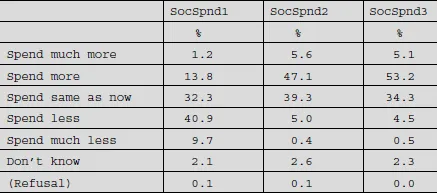
Source: NatCen Social Research’s British Social Attitudes survey
THE BASICS OF SAMPLING
A survey only collects information about a small subset of the population. The word ‘population’ can and often does refer to all the people in Britain or a town, but for statisticians it is also a general term used to refer to all groups or items being surveyed. For instance, it could refer to the viewing habits of all children in a town or, as you will see in a later chapter, it could refer to the weights of jars of coffee produced by a company during a week. The alternative to a survey is to question every member of the population, and when this is done it is called a census. Unfortunately it is expensive and very difficult to carry out a census, and also unnecessary. A survey of a small subset of the population, called a sample, can give surprisingly accurate results if carried out properly. This and other chapters will show you what factors must be taken into account to give accurate results.
It is crucial to be clear about the purpose of the survey as this will define your target population. Once you have selected your target population, you need to determine whether there is any list that would allow you to identify every me...
Table of contents
- Cover
- Title Page
- Copyright
- Contents
- List of Figures
- List of Tables
- Preface to Quantitative Methods
- Acknowledgements
- 1. Collecting Data: Surveys and Samples
- 2. Describing Data Using Tables and Charts
- 3. Describing Data Using Simple Statistics
- 4. Index Numbers
- 5. Applications of Probability
- 6. Probability Distributions
- 7. Analysis of Sample Data
- 8. Hypothesis Testing
- 9. Correlation and Regression
- 10. Investment Appraisal
- 11. Time Series Analysis
- 12. Linear Programming
- 13. Critical Path Analysis
- Appendix 1 Statistical Tables
- Bibliography
- Index
Trusted by 375,005 students
Access to over 1.5 million titles for a fair monthly price.
Study more efficiently using our study tools.
Frequently asked questions
Yes, you can cancel anytime from the Subscription tab in your account settings on the Perlego website. Your subscription will stay active until the end of your current billing period. Learn how to cancel your subscription
No, books cannot be downloaded as external files, such as PDFs, for use outside of Perlego. However, you can download books within the Perlego app for offline reading on mobile or tablet. Learn how to download books offline
Perlego offers two plans: Essential and Complete
- Essential is ideal for learners and professionals who enjoy exploring a wide range of subjects. Access the Essential Library with 800,000+ trusted titles and best-sellers across business, personal growth, and the humanities. Includes unlimited reading time and Standard Read Aloud voice.
- Complete: Perfect for advanced learners and researchers needing full, unrestricted access. Unlock 1.5M+ books across hundreds of subjects, including academic and specialized titles. The Complete Plan also includes advanced features like Premium Read Aloud and Research Assistant.
We are an online textbook subscription service, where you can get access to an entire online library for less than the price of a single book per month. With over 1.5 million books across 990+ topics, we’ve got you covered! Learn about our mission
Look out for the read-aloud symbol on your next book to see if you can listen to it. The read-aloud tool reads text aloud for you, highlighting the text as it is being read. You can pause it, speed it up and slow it down. Learn more about Read Aloud
Yes! You can use the Perlego app on both iOS and Android devices to read anytime, anywhere — even offline. Perfect for commutes or when you’re on the go.
Please note we cannot support devices running on iOS 13 and Android 7 or earlier. Learn more about using the app
Please note we cannot support devices running on iOS 13 and Android 7 or earlier. Learn more about using the app
Yes, you can access Quantitative Methods by Les Oakshott in PDF and/or ePUB format, as well as other popular books in Business & Business Mathematics. We have over 1.5 million books available in our catalogue for you to explore.