eBook - ePub
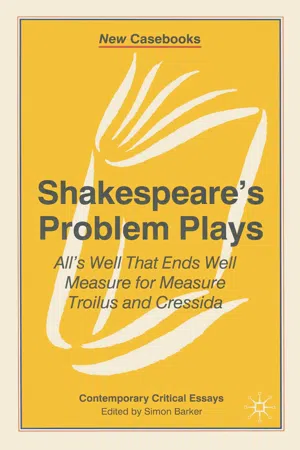
Shakespeare's Problem Plays
All's Well That Ends Well, Measure for Measure, Troilus and Cressida
- 250 pages
- English
- ePUB (mobile friendly)
- Available on iOS & Android
eBook - ePub
Shakespeare's Problem Plays
All's Well That Ends Well, Measure for Measure, Troilus and Cressida
About this book
This New Casebook offers a wide-ranging selection of contemporary critical readings of Shakespeare's three 'problem plays': All's Well that Ends Well, Measure for Measure and Trolius and Cressida. Together, they reflect the diversity of late twentieth-century theory and the controversy that continues to be generated by the plays, and discuss a variety of key issues. These include the meaning of the term 'problem play', the historical context and political and cultural significance of the plays, as well as issues of staging and theatre history. The volume also provides a helpful introduction which guides the reader through the critical approaches, terms and debates, as well as explanatory notes for each essay and a useful section on further reading.
Information
1
Shakespeare’s Problem Plays: Concepts and Perspectives
VIVIAN THOMAS
[A] number of strong connecting links have been discerned between Troilus and Cressida, All’s Well and Measure for Measure and it is worth specifying their precise nature in an attempt to evaluate the argument for grouping together these three plays as opposed to other possible combinations.
The first significant unifying feature of these plays is that we are left pondering the questions raised by the action rather than contemplating the sense of loss characteristic of tragedy or of feeling the release or joy inherent in Shakespeare’s romantic comedies. Whatever affinities these plays may share with Hamlet or Timon of Athens the feelings engendered by those plays are different and belong distinctly to the world of tragedy. Thus we are caught up with the problems which form the stuff of these plays and feel at a loss to categorise them. They are truly problem plays. The matter of genre is not merely one of wanting to pigeonhole plays out of an excessive sense of order. Rather, the nature of the contemplation provoked by these plays is such that we ponder both the social realities encompassed by them and the dramatic form in which they are embodied. Incongruity is perhaps the word that most effectively conveys the feeling of the audience: it does not really believe in the happy end and is more engaged by the concerns of character, relationships and institutions, both inside and outside the drama. As for Troilus and Cressida, bewilderment appears to have been historically the most characteristic response, and in recent times there has been a temptation to tilt the play towards tragedy in order to diminish the ambivalence of the audience which this play usually engenders.
Second, each of the three plays possesses a crucial debate scene which focuses sharply on the central themes. Moreover, the scene occurs in almost an identical position in each play. In Troilus and Cressida (II.ii) the issue is one of value, worth and honour; in All’s Well (II.iii) the critical question relates to human valuation in terms of intrinsic and extrinsic considerations; the debate in Measure for Measure (II.ii) centres on law and justice.
Third, all the plays interrogate the relationship between human behaviour and institutions. Each play is concerned with authority, hierarchy, decision-making and the consequence of these decisions for the society as a whole and for particular individuals. Who are the decision-makers (in the Trojan war)? What are the foundations for these decisions? What are the consequences? What is the nature of obligation and privilege (in the French court)? How far can the law go in controlling human behaviour (in Vienna)? What is the nature of the obligation placed on a ruler? These are merely a few of the most central questions relating to human behaviour and social institutions in the plays.
Fourth, these plays are particularly concerned with contrasts between appearance and reality. Continually an attractive exterior gives way to an unattractive interior. The great hero Achilles resorts to murder when he is incapable of defeating his enemy by fair means; Bertram has fine breeding and upbringing but behaves despicably. Parolles has an extravagant manner which covers a coward’s heart. Angelo is a most precise and unrelenting judge but descends to the lowest depths of depravity. Occasionally this aspect is emblematic: the soldier in sumptuous armour killed by Hector turns out to be diseased.
Fifth, all the plays provoke a considerable degree of detachment. This feature is most marked in Troilus and Cressida, where Pandarus and Thersites are key figures in ensuring that the audience is not afforded the luxury of identifying too closely with any of the characters. But this feature is also present in the other two plays: despite the passionate intensity created through the collision of characters, the action is placed in such a way that the issues remain clear and constantly on the surface. Irony, paradox and deflation are essential elements in maintaining the detachment of the audience. There are exemplary characters but they form part of the structure that underlines the questioning of characters like Isabella and Bertram. Moreover, scurrilous individuals like Thersites, Parolles and Lucio have an attractive side and represent features of life that make for human vitality: Thersites precludes sentimentality by constantly reminding the audience of stark realities; Parolles’ dishonesty is charmingly innocuous compared with Bertram’s vicious lying; Lucio’s scandalous tongue and disreputable behaviour must be checked, but his refusal to be put down represents a defence against the authoritarianism of Angelo – it is he, after all, who presses Isabella to persist with and reinforce her plea on Claudio’s behalf.
Sixth, Thersites, Parolles and Lucio share another characteristic which links the plays: they are not clowns or fools but denigrators. Thersites exposes the boils on the body politic with his savage insights; Lucio delights in scandalous lies and abuses his associates – particularly the woman who has borne his child; Parolles lacks the sharpness and bite of Thersites and Lucio but seeks to deceive through presenting a false appearance to the world. Interestingly, they all play a major role in the action but remain outsiders. Thersites is tolerated with amusement or contempt by his associates but his status remains the same throughout the course of the play and his presence makes the audience continually aware of the bleakest interpretation of the action. Like Thersites, both Parolles and Lucio have tongues which run away with them but ultimately it lands them in trouble which changes their status. But if Lucio is a liar and a scoundrel he presents a healthy counter-weight to Angelo’s interpretation of justice in sexual matters and he uses his energy to drive Isabella to greater exertions in an attempt to save Claudio. Moreover, while his interruptions in the last scene are irritating he represents a type which cannot be bludgeoned into subservience – a valuable antidote in any society threatened with totalitarianism. Parolles is the most innocuous of the three: he neither exposes nor commits a significant crime, unless his willingness to surrender secrets to the enemy is taken seriously. However, he does attempt to perpetuate fraud by pretending to be what he is not and it is he who experiences the greatest change of circumstances by the end of the play: he is given a new and humbler role. Parolles’ vices do not go deep, they are effectively beyond his own control and he is easily exposed for what he is. Contemplation of his character and actions inevitably produces a more severe critique of Bertram’s character and actions. Thus it is evident that there are significant differences between these characters in terms of behaviour and dramatic function, but as Northrop Frye recognises, each of them provides ‘a focus for slander and railing’.1
Seventh, a major theme in these plays is honour. The plays all invite a probing of this concept and insist on separating its various strands. Bertram inherits honour, but surprisingly the King, among others, expresses the hope that Bertram will prove worthy of his inheritance: honour derived from ancestry has to be reaffirmed by the behaviour of the recipient. Moreover, honour can be attained in different ways, but different kinds of honour are not necessarily interchangeable. The Countess insists that Bertram cannot recover the honour lost in his treatment of Helena by means of his exploits on the battlefield. Angelo has behaved in a totally dishonourable way in his treatment of Mariana, but seems oblivious of the fact when we first encounter him. His conscious abandonment of honour is rapid after his initial meeting with Isabella. Hector asserts the primacy of honour over life but simplifies the equation by failing to recognise the dependence of others on his life. Moreover, for his chief antagonist honour can be put on and off like a suit of armour depending on the circumstances. Throughout these plays honour is a central concept and theme which, however significant in other Shakespeare plays, is so intimately linked to the major themes that it binds them together.
Eighth, these plays are all peculiarly concerned with sex. At the centre of the Trojan war are two faithless women who are fought over, enjoyed and denigrated. (Of the four outstanding cases of jealousy in Shakespeare three of the women are incapable of infidelity. Only in Troilus and Cressida do we find a mad outburst of jealousy which is justified.) Diomedes provides an annihilating evaluation of Helen while Troilus has to endure the agony of watching Cressida’s betrayal. But women are both sex objects and symbols. Troilus is prepared to risk his arm to regain a tarnished love token, while the very existence of Troy is gambled through the retention of Helen. Angelo will treat a novice like a whore for sexual gratification and yet will execute a man for consummating his unofficial marriage with the woman he loves and by whom he is loved. Meanwhile sex as a commodity and a means of livelihood displays a vitality and ubiquity which is beyond the reach of the most restrictive legal system. Bertram is prepared to seduce and dishonour a woman without a blush or a moment’s remorse and then denounce her in public as a prostitute. Yet he is loved by a woman remarkable for her virtue, perception and energy. Love and lechery feature powerfully in all three plays and provoke serious questions about sexual attraction, sexual desire and repression and the extent to which institutions ought to impinge on these fundamental human drives.
Ninth, disillusionment is close to the centre of these plays and is intimately connected with love and lechery. By the end of the play Troilus is disillusioned with both love and war – as indeed are most of the major characters long before the end. The Countess and the King are bitterly disillusioned by the failure of Bertram to measure up to his father, while several of the young men are disillusioned by the incongruity between Bertram’s performance on and off the battlefield. Angelo is disillusioned about his moral rectitude: he is shocked and distressed when he discovers his vulnerability. In the latter two plays disillusionment may be dispelled by the rapid adjustment which takes place at the conclusion of the action – even so the audience may feel disillusioned that characters as worthy as Helena and Mariana can be so deeply attached to such dubious characters as Bertram and Angelo. In Troilus the sense of disillusionment is pervasive: the Greeks scent victory but they have long since relinquished their ideals. The audience is deprived of any illusions about the ability of human beings to conduct their most vital affairs in a rational manner.
Tenth, the other side of the disillusionment which the three plays exhibit, is a passionate desire to believe in total integrity: a wholeness and beauty in life which cannot be tarnished. Hector is emphatic in placing honour before life itself, and believes that the code to which he adheres is universal. His dying words express disbelief that this code can be discarded by Achilles. Helen thinks of Bertram as godlike (‘my idolatrous fancy/Must sanctify his relics’ (I.i.95–6) but has to adjust to a reality that is very different. However, she moves from image to reality without any apparent sense of disillusionment except for one poignant moment (when Bertram refuses to kiss her farewell). It is as if her integrity will be enough for both of them. The confidence of several other characters in the play, however, suffers more severely and the King is evidently disillusioned with life before he is healed by Helena – a disillusionment which is made abundantly clear by his references to the hopes, beliefs and expectations he had held when younger and surrounded by such men as Bertram’s father. Isabella yearns for the nunnery, and an austere regime, presumably to live in a world that is pure. Her encounter with Angelo forces upon her a recognition that the world outside the nunnery is far worse than she imagined. But what is the consequence for her after this initial disillusionment? She shows herself capable of an astonishing capacity for forgiveness and perhaps has developed the ability to live in an impure world. She seems as impervious to the destructive consequences of disillusionment as Helena. Arguably idealism triumphs over disillusionment in two of these plays, but that interpretation may be limited to the characters in the drama. The audience may experience a severe sense of disillusionment in all three plays while recognising the force of the aspiration for wholeness or purity in a flawed universe.
Another explicit concern of these plays is with the matter of identity and kinship. Virtually every character in Troilus and Cressida is identified in terms of kinship and several implications are suggested. Even the illegitimate Margarelon and Thersites emphasise the kinship network, and the one man who relinquishes his place in this pattern, Calchas, virtually loses his identity. Although the pattern is not as ubiquitous or persistent in the other two plays it still plays a remarkable role. All’s Well opens with comments on two dead fathers and these live on vividly in the minds of others. Helena is the adoptive child of the Countess who would gladly receive her as a daughter-inlaw. Lafew promises that the King will be a second father to Bertram, and later agrees that his own daughter be allowed to marry the prodigal son. Diana is accompanied by her mother and is advised by her. In Measure for Measure, Isabella and Julietta play at being cousins; Isabella has temporarily to leave her chosen vocation to fight for the life of her brother; Mariana initially loses Angelo because her brother is lost at sea; Lucio denies his paternity in order to avoid marriage to a whore. Angelo demands Claudio’s head but he can be satisfied with a substitute because death creates a kinship through disguising identity; Claudio’s fear of death with all its implications leads Isabella to doubt the fidelity of her mother. Mistress Overdone has run through more husbands than stockings. Thus once more a pattern that is discernible in several plays is greatly accentuated in the problem plays.
A number of critics appear to feel that there is something peculiar about the societies portrayed in these plays. It was Boas who suggested that they are ‘highly artificial societies’ and that an ‘atmosphere of obscurity surrounds them’.2 What decidedly seems the case is that in each instance we enter a society which is introspective and manifests a sense of having a major problem. The Greeks and Trojans have punched themselves to a standstill and no longer seem to possess the capacity to change direction: they lack the energy and imagination to transform their situation. The disasters of the past have not illuminated their difficulties in any way but press down upon them like a dead weight. Vienna seethes with a licentiousness that is a matter of concern to the Duke but which is hardly a serious social threat in comparison with the unfeeling harshness of one of the outstanding deputies in the state. However, the feeling remains that if Angelo has been transformed there is little likelihood of transforming Vienna. All’s Well also conveys a feeling of social strain: it is an ageing society: one in which a gap has opened up between the generations and there are too few talented young people mature enough to take the place of those who have died or are about to relinquish their positions. In varying degrees the leaders in these societies recognise that they are confronted by a social problem. In the case of Troilus and Cressida the failure of both societies is manifest, but in All’s Well and Measure for Measure the audience is left with a dim awareness that these societies have not resolved their problems. Nowhere else in Shakespeare is the feeling articulated in this way. The Tempest leaves the audience doubting the ability of any state to remain invulnerable to the manoeuvres of the politically ambitious, but that remains, as it were, one of the ongoing contests or tensions intrinsic to the political process. In the problem plays something less tangible and therefore more intractable is alluded to. Paradoxically, Troilus and Cressida is less problematical in this sense: the failure of the society is apparent and this directs attention to the parallels between the world of the Trojan War and the world inhabited by the audience. This is one of the reasons why Troilus and Cressida now appears so fresh and so meaningful to a modern audience. We share the problems of the Trojans and Greeks – the possession of an advanced civilisation under severe threat, slipping inexorably beyond rational control – and are fascinated by it; we don’t quite understand the full extent and nature of the problems of Vienna and the French court because they are only partially articulated. They remain obscure.
The final unifying characteristic is the toughness of the language. Although the language of each play is very distinctive (only Troilus and Cressida is rich in imagery) these plays contain many speeches which are not merely ambiguous but have a construction which is positively awkward: the verse occasionally exhibits a strain and tension which reflect the stress of conflicting emotions within the characters who voice them. […]
The foregoing summary has provided an indication of the way in which the concept of the problem play has been perceived by some distinguished critics during the course of the past century. Definitions have varied, the plays encompassed by the term have changed and perceptions of the essential elements which go to make up the plays have differed. Nevertheless, there have been common points of reference and these have been delineated and developed during the preceding discussion. Moreover, additional parallels and comparisons have been made in order to suggest the relevance of the term problem plays when attached to Troilus and Cressida, All’s Well and Measure for Measure. The most significant of these connections will be underlined in the concluding chapter [of The Moral Universe].
What is essential, however, before proceeding to detailed discussion, is to have a clear definition of the term problem play which will provide a useful framework for the ensuing analysis. The term problem play is here used to encompass three plays which defy absorption into the traditional categories of romantic comedies, histories, tragedies and romances, but share striking affinities in terms of themes, atmosphere, tone and style. In particular, they explore fundamental problems relating to personal and social values within a framework which makes the audience acutely aware of the problems without providing amelioration through the provision of adequate answers or a dramatic mode which facilitates a satisfactory release of emotions.
From Vivian Thomas, The Moral Universe of Shakespeare’s Problem Plays (London, 1987), pp. 14–21.
Notes
[This extract is from Vivian Thomas’s full-length study The Moral Universe of Shakespeare’s Problem Plays, which was first published in 1987 but republished for a new readership in 1991. In a bold and incisive introduction Thomas sets out the unifying ...
Table of contents
- Cover
- Title Page
- Copyright
- Contents
- Acknowledgements
- General Editors’ Preface
- Introduction
- 1. Shakespeare’s Problem Plays: Concepts and Perspectives
- 2. All’s Well That Ends Well and the Tale of the Chivalric Quest
- 3. The Political Effects of Gender and Class in All’s Well That Ends Well
- 4. Subjectivity, Desire and Female Friendship in All’s Well That Ends Well
- 5. Transgression and Surveillance in Measure for Measure
- 6. London in Measure for Measure
- 7. Love’s Tyranny Inside-out in the Problem Plays: Yours, Mine, and Counter-mine
- 8. ‘Tricks We Play on the Dead’: Making History in Troilus and Cressida
- 9. Invading Bodies/Bawdy Exchanges: Disease, Desire, and Representation
- 10. Fragments of Nationalism in Troilus and Cressida
- Further Reading
- Notes on Contributors
- Index
Trusted by 375,005 students
Access to over 1.5 million titles for a fair monthly price.
Study more efficiently using our study tools.
Frequently asked questions
Yes, you can cancel anytime from the Subscription tab in your account settings on the Perlego website. Your subscription will stay active until the end of your current billing period. Learn how to cancel your subscription
No, books cannot be downloaded as external files, such as PDFs, for use outside of Perlego. However, you can download books within the Perlego app for offline reading on mobile or tablet. Learn how to download books offline
Perlego offers two plans: Essential and Complete
- Essential is ideal for learners and professionals who enjoy exploring a wide range of subjects. Access the Essential Library with 800,000+ trusted titles and best-sellers across business, personal growth, and the humanities. Includes unlimited reading time and Standard Read Aloud voice.
- Complete: Perfect for advanced learners and researchers needing full, unrestricted access. Unlock 1.5M+ books across hundreds of subjects, including academic and specialized titles. The Complete Plan also includes advanced features like Premium Read Aloud and Research Assistant.
We are an online textbook subscription service, where you can get access to an entire online library for less than the price of a single book per month. With over 1.5 million books across 990+ topics, we’ve got you covered! Learn about our mission
Look out for the read-aloud symbol on your next book to see if you can listen to it. The read-aloud tool reads text aloud for you, highlighting the text as it is being read. You can pause it, speed it up and slow it down. Learn more about Read Aloud
Yes! You can use the Perlego app on both iOS and Android devices to read anytime, anywhere — even offline. Perfect for commutes or when you’re on the go.
Please note we cannot support devices running on iOS 13 and Android 7 or earlier. Learn more about using the app
Please note we cannot support devices running on iOS 13 and Android 7 or earlier. Learn more about using the app
Yes, you can access Shakespeare's Problem Plays by Simon Barker in PDF and/or ePUB format, as well as other popular books in Literature & Modern Literary Criticism. We have over 1.5 million books available in our catalogue for you to explore.