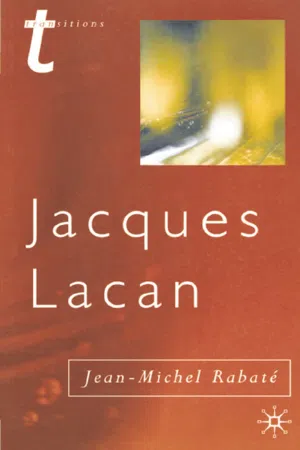
- 225 pages
- English
- ePUB (mobile friendly)
- Available on iOS & Android
eBook - ePub
About this book
The French theorist Lacan has always been called a 'literary' theoretician. Here is, for the first time, a complete study of his literary analyses and examples, with an account of the importance of literature in the building of his highly original system of thought. Rabate offers a systematic genealogy of Lacan's theory of literature, reconstructing a doctrine based upon Freudian insights, and revitalised through close readings of authors as diverse as Poe, Gide, Shakespeare, Plato, Claudel, Genet, Duras and Joyce. Not simply an essay about Lacan's influences or style, this book shows how the emergence of key terms like the 'letter' and the 'symptom' would not have been possible without innovative readings of literary texts.
Information
1 Jacques Lacan, from L to Z, or ‘Against Interpretation’
The focus of this volume is Lacan’s contribution to literary studies, or more properly, what could be called Lacan’s theory of literature. While several attempts have recently been made to produce Lacanian readings of literary texts, most of these have proved rather disappointing. Moreover no-one has yet addressed the consistency of Lacan’s approach to literature. Excellent books have been written to explain the ‘literary’ side of Lacan’s texts (for instance Malcolm Bowie’s brilliant inroads into Lacan’s Gongorism and links with Proust) but they tend to be obsessed with the difficulty of Lacan’s style. Whereas these attempts are worthwhile, and often very useful, this book takes a different approach: I believe that Lacan was not only a ‘user’ of literary examples but also a ‘reader’ of literary texts, and that an entire system of criticism – of a special type – can be found in his seminars and various ‘writings’.
Many British and American psychoanalysts who have tried to grapple with the intricacies of Lacan’s convoluted style have expressed their regret about the paucity of case studies in his texts. Indeed, apart from one striking exception – a remarkable interview with a psychiatric patient who, among other delusions, believed he was the reincarnation of Nietzsche and Antonin Artaud,1 – there exists almost nothing in English that testifies to his clinical practice (Lacan’s doctoral thesis on paranoia has yet to be translated). And it would be a mistake to think that the missing ‘Lacanian case studies’ are to be found in the many unpublished seminars: these seminars, often full of gems as they are, seem more concerned with a systematic reading of Freud’s basic texts and the development of Lacan’s own concepts than with any careful theoretical elaboration based on a few well-chosen cases. And yet, as Lacan notes at the end of the interview with the psychotic patient mentioned above, today’s symptoms look less classically Freudian than Lacanian: ‘Today we have seen a ‘Lacanian’ psychosis ... very clearly marked. With these ‘imposed speeches’, the imaginary, the symbolic and the real.’2 Before considering to these notions, I wish to note that the relative scarcity of clinical presentations and the curious discretion facing the cases he himself studied, such as the famous Aimée of his thesis, seem to be offset by an almost equivalent increase in literary analyses, as if the lack of case histories was compensated by a wealth of literary and cultural exegeses. Could it be that literature has taken – in the published works – the place of the stricter, more scientific if not always quite verifiable field of clinical studies?
In fact, Lacan’s whole effort is aimed at undermining the naiveté of the above question. Not only does he show how much Freud and other practitioners rely on literary effects in many case studies, with all the subsequent narratological problems they entail, but he also follows Freud in the suggestion that there is not opposition but complementarity between the literary domain and ‘real cases’. Like Freud, who found in a famous play by Sophocles the doomed hero whose fate could explain a vast array of phenomena, Lacan goes to Joyce’s works to discover a new way of understanding the symptom; in Hamlet he gains an insight into the way in which a man’s desire can remain determined by the wish to solve the riddle of his mother’s desire; and in Antigone he finds a surprising reversal between ethics and aesthetics that provides him with a motto, a tragic vision and radically new formulations of human desire.
This volume will thus attempt to explain systematically what Lacan has brought to our understanding of literature – poetry, plays and novels – while highlighting the crucial concepts that are brought to bear on fundamental issues in literary texts, of their ‘literariness’, such as the ‘letter’, the ‘symptom’ and jouissance. I use the word ‘understanding’ deliberately, since Lacan does not particularly privilege individual literary texts, and moves effortlessly in his seminars from Dante to Frege, Plato to Gide. He reads them in order to understand something of human nature, which may sound grandiose but it should not be forgotten that his approach is founded on what he constantly calls an ‘experience’ – the experience of psychoanalysis. What does this consist of? Basically it consists of two persons interacting through language only, engaged as they are in a certain pact (one pays and speaks, the other listens and often remains silent) aiming at the resolution of certain personal difficulties or the transformation of certain inhibitory situations. This experience is an experience of language as living speech, a fundamental factor Lacan always puts to the fore. But it is also an experience of ‘writing’ or of ‘reading’ of some kind – not only because Lacan’s practice is based on a fresh rereading of Freud’s texts, not simply because the analysand’s symptoms are organised like a written text, themes to which I shall return, but because the ‘experience’ of psychoanalysis introduces the two agents into a very complex enmeshing of speech and writing. Lacan’s main tenet is that literature provides uniquely significant models that allow both the psychoanalyst and the patient to understand new configurations in dreams, symptoms, parapraxes.
This is why Lacan’s lifelong confrontation with literature has always hinged on basic and almost naive questions, such as why do we write? Why do we read? What touches us in this apparently simple process? Why do we enjoy reading certain texts and hate other texts? What is the psychic economy implied by these acts? Where and how are our bodies touched by the ‘letters’ of literature? One consequence of these fundamental questions is that they imply a radical critique of everything that has been produced under the name of applied psychoanalysis or psychoanalytical criticism. As he states in texts devoted to single authors such as Duras or Joyce, Lacan refuses to psychoanalyse either the author or the works. This would be too easy and would miss the mark. In a foreword to an essay devoted to him, he writes this dense concluding statement in response to what literary criticism usually does with psychoanalysis:
It is because the Unconscious needs the insistence of writing that critics will err when they treat a written work in the same way as the Unconscious is treated. At every moment, any written work cannot but lend itself to interpretation in a psychoanalytic sense. But to subscribe to this, ever so slightly, implies that one supposes the work to be a forgery, since, inasmuch as it is written, it does not imitate the effects of the Unconscious. The work poses the equivalent of the Unconscious, an equivalent no less real than it, as it forges the Unconscious in its curvature. And for the work, the writer who produces it is no less a forger, if he attempts to understand while it is being produced, as Valéry did when he addressed the new intelligentsia between the wars.3
Lacan points to Paul Valéry’s attempts to analyse the functioning of his mind when he was writing some famous poems, an effort similar to Poe’s famously mythical reconstruction of the genesis of ‘The Raven’ in The Philosophy of Composition. The paradox underlined by Lacan (the writer cannot know what he or she does when writing, since writing is caught up in the effects of the Unconscious, both being a production of writing) implies that one cannot understand the text in a reductive way, as the mere expression of a neurosis for instance. What he does with texts, then, is similar to what he does with patients: he treats ‘the symptom as a palimpsest’ and tries to understand the ‘hole’ created by the signifier, into which significations pour and vanish. However in both cases ‘interpretation does not have to be true or false. It has to be just’. And Lacan continues his attack on imitation:
The literary work fails or succeeds, but this failure is not due to the imitating of the effects of the structure. The work only exists in that curvature which is that of the structure itself. We are left then with no mere analogy. The curvature mentioned here is no more a metaphor for the structure than the structure is a metaphor for the reality of the Unconscious. It is real, and, in this sense, the work imitates nothing. It is, as fiction, a truthful structure.4
We shall have to reopen the ‘Purloined Letter’ by Poe and Lacan’s systematic exploitation of this text to plumb the depths of the concept of a language that can provide the key to the structure of the unconscious and of a structure that describes the most fundamental codes of society. In this introduction Lacan names three authors he has used at various points of his career in order to invent and refine notions: Poe, with the famous letter whose meaning is never disclosed; Racine, whose Athalia he read to reach the concept of the ‘quilting point’ in Seminar III; and Sartre’s political plays. He concludes that, like all these writers, he cannot remain the master of his ‘intentions’ when he writes.
In order to reconstruct Lacan’s theory of literature – and as we have seen, there cannot be a theory without an experience, without a subjective discovery, without a dynamic ‘understanding’ – it is necessary first to provide a sense of the contemporary context of Lacan’s reception in English-speaking countries. I believe that this has been strongly marked by Slavoj Zizek, whose groundbreaking culturalist and political approaches have never really worried about the place of literature in Lacanian theory. After this contextualisation, I shall discuss a number of ‘keywords’ and ‘schemes’ that have to be presented in their proper philosophical context. Finally, I shall discuss in some detail a few paradigmatic ‘readings’ of literary texts by Lacan: Poe’s Dupin stories; several plays, including Hamlet, Antigone and Claudel’s Coûfontaine trilogy; Gide’s and Genet’s works; Marguerite Duras’s novels; Sade’s novels and political tracts; and Joyce’s entire works.
The range of Lacan’s literary readings is not immense (his area of interest, nevertheless, was extremely broad and extended into anthropology, philosophy and scientific knowledge), but it does deal with essential texts in the Western canon, from Plato and Aristotle to Joyce and Duras, with inroads into out-of-the-way fields such as feminine mystics, troubadours, Dante, Gide, Genet and Surrealist poetry, all backed by constant reference to Freud’s readings. (The Annotated Bibliography at the end of this book surveys Lacan’s main texts and lists about twenty useful commentators.) The phrase ‘the Last Word’ in the title of this book alludes to Lacan’s prophetic mode of address, and also to the current controversy about his allegedly ‘Christianised’ version of Freud’s theories. The sequence of the letters of the alphabet will be played with systematically in an attempt to come to terms with what Lacan calls the materiality of writing and of letters. Finally, the ‘Last Word’ points to Lacan’s personal identification with a living voice that was not above toying (playfully, of course, but with a hint of paranoiac delusion of grandeur) with an embodiment of truth. Lacan has often uttered, half-seriously, half-jokingly, ‘I the Truth, speak’. We shall question this oracular mode of speech and see how its own material textualisation via writing leads to the placing of a theoretical wedge between the position of an author, a ‘founder of discursivity’ as Foucault would say, and the attendant delusion of founding a logos or dogma. An author needs the agency of ‘dead letters’ in order to let the ‘spirit’ – or ghost – survive.
When attempting to describe, or rather to introduce, what might be called a Lacanian poetic, this book will not reopen the various debates on Lacan’s theory of rhetorics, his idiosyncratic use of ‘metaphor’ and ‘metonymy’ as equivalent to the main Freudian unconscious processes of ‘condensation and displacement’; this has been done all too often, and has led to a simplified version of a purely ‘structuralist’ Lacan whose theses merely add a post-Freudian footnote to Roman Jakobson’s formalist poetics. However one debate I do wish to address revolves around the function of literature, or more precisely its status in Lacanian theory, an issue that has opposed Lacan to Derrida and the Derridians. I shall try to show how, if both Lacan and Derrida oppose the notion of ‘applied psychoanalysis’, they disagree fundamentally about the function of literature. Some questions they dispute are very broad. Can one reduce literature to truths? Can these truths be used as examples of a general theory? Is literature as such amenable to theoretical modelling? Far from voicing a traditional defence of the ‘autonomy’ of literature, a literature that would have to be defended from the encroachments of an imperialist psychoanalytic theory, Derrida resists the idea that one should be allowed to use literary texts as examples. Here is what he says about a reading of Poe in Lacan’s Seminar (this reading will be presented at some length in Chapter 4):
From the outset, we recognize the classical landscape of applied psychoanalysis. Here applied to literature. Poe’s text, whose status is never examined – Lacan simply calls it ‘fiction’ – finds itself invoked as an ‘example’. An ‘example’ destined to ‘illustrate’, in a didactic procedure, a law and a truth forming the proper object of a seminar. Literary writing, here, is brought into an illustrative position: ‘to illustrate’ here meaning to read the general law in the example, to make clear the meaning of a law or of a truth, to bring them to light in striking or exemplary fashion. The text is in the sphere of the truth, and of a truth that is taught.5
Derrida, then, opposes the undecidability and ‘infinity’ of literature to any idealisation that will aim at ‘modellising’ it in the name of a pre-established truth that will merely confirm its presuppositions. However, as the two Derridian scholars who have examined Lacan’s theory of language and of the letter critically and at some length conclude, it is because Lacan’s theories do not form a totalising system that they partly escape this reproach. Lacan’s theses do not just ‘exploit’ literary examples as so many confirmations of Freudian insights, for instance, they also, since they present themselves as fundamentally ‘literary’, give literature a much more ambiguous role to play in them and for them: literature cannot be just an ‘object’ caught up, traversed or exhibited by a discourse seeking a simple justification through exemplification, it inhabits the theory from the start, and makes it tremble, hesitate as to its own status, it ruins the mirage of a pure and clean theory neatly opposed to a few well-chosen examples. In The Title of the Letter, Lacoue-Labarthe and Nancy conclude their analysis of Lacan’s elaboration on metaphor in the following terms:
It is certainly not by chance if, along with the usual meaning of the word ‘metaphor’, Lacan also incorporates the literary genre where we seem to find it most often – namely poetry, and more precisely poetry circumscribed by two references: Hugo and surrealism.... That is, the poetry that we are able to designate, in its own terms, as that of the Word – of Divine Speech or of speech – and of the ‘power’ or ‘magic’ of words. An entire poetics of this order and an entire poetic practice of this style indeed subtend Lacan’s text, here as elsewhere, in its literary references, its peculiar stylistic effects, and finally its theoretical articulations.6
Even if they reach a more critical assessment in the end, pointing out Lacan’s equivocations about the role of Heidegger in his discourse and the crucial reference to a truth that is hidden but nevertheless known or implied by the psychoanalyst, they acknowledge that although Lacan is unable to found his own discourse rigorously, moving strategically between a pragmatics of therapy and borrowings from many other theories of philosophy, linguistics, rhetorics, anthropolgy and so on, at least he can be described as an essentially ‘literary’ theoretician, (or a home-made bricoleur of theory, to use Lévi-Strauss’s useful term).
Lacoue-Labarthe and Nancy are not blind to the cunning effects derived by Lacan when he advances partly hidden, proffering his ‘anti-pedagogy’ as a subtler and more powerful form or domination:
Hence Lacan’s search for what he calls ... formative effects, a search which commands, on this we must insist, a certain recourse to speech, a certain use of the efficacy proper to speech and, as it were, of its persuasive power. This is in fact what animates and governs the entire Lacanian strategy, and accounts, up to a point, for the scrambling, the turns and disruptions which alter the demonstrative thread of his discourse.... The fact that Lacan seeks to rescue psychoanalysis from a certain orthopedics does not prevent, on the contrary, his project as a whole from being orthopedic. It is, if you will, and anti-orthopedic orthopedics, or a counter-pedagogy, which is not unrelated, in its critical intention as well, perhaps to the most fundamental aim of philosophy, as a whole, at least since Socrates.7
It is clear that Lacan would not deny any of this, and as we shall see in Chapter 9 he claims a line of descent from Socrates to Freud and beyond. On the other hand, he would probably not agree with the two critics when they align him with the project of the Enlightenment: ‘Lacan’s formation would thus be nothing else, presumably, than παιδεια itself, or its revival in the Bildung of the Enlightenment (with which Lacan explicitly affiliates himself) and of German Idealism,’8 even if, as they note in their reference, the introductory note to the French Ecrits begins with an allusion to the Lumières (Enlightenment), and opposes the deliberate obfuscation that has been perpetuated in the name of the ego to the ‘dawn’ of a new wisdom gained from Freud.9 For as we shall see in our reading of ‘Kant with Sade’, Lacan does not hesitate to question the whole humanistic and anti-humanistic conceptions of the Enlightenment.
The theoretical debate would have to focus on the main rhetorical or strategic consequences of one central thesis in Lacanian theory: that there is ‘no metalanguage’, that is, that truth can never be said fully in a philosophical or scientific discourse made up of preliminary definitions, basic concepts and fundamental axioms. As speaking subjects who inhabit language, we are all plunged, even before our birth, into a world of linguistic effects that are both momentous in that they determine our fate, from our first and last names to our most secret bodily symptoms, and also totally unaccountable, since this belongs to the Unconscious, or in Lacanian terms, pertains to the discours...
Table of contents
- Cover
- Halftitle
- Title Page
- Copyright
- Contents
- General Editor’s Preface
- Abbreviations
- Acknowledgements
- 1. Lacan from L to Z, or ‘Against Interpretation’
- 2. Lacan from A to L: Basic Lacanian Issues and Concepts
- 3. The Theory of the Letter: Lituraterre and Gide
- 4. Poe’s ‘Purloined Letter’
- 5. Hamlet and the Desire of the Mother
- 6. Antigone: Between the Beautiful and the Sublime
- 7. Sade: Subverting the Law
- 8. Ravishing Duras, or the Gift of Love
- 9. Tragedies and Comedies of Love: from Plato to Claudel and Genet
- 10. Joyce’s Jouissance, or a New Literary Symptom
- 11. Conclusion
- Notes and References
- Annotated Bibliography
- Index
Trusted by 375,005 students
Access to over 1.5 million titles for a fair monthly price.
Study more efficiently using our study tools.
Frequently asked questions
Yes, you can cancel anytime from the Subscription tab in your account settings on the Perlego website. Your subscription will stay active until the end of your current billing period. Learn how to cancel your subscription
No, books cannot be downloaded as external files, such as PDFs, for use outside of Perlego. However, you can download books within the Perlego app for offline reading on mobile or tablet. Learn how to download books offline
Perlego offers two plans: Essential and Complete
- Essential is ideal for learners and professionals who enjoy exploring a wide range of subjects. Access the Essential Library with 800,000+ trusted titles and best-sellers across business, personal growth, and the humanities. Includes unlimited reading time and Standard Read Aloud voice.
- Complete: Perfect for advanced learners and researchers needing full, unrestricted access. Unlock 1.5M+ books across hundreds of subjects, including academic and specialized titles. The Complete Plan also includes advanced features like Premium Read Aloud and Research Assistant.
We are an online textbook subscription service, where you can get access to an entire online library for less than the price of a single book per month. With over 1.5 million books across 990+ topics, we’ve got you covered! Learn about our mission
Look out for the read-aloud symbol on your next book to see if you can listen to it. The read-aloud tool reads text aloud for you, highlighting the text as it is being read. You can pause it, speed it up and slow it down. Learn more about Read Aloud
Yes! You can use the Perlego app on both iOS and Android devices to read anytime, anywhere — even offline. Perfect for commutes or when you’re on the go.
Please note we cannot support devices running on iOS 13 and Android 7 or earlier. Learn more about using the app
Please note we cannot support devices running on iOS 13 and Android 7 or earlier. Learn more about using the app
Yes, you can access Jacques Lacan by Jean-Michel Rabaté in PDF and/or ePUB format, as well as other popular books in Literature & Literary Criticism Theory. We have over 1.5 million books available in our catalogue for you to explore.