- 240 pages
- English
- ePUB (mobile friendly)
- Available on iOS & Android
eBook - ePub
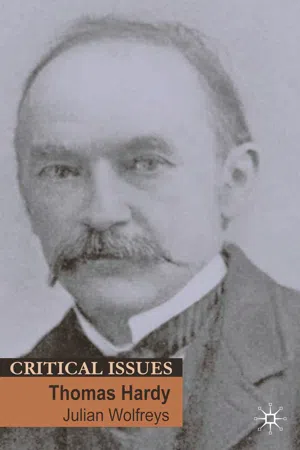
Thomas Hardy
About this book
No other major author of the nineteenth century has arguably produced as much critical activity as Thomas Hardy. This timely addition to the Critical Issues series explores the various philosophical views of critics, with close textual analysis of Hardy's novels and with reference to his poetry.
Information
1
Apprehension, Suspension, Abstention: Desperate Remedies (1871)
I. HARDY’S PERFORMATIVE TEXT
Desperate Remedies, Hardy’s first novel, is typically regarded as an apprentice work, as derivative. It is worthy of close reading, however, because it will teach us how to read Hardy if you pay close enough attention, and if your reading is directed especially to the unique manner in which it arrives as a series of epistemologically disconcerting textual events. Desperate Remedies is, in effect, a forceful, if crude, elaboration of transformations in the modern world brought about in perception, and how these mediate, and are mediated in turn by, narrative. At first glance, the novel appears to inhabit the sensation genre. On the surface it seems a merely imitative narration. Moreover, a surface reading might suggest that this is not really what Hardy does. At least, it does so if one reads the novel as if it were readable, and therefore capable of being subsumed, within the totality of Hardy’s fiction. To put this differently, there is too great a readiness not to read and to ignore the singularity of Desperate Remedies. Such an avoidance of reading falls into a programmed assessment, however, which does not recognize Hardy’s experiment with the ‘machine’, that narrative technic we know as the novel, which exposes the merely mechanical nature of much fiction. Even though Hardy draws on the sensational novel, which is ‘already a subversive form, bringing the licensed margins of the gothic into daily life’ (Goode 1988, 11), there is much that takes place in Hardy’s ‘parasitical’ inhabitation of conventional form. It haunts as much as it inhabits the genre in question, and in doing so subverts subversion, illuminating in the process through its phantasmal habitation the haunted condition of modernity.
Moreover, the parasite actively transforms the host; for Hardy’s writing is marked by a ‘formal break which [his] entry into the writing trade inaugurates’ (Goode 1988, 11). Desperate Remedies announces this rupture in many ways, not least in the fact that it plays on its fictional status and its place in nineteenth-century fiction quite monstrously, quite knowingly. It disturbs, deforms, and destroys relentlessly any possible claim for organic unity in narrative, not simply that narrative which would promote a notion such as Hardyean themes, but also, internally, the very narrative structure of Desperate Remedies itself. It does so in a fashion that will not quite be resolved according to readings that attempt to domesticate its monstrosity according to the rules of pastiche or, for that matter, in gestures that seek to account for any apparent awkwardness or roughness of ‘style’ or ‘composition’ with reference to Desperate Remedies’ status as a first or early work. What is read in aesthetic or organic terms is a misreading, inasmuch as there is little if any understanding that Hardy is ‘already in the process of transforming narrative’ (Goode 1988, 11).
Subversion of genre operates in Desperate Remedies in a number of ways. It takes place not least through the advertising and knowing foregrounding of the novel’s narrative temporality, its arbitrary deployment and its temporal frames, the arbitrary condition of narrative motion, and a self-conscious revelation of the limits of mimetic and realist representation. In anticipation of many of his later more subtly ‘haunted’ or ‘contaminated’ texts, Hardy’s first novel presents the reader with certain experiments both in fiction and the very language of representation, including significant reorientations and reformations of narrative handling of conventional motifs, themes, figures and plots, in addition to those other aspects of textual practice already mentioned.
One significant effect of such play or experiment is the production of narrative as having performative rather than merely constative powers, of which there will be more to be said. Additionally, there are moments when Hardy is either happy to express or else resigned to demonstrating the limits of narrative representation, and so, with that, the limits of fiction, especially concerning the ‘true’ – that is to say psychological and ontological – presentation of the subject as opposed to mere, mimetically faithful outward sketching of physical appearance. This he justifies through acknowledging a psychological associationism, which functions despite the absence of any form of similarity or resemblance, the very conditions on which realist fiction1 depends. ‘Emotions’, Hardy reflects, in the abstract and in present tense, itself a rhetorical ploy often used to present an apostrophe or instant of frame-breaking parabasis to the reader, ‘will attach themselves to scenes that are simultaneous – however foreign in essence these scenes may be – as chemical waters will crystallize on twigs and wires’ (DR I.I.15). This commentary, strangely dispassionate given that its context is the violent death of an architect through the fall from a church spire witnessed by his daughter, recognizes how trauma takes place, long before Freud theorizes the same. Thus it is, as a result, and at any subsequent time that ‘sunlight streaming in shaft-like lines’ brought ‘mental agony’ (DR I.I.15) to mind for the heroine of Desperate Remedies, Cytherea Graye, more than any other medium or phenomenon. Clearly, there is no direct mimetic correlation between shafts of sunlight and the figure of an architect plunging to his death. The association is phantasmic and analogical, for which Hardy owes much to Locke and Schopenhauer, amongst others like them. Hardy traces the connection between the inner and outer world through the indirection of analogy and the association of a ‘relation without relation’ that the mind perceives and memory enacts, in iterable fashion. It is as if Hardy wants to inform us of the ways in which literary narrative, its figures and structures, may be comprehended as working and not working. Representation is insufficient to the task of conjuring feeling, because it cannot show the inner workings of the subject. However, through the play of analogy literature can sidestep this aporetic experience for the reader to make the reader feel in a manner that, not necessarily traumatic, is nevertheless and by analogy similar in its mechanics to the subject’s emotional response.
Literary form is in its most heightened or intensified manifestations when it bypasses the logic and economy of constative depiction in order to perform the sensation or effect it is describing, which performance takes place in the reader’s registration of the same. Realist representation pretends to order, design and appropriate unity in design; there is the illusion of adequacy and efficacy in representation, which informs realist art. However, for Hardy such adequacy is found wanting when it comes to the presentation of subjectivity. Take Hardy’s introduction to Cytherea Graye as an example:
Indeed, motion was her speciality, whether shown on its most extended scale of bodily progression, or minutely, as in the uplifting of her eyelids, the bending of her fingers, the pouting of her lip. The carriage of her head – motion within motion – a glide upon a glide – was as delicate as that of a magnetic needle. And this flexibility and elasticity had never been taught her by rule, nor even been acquired by observation, but, nullo cultu, had naturally developed itself with her years . . . At mixed Christmas parties, when she numbered but twelve or thirteen years, and was heartily despised on that account by lads who deemed themselves men, her apt lightness in the dance covered this incompleteness in her womanhood, and compelled the self-same youths in spite of resolutions to seize upon her childish figure as a partner whom they could not afford to contemn. And in later years, when the instincts of her sex had shown her this point as the best and rarest feature in her external self, she was not found wanting in attention to the cultivation of finish in its details.
Her hair rested gaily upon her shoulders in curls and was of a shining corn yellow in the high lights, deepening to a definite nut-brown as each curl wound round into the shade. She had eyes of a sapphire hue, though rather darker than the gem ordinarily appears; they possessed the affectionate and liquid sparkle of loyalty and good faith as distinguishable from that harder brightness which seems to express faithfulness only to the object confronting them.
But to attempt to gain a view of her . . . from a measured category, is as difficult as to appreciate the effect of a landscape by exploring it at night with a lantern – or of a full chord of music by piping the notes in succession. (DR I.I.12–13; emphasis added)
Like his subject, Hardy is not found wanting in attention to the cultivation of finish in the details. Indeed, there are so many details that, arguably, Cytherea is obscured as a ‘whole’. However, such is the nature of a performative literary act: instead of merely describing, it ‘does’ the very thing it purports to represent – it performs the ‘attention to the cultivation of finish in the details’, yet without giving us a picture. The problem, if there is one, is not in Hardy’s literary abilities. Nor does it reside in the subject, but instead in the very mode of representation, as that mimetic mode is assumed in realist terms to be adequate. The external self is all very well, and detail presents us with a picture, after a fashion. There is hair in curls, with corn coloured highlights, deepening to a nut-brown. The colour and light in the eyes is expressive of personality traits, moreover.
As to age, this is more problematic. Cytherea’s ‘lightness’ in dance occludes what Hardy calls her womanly incompletion, suggesting that her motion is at odds with her physical age, and that this is as a result of that attention to detail which is also not typically that of someone twelve or thirteen years of age. It is as if Cytherea’s is marked by a contretemps, that she is not of her time or ‘on time’, if I can put it like that, or that she in some manner appearance and self are not synchronous. Such questions only anticipate the last paragraph, in which, having gone to such great lengths attempting to describe the fewest of details, Hardy admits that such representation will not do. Perception of the material circumstances will not give the reader access to the truth of Cytherea. Cytherea’s outer form is approximated by motion and the play of light and shade. In short, her ‘image’ is produced as an effect of optical science, apprehended kinetic energy, and the physics of light, as far as the pen can capture this. With the reader’s perception in mind, Hardy’s text performs, therefore, to come back to the matter of the performative. It seeks to have language not merely describe but ‘do’ things. Representation is enacted for the reader, as if the reader were the one standing in the place which narrative appears to open to him or her.
However, all one can see is that one cannot ‘see’ Cytherea. She is irreducible to external traits, and the analogy of landscape is telling in the light of much of Hardy’s later fictional and poetic attention to the idea of Wessex and all such historical or ghostly remains that such a name can be made to evoke. Such a narrative enactment becomes, in the event, indissociable from phenomenological translation. I read, I see, as does the character or narrator, over whose shoulder I am looking. I thus am put in the position of having to interpret, to be active in the deciphering of codes, whilst at the same time being confronted by the narrator’s confession of, if not a personal failure, then at least the failure of the medium. That the analogy is necessary and incapable of being sustained – the landscape by lantern becomes a musical chord given in arpeggiated form – suggests a potentially endless series of substitutions. Everything is in the perception, but perception is partial, limited by the very powers it is capable of marshalling. The apprehended phenomena of another’s being are incapable of being figured, except through the work of indirect literary devices, which substitute material and externalized tropes as ciphers of being. In effect, Hardy is subverting the efficacy of fiction, its modes and mastering or controlling devices, from the outset.
II. INSIGHT AND ILLUMINATION
To claim Hardy as a ‘phenomenological’ novelist, as I am implicitly doing, is not new (see Johnson [1970] and Miller [1970]). What is particularly interesting about such a perspective, though, is the extent to which Hardy can be read as drawing into his constitution of performative narrative modes matters of historicity, identity, an ethics of memory, and the relation between the materiality of representational construction and the phenomenological involvement in the shaping of representation. Regarding Hardy’s oeuvre, in most if not all of the novels’ evident apprehension of the materiality and historicity of identity, and their exploration of being, subjectivity, and the temporal conditions of selfhood, they resist the seemingly organic unity required of conventional realist representation. With experiment comes knowledge that is simultaneously insight into the nature of existence. In their repeated, nuanced manifestation of an appreciation of the importance of personal memory and cultural anamnesis as an ineluctable ethical dimension to any narrative’s responsibility to the past, the novels leave open a wound in the narrative representation of otherwise enclosed historical moments, to indicate how knowledge is always indelibly transformative.
Moreover, in Hardy’s insistent interest in matters of the visible and invisible, perspective and lines of sight (what one can see of Cytherea, what remains hidden, how sunlight illuminates the traumatic process, whilst acting as the trope for the work of memory), one witnesses Hardy’s struggle to suspend mere narrative representation in the implication of the reader in the event being represented through the time of reading, a temporality exceeding the moment described. With regard to the work of the narrative eye and the role of memory in the various forms of textual transmission and transport that arrive in Hardy’s narratives often to interrupt them, we find the suspension of narrative movement, through a formal interruption of narrative that inevitably involves a distortion of perception. To return to the introduction of Cytherea, everything is motion, detail, substitution and impossibility. That Hardy does experiment with narrative modes of representation can hardly be overstated. Through such experiments there is readable a self-reflexive attentiveness to the epistemology of aesthetic perception and its subsequent phenomenal inscription.
The consideration of aesthetic perception in Hardy is not an end in itself. One is not presented with a mode of self-conscious reflection on art for art’s sake. Instead, we read an author who questions the very means by which being is caused to reflect on its self-conscious location in a material and historical world. If ‘the eye, the seeing subject, is antecedent to and formative of the I, or the speaking subject’, as Judith Wittenberg remarks in an essay on Hardy’s early novels of Desperate Remedies and A Pair of Blue Eyes (1983, 151–64), then that which strikes the eye with a pre-phenomenal immediacy, must, in the wake of that moment of revelation, translate what has been seen. To this I would add, what goes for the eye, holds true also for the work of memory, which taken as a phantasmic camera or recorder, releases in Hardy’s fiction at heightened moments of emotional and conscious awareness an image or memory, that interrupts the purely present instant and suspends character or occasionally reader and narration of principal acts.
The following moment in Desperate Remedies illuminates the observations just made:
The direct blaze of the afternoon sun, partly refracted through the crimson curtains of the window, and heightened by reflections from the crimson-flock paper which covered the walls, and a carpet on the floor of the same tint, shone with a burning glow round the form of a lady standing close to Cytherea’s front with the door in her hand. The stranger appeared to the maiden’s eyes – fresh from the blue gloom, and assisted by an imagination fresh from nature – like a tall black figure standing in the midst of fire. It was the figure of a finely-built woman, of spare though not angular proportions. (DR I.IV.56)
As before, Hardy presents the reader with a performative event rather than a descriptive representation; or, more precisely, the performative is within description, and illuminates this in a such a manner that, once we attend, or are receptive, to the performative, we cannot return to a naive reading of the passage as ‘heightened’ or exaggerated representation. For what strikes the reader’s eye is analogous with that which strikes Cytherea’s: for both, though with that difference that is their respective perspectival positions, all that one can see is light, the direct blaze. We read and so see the form of a lady, a stranger, a tall black figure, as this appears ‘to the maiden’s eyes’, and, as a result of that refraction through the crimson curtains, apparently in the midst of fire. Language here enacts the occlusion of more precise human detail through attention to light. In this, it illuminates how illumination can both define and obscure, can shed light and blind, albeit partially. What strikes the eye is, indeed, striking, whether the eye is that of Cytherea or the reader, but what the literary language also bears in it is the revelation – the illumination – of how it achieves its effects, for this is a reflective commentary on the work of literary language and its visionary force.
Thus, as the eye registers the effect of the visual on the mind, as if it were a wax tablet on which is left an impression before the mind can interpret the signal into something more meaningful, so Hardy’s text interprets this pre-phenomenal registration in a phenomenal sleight of hand. As Judith Wittenberg observes: ‘This precept is relevant to Hardy’s fiction, which linguistically enunciates the way in which knowledge is acquired and in which the I-world dialogue is carried on by means that are predominantly specular’ (1983, 152). Hardy’s process thus includes a recognition that all ‘knowledge’, that is to say all articulation of the world unveiled to the eye, is always belated. Moreover, as the detail of any moment of focalization in Hardy makes explicit, the eye, whether that of the character or the reader, is only a medium, a device for connecting between word and world. And the word, though arriving belatedly, takes place as a translation, which paradoxically, once placed on the page, is always temporally before the world, after which it seeks in effect to catch up with. There is, then, a disjunction, both spatial and temporal, in Hardy’s constitution of the modern subject’s powers of perception. This rupture between self-conscious location and the erstwhile belief in the immediacy of empirical experience is not to be closed up. Correspondence is displaced in the process of the subject’s becoming aware that it is the work of what Jacques Derrida calls différance that makes possible the illusion of immediacy and presence. Beginning with the very idea of mimetic and representational framing and control, Hardy ruptures the frame within which representation is staged as visual form, and so invites the reader to become aware of the motions of the past not as distant representation but as flows and forces still reaching out, determining our responses in any given present.
To the end that Hardy wants to make the reader aware of one’s mediatin...
Table of contents
- Cover
- Title Page
- Copyright
- Dedication
- Contents
- Abbreviations and a Note on References
- Acknowledgements
- Introduction: Dwelling on Hardy
- 1. Apprehension, Suspension, Abstention: Desperate Remedies (1871)
- 2. Distortions and Transformations: Under the Greenwood Tree (1872), A Pair of Blue Eyes (1873)
- 3. Being and Dwelling: Far from the Madding Crowd (1874), The Return of the Native (1878), Two on a Tower (1882)
- 4. Uncommon Events: The Trumpet-Major (1880), A Laodicean (1881), The Mayor of Casterbridge (1886)
- 5. Confessions of the Other: The Woodlanders (1887), Tess of the D’Urbervilles (1891), Jude the Obscure (1895)
- Afterword
- Notes
- Bibliography
- Index
Trusted by 375,005 students
Access to over 1.5 million titles for a fair monthly price.
Study more efficiently using our study tools.
Frequently asked questions
Yes, you can cancel anytime from the Subscription tab in your account settings on the Perlego website. Your subscription will stay active until the end of your current billing period. Learn how to cancel your subscription
No, books cannot be downloaded as external files, such as PDFs, for use outside of Perlego. However, you can download books within the Perlego app for offline reading on mobile or tablet. Learn how to download books offline
Perlego offers two plans: Essential and Complete
- Essential is ideal for learners and professionals who enjoy exploring a wide range of subjects. Access the Essential Library with 800,000+ trusted titles and best-sellers across business, personal growth, and the humanities. Includes unlimited reading time and Standard Read Aloud voice.
- Complete: Perfect for advanced learners and researchers needing full, unrestricted access. Unlock 1.5M+ books across hundreds of subjects, including academic and specialized titles. The Complete Plan also includes advanced features like Premium Read Aloud and Research Assistant.
We are an online textbook subscription service, where you can get access to an entire online library for less than the price of a single book per month. With over 1.5 million books across 990+ topics, we’ve got you covered! Learn about our mission
Look out for the read-aloud symbol on your next book to see if you can listen to it. The read-aloud tool reads text aloud for you, highlighting the text as it is being read. You can pause it, speed it up and slow it down. Learn more about Read Aloud
Yes! You can use the Perlego app on both iOS and Android devices to read anytime, anywhere — even offline. Perfect for commutes or when you’re on the go.
Please note we cannot support devices running on iOS 13 and Android 7 or earlier. Learn more about using the app
Please note we cannot support devices running on iOS 13 and Android 7 or earlier. Learn more about using the app
Yes, you can access Thomas Hardy by Julian Wolfreys in PDF and/or ePUB format, as well as other popular books in Literature & Modern Literary Criticism. We have over 1.5 million books available in our catalogue for you to explore.