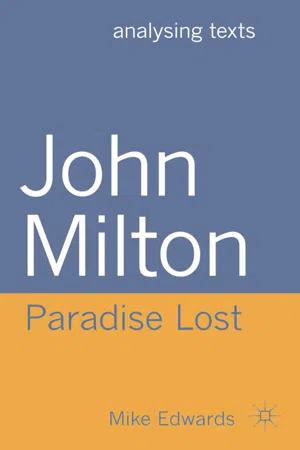
Paradise Lost is for many the greatest poem written in English. Composed late in the author's life, it deals with nothing less than the destiny of mankind.
This essential introductory guide:
- Leads the reader into the epic poem through detailed analysis of key extracts, exploring Milton's original thought and style
- Provides useful sections on 'Methods of Analysis' and 'Further Work' to aid independent study
- Offers valuable information on Milton's life, times and literary legacy
- Examines the development of critical opinion and discusses some recent critical views of the poem.
John Milton: Paradise Lost is ideal for anyone who is studying this complex and beautiful work for the first time. It will enable you to approach your own critical analysis of the poem with confidence.
- 280 pages
- English
- ePUB (mobile friendly)
- Available on iOS & Android
eBook - ePub
John Milton: Paradise Lost
About this book
Information
PART 1
ANALYSING PARADISE LOST
1
Milton’s Conception in Paradise Lost
Extracts used:
Book 1. 1–26 (‘Of Mans First Disobedience... justifie the wayes of God to men’)
Book 3. 1–55 (‘Hail holy light... things invisible to mortal sight’)
Book 7. 1–40 (‘Descend from Heav’n Urania... shee an empty dreame’)
Book 9. 1–47 (‘No more of talk... who brings it nightly to my Ear’)
The subject of this chapter is the four invocations distributed at significant points in the course of the poem. The first is the most important because it begins the whole poem. The second invocation introduces Books 3 and 4 in which Satan finds his way to Eden and discovers Adam and Eve. The third invocation introduces Raphael’s account of the Creation in Books 7 and 8. The fourth and final invocation changes the mood, heralding the Fall, which occupies the final four books of the poem.
These invocations are important for our study because in them Milton addresses his audience directly. They are conventionally called ‘invocations’1 because in each of them Milton invokes his ‘muse’, the source of his inspiration, whether Christian or pagan, to assist him in rising to the challenge of the great story he has to tell. He also tells us his intentions in the poem, and expresses what he feels about his own situation as well as how he views the events he describes.
It is not until the final invocation that Milton speaks about the genesis of the poem. This is a little surprising, but fits in rather well with the anti-chronological ordering of the material in the poem as a whole, which may well be an effect of the way in which the poem was composed. Milton speaks about his muse thus:
Of my Celestial Patroness, who deignes
Her nightly visitation unimplor’d,
And dictates to me slumbring, or inspires
Easie my unpremeditated Verse:
Since first this subject for Heroic Song
Pleas’d me long choosing, and beginning late
(9.21–6)
Here Milton presents a picture of himself as a poet from whom verse flows effortlessly, without conscious thought (‘unpremeditated’) on his part, because it springs from a superhuman source. This is an attractive, even inspirational picture, but it is misleading. The truth lies in the final line: Milton spent many years premeditating Paradise Lost.2 By the end of the gestation period, his conception had become a huge project, and by the time he began to compose his poem, he was nearly sixty years old.
In Paradise Lost, then, Milton undertook a large task, and he did not attempt to minimise its demands. Indeed, the poem contains not only the story of Adam and Eve, but also the creation and the fall of Satan; it includes key figures and events in the biblical history of the Old Testament, and refers to the incarnation of the Son in the New Testament. He also refers to later events leading up to his own time. Far from restricting his scope, he seems to be trying to incorporate the whole of divine and human history in his poem.
Let us turn now to the first invocation, which will occupy most of our attention in this chapter, to see how Milton chooses to introduce his large subject. Remarkably, considering its vast scope, he manages to encapsulate much of the whole matter of the poem in this first paragraph:
Of Mans First Disobedience, and the Fruit
Of that Forbidden Tree, whose mortal tast
Brought Death into the World, and all our woe,
With loss of Eden, till one greater Man
Restore us, and regain the blissful Seat,
Sing Heav’nly Muse, that on the secret top
Of Oreb, or of Sinai, didst inspire
That Shepherd, who first taught the chosen
Seed, In the Beginning how the Heav’ns and Earth
Rose out of Chaos: Or if Sion Hill [10]
Delight thee more, and Siloa’s Brook that flow’d
Fast by the Oracle of God; I thence
Invoke thy aid to my adventrous
Song, That with no middle flight intends to soar
Above th’ Aonian Mount, while it pursues
Things unattempted yet in Prose or Rhime.
And chiefly Thou O Spirit, that dost prefer
Before all Temples th’ upright heart and pure,
Instruct me, for Thou know’st; Thou from the first
Wast present, and with mighty wings outspread [20]
Dove-like satst brooding on the vast Abyss
And mad’st it pregnant: What in me is dark
Illumine, what is low raise and support;
That to the highth of this great Argument
I may assert th’ Eternal Providence,
And justifie the wayes of God to men.
(1.1–26)
This is a complex beginning. Few students will feel that they have a full understanding of it on their first reading As the opening paragraph of a long project, the passage demands and will repay repeated readings: here Milton tells us what he hopes to achieve in his epic poem, and we should listen carefully to what he says.
We will study the passage in several different ways, looking at the different structures that underpin it. There is, first, the verse structure – the organisation of lines and stresses. Superimposed on that there is a syntactic* structure – the order of words and its relation to meaning. Only after looking at these structures will we finally consider the thematic structure of the passage – its meaning and implications, and how it relates to the rest of the poem.
Perhaps the first things we notice about this passage are the broad features of the verse. There is no formal rhyme, and there are no regular stanzas. There is a regular metrical structure, which we might describe as ‘iambic pentameter’* – the same pattern that Shakespeare adopted in his plays, and that has been a perennial choice throughout the history of English poetry. Some commentators prefer to regard these as decasyllabic* (or ten-syllable) lines on the grounds that Milton’s treatment of metre* is too free to be considered iambic. Look, for example, at lines 6–7, 9–10, 11–12 and 20–1, in which the enjambement*, caesuras* and reversals of the metrical feet make it quite hard to view the metre as iambic. Nonetheless, Milton is very disciplined in his use of the decasyllabic line. In the interest of regularity, he frequently uses elisions* such as ‘Th’upright’ and ‘th’Aonian’, ‘Heav’nly’ and ‘heav’ns’, and ‘adventrous’, as well as the commonplace ‘know’st’, ‘sat’st’ and ‘mad’st’. Milton is free in his use of metre, therefore, but strictly adheres to the basic structure of the verse.
Milton himself was clear on the subject of his verse form, adding a preface on the subject of ‘The Verse’ to the 1674 edition, in which he defends his use of ‘English Heroic Verse without Rime’. Rhyme he dismisses as the unnecessary ‘Invention of a barbarous Age’ and later as a ‘troublesom and modern bondage’, useful only to offset weak material and poor metrical control. He prefers to follow the example of Homer and Virgil, whose verse was metrically strict and unrhymed. Perhaps the most interesting aspect of this preamble is that it was necessary at all. In fact, Milton felt compelled to defend himself against criticism levelled at him by conservatives in the literary world who were shocked at his abandoning rhyme. This was the first narrative poem in English that did not use rhyme.
Dispensing with the formal structural props of rhyme, Milton is free to develop a broad rhythmic sweep in which the ear is guided emphatically to the meaning of the verse. Although this was, perhaps, one of the first English poems, if not the first of all, composed in the knowledge and expectation that it would be read from the printed page, this verse is intended for the ear. You only have to read a few lines to feel the demand for sound. Significantly, Milton did not write it: he dictated it. Thus the poem may reasonably be seen a late flowering of the oral tradition of poetry. This point is made strongly by Philip Pullman, the title of whose trilogy, His Dark Materials, is drawn from Paradise Lost. In his Introduction to the OUP edition of the poem, he writes:
So I begin with sound. I read Paradise Lost not only with my eyes, but with my mouth. I was lucky enough to study Books I and II for A Level many years ago and to do so in a small class whose teacher, Miss Enid Jones, had the clear-eyed and old-fashioned idea that we would get a good sense of the poem if, before we did anything else to it, we read it aloud.
(pp. 1–2)
It is a good idea to follow Pullman’s example and try to develop (if it does not come to you at once) a sense of the sound of the poem. There is a BBC recording available on CD of Anton Lesser reading the whole poem, which is well worth listening to.3 Better still is to read it aloud yourself, and make the sound of the words – to read it with your mouth and ears as Pullman did.
Prosodic* Structure
Let us explore the verse structure of the invocation by trying to read it in this way, thinking about how we might speak it. There is obviously more than one way of ‘performing’ the poem. But if we look again at the first paragraph and split it into its natural breaths, by spacing, and using the slash symbol for brief pauses, we would, I think, probably be able to agree on something like this:
Of Mans First Disobedience,
and the Fruit
Of that Forbidden Tree, / whose mortal tast
Brought Death into the World, / and all our woe,
With loss of Eden,
till one greater Man
Restore us, and regain / the blissful Seat,
Sing / Heav’nly Muse,
that on the secret top
Of Oreb, / or of Sinai, / didst inspire
That Shepherd, / who first taught the chosen
Seed,
In the Beginning how the Heav’ns and Earth
Rose out of Chaos:
Or if Sion Hill [10]
Delight thee more,
and Siloa’s Brook / that flow’d
Fast by the Oracle of God;
I thence
Invoke thy aid to my adventrous
Song, That with no middle flight intends to soar
Above th’ Aonian Mount, while it pursues
Things unattempted yet in Prose or Rhime.
And chiefly Thou
O Spirit,
that dost prefer
Before all Temples th’ upright heart and pure,
Instruct me,
for Thou know’st;
Thou from the first
Wast present, / and with mighty wings outspread [20]
Dove-like satst brooding on the vast Abyss
And mad’st it pregnant:
What in me is dark
Illumine,
what is low raise and support;
That to the highth of this great Argument
I may assert th’ Eternal Providence,
And justifie the wayes of God to men.
This rough-and-ready illustration is not the only way of reading these lines, but serves to illustrate the kind of rhythmic structure Milton develops. Within this general rhythmic structure, also, there is a spectrum of longer and shorter cadences which may be variously interpreted. The main point I wish to make, however, is clear: this verse is full of cross-currents of phrasing and emphasis that engage in a lively duet with the basic structural metre, sometimes following, sometimes conflicting. It is not easy to read this verse in a mechanical style. Already in the first line, Milton denies the regularity of the pentameter. A regular iambic pentameter would suggest the following emphases:
Of Mans First Dis-o-be-dience, and the Fruit
Stressed this way, the line fulfils the mechanical requirements of the iambic pentameter because ‘disobedience’ is pronounced with four syllables, and not five.4 Obviously, it would sound silly to speak the line this way. But as soon as we try to analyse the actual pattern of the line, we run into difficulties. What are we to make of ‘Mans First’? Should we stress ‘Mans’, referring to Adam or Eve, or to the whole human race as opposed to Satan, whose pride was the first of all sins. Or should we stress ‘First’, meaning Eve’s sin as distinct from Adam’s, or any other sin, or anyone else’s sin, or the sin of our general parents conjointly, or should we take it more generally as referring to the concept of original sin? Here, in fact, is the perfect illustration of the uneasy relationship between the form of the verse and its meaning. We will come across such ambiguities frequently in the course of our study of the poem.
Underlying the complexities of the decasyllabic line we can find a simpler structure of stresses. There are normally four stressed syllables within each line of decasyllabic verse:
Of Mans First Disobedience and the Fruit
Of that Forbidden Tree, whose mortal tast
Brought Death into the World, and all our woe.
Even here there are uncertainties. Should we in the third line not emphasise ‘Brought’ rather than ‘all’? Or perhaps both? This is not a question I propose to answer: it is a matter for individual interpretation or performance. Suffice it to say that Milton’s treatment of the decasyllabic line represents a triumph of disciplined, reasoned verse treated flexibly to develop great density of meaning. Notice, for e...
Table of contents
- Cover
- Title Page
- Copyright
- Contents
- General Editor’s Preface
- How to Use this Book
- A Note on Texts and Supplementary Materials
- Abbreviations and References
- Part I: Analysing Paradise Lost
- Part II: The Context and The Critics
- Notes
- Glossary
- Appendix A: Characteristics of Epic
- Appendix B: Milton’s Rhetoric
- Further Reading and Bibliography
- Index
Trusted by 375,005 students
Access to over 1.5 million titles for a fair monthly price.
Study more efficiently using our study tools.
Frequently asked questions
Yes, you can cancel anytime from the Subscription tab in your account settings on the Perlego website. Your subscription will stay active until the end of your current billing period. Learn how to cancel your subscription
No, books cannot be downloaded as external files, such as PDFs, for use outside of Perlego. However, you can download books within the Perlego app for offline reading on mobile or tablet. Learn how to download books offline
Perlego offers two plans: Essential and Complete
- Essential is ideal for learners and professionals who enjoy exploring a wide range of subjects. Access the Essential Library with 800,000+ trusted titles and best-sellers across business, personal growth, and the humanities. Includes unlimited reading time and Standard Read Aloud voice.
- Complete: Perfect for advanced learners and researchers needing full, unrestricted access. Unlock 1.5M+ books across hundreds of subjects, including academic and specialized titles. The Complete Plan also includes advanced features like Premium Read Aloud and Research Assistant.
We are an online textbook subscription service, where you can get access to an entire online library for less than the price of a single book per month. With over 1.5 million books across 990+ topics, we’ve got you covered! Learn about our mission
Look out for the read-aloud symbol on your next book to see if you can listen to it. The read-aloud tool reads text aloud for you, highlighting the text as it is being read. You can pause it, speed it up and slow it down. Learn more about Read Aloud
Yes! You can use the Perlego app on both iOS and Android devices to read anytime, anywhere — even offline. Perfect for commutes or when you’re on the go.
Please note we cannot support devices running on iOS 13 and Android 7 or earlier. Learn more about using the app
Please note we cannot support devices running on iOS 13 and Android 7 or earlier. Learn more about using the app
Yes, you can access John Milton: Paradise Lost by Mike Edwards in PDF and/or ePUB format, as well as other popular books in Literature & Modern Literary Criticism. We have over 1.5 million books available in our catalogue for you to explore.